Showing 81–96 of 146 results

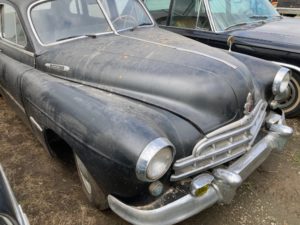
Gaz 12 Zim

Year of Manufacture: 1953
Power: 95 horsepower
Displacement:3,485 cm3

Number of Cylinders/Valves: 6/2
Weight: 1,900 kg

Condition: Operational

Catalogue Number: 247

This is a representative limousine over 5.5 meters long. Due to time constraints, chief designer Andrei Lipgart was given a choice between copying an American product (Buick) or developing an entirely new model — he chose the latter.

The GAZ-12 was a Soviet limousine produced from 1950 to 1960 by the Gorky Automobile Plant. It was built to serve both the upper and middle class, but was also widely used as a taxi and ambulance. Unlike its successors, the GAZ-12 was the only Soviet executive vehicle intended for private ownership. While a Pobeda cost about 16,000 rubles, a GAZ-12 cost around 40,000 rubles. It was designed for mid-level political and economic officials and was also used by the KGB.

The vehicle boasted a length of 5,530 mm and a wheelbase of 3,200 mm. Inside, it featured two rows of soft plush bench seats, with two additional fold-out jump seats integrated into the floor. For its time, it was considered highly luxurious.

It was powered by a 3,485 cm3 inline six-cylinder engine with a maximum output of 66 kW (95 hp), paired with a three-speed gearbox. The car could reach a top speed of around 125 km/h and accelerated from 0 to 100 km/h in roughly 40 seconds. Fuel consumption was about 19 l/100 km.

Over the ten-year production span, a total of 21,527 units were made. A few made their way to Czechoslovakia, where they were used by state officials. One such vehicle was used by then-Minister of Defense Alexej Čepička.

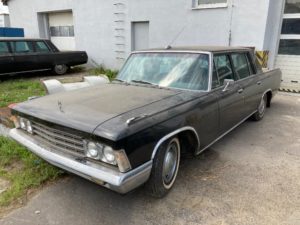
ZIL 114

Year of Manufacture: 1974
Power: 300 horsepower
Displacement:6,959 cm3

Number of Cylinders/Valves: 8/2
Weight: 3,085 kg

Condition: Operational

Catalogue Number: 244

In the 1970s and 1980s, ZIL automobiles were a symbol of socialist luxury. However, aging caught up even with the best, and by the late 1980s, the modern ZIL 4102 was rejected, effectively marking the end of the line for these models.

The new generation of ZIL limousines debuted in 1967. The successor to the 111G model was named the 114 and introduced a significantly revised design. It featured boxier lines, while retaining the four round front headlights. The ZIL 114 was heavily inspired by American luxury cars, especially the Lincoln Continental.

Compared to its predecessor, the 114 boasted a length of up to 6.3 meters and a curb weight exceeding 3 tons. A new 7-liter V8 engine producing 221 kW (300 hp) powered the rear axle through a two-speed automatic transmission, later upgraded to a three-speed version. The front axle was newly designed with independent suspension. Initially equipped with drum brakes, the model soon received disc brakes on all wheels, featuring a three-circuit braking system to maintain safety in case of failure. The car was also equipped with central locking.

This seven-seater vehicle, with two emergency seats in the rear and a partition separating the driver from the rear passengers, came with a surprisingly rich interior: air conditioning, height-adjustable steering wheel, leather upholstery, electric windows and mirrors, wooden trim, and tinted glass to reduce light and heat penetration.

Production of this state limousine was extremely limited. ZIL kept a record of every owner, and no one could acquire the car without the approval of the Communist Party leadership. Production of the 114 and 117 models ended in 1977. In total, only 113 units of the extended version and 73 units of the shorter limousine were produced.

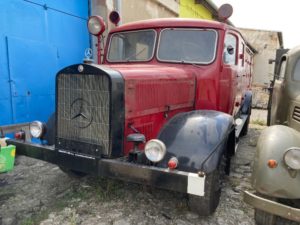
Mercedes Benz L 4 500

Year of Manufacture: 1942
Power: 112 horsepower
Displacement:7,274 cm3

Number of Cylinders/Valves: 6/2
Weight: 10,400 kg

Condition:

Catalogue Number: 232

Mercedes-Benz L 4500 is a heavy-duty truck produced between 1939 and 1944. The vehicle was manufactured in versions with rear-wheel drive (L 4500 S) and all-wheel drive (L 4500 A).

During World War II, the Wehrmacht used the L 4500 extensively, including as a towing vehicle for anti-aircraft guns — which is the version in our collection. However, it was widely employed by the military as a universal base for various superstructures and modifications.

The engine was an inline six-cylinder diesel with 112 horsepower and water cooling. The very robust chassis was built with a frame made of pressed U-profile sections. Both axles were rigid and suspended using leaf springs. The payload capacity was 5 tons.

Surviving vehicles continued to operate reliably long after the war. In the 1950s, the model was modified into the L 312 type, which remained in production until 1955.

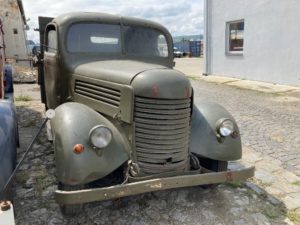
Praga RN/RND

Year of Manufacture: 1950
Power: 60 horsepower
Displacement:4,500 cm3

Number of Cylinders/Valves: 4/2
Weight: 6,300 kg

Condition:

Catalogue Number: 233

History

These were vehicles that didn’t stand out with eccentricity or innovation. Their design was classic — timeless and indestructible.

The “Erena” was developed before World War II. The designation RN stood for “Rychlý Nákladní” (Fast Truck). A parallel model, the RND, indicated a diesel engine version.

The first Praga, with a different front design, was introduced in 1933 as a 2-ton truck powered by a petrol inline six-cylinder engine producing 38 kW. The initial versions weren’t mass-produced — between 1934 and 1936, only 94 units were built.

Twelve series were produced before the war. The new RND version (Fast Diesel Truck) adopted all the improvements of its petrol-powered sibling, differing only in having a diesel engine.

Technical Specifications

The first version could carry a 2-ton payload. In 1937, Praga increased the power to 53 kW, which raised the payload capacity to 2.5 tons. The fifth series, from 1938, introduced a more rounded front and streamlined fenders.

After the war, the engine power remained unchanged, but a reinforced frame and upgraded brake system allowed a payload increase to 3 tons. This configuration remained in production until the end.

The original RN had a petrol six-cylinder engine; the diesel version had four cylinders. The modernized rounded version was produced until 1953 in Prague’s Vysočany district. It was eventually succeeded by the three-axle off-road Praga V3S, which was mainly used by the military.

No other vehicle in this category was produced in Czechoslovakia for many years, so the Praga trucks remained in service until the 1970s, when they were gradually replaced by licensed Avia A30 models.

Post-war Era

After the war, the Czechoslovak army also faced a shortage of trucks. From 1949 onward, over 4,000 Erenas were supplied for military use, despite having only rear-wheel drive. Both axles were solid and mounted on longitudinal leaf springs.

As was common, many superstructures and modifications were built on the RN chassis. Buses — in short supply after the war — were especially popular.

Czechoslovak Success

The petrol RN versions always enjoyed more popularity due to their higher speed. In 1938, Praga won a comparative trial in the former Yugoslavia. Reportedly, over 18,000 units were produced under license there, while over 40,000 were made in Czechoslovakia.

Today, the Erena is a cult classic among historical trucks. It receives great attention from collectors and participates in historic vehicle events.

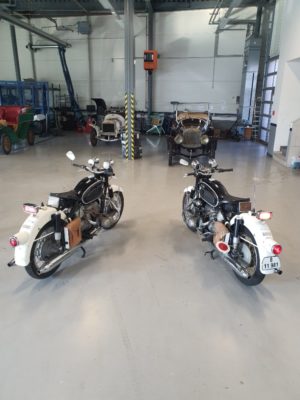
BMW R69S

Year of Manufacture: 1968
Power: 42 horsepower
Displacement:590 cm3

Number of Cylinders/Valves: 2/2
Weight: 202 kg

Condition: operational

Catalogue Number: 257

This is a motorcycle manufactured in Germany.

The year is 1960, and the very reliable and proven chassis platform from the R50, R60, and R69 models received a new heart. The engine had a displacement of 594 cm3 and produced 42 horsepower at 7,000 rpm. At first glance, the motorcycle differed only slightly, with more robust heads and cylinders. The air filter housing lacked a cold start valve, and the intake pipes to the carburetors were mounted directly onto the flanges. The exhausts had aluminum star nuts securing them to the heads instead of smooth steel ones.

This motorcycle was widely used by police forces around the world. For an additional fee, BMW offered optional upgrades such as different seats, tanks, handlebars, spotlights, tachometers, mirrors, turn signals, and more.

One unique feature is the sideways engine kickstart from the motorcycle’s longitudinal axis. Due to the engine’s high compression, a strong kick is recommended for a proper start.

What makes the “S” version special is its performance. A major advantage during smooth cornering is the low center of gravity and overall weight of the motorcycle. The characteristic front fork design also plays a key role in its specific handling behavior. A downside, however, is the drum brakes. The R69S features a classic steering damper like today’s sport motorcycles, which can be disengaged at any time.

More than 11,000 units were produced between 1960 and 1969, including a U.S. version with a conventional front fork.

We own two of these motorcycles in a special configuration, which were used as police escorts for official state visits.

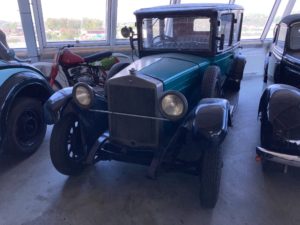
Fiat 520

Year of Manufacture: 1926
Power: 46 horsepower
Displacement:2,244 cm3

Number of Cylinders/Valves: 6/2
Weight: 1,750 kg

Condition:

Catalogue Number: 229

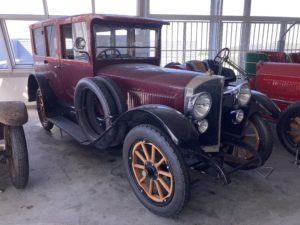
This was a car offered by Fiat at the end of the 1920s. It was intended for the upper middle class. It featured a 6-cylinder inline engine with an output of 46 horsepower and a large, spacious body. The transmission had four speeds and power was delivered to the rear wheels. Interestingly, the same vehicle was used at the time by the Pope for his personal transportation.

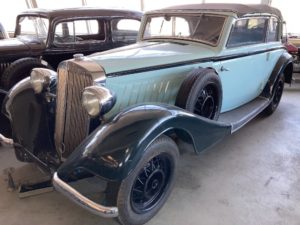
Horch 830 cabrio

Year of Manufacture: 1939
Power: 92 horsepower
Displacement:3,823 cm3

Number of Cylinders/Valves: 8/2
Weight: 1,960 kg

Condition: after renovation

Catalogue Number: 228

Horch automobiles were among the most prestigious representatives of the top class between the wars and in some respects even surpassed Mercedes-Benz vehicles.

The Horch 830 featured a V8 engine with a displacement ranging from 3.0 to 3.8 liters. Initially, inline six- and eight-cylinder engines were used. Horch was one of the few manufacturers daring enough to produce a V12 engine. However, this engine was very complex, expensive, and had limited use. The new V8 engine was structurally derived from the V12. It was completed in 1932 and introduced in a production vehicle the following year. It was simpler and more affordable in design. Among the unique features borrowed from the V12 were the “horizontal” valves driven by a camshaft located between the cylinders, which formed a 66-degree angle. The engine had only three crankshaft bearings and was significantly shorter than an inline-eight or V12 engine. The original engine had a displacement of 3.0 liters, and the final version from 1938–1940 increased it to 3.8 liters.

The Horch 830 was a luxury-class car, sold in several versions, including a short sedan, an extended Pullman version, and various cabriolet body styles.

The vehicle was produced for a relatively long period, from 1933 to 1940, when the war halted its production. As the engine evolved, the chassis and other components were gradually improved as well. The engine was located in the front, and power was delivered to the rear wheels via an original four-speed transmission, later upgraded with a fifth gear as an overdrive. The axles were initially rigid, and the brakes mechanical and cable-operated. Later, the front axle was replaced with independent suspension, and the rear with a De Dion axle. Hydraulic brakes were also introduced.

A total of 11,625 units of types 830 and 930 were produced. Additionally, 4,536 off-road 830 R Kübelwagen vehicles were built for the German army with all-wheel drive.

At the end of the war, the production plant in Zwickau was heavily damaged by Allied bombing and after the war fell into the Soviet zone. Later, instead of Horch vehicles, the Trabant was produced there—a paradox of war.

In parallel with the 830, the 930 model was produced, which differed mainly in body design. In 1940, improved versions of the 830 and 930 were ready for production, but due to wartime events, they were never realized.

The vehicle from our collection is a two-door, four-seat convertible. It has been renovated and is in operable condition. It has appeared in several films and TV series.

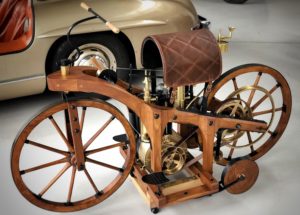
Daimler Reitwagen

Year of Manufacture: 1885
Power Output: 0.5 horsepower
Displacement: 264 cm3

Number of Cylinders/Valves: 1/2
Weight: 90 kg

Condition: replica

Catalogue Number: 258

The Daimler Reitwagen, also known as the “Petroleum Reitwagen” or “Einspur”, is recognized as the world’s first true motorcycle. This motorized vehicle was built by Gottlieb Daimler and Wilhelm Maybach in 1885. The term “Motorrad” was first used later by Heinrich and Wilhelm Hildebrand together with Alois Wolfmüller for their 1.49-liter twin-cylinder machine.
The Reitwagen was essentially still a “rider’s carriage”. In fact, it wasn’t truly a single-track vehicle, as it had small auxiliary wheels on the sides to help maintain stability.

However, it took a long journey to get there. In 1861, at the age of 27, Gottlieb Daimler traveled to Paris to explore the invention of the Belgian Étienne Lenoir—an internal combustion engine. This experience later proved useful when he joined Nicolaus August Otto, who designed a single-cylinder gas-powered engine in 1864. In July 1872, Daimler was appointed technical director of Otto’s company, where Wilhelm Maybach also worked as head of the design department.

Four years later, in 1876, Otto developed his famous four-stroke engine with higher compression. However, Otto had no interest in miniaturizing his commercially successful industrial engines for broader use in transportation. They barely reached 150 to 200 revolutions per minute. Thus, Daimler and his longtime friend Maybach left the company. Daimler moved to Cannstatt near Stuttgart. In June 1882, he bought a villa at Taubenheimstrasse 13 for 75,000 gold marks, where he lived with his wife Emma and their five children.

He converted the large garden house into an experimental workshop with water and gas lines. Maybach joined Daimler at the beginning of November. They lived close to each other; Wilhelm turned one room into a design office and translated Daimler’s ideas into technical drawings.

In the workshop, they began developing their own high-speed four-stroke engine. But Daimler and Maybach weren’t interested in slow combustion. The first prototype ran in the second half of 1883. From a displacement of around 100 cm3, it produced 184 W—about a quarter of a horsepower at 600 rpm, which was Daimler’s goal. It could even run on coal gas.

An evolved version called the “pendulum engine” from 1884 produced 735 W from a much larger 462 cm3, equaling one full horsepower. It earned its nickname from its oscillating motion, resembling a pendulum clock. The gearbox components and flywheel were enclosed in a crankcase. The float-type carburetor was Maybach’s invention.

They decided to mount the revised engine in a test frame with two 60 cm high wheels. The frame was made from hickory wood reinforced with metal. Tires didn’t exist yet, so the wheels were wrapped in 35 mm wide iron bands.

At the heart was an air-cooled four-stroke single-cylinder engine with a 264 cm3 displacement. The modified “pendulum” engine had a 58 mm bore and 100 mm stroke, was mounted on rubber blocks, started by hand crank, and had two flywheels (one on the crankshaft), an aluminum crankcase, and fan-based cooling. It produced just 0.37 kW—half a horsepower at 700 rpm. Compression was very low, only 2.3:1. Like its predecessors, it used a hot-tube ignition invented by the Englishman Watson. A platinum tube led into the combustion chamber, and it had to be ignited by an external open flame—basically, by striking a match.

Although electric systems existed, they were unreliable and too slow to ignite the air-fuel mixture in a high-speed engine. Daimler and Maybach mounted the engine vertically between wooden supports and cross braces in the frame. The intake valve operated automatically—the piston’s suction opened the mixture intake into the cylinder, while Daimler invented a mechanical exhaust valve. The transmission had just one gear, and power was delivered to the rear wheel by a belt. This 90-kg ancestor of today’s motorcycles could reach a speed of just 11 km/h. It had no suspension or front brake; the rear block brake was cable-operated from the handlebars. The engine alone weighed 60 kg.

Daimler received patent DRP 36423 for a “single-track vehicle with a gas or petroleum engine” on August 29, 1885. The first motorcyclist was his son Adolf, who completed the first 3-kilometer ride in early November. On November 10, his other son Paul rode 9.5 kilometers from Cannstatt to Untertürkheim. He was 17 years old at the time.

The test machine, with dimensions of 1680 x 610 x 1040 mm (length, width, height), proved the feasibility and viability of a compact liquid-fueled engine. Even Maybach later test-rode it. Preparation for a ride took only a minute—an enormous advantage over steam-powered vehicles.

The original Reitwagen did not survive; it was lost in a fire at the Daimler-Motoren-Gesellschaft factory in 1903. More than ten replicas have been made. Besides museum displays, the German carmaker built one working demo machine as part of its collection. Others are housed in the Deutsches Museum in Munich, the Verkehrsmuseum in Dresden, the Auto und Technik Museum in Sinsheim, the NSU Zweirad Museum in Neckarsulm, the Deutsches Technikmuseum in Berlin, and the Motor-Sport Museum at the Hockenheimring.

They can also be found outside Germany, including at the Honda Collection Hall at the Twin Ring Motegi circuit, in the Lyman & Merrie Wood Museum collections in Springfield (Massachusetts), and the AMA Hall of Fame in Columbus (Ohio). Other examples are on display at the Guggenheim Museum in New York, the Deeley Motorcycle Exhibition in Vancouver, Canada, and in Melbourne, Australia.

Our replica is very well-made but unfortunately non-functional. Nevertheless, it complements our collection of automotive history—this piece, quite literally, from the prehistoric age of motoring.

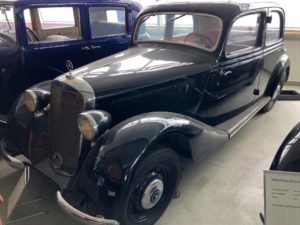
Mercedes-Benz 170V (W136)

Year of manufacture: 1938
Power: 38 hp
Displacement: 1,697 cm3

Number of cylinders/valves: 4/2
Weight: 1,160 kg

Condition: restored
Catalog number: 225


The Mercedes-Benz 170 V was first introduced on February 15, 1936, at the Berlin Motor Show. This was the W136 model, which almost immediately became a benchmark for a modern European car in the late pre-war period. Although it was the smallest car from Daimler-Benz A.G., its 1.7-liter engine and relatively spacious interior for the time placed it among the “better” mid-range cars. By 1942, it was the best-selling model, with over 75,000 units sold. Its direct predecessor was the Mercedes-Benz 170 type W15, produced from 1931 to 1935. That model had an engine of the same displacement, even a six-cylinder, but with 6 hp less power.

The 170 V was produced in two- and four-door sedans, cabriolets, two-seat roadsters, as well as adapted utility versions such as ambulances and vehicles for police, mountain rescue, and the military. For military purposes, Mercedes-Benz built over 19,000 units with the so-called “Kübelwagen” body.

The car’s body was very advanced and fully made of metal. Unlike previous practice, no wooden frames covered with sheet metal were used. The engine was front-mounted, and power was transmitted to the rear wheels via a driveshaft. The engine was an inline four-cylinder with side valve (SV) design, displacing 1,697 cm³, with a bore of 73.5 mm and stroke of 100 mm. It was equipped with a Solex carburetor. During and after the war, some cars were converted to run on wood gas generators, which reduced engine performance and caused various operational issues.

The 170 V was continuously improved over time. From May 1949, a diesel engine with 38 hp was also introduced. The car reached a top speed of 116 km/h. With standard fuel, the engine produced 28 kW at 3,400 rpm. A four-speed gearbox transmitted power to the rear axle equipped with a differential. The wheelbase was 2,850 mm, and the weight was 1,120 kg. Popular optional accessories included practical fog lamps, which were not commonly fitted at the time.

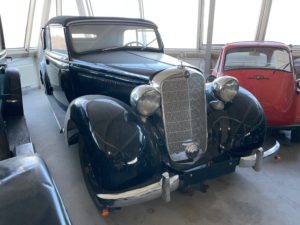
The car in our collection is a classic four-door, four-seat limousine that has been fully restored and is in running condition.

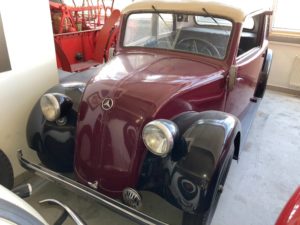
Mercedes-Benz 170V W136

Year of manufacture: 1939
Power: 38 hp
Displacement: 1,697 cm3

Number of cylinders/valves: 4/2
Weight: 1,160 kg

Condition: restored
Catalog number: 221


The Mercedes-Benz 170 V was first introduced on February 15, 1936, at the Berlin Motor Show. It was the W136 model, which almost immediately became the benchmark for a modern European car at the end of the pre-war era. Although it was the smallest car from Daimler-Benz A.G., with its 1.7-liter engine and for its time spacious interior, it also ranked among the “better” mid-range cars. By 1942, this model was the best-selling vehicle, with over 75,000 units sold. Its direct predecessor was the Mercedes-Benz 170 type W15, produced between 1931 and 1935. That model had an engine of the same displacement, even a six-cylinder, but with 6 hp less power.

The model was produced as two- and four-door sedans, cabriolets, two-seat roadsters, and also adapted utility versions such as ambulances or cars for police, mountain rescue, and the military. For military use, Mercedes-Benz produced over 19,000 units with the so-called “Kübelwagen” body.

The vehicle’s body was very advanced, made entirely of metal. Unlike previous practice, no wooden frames covered with sheet metal were used. The engine was front-mounted, and rear-wheel drive was delivered by a driveshaft. It featured an inline four-cylinder SV (side valve) engine with a displacement of 1,697 cm³, bore of 73.5 mm, and stroke of 100 mm. During and after the war, some cars were converted to run on gas generator wood gas, which reduced engine power and caused various operational issues.

The Mercedes-Benz 170 V was gradually improved and refined. Starting in May 1949, a diesel engine with 38 hp was even offered. The car reached a top speed of 116 km/h. With normal fuel, the engine delivered 28 kW at 3,400 rpm. The four-speed gearbox transmitted power to the rear axle equipped with a differential. The wheelbase was 2,850 mm, and the weight was 1,120 kg. Popular optional accessories included practical fog lamps, which were not commonly installed at that time.

The car from our collection is a Cabriolet type B and has been fully restored and is in operational condition.

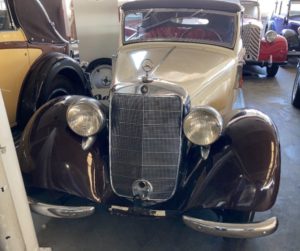
Mercedes-Benz 200 (W21)

Year of manufacture: 1933
Power: 40 hp
Displacement: 1,961 cm3

Number of cylinders/valves: 6/2
Weight: 1,160 kg

Condition: restored
Catalog number: 224


The Mercedes-Benz 200, designated by factory number W21 and introduced in February 1933, was the successor to the previous type 170, which had slightly less power and interior space. At the International Motor Show in Berlin, the more powerful and somewhat roomier versions 200 (W21), 290 (W18), and 380 (W22) were presented.

The six-cylinder side-valve engine had a displacement of 1,961 cm3 and produced a maximum power output of 29 kW, or 40 hp, at 3,200 rpm. The power was transmitted to the rear wheels through a four-speed manual gearbox, where the highest gear functioned practically as an overdrive. The two highest gears were synchronized. The brakes operated on all four wheels via hydraulic linkage. The engine shared its 85 mm (3.3 inch) piston stroke with a smaller six-cylinder unit. However, the manufacturer increased the bore by 5 mm (0.20 inches) to 70 mm (2.8 inches) for the W21.

During the last year of this model, in June 1936, Mercedes-Benz announced the availability of a more powerful 2,229 cm3 engine delivering 55 hp, which was seen as a necessary response to criticism about the car’s relatively low power output.

In 1933, the choice of body styles was still modest, consisting of a four-door sedan with an integrated trunk, optionally available from the factory with a sunroof, a Cabriolet C, and a two-seat special roadster.

In its second model year starting February 1934, the 200 underwent a significant modernization. The flat radiator gave way to a more stylish, gently wedge-shaped variant, which became the face of common Mercedes-Benz passenger cars for decades. The body style selection also expanded. Besides Cabriolet A, the lineup included two four-seat touring cars: a two-door version with a body by another coachbuilder and a four-door version with a body made in Sindelfingen. The roadster and Cabriolet A had a 2,600 mm wheelbase, the same as the 170 (W15), and 100 mm shorter than the four-seat versions. The price tag of 7,800 RM made the Cabriolet A the most expensive 200 variant.

The addition of a longer 3,050 mm wheelbase version proved to be a wise move. This same wheelbase served as the basis for generously sized limousines until the arrival of the 300 in 1951. The longer wheelbase was used for the four-seat Cabriolet B as well as three six-seat coach-built variants: besides the Pullman sedan and Pullman landaulet, there was an open tourer originally available with a body from another coachbuilder, and from June 1934 it could be ordered with a body made in Sindelfingen. Thanks to the spacious interior, the Pullman sedan was especially suitable for use as a taxi.

In February 1935, a year after introducing the long-wheelbase version, prices for both chassis types and most body variants were reduced. The body selection was also expanded with three new long-wheelbase variants. The four/five-seat four-door sedan was aimed at satisfying the growing customer demand for space. The target group for the aerodynamically styled progressive sedan with excellent quality was avant-garde clients. However, the price was an additional 3,700 RM. The price was even higher for the equally new “Special Cabriolet A,” which at 11,500 RM became by far the most expensive W21 variant — at the same price, two four/five-seat sedans of the two-liter swing-axle version could be purchased.

February 1935 brought a greatly expanded offer for customers who wanted a sedan but did not want to give up the advantages of an open roof. The standard-wheelbase limousine was optionally available not only with a sunroof made in Sindelfingen but also alternatively with a sliding roof by Happich. The long-wheelbase limousine could be ordered optionally with a sliding roof by Happich or Webasto, while the Pullman sedan was optionally available with either a standard or special version of the Webasto sliding roof.

Other changes for the 1935 model year included larger dials on the instrument panel, a stiffer front end with a metal bulkhead to reduce body vibrations, and a reinforced frame. In April 1935, the option to order a sedan with a sunroof made in Sindelfingen was discontinued. Instead, as an alternative to the Happich sliding roof, a roof from Webasto could be ordered.

A total of 15,622 units of the 200 model were produced — the car in our collection is from 1933, from the first series, and is a classic sedan. It has been fully restored and is in drivable condition.

Mercedes-Benz 130H cabrio

Year of manufacture: 1934
Power: 26 hp
Displacement: 1,308 cm3

Number of cylinders/valves: 4/2

Condition: restored
Catalog number: 222


At the beginning of the 1930s, attempts were increasing in Europe to create more aerodynamic car designs, including relocating the engine from the front to the rear. Between 1931 and 1939, Daimler-Benz AG produced the Mercedes-Benz 130, 150, and 170 H models. Production numbers for each of these models remained relatively low, especially compared to the output of classic front-engine Mercedes-Benz cars.

The 130 H was introduced at the International Motor Show in Berlin in 1934. Not only was it the smallest mass-produced car and the first four-cylinder model by Daimler-Benz, but it was also the first large-scale German car with a rear engine, if we exclude various miniature vehicles.

This model was inspired by Edmund Rumpler’s car called the Rumpler Tropfenwagen, which ran from 1923 to 1926. Hans Nibel, Mercedes’ chief engineer, drew inspiration from the Tropfenwagen (teardrop-shaped car) designed in 1921 by the Austrian-born engineer Edmund Rumpler. Nibel began developing the 130 in 1931 and chose a 1.3-liter four-cylinder SV engine mounted at the rear to drive the rear wheels.

The letter H, indicating engine placement (from the German word Heck, meaning rear), was not yet used. The car had a synchronized three-speed transmission with a semi-automatic fast-shift (no clutch required) and a final drive housed in the same unit as the engine. The car featured a backbone chassis with a central tube; the front wheels were independently suspended on two transverse leaf springs, and the rear swing axle was sprung by two coil springs.

The engine produced 26 hp (19 kW) and could propel the small two-door sedan to a top speed of 92 km/h. The synchronized four-speed gearbox was located ahead of the rear axle, balanced by coil springs. The front axle had two transverse leaf springs. The two-door Mercedes-Benz 130 H had a wheelbase of 2,500 mm and overall dimensions of 4,050 x 1,520 x 1,510 mm.

The car was sold as a sedan, a sedan with an open roof, or a convertible (with or without a convertible top and without side windows), each equipped with two doors. Nearly 4,300 units were sold before production ended in 1936.

The car in our collection is a beautifully fully restored cabriolet.

Benz 16/50

Year of manufacture: 1924
Power: 50 hp
Displacement: 4,160 cm3

Number of cylinders/valves: 6/2
Weight: 1,750 kg

Condition: restored
Catalog number: 217

The car was equipped with a six-cylinder inline engine with a displacement of 4160 cc and an output of 50 hp at 2000 rpm. The engine’s power was transmitted via a leather cone clutch to a four-speed gearbox and from there through a driveshaft to the rear wheels. The maximum speed was 90 km/h, with fuel consumption of 16–18 l/100 km.

The car featured solid axles with leaf springs and wooden or wire-spoked wheels. In 1924, the car was offered at a price of 19,500 RM. By 1926, the price dropped to 12,900 RM, and the limousine version cost 15,000 RM.

In 1923, a sports model also began production. Otherwise, the car was manufactured with a wide range of bodies, which were common in the market at the time.

An interesting fact is that Adolf Hitler ordered this model in a cabriolet version in 1924. It was his first car, and a well-known photograph exists showing him with this car in front of the Landsberg prison after his release.

Production of the sports model ended in 1925, and the standard model disappeared without a successor in 1927 as part of model rationalization by the merged Daimler-Benz AG.

The car in our collection is a limousine version and has been fully restored to drivable condition.

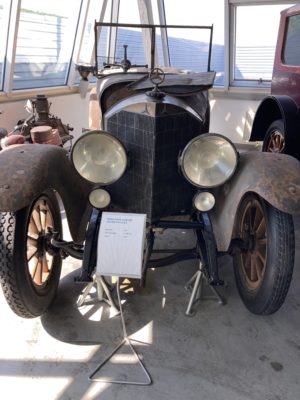
Mercedes Knight 16/45 PS Tourenwagen

Year of manufacture: 1918
Power: 50 hp
Displacement: 4,084 cm3

Weight: 1,750 kg

Condition: restored
Catalog number: 218

Since 1911, the Daimler-Motoren-Gesellschaft (DMG) company equipped some passenger car models with Knight engines. The engines, invented by American Charles Knight, operate with sleeve valves instead of conventional valves, offering exceptionally smooth operation. The company acquired a license for this engine in 1910 and used it in some of its cars since then. With more than 5,000 vehicles produced, the Mercedes-Knight with a power output of 16/45 PS became the most successful Mercedes model by 1926.

This three-door, five-seat car featured a front engine and rear-wheel drive. It had a spark ignition, water-cooled inline four-cylinder engine (I4) with sleeve valve (Knight) valve timing, displacement of 4,084 cm³, carburetor, naturally aspirated, producing 50 hp, and a mechanical four-speed manual gearbox. The curb weight was 1,750 kg, and the top speed reached 80 km/h. The front axle was solid with longitudinal leaf springs; the rear axle was also solid with longitudinal leaf springs. The car had no front brakes and drum brakes on the rear wheels.

This particular car in our collection is the oldest vehicle bearing the Mercedes name. Originally manufactured in 1918 in green, it still saw service at the end of World War I as an officers’ vehicle. After many vicissitudes, it was purchased for our collection and restored to its current condition.

Škoda 1102 Tudor Roadster

Jasně, tady je překlad do angličtiny se zachováním formátování:

Year of manufacture: 1951 Power: 32 hp Displacement: 1,089 cm3

Number of cylinders/valves: 4/2 Weight: 960 kg

Condition: drivable Catalog number: 261

These passenger and light utility vehicles were produced in Mladá Boleslav and its branch plants, primarily in Kvasiny and Vrchlabí. The Škoda 1101, or Škoda 1102, also popularly known as Tudor, was a modernization of the pre-war Škoda Popular 1101, mainly distinguished by an updated body. Between 1946 and 1952, a total of 71,591 units of all versions were produced, most of which were exported to various countries, especially Poland, the Netherlands, and Belgium.

Technical data

Compared to its predecessor, the Škoda 1102 had a slightly modernized engine with the same power output. The flexible Hardy couplings on the drive shaft were replaced by universal joints, and the original friction shock absorbers on the front axle were replaced by lever-type hydraulic shock absorbers. A four-speed gearbox was standard. The entirely new dashboard replaced individual gauges with a combined instrument panel, and in the center, a grille prepared for a car radio appeared. The vehicle was not equipped with heating as standard (except for the ambulance version).

Vehicle development

The most modern pre-war model of the Mladá Boleslav automaker Škoda Popular was produced between 1940 and 1944. Development of the new car took place secretly during the war. A 1944 brochure already showed a drawing of a car with a body very similar to the eventual production version. The final design was completed during 1945 shortly after the war ended. In the 1102 version, passenger cars (mainly four-door sedans) were produced, while utility variants were mostly built on the 1101 chassis.

Production variants

An unfinished first prototype, still based on the old Popular 1101 chassis, was presented to journalists at the end of 1945. The prototype was completed in March 1946 and then underwent a promotional tour around Czechoslovakia. This first car had a Tudor body. Between April and October 1946, the body variants gradually emerged: ambulance, roadster, four-door sedan, Tudor convertible, and delivery van.

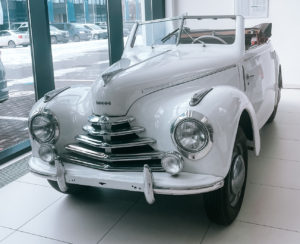
The roadster model differed from other versions by its two-piece, arrow-shaped windshield. The upper part of the windshield frame was made of a chrome strip. The roadster’s doors were frameless, and the curved sliding windows were trimmed with a thin chrome strip. The body was four-seater, although the rear seats were only for emergency use.

Modernization

In October 1947, a roadster prototype with a new grille consisting of five thick ribs was presented. This grille was adopted for all series roadsters and sedans. Other passenger versions received the new grille starting in 1948. In mid-1950, a new two-spoke steering wheel began to be installed.

The 1101/1102 series was replaced in 1952 by the Škoda 1200, which inherited the updated engine and chassis.


The vehicle from our collection is fully restored and in drivable condition.

Mercedes-Benz 230 W143 cabrio

Here is the English translation of your text with the original formatting preserved:

Year of manufacture: 1941 Power: 55 hp Displacement: 2,229 cm3

Number of cylinders/valves: 6/2 Weight: 1,000 kg

Condition: after renovation Catalogue number: 230

The Mercedes-Benz type 230 W143 was introduced in 1937. It was produced until 1941, with a total of 20,336 units manufactured.

This model was the successor to the Mercedes-Benz 230 W21, from which it inherited the frame. The body of the new 230 is wider and longer than its predecessor, although the first prototypes were built on the shorter wheelbase chassis of the previous model.

Only from 1938 onwards did versions with a long wheelbase appear. Generally, the 230 W143 was available in several body styles: from classic limousine to sedan, from sporty roadster to two types of convertibles. In its time, it was one of the flagship models of Mercedes-Benz production.

The Mercedes-Benz 230 was powered by a 2.3-liter engine delivering 55 hp, capable of propelling the vehicle to speeds exceeding 116 km/h. In the roadster body version, the same engine was slightly modified, increasing its maximum power to 58 hp and the top speed to 122 km/h.

The car from our collection is a Cabrio “B” model, fully renovated and in very good condition.