Showing 113–128 of 146 results

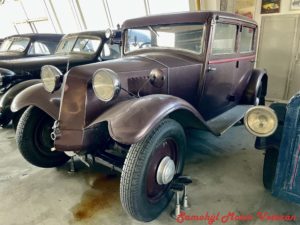
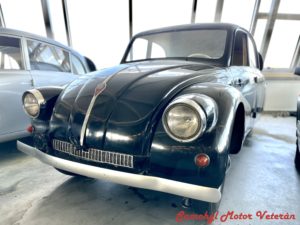
Tatra 54

Year of Manufacture: 1935
Power: 22 hp
Displacement: 1,463 cm3

Number of Cylinders/Valves: 4/2
Weight: 1,350 kg

Condition: drivable
Catalog Number: 267


Introduction

The Tatra 54 is a mid-range passenger car manufactured between 1931 and 1934 by the Czechoslovak automaker Tatra.


Development

The Tatra 54 was an economical version of the Tatra 52. It was considered “one of the most durable and reliable cars of the Kopřivnice manufacturer.” In 1934, it was replaced by the Tatra 75 model.


Technical Specifications

The Tatra 54 was available as a four-door, four-seat sedan equipped with the T30 engine, which had a bore 5 mm larger than the predecessor with the same stroke, resulting in a displacement of 1,463 cm3. The engine was front-mounted and powered the rear wheels with a conventional drivetrain layout. The body measured 4,000 mm in length, 1,650 mm in width, and 1,700 mm in height. With a wheelbase of 2,820 mm, the track width was 1,300 mm both front and rear, and the ground clearance was 220 mm. All four solid disc wheels were 18″ in size and equipped with mechanical drum brakes; hydraulic brakes were available as an option.

The front rigid axle was suspended by transverse semi-elliptical leaf springs, as were the two rear swinging half-axles. Torque was transmitted to these half-axles via a dry four-plate clutch and a directly-shifted, non-synchronized four-speed gearbox with a reverse shaft housed within a supporting tube forming the vehicle’s central backbone. This was the so-called “Tatra concept,” designed by the chief designer Hans Ledwinka. The engine was a flat, four-stroke, air-cooled boxer four-cylinder mounted longitudinally at the front.

The Tatra 54 featured mechanical worm steering and, with a curb weight between 1,000 and 1,090 kg, could reach speeds up to 80 km/h. Fuel capacity was 45 liters with 5 liters of oil. The car was equipped with a 12 V electric starter Bosch BGC 0.6/12 l z7 or Scintilla 12 V.


Production

Four- and six-seat sedan bodies with two or four doors were offered on the market.


Sales

During four years of production, a total of 1,510 vehicles were sold.


Car in Our Collection

The car in our collection is in fully functional and drivable condition.

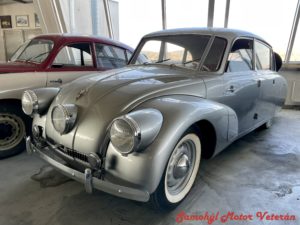
Tatra 87

Year of manufacture: 1946
Power: 75 hp
Displacement: 2,968 cm3

Number of cylinders/valves: 8/2
Weight: 1,490 kg

Condition: drivable
Catalog number: 158


Introduction

The Tatra 87 is an upper-class automobile manufactured by the Czechoslovak car company Tatra between 1937 and 1950. It is a luxury aerodynamic car and the successor to the T 77 A model.


Development

In 1936, the first two T 87 prototypes were produced for testing, followed by another five vehicles in 1937 as a verification series. The Tatra 87 was officially introduced in 1937. From 1938, the T 87 was manufactured in series. In 1940, two convertibles were also made for possible army use. After the war, serial production of the T 87 continued with minor body modifications until 1950.

In 1948, the front part of the body was modernized; headlights were recessed into larger wheel arch bulges, flush with the protective glass. The cars received new bumpers that formed a more compact unit with the body. This model also came standard with a sliding roof section over the front seats. This modernization was designed by František Kardaus. After the update, the central headlight became steerable and was controlled from the dashboard in the standard version; in the premium version, it was linked to the steering wheel. The car was delivered in this form until 1950, exclusively for the needs of state and party organizations.


Technical specifications

Compared to its predecessor, the new car was significantly lighter, while the engine displacement was increased to 2,968 cm3. The result was a power output of 55 kW (75 hp) at 3500 rpm and a maximum speed of 155 km/h. The type 87 was also shorter and narrower with a shorter wheelbase. The weight reduction was mainly achieved by using lightweight materials and alloys, resulting in a curb weight of 1,490 kg.

Compared to its predecessor, the T 87 had improved oil cooling; the engine was equipped with a full-flow oil filter, a ram-air oil cooler, and a double-barrel carburetor. The engine was located under an aerodynamically further improved rear hood with a stabilizing fin-shaped spoiler and powered the rear wheels. Next to the accelerator pedal, there is a button that the driver has to press approximately every 100 kilometers to pump additional oil into the engine and lubricate critical chassis points.

The Tatra 87 features a unique all-metal aerodynamic body (except for the door frames, which are wooden—as wooden construction was commonly used in most cars at the time), designed by Hans Ledwinka together with Erich Übelacker, based on the Tatra 77, which was the first car designed with an aerodynamic body concept. The body design was also influenced by Hungarian Paul Jaray, who designed the famous German airships Graf Zeppelin. The fin mounted on the sloping rear of the car helped split airflow to both sides of the vehicle, an idea later adopted by the aviation industry.

The car has rear wheel covers to reduce air turbulence around them. The windshield, originally intended to be panoramic, is divided into three parts; since manufacturing was unsuccessful, it was made of three flat panes. This car had a drag coefficient of 0.36 when tested in a Volkswagen wind tunnel in 1979; a 1:5 scale model tested in 1941 had a drag coefficient of 0.244.

The car has a central load-bearing frame that splits at the rear into a Y-shape. The wheels are independently suspended and measure sixteen inches, with the front axle supported by two semi-elliptical leaf springs and the rear by swing half-axles with quarter-elliptical springs. Many design features of the Tatra 87, later the V570 prototype and subsequently the T97, were copied by later car manufacturers. For example, Ferdinand Porsche was heavily influenced by the Tatra 87 and 97 and was subsequently sued by Tatra.

Between 1950 and 1953, some T 87 cars were fitted with the new T 603 A engine, later used in the “six hundred threes.” The engine provided sufficient power for the car to reach a maximum speed of nearly 170 km/h. These cars were labeled Tatra 87-603.


Production

A total of 3,023 vehicles of this type were produced over thirteen years (with production interrupted due to World War II), including 1,371 before 1945 and the remaining 1,652 after 1946. The highest production was in 1948, around 700 cars. The model was also successfully exported to countries such as Hungary, Romania, the USSR, Belgium, Germany, Austria, France, Sweden, South Africa, Egypt, Argentina, and even Australia. The successor to the T 87 was the more modern T 603.


Market

When introduced in the 1940s, the new car’s price was 25,000 Swiss francs.


Trivia

The Tatra 87 was highly regarded by Wehrmacht officers during World War II for its high speed and handling, suitable for driving on the German highways of the time—the Autobahns. The Minister of Armaments and Munitions Fritz Todt even stated: “This 87 is a car for the Autobahn…”. The car was also known as the Czech secret weapon because during high-speed accidents it killed so many officers that the Wehrmacht eventually banned all officers from driving the Tatra 87. The car had a light front end, making it easy to control at first glance even without power steering, but at high speeds, the car could disobey the driver due to weight placed on the rear.

Another interesting fact is that in 1947, travelers Jiří Hanzelka and Miroslav Zikmund, who met at university and became inseparable friends, decided to support the car company’s sales and fame worldwide. They embarked on expeditions in the Tatra 87 to Africa, South, and Central America. They had planned the world tour before the war, which disrupted their plans, and only after the war did they receive financial and political support, including from Tatra (for which they became sales representatives). They set out on April 22, 1947, from Opletalova Street in Prague, sailed via Marseille to Morocco, traveled through Egypt, Sudan, Ethiopia, and ended in South Africa.

On their journey, they had to replace the Tatra once, not due to technical problems but because of a serious accident in Libya. The original silver Tatraplán with recessed headlights was rendered immobile. They continued their journey with a new car. In Africa, they were also the first to cross the Nubian Desert by car and reached the summit of Kilimanjaro.

After their adventure in Africa, the duo moved to South America, starting their journey in Argentina and continuing to Mexico. They wanted to get to the USA, but the political atmosphere of the late 1940s and early 1950s, heightened by the Cold War, prevented this. Neither traveler received visas, and Hanzelka also broke his arm. Thus, they returned to Czechoslovakia in November 1950 with the Tatra 87, which was no longer the same country they had left.

Although the Communist Party was the main force of the National Front already in 1947—Klement Gottwald was prime minister at the time—neither of the two experienced the communist coup in February 1948 directly in Czechoslovakia. Many orders the duo secured abroad during their expedition were never fulfilled. Production of the Tatra 87 ended at the end of 1950, and in Kopřivnice, due to the central plan, production shifted mainly to trucks, and passenger cars became marginal.

Hanzelka and Zikmund brought back from their first expedition with the Tatra 87 about 120,000 slides, around 150 films, and produced numerous radio reports and travelogues. They traveled through 44 countries and covered nearly 62,000 kilometers in the Tatra 87 alone. Their original car, now a national cultural monument, can still be seen at the National Technical Museum in Prague.


Car in our collection

The car in our collection is a four-door five-seat sedan in perfect and fully functional condition from 1946.

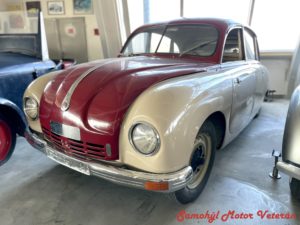
Tatra 600 Tatraplan

Year of manufacture: 1949
Power: 52 hp
Displacement: 1,952 cm3

Number of cylinders/valves: 4/2
Weight: 1,200 kg

Condition: drivable
Catalog number: 155

Introduction

The Tatra 600, also known as Tatraplán, is a mid-size passenger car produced from 1948 to 1951 by the company Tatra, n.p., and subsequently until 1952 by AZNP Mladá Boleslav. The car, featuring a streamlined body and a rear-mounted air-cooled flat-four engine, continued the tradition of aerodynamic automobiles made by Tatra. Its size corresponded to the pre-war Tatra 97 model.

Development

Originally designated as Tatra 107, the lucky “7” followed the previous aerodynamic models from Kopřivnice – T 77, T 87, and T 97. Development of the Tatraplán began at the end of World War II, intending to build upon the successes and traditions of the earlier aerodynamic cars. It was meant to be a newer, smaller, and more affordable version, also replacing the then somewhat outdated Tatra 57, whose production was ending.

The later designation Tatra 600 came from the new post-war numbering system of Tatra production, which assigned personal cars numbers beginning with 600. The name “Tatraplán” was inspired by the sleek shape resembling an airplane – an aeroplane. Some later brochures distorted this to associate the name with the two-year plan and planned economy, including the long á in the name.

Technical Specifications

The Tatraplán was characterized by a modern design for its time, featuring several advanced elements. It was one of the first cars with a pontoon-shaped body. The body was steel and self-supporting, without a wooden frame. A notable feature was the front split V-shaped windshield without a central pillar, sealed only with a narrow rubber profile.

The front axle consisted of two transverse semi-elliptical leaf springs, and steering was implemented via a rack and pinion system, contributing to light and precise control. The rear axle was a swing axle, sprung by transverse torsion bars. The four-speed gearbox with synchromesh on 2nd through 4th gears was operated by a gear lever located under the steering wheel.

The car was powered by a flat-four engine with relatively large cylinder dimensions (bore 85 mm, stroke 86 mm), cooled by a single axial fan initially driven by a bevel gear, later replaced by V-belts, with the fan axis changed from vertical to horizontal. The updated engine had two carburetors, improving the car’s performance.

The entire unit was mounted on robust rubber blocks in the body. The aerodynamically designed body with recessed headlights, handles, and door hinges had a drag coefficient of 0.32 to 0.33 – a leading value for serial production cars at the time, a figure other manufacturers only reached many years later.

Thanks to this, the Tatraplán (despite its relatively small engine displacement and size) could reach speeds up to 130 km/h. In later years, with the use of the Tatra 603 engine, T 600 cars (usually in security services) were capable of speeds well over 170 km/h. During development, a prototype with a diesel engine was tested in Kopřivnice, a pioneering effort at the time. Three Tatraplán Diesel cars produced in 1949 had an output of 31 kW (42 hp) and reached speeds of 125 km/h.

Despite the somewhat louder engine, the Tatraplán was among the quietest cars inside due to good sound insulation. This was helped by the luggage compartment located behind the rear seats, separated by a partition. The front compartment was designed for small luggage, mainly housing the spare wheel (with space for two spares), tools, and fuel tank. The oil cooler was also placed at the front.

Production

The Tatraplán was also made in a sporty two-door version with an aluminum body – the Tatra 601 Monte Carlo (named after the famous rally it was meant to enter but did not) and a few open racing versions T 602 Tatraplán Sport. These cars later served as test beds for the development of the eight-cylinder 2,545 cm³ engine used in later Tatra 603 cars.

Utility prototypes with the T 600 engine mounted in the front of the body were also derived from the Tatraplán.

An interesting prototype was the T 600 convertible bodied by Sodomka in Vysoké Mýto for the 1949 Geneva Motor Show, where it attracted deserved attention. Instead of planned serial production, which could have brought valuable foreign currency from exports, the leadership decided to gift the car for J. V. Stalin’s birthday (though he likely never used it). Fortunately, the car later returned to the company museum in Kopřivnice during an exchange in the 1980s.

In 1951, the production of the Tatraplán was centrally halted by the Ministry of Industry of the planned economy and transferred to Mladá Boleslav. Tatrapláns made at Škoda (identifiable by several detail differences) quickly damaged their reputation due to a decline in build quality, leading to falling interest abroad. The decision also halted Škoda’s project, reflecting tense relations between Tatra (Moravia) and Škoda/Praga (Bohemia) at the time. Tatra was to focus only on heavy trucks, while Škoda imported conventional cars with rigid axles and ladder frames. Škoda ceased Tatraplán production in 1952. In total, 6,342 T 600 cars were produced, 4,242 of them in Kopřivnice.

Market

Although not produced in large series, the T 600 enjoyed considerable commercial success abroad, helped by its sporting achievements. The Tatraplán was exported to many European countries and even overseas. In Czechoslovakia, it mainly served as an official car for state and party officials; it was inaccessible to ordinary motorists due to the political situation after February 1948.

Trivia

Serial Tatraplán cars were driven on Czechoslovak roads for many years and abroad, imported for example to the Netherlands by the well-known company Auto Palace. Today, they are sought-after vintage cars due to their unusual and timeless design.

Car in Our Collection

The car in our collection is in fully functional, drivable condition.

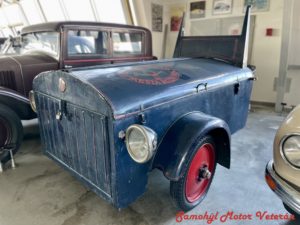
Tatra 49

Year of Manufacture: 1936
Power: 7 hp
Engine Displacement: 528 cm3

Number of Cylinders/Valves: 1/2
Weight: 515 kg

Condition: drivable
Catalog Number: 268


Introduction

The Tatra 49 is a three-wheeled two-seater delivery vehicle produced between 1929 and 1939 by the Kopřivnice automobile factory in northern Moravia.


Development

The development of the Tatra 49 was inspired by the Tatra 12 and Tatra 30 models.


Technical Specifications

The three-wheeler adopted a rigid front axle suspended on a transverse leaf spring and equipped with mechanically operated drum brakes from the four-cylinder Tatra 30. The front axle was mounted at the front end of a backbone frame made from a circular steel tube, to the rear end of which the drivetrain was attached. Ahead of the driven rear wheel was a transversely mounted, air-cooled, upright single-cylinder OHV engine with a displacement of 528 cm3, having the same bore (82 mm) and stroke (100 mm) as the horizontally opposed cylinders of the Tatra 12 two-cylinder engine. The single-cylinder engine was cooled by a blade fan and produced 7 hp at 2,500 rpm. It was started by a foot pedal in motorcycle style.

To the right of the engine was a two-plate clutch, and to the left a three-speed gearbox controlled by a lever operated by the driver’s left hand. The single rear wheel was cantilevered on the left side on a hollow swing arm through which a driveshaft passed. Torque was transmitted from the gearbox output to the driveshaft and then to the rear wheel by a pair of bevel gears.

The utility version of the tricycle had the driver’s seat above the engine and a steering column with a steering wheel positioned centrally in front of the driver. The cargo space was located above and behind the front axle, usually in the form of a metal box with double-wing doors in the front wall and on top. The box measured 1,640 mm long, 1,100 mm wide, and 950 mm high and could carry up to 400 kg of cargo.

Between the cargo area and the driver was a double partition wall, with the fuel tank (12 liters) on the left and the battery on the right. The simple dashboard carried an ignition switch and a speedometer with an odometer, although period photos suggest that some three-wheelers might have lacked a speedometer. The cargo tricycle had a wheelbase of 2,265 mm and a front track of 1,300 mm. Its overall length was 3,300 mm, width 1,600 mm, and height up to the top of the steering wheel 1,300 mm. It weighed 515 kg and reportedly reached a top speed of 55 km/h with fuel consumption between 6 and 8 liters per 100 km.

The chassis of the passenger version was modified in several ways. The steering wheel was moved forward and to the right, and the gearshift lever was relocated forward and to the center, requiring a new shifting mechanism. On Tatra 49 passenger tricycle prototypes, the foot brake acted only on the front axle, while the hand brake controlled the rear wheel brake.


Production

The passenger tricycle resembled its four-wheeled sister Tatra 12, including a shortened front end shaped like Kopřivnice’s “iron.” The two-seat cabin was made of wood covered with artificial leather, with doors on both sides fitted with sliding windows. The windshield had a manual wiper. The engine was equipped with an electric starter, and the exhaust with a silencer exited near the rear wheel. The equipment included an electric horn, but the driver still had the classic bulb horn at hand. The spare wheel was mounted on the rear fender.

The passenger version was 3,100 mm long, 1,600 mm wide over the front fenders, and 1,680 mm tall. Its weight was around 600 kg, with a top speed estimated not to exceed 50 km/h. Probably only two passenger Tatra 49 tricycles were made, which remained prototypes. However, in March 1930 the magazine Auto announced that Tatra had completed a small series of utility three-wheelers type 49 and would soon launch them on the market for less than 20,000 Kč.

According to factory records, the first series included 100 utility three-wheelers T 49 in several variants, mainly with metal boxes but also with open wooden beds. For an additional fee, the factory offered a second seat in tandem behind the driver on the rear fender, a protective windshield in front of the driver, and a simple fabric roof.


Market

Nearly twenty T 49 chassis were delivered in 1930 and 1931 to the Austro-Tatra company in Vienna, where they received utility superstructures. In October 1930 and again the following year, Tatra 49 three-wheelers were repeatedly displayed at the Prague Motor Show in the Kopřivnice commercial vehicle exhibit—two each time, one with a closed and one with an open cargo box.

The second 100-unit series of Kopřivnice three-wheelers began production in 1934. Their exclusive dealer from spring 1934 was the Prague firm Bratří Šulcové, which also represented British BSA motorcycles and Strakonice ČZ machines. The single-seat delivery tricycle with a metal box was offered for 12,300 Kč; the two-seat version was available at an extra charge.

“The ideal vehicle of today that truly reduces transport overhead to a minimum is the Tatra cargo tricycle,” proclaimed a Bratří Šulcové advertisement published in early April 1934 in Národní listy.

The last of the 200 utility Tatra 49 three-wheelers were reportedly assembled and sold in the late 1930s, after which these uniquely designed vehicles nearly faded into oblivion. Only a few examples have survived to this day and enjoy great interest and affection among vintage vehicle enthusiasts.


Sales

Over 9 years of production, the company sold nearly 210 units.


Trivia

An interesting fact is that on May 1, 1931, the same advertisement featuring drawings of the Tatra 49 delivery tricycle and the slogan “A helper that pays off for you. Tatra tricycle.” appeared simultaneously in three major newspapers: Národní listy, Národní politika, and Lidové noviny. The ad did not state the selling price.


Vehicle in Our Collection

The vehicle in our collection is in fully drivable condition.

Tatra 97

Year of Manufacture: 1937
Power: 40 hp
Engine Displacement: 1,749 cm3

Number of Cylinders/Valves: 4/2
Weight: 1,150 kg

Condition: drivable
Catalog Number: 159


Introduction

The Tatra 97, also known as the Tatra T97, was a Czechoslovak limousine produced by the Tatra automobile company. It was created as a less powerful alternative to the Tatra 87, sharing most components but being smaller and less equipped.


Technical Specifications

The Tatra 97 is a four-door, five-seat sedan with a rear-mounted engine and rear-wheel drive. It is equipped with a spark-ignition, air-cooled flat four-cylinder engine with a displacement of 1,749 cm³ and a Zenith carburetor without supercharging. The vehicle produces 29 kW (40 hp) at 3,500 rpm and has a curb weight of 1,150 kg. The front wheels are suspended on two transverse leaf springs, and the rear features a swing axle (half-axles) with oblique leaf springs. Both front and rear brakes are drum brakes.


Production

Production of this model lasted only three years, from 1937 to 1939. After World War II, production briefly resumed in 1946 but was soon definitively stopped to make way for the Tatra 600 – Tatraplan.


Sales

Only 510 units were produced during the entire production period, making it a highly valued collector’s car.


Trivia

An interesting fact is that the Tatra 97 resembled the Volkswagen Beetle, which was created at Adolf Hitler’s behest. Hitler wanted an affordable people’s car for all citizens, and the task was given to Ferdinand Porsche, a native of the Czech town Vratislavice nad Nisou. Porsche had strong support from Hitler at the time but later became known as the “devil’s engineer.”

So where does Tatra fit in? The Beetle and the Tatra 97 share several design similarities. The Beetle had a strikingly similar aerodynamic body and a rear-mounted, air-cooled four-cylinder engine, just like the Tatra 97. It could be said that Porsche copied Hans Ledwinka, the Tatra designer, but it was not that simple. The engineers were friends and often consulted each other’s designs. Nevertheless, German production was accused of plagiarism. The lawsuit, however, did not concern the appearance but the chassis concept with independent suspension. Ferdinand Porsche confided the lawsuit to Adolf Hitler, who said he would solve the problem.

When the Tatra 97 had been in production for a year, the occupation of Czechoslovakia began in 1938. In 1939, the Beetle and Tatra appeared together at the Berlin Motor Show, where Hitler himself noticed the visual similarity. He ordered the production of the Tatra 97 to be stopped, but that was not the end. Nazi forces confiscated all documentation related to the car and transported it to Germany. According to some sources, the documentation is still somewhere in Stuttgart. When the war started later that year, Tatra’s lawsuit was dropped. It was revived only after the war ended, and in 1961 Volkswagen was forced to pay one million West German marks.


Car in Our Collection

The car in our collection is from 1937, fully restored, and in perfect working condition.

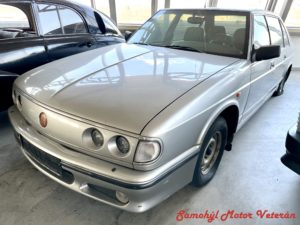
Tatra 700

Year of Manufacture: 1996
Power: 198 hp
Engine Displacement: 3,495 cm3

Number of Cylinders/Valves: 8/2
Weight: 1,840 kg

Condition: drivable
Catalog Number: 272


Introduction

The Tatra 700 was first introduced to the public on April 9, 1996, during a grand presentation at the Hilton Hotel in Prague. However, the vehicle did not bring the expected success to the company. Despite new body shapes and a more luxurious interior, it could not compensate for the already significantly outdated technical solutions at the time, combined with a relatively high price due to its limited production volume. The persistently negative image of Tatra passenger cars, associated with their typical longtime users from the Czechoslovak Communist Party, also played a role.


Development

The Tatra 700 was technically based on its predecessor, the Tatra 613-4 MiLong, inheriting not only the air-cooled engine concept mounted above the rear axle but was essentially the last developmental variant of this vehicle, although with a different designation. Due to the inheritance of original homologations, its official designation is Tatra 613-4 T 700.


Technical Specifications

The body of the Tatra 700 was based on the T 613 body designed between 1968 and 1969 by the Italian design firm Carrozzeria Vignale. It was significantly refreshed by British designer Geoff Wardie, who softened the strictly angular shapes of the previous model and incorporated some design elements from earlier Tatra passenger cars — for example, the chromed oval on the front inspired by the Tatra 603. The design was exclusively based on the long-wheelbase version T 613 Long.

Due to the factory’s complete lack of equipment for producing a new model, modified and reworked sheet metal parts from the original T613 were used for the new series. In 1996, significant design changes were made (mainly a raised rear part of the body and changes to the dashboard) by Jiří Španihel, an academic sculptor from Kopřivnice. A horizontal crease around the front grille emblem was also added. This updated T700 is considered the second series and is technically designated T700 M97.

The cars were equipped with a five-speed manual transmission and a 3,495 cm3 engine producing 147.6 kW (198 hp). Later, the Tatra 700-2 version had engines of 4,360 cm3 producing 172 kW (231 hp). However, not many of these vehicles were produced. The engines mainly differed by improved torque curves and were equipped with sequential fuel injection controlled by a British GEMS electronic unit.


Production

The Tatra 700 is a luxury upper-class car manufactured by Tatra from 1996 to 1999. Since production became unprofitable after the first year and was merely a prestige matter for the company, the model line was discontinued in 1999. A total of 75 cars of the T 700 series were produced, which quickly became collector’s items and objects of interest for Tatra enthusiasts after being retired from state service. Consequently, their market price is very high.


Market and Sales

Most T700s were used within state institutions, including district and regional offices, the Senate, Parliament, and the government. The best-known user was the current President of the Czech Republic, Miloš Zeman, who used the Tatra 700 as his official car from 1996 to 1998 as the Chairman of the Chamber of Deputies and later from 1998 to 2002 as Prime Minister. At the time of its production, any foreign car was already available on the market, and the T700 significantly lagged behind in this competition. Thus, sales to the private sector failed, and usage remained confined to state organs, explaining the low production numbers.


Trivia

This car was also owned by former Czech President Václav Klaus. It was the sixth prototype T700 delivered quickly by the Tatra factory after Klaus had an accident in his Tatra 613-4 Mi Long. The black 1998 model with 162,000 km is currently offered for 5,100,000 CZK.


Car in Our Collection

The car in our collection dates from 1996, is a sedan, and originally belonged to the Ministry of Agriculture.

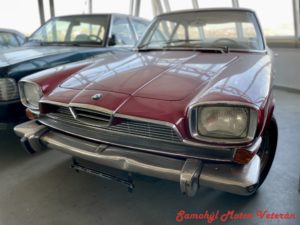
BMW Glas 3000 V8

Year of Manufacture: 1968
Power: 160 hp
Engine Displacement: 2,982 cm3

Number of Cylinders/Valves: 8/2
Weight: 1,350 kg

Condition: drivable
Catalog Number: 111


Introduction

The German company BMW was founded in 1916 as a manufacturer of aircraft engines, later producing motorcycles as well. In 1928, it started manufacturing passenger cars by acquiring the Dixi factory and its car, which was produced under license from the Austin Seven. Before World War II, the main production plant was located in Eisenach, which became part of East Germany after the war. The Eisenach factory produced cars under the BMW brand between 1948 and 1951, but was later forced to change its name to EMW. The West German company, based in Munich, resumed passenger car production only in 1951. In 1966, BMW took over the Glas company to expand its manufacturing capacities and gradually phased out its production by 1969. Today, BMW is one of the most prominent global manufacturers of premium sports-oriented cars.


Development

This little-known chapter in BMW’s history involved an interesting collaboration between the small German car manufacturer Hans Glas GmbH and Pietro Frua, one of the most significant Italian designers of his time. Frua designed a series of cars that Glas hoped would save its struggling company. He also designed the Glas 3000 V8 coupe, which was produced between 1965 and 1968. Approximately 389 units were made in total.


Technical Specifications

The car body was designed by the Italian company Frua from Moncalieri. The car has a 2,982 cm3 front-mounted V8 engine designed by Glas. The BMW Glas 3000 V8 produces 160 hp and is equipped with a 4-speed manual transmission. The chassis was high-quality and very modern for its time. At the front, the car has independent suspension with coil springs, and at the rear, a De Dion axle suspended by leaf springs.


Car in Our Collection

The car in our collection dates from 1968 and is in fully functional and drivable condition.

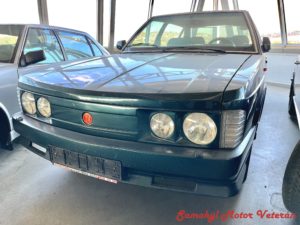
Tatra 613

Year of Manufacture: 1988
Power: 167 hp
Engine Displacement: 3,495 cm3

Number of Cylinders/Valves: 8/2
Weight: 1,690 kg

Condition: drivable
Catalog Number: 273


Introduction

In 1974, Tatra introduced a new luxury four-door limousine that dramatically changed the company’s previous design direction. This was the model 613, designed by the Italian coachbuilder Vignale, and it bore almost no resemblance to its predecessor, the 603, except perhaps for being produced at the subsidiary plant in Příbor. The high degree of handcrafting in production made the Tatra expensive and, due to slow and regulated production, also rare.


Development

The appearance, however, changed and modernized several times during its long production. Already in 1980, a more economical version 613-2 was introduced, and in 1985 the 613-3 version came with a design updated by Mr. Ladislav Výborný. It is recognizable by a different grille, lights, bumpers, and typical smooth plastic hubcaps. Plastic was used more than chrome, earning it the nickname “plasťák” (the “plastic one”).


Technical Specifications

The Tatra 613 was also known as a fast, spacious, and comfortable vehicle with a flexible carbureted 2×2 OHC engine of 3.5 liters producing 168 hp, reaching speeds up to 190 km/h. Later engines offered better performance, higher displacement, and near the end of production even fuel-injected engines with 200 hp. These cars could reach speeds up to 230 km/h. The transmission was initially 4-speed, later 5-speed in the newest models. Its curb weight was 1,690 kg.


Production

Besides the limousine, there were extended-wheelbase sedans, rescue versions, and a coupe prototype that was never produced.


Sales

This car is a piece of Czech automotive history, and today its price would rise to around 2.5 million CZK.


Interesting Facts

The Tatra 613 was not available to just anyone. New cars were distributed mainly to politicians, then company directors, rescue and armed forces, and also the police, where it was used for covert road traffic monitoring with a built-in speed radar.


Car in Our Collection

The car in our collection dates from 1988 and is in fully functional and drivable condition.

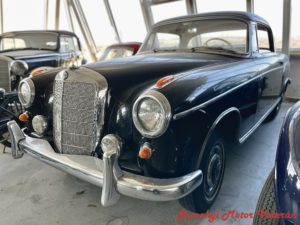
Mercedes-Benz 220 SE W128

Year of Manufacture: 1960
Power: 120 hp
Engine Displacement: 2,195 cm3

Number of Cylinders/Valves: 6/2
Weight: 1,380 kg

Condition: drivable
Catalog Number: 264


Introduction

The Mercedes-Benz 220 SE W128 is a six-cylinder luxury car produced by Mercedes-Benz from 1958 to 1960.

Development

It was the last new model of the “Ponton” series, whose design and style roots date back to the 1953 Mercedes-Benz 180 (W120) sedan. It was largely identical to its predecessor, the 220 S, except for fuel injection—“Einspritzung” in German—reflected by the additional E in its name 220 SE. The W128 was later succeeded by the emerging W111 series.

Technical Specifications

The 220 SE features a unibody construction and a chassis with fully independent suspension. All models are equipped with a 2.2-liter inline six-cylinder petrol engine with an aluminum head and Bosch mechanical fuel injection. This was performed as intermittent injection into the intake manifold and meant that the 2.2-liter engine produced 120 hp. The vehicle’s curb weight is 1,380 kg, it is rear-wheel drive, and its top speed is 160 km/h. The engine displacement is 2,195 cm3 with a four-speed manual transmission.

Production

Almost every interior is covered with wood and leather, and matching leather luggage was also available. However, original equipment for the 220 SE did not include power steering, electric windows, air conditioning, or an automatic transmission.

Market

This model was available as a sedan, coupe, convertible, and limousine.

Interesting Facts

The Mercedes-Benz 220 SE coupe is very rare, as only 830 units were produced.

Car in Our Collection

The car in our collection is a coupe and is in fully functional and drivable condition.

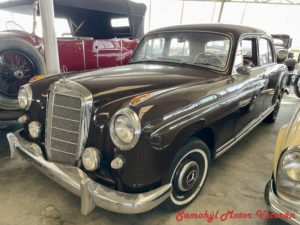
Mercedes-Benz 220 SE W128

Year of Manufacture: 1959
Power: 115 hp
Engine Displacement: 2,195 cm3

Number of Cylinders/Valves: 6/2
Weight: 1,380 kg

Condition: drivable
Catalog Number: 276


Introduction

The Mercedes-Benz 220 SE W128 is a six-cylinder luxury car produced in 1958 and 1959. It was the last new model of the “Ponton” series, which traced its design and style roots back to the 1953 Mercedes-Benz 180 (W120) sedan. It was largely identical to its predecessor, the 220 S, except for fuel injection — “Einspritzung” in German — reflected by the additional E in its name 220 SE. The W128 was succeeded by the emerging W111 series.

Technical Specifications

The 220 SE features a unibody construction with a chassis that has fully independent suspension. All models are equipped with a 2.2-liter inline six-cylinder petrol engine with an aluminum head and Bosch mechanical fuel injection. This injection was intermittent into the intake manifold, enabling the 2.2-liter engine to produce 115 horsepower. This stronger engine delivered better performance with lower fuel consumption but came at a cost: 1,900 DM more than the carburetor version.

Production

Almost every interior is covered with wood and leather, and matching leather luggage was also available. However, original equipment for the 220 SE did not include power steering, electric windows, air conditioning, or automatic transmission.

Market

This model was available as a sedan, coupe, convertible, and limousine.

Sales

A total of 1,974 units were produced in the four-door limousine configuration.


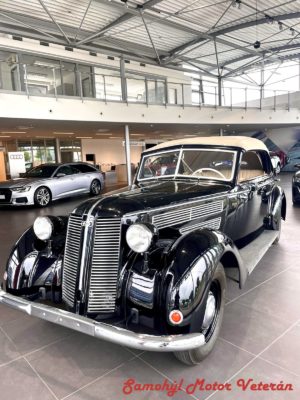
Audi 920

Year of Manufacture: 1939
Power: 75 hp
Engine Displacement: 3,281 cm3

Number of Cylinders/Valves: 6/2
Weight: 1,640 kg

Condition: drivable
Catalog Number: 270


Introduction

The Audi 920 is an upper mid-range passenger car with rear-wheel drive, introduced by the Audi brand, part of the Auto Union group, at the end of 1938 as the successor to the front-wheel-drive Audi 225 model.


Development

The German car manufacturer Audi was founded in 1910 in Zwickau by August Horch and his partners. In 1928 it became part of DKW, and finally in 1932 the four German automakers DKW, Audi, Horch, and Wanderer officially merged into the Auto Union conglomerate.

Since most of the holding remained in East Germany after the war, the West German Auto Union resumed production only under the DKW brand. In 1965 Volkswagen took over the company, and within the Volkswagen Group, Audi gained a position as a producer of advanced and well-equipped vehicles.


Technical Specifications

The Audi 920 is a two-door, four-seat convertible with a front-mounted engine driving the rear wheels. The ignition, liquid-cooled inline six-cylinder engine with an OHC valve train has a displacement of 3.3 liters and produces 75 hp (55 kW) at 3,000 rpm, equipped with a Solex carburetor. The chassis has a wheelbase of 3,100 mm, track widths of 1,435/1,465 mm, external dimensions: length 4,900 mm, width 1,720 mm, height 1,620 mm, curb weight 1,640 kg, and a top speed of 130 km/h.

The vehicle features a ladder frame chassis with a hydraulically operated foot brake (“oil pressure brake”) from ATE (licensed from Lockheed) and a fully synchronized four-speed gearbox with a central gear lever. The front wheels are suspended on double wishbones; the lower arm is a transverse leaf spring, while the upper arm controls the shock absorber. At the rear, there is a rigid “floating axle” guided by trailing arms and a high-mounted transverse leaf spring.


Production

The Audi 920 was produced from 1938 to 1940. Like its predecessor, the UW 225, it was manufactured at the Horch factories. The car was available as a 4-door sedan or a 2-door convertible — the bodies were made by Gläser Dresden.


Market

The car was originally intended to be launched as a smaller Horch model, but Auto Union management decided to place it between the large Horch models and smaller Wanderer models under the Audi brand.


Sales

The unit in our collection was manufactured in 1939, with the original price of 8,750 Reichsmarks. A total of 1,281 units were sold, including 795 convertibles.


Interesting Facts

It was the last pre-war model of the Audi brand, production of which ceased due to the war.


Car in Our Collection

The car in our collection is a convertible from 1939 and is in fully functional and drivable condition.

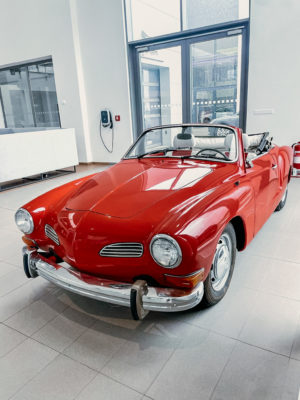
Volkswagen Karmann-Ghia

Year of Manufacture: 1971
Power: 50 hp
Engine Displacement: 1,600 cm3

Number of Cylinders/Valves: 4/2
Weight: 820 kg

Condition: drivable
Catalog Number: 271


Introduction

The Karmann-Ghia prototype premiered at the Paris Motor Show in 1953 and was created completely outside Wolfsburg. It carries the name of two coachbuilders, and rightly so. The German Karmann had asked the Italian studio Carrozzeria Ghia whether they could design something sexier, more attractive, and more interesting on the Beetle chassis. The Karmann coachworks in Osnabrück was already producing the open version of the legend, the classic cabriolet. The market would surely welcome such a car, so there was room for something new and fresh.

Important figures behind the creation of this model are the coachbuilder founder Wilhelm Karmann and the designer Luigi Segre, who worked at the Ghia studio in Turin. It was between these two men that a prestigious conversation took place at the Paris show. Segre and his team eventually designed a new coupe — why a convertible was not made first is unfortunately unknown. He showed his work in October 1953 to influential Karmann executives, led by the boss, in a Paris garage, and the decision was made.

The elegant car appeared in November at the motor show stand. Journalists and others were enthusiastic. What about Volkswagen itself? Its then head Heinz Nordhoff thoroughly inspected the car, liked it a lot, but shortly after the show delivered sad news: mass production would be too expensive for the factory alone. However, cheerful news came from Osnabrück: there was capacity alongside open Beetle production. The agreement among all three companies faced no further obstacles.

The series-production Volkswagen Karmann-Ghia Type 14 began selling in Europe in early 1955, and the production coupe differed little from the original prototype, with only minor changes to the body and interior. The convertible version with a fabric roof came into production in 1957.


Technical Specifications

The air-cooled flat four-cylinder engine with a displacement of 1.2 liters was rear-mounted and produced only 30 hp (22 kW). The convertible arrived in 1957 — Segre presented it directly in Wolfsburg. The variant with a fabric roof helped the brand, then still with a short tradition, build a solid image. Using existing technology was logical, as Wolfsburg had no other options available.

A comparison with the Porsche 356 somewhat suggests itself, but Volkswagens were more popular. Today they are sometimes disparagingly called “the slowest sports cars in the world.” After all, the original models with 1.2-liter engines reached a maximum speed of 120 km/h and accelerated to 100 km/h in 28 seconds. Throughout production, the chassis was consistently based on the classic Beetle, but engine displacement and power were gradually increased. First to 1.3 liters and 40 hp, and finally to 53 hp from 1.6 liters.


Production

The Volkswagen Karmann-Ghia was produced as a two-door coupe or convertible, with over 445,000 units manufactured from 1955 to 1974.


Car in Our Collection

The car in our collection is a convertible version, dates from 1971, and is in fully functional drivable condition.

Placeholder

Mercedes-Benz SL 320 R129

Year of Manufacture: 1997
Power: 231 hp
Engine Displacement: 3,199 cm3

Number of Cylinders/Valves: 6/4
Weight: 1,775 kg

Condition: perfect
Catalog Number: 4


Introduction

Mercedes-Benz has been producing roadster-type cars since the mid-1950s. There were several predecessors to the “iron” (Žehlička), but the direct predecessor was the R107 generation.


Development

After the 1954 Gullwing, the world welcomed the Pagoda in the 1960s, followed by the R107 generation. This generation became famous not only for its coupe version but especially for maintaining production for the nearly unimaginable span of eighteen years. Each generation of the two-seat roadster always had a long lifecycle, but one of the most popular and best-selling was the fourth generation (R129), introduced at the Geneva Motor Show in 1989. It was the last Mercedes to carry the “gullwing” designation 300 SL.

The car’s design was created by Bruno Sacco, who aimed to craft a living legend. The then company director Werner Niefer was also deeply involved in development; he developed a fond attachment to the R129 and even called it his favorite. It’s no surprise—he spent an incredible amount of time and kilometers behind the wheel of the test prototypes, refining every detail.


Technical Specifications

The car boasted more than twenty patented components, the most interesting of which concerned the safety of the two-seat crew. For example, the pop-up rollover protection bar behind the seats—now common in open cars—made its debut with this “SL.” It could deploy in 0.3 seconds during a rollover, protecting occupants from head injuries on the asphalt. Compared to its predecessor, the torsional rigidity of the body was significantly increased by approximately 30%. It reached the same values as Mercedes sedans, and the car did not twist without the roof. Diagonal braces further improved driving dynamics.

Other production firsts in the “iron” included self-retracting three-point seat belts mounted in comfortable seats with a solid frame made from five magnesium castings, which partially absorbed unwanted forces on the occupants during side impacts.

The initial variant was the 300 SL with a 3.0-liter inline six-cylinder M103 engine, featuring a unique three-valve technology and outputting 190 hp at 5,700 rpm. Its top speed in 1989 was a respectable 228 km/h.

More powerful versions traditionally featured four-valve technology, exemplified by the 300 SL-24, powered by the M104 engine delivering up to 231 hp at 6,300 rpm and reaching 240 km/h. For more demanding customers, the 500 SL with a 32-valve V8 (M119) was available, producing 326 hp at 5,500 rpm. This version had a speed limiter set at the usual 250 km/h.

However, this was not yet the true peak, although power was certainly abundant. Three years after launch, Mercedes introduced the 600 SL with a 6.0-liter V12 engine producing 394 hp at 5,200 rpm. The following summer brought a facelift with updated badging and the discontinuation of the three-liter engines. The SL 280 version was powered by a 2.8-liter six-cylinder with 193 hp, and the SL 320 by a 3.2-liter unit with 231 hp. AMG also contributed with a 6.0-liter V8, the SL 60 AMG, producing 381 hp.

The facelift unveiled in 1995 at the Frankfurt IAA brought styling changes and better equipment. Features such as xenon headlights from the E-Class W210 (“masárek”) and cruise control were introduced. New five-speed automatic transmissions were installed in SL 500 and 600 models. From that time, even the weaker V8s could be ordered with ESP, while the V12 came with this electronic aid standard. Shortly thereafter (December 1996), SL received a revolutionary Brake Assist System (BAS).

The last facelift dated spring 1998 and included modernization of the six- and eight-cylinder engine lineup along with light design updates (new mirrors, 17-inch wheels, and modified bumpers). The lineup started again with the SL 280 at 204 hp, continued with the SL 320 at 224 hp, and culminated with the V8 in the SL 500 producing 306 hp. The newer 6.0-liter V12s were missing at that time; the strongest variant was the existing SL 60 AMG. One year later, the SL 55 AMG with a V8 producing 354 hp replaced it. The absolute pinnacle of the lineup was the brutal SL 73 AMG, astonishing with 525 hp from a 7.3-liter V12.

In July 2001, the last model of the R129 series rolled off the Bremen assembly line. In total, Mercedes-Benz produced 204,940 units of the fourth-generation SL. The most successful model was the 500 SL/SL 500 with the four-valve M119 V8 engine. Between launch and 1998, 79,827 units of this model were produced.

Placeholder

Mercedes-Benz UNIMOG U 2450 L

Year of Manufacture: 1992
Power: 214 hp
Engine Displacement: 5,958 cm3

Number of Cylinders/Valves: 6/2
Weight: 6,825 kg

Condition: drivable
Catalog Number: 5


Introduction

The designation Unimog (an abbreviation of the German Universal-Motor-Gerät, meaning universal motor device) refers to a range of German universal light trucks produced by Mercedes-Benz (now part of Daimler AG).


Development

In the completely shattered post-war German economy, Mercedes-Benz aircraft engine designer Albert Friedrich began developing a vehicle that combined the advantages of an off-road vehicle and an agricultural tractor, seeking a suitable manufacturer. The first prototype U1, completed by the end of 1947, was introduced in 1948, but the history of the vehicle, originally intended for farmers, began in 1949. At that time, by mutual agreement, the Böhringer brothers built the first functional U5 model in their small workshop in the town of Göppingen, powered by the OM636 diesel four-cylinder engine from the Mercedes-Benz 170D passenger car.


Technical Specifications

The vehicle’s construction was simple — a robust rectangular frame, solid driven axles, transmissions, transfer cases, and economical Mercedes diesel engines. It offers up to 24 gear ratios for both road and off-road driving. The driver does not need to worry; the basic gearbox can also be automated by simply selecting the driving mode. Using the so-called crawler gear, the Unimog moves very slowly but can tow a train.

The Unimog is produced in several model series. The lighter U200 to U500 series with Euro 6 OM934 engines producing 140 kW (190 hp) are intended for agriculture and road maintenance.

Wheelbases are 2.8 or 3.0 meters. For the heaviest operating conditions, rescue services, or the military, the U4000 and U5000 series with OM934LA 5,132 cm3 engines, 170 kW (231 hp), and 900 Nm/1400 rpm are used. These vehicles have a base wheelbase of 3,850 mm, a climbing ability of 110%, a wading depth of 1.2 m, and their top speed is limited to 89 km/h. Their capabilities are tested at the Öttigheim test polygon near Wörth, which features natural and artificial obstacles such as slopes with various inclinations (60, 80, and 100%), deep fords, transverse and longitudinal unevenness, stairs, and curbs. A special section tests the operation of axle and inter-axle differentials with locks.

Shortly after the Unimog series was renewed between 1985 and 1988, Daimler-Benz launched a new innovative drive in 1992. New light and medium-heavy series 408 (U 90) and 418 (U 110, U 140) replaced their predecessors. Their most noticeable feature was a completely redesigned cab with a front section set at a very steep angle to provide the driver with excellent forward visibility. Optionally, the hood featured an asymmetric cutout on the driver’s side, allowing the best possible view of attachments and mounted tools. The Unimog’s handling and driving characteristics were improved by a new frame and progressively acting coil springs.

The proven ladder frame with tubular crossmembers welded to the longitudinal beams was retained. This frame construction allowed extreme twisting while remaining remarkably stiff overall. Together with the suspension, it offered excellent wheel load distribution in off-road conditions. The progressively acting coil springs ensured consistent and optimally adjusted suspension quality, whether loaded or unloaded. Rear telescopic shock absorbers also operated with a load- and stroke-dependent characteristic, reducing damping on an empty vehicle.

The completely redesigned cab with a raised roof provided significantly more space than before, clearly arranged controls, and an attractive working environment. Special technical features of the new Mercedes-Benz Unimog included a tire pressure control system operable on the move, an anti-lock braking system, new engines from the light U 90 series, and “Servolock,” a unit for hydraulic locking of working equipment.

The new Unimog U 300, U 400, and U 500, available from 2000, are also adapted for municipal work. The vehicles combine an impressive appearance with a practical and attractively designed cab made of fibrous composite materials, and the driver’s workplace called VarioPilot, which can be moved from left to right and back within seconds.

Since 1993, the range has been completed by the Unimog U 2450 L 6×6, a three-axle all-wheel-drive unit. The people who developed the first Unimog more than 40 years ago surely would not have dared dream of such models — and when you compare engine power, it is clear: from the first Unimog to the new top model, power increased nearly tenfold.

Placeholder

Mercedes-Benz 600 SL R129

Year of Manufacture: 1992
Power: 394 hp
Engine Displacement: 5,987 cm3

Number of Cylinders/Valves: 12/4
Weight: 1,980 kg

Condition: excellent
Catalog Number: 7


Introduction

Mercedes-Benz has been producing roadster-type cars since the mid-1950s. There were several predecessors to the “Pagoda,” but the direct predecessor was the R107 generation.


Development

After the 1954 Gullwing, the world welcomed the Pagoda in the 1960s, followed by the R107 generation. This model became famous not only as a coupe version but especially because it managed to stay in production for an astonishing eighteen years. The individual generations of the two-seat roadster always had a long lifecycle, but one of the most popular and best-selling was the fourth generation (R129), introduced at the Geneva Motor Show in 1989. It was the last Mercedes to carry the “gullwing” designation 300 SL.

The car was designed by Bruno Sacco, who aimed to create a living legend. The then company director Werner Niefer was also deeply involved in the development; he developed a warm relationship with the R129, even calling it his favorite. It’s no surprise – he spent an incredible amount of time and mileage behind the wheel of the test prototypes, fine-tuning every detail.


Technical Specifications

The car boasted over twenty patented features, the most interesting of which concerned the safety of the two-seat occupants. For example, the deployable rollover protection bar behind the seats, which today’s convertibles commonly have, made its debut in this “SL.” It could deploy within 0.3 seconds in the event of a rollover to protect the occupants’ heads from scraping the asphalt. Compared to its predecessor, the torsional rigidity of the body was significantly improved, reportedly by 30%. It reached the same levels as Mercedes sedans, so the roofless car did not twist. Diagonal struts further enhanced driving dynamics.

Other firsts in the production “Pagoda” included self-retracting three-point seat belts mounted in comfortable seats with a rigid support frame made of five magnesium castings, which partially absorbed unwanted forces acting on occupants during a side impact.

In summer 1992, Mercedes-Benz introduced a new top model: the 600 SL with a V12 engine producing 290 kW (394 hp). This was the first SL equipped with a twelve-cylinder engine. From the outside, only the model badge and the V12 emblem on the air outlet slits indicated the engine.

At the 1995 Frankfurt Motor Show (IAA), the Stuttgart brand presented a facelifted SL. Exterior changes included a grille with six slats, consistently white front lighting units, bichromatic rear lights, and new side skirt trims. Technical upgrades included a new electronically controlled five-speed automatic transmission for the 500 SL and 600 SL models. Under the motto “light from gas,” Mercedes-Benz introduced new xenon headlights, whose light output was twice that of conventional halogen bulbs.

The facelifted SL also premiered a new panoramic glass roof made of four panels of varying thicknesses, connected to a supporting aluminum structure. This option became available from 1996.

The last facelift came in spring 1998 and featured updates to the six- and eight-cylinder engine portfolio along with light design tweaks (new mirrors, 17-inch wheels, and modified bumpers). The lineup started again with the SL 280 producing 204 hp, continued with the SL 320 at 224 hp, and peaked with the V8 SL 500 at 306 hp. Missing at the time were newer six-liter V12 engines, while the strongest version was the existing SL 60 AMG. One year later, the SL 55 AMG with a V8 and 354 hp replaced it. The absolute top of the portfolio was the brutal SL 73 AMG, boasting 525 hp from a 7.3-liter V12.

In July 2001, the last model of the R129 series rolled off the production line in Bremen. Mercedes-Benz produced a total of 204,940 units of the fourth-generation SL. The most successful model was the 500 SL/SL 500 with the four-valve M119 V8 engine. Between launch and 1998, a total of 79,827 units of this model were produced.

Placeholder

Mercedes-Benz 190 E 1.8 W201

Year of Manufacture: 1991
Power: 109 hp
Engine Displacement: 1,797 cm3

Number of Cylinders/Valves: 4/2
Weight: 1,160 kg

Condition: excellent
Catalog Number: 9


Introduction

At the beginning of the 1980s, Mercedes offered only seven vehicles. Except for one coupe, one roadster, and one commercial model, there were four sedans – all targeted at a more demanding clientele. However, various factors gradually pushed the brand to enter entirely new segments aimed at much broader customer groups.

As a result, even before 1977, the future C-Class began to take shape in the minds of designers. It was introduced five years later, bearing the internal designation W201. However, it was better known to the public under the names 190 and 190E (or the nickname “baby Benz”), as the official C-Class designation only came in 1993.


Development

From January 1974 to January 1982, Mercedes spent more than 2.25 billion German marks on the research and development of the W201, subsequently declaring it “massively over-engineered,” as evidenced by features like ABS, seat belt pretensioners, multi-link rear suspension, and multi-point fuel injection. The company began testing early prototypes in 1978, with the final design approved on March 6, 1979. The W201 was officially unveiled at the Paris Motor Show in October 1982.


Technical Specifications

Besides refined engineering, the Mercedes 190 and 190E boasted incredible reliability. Most examples managed to cover 500,000 km without a single serious mechanical issue. This was true even for models powered by a turbodiesel engine, which in the 1980s was not exactly at the forefront of development.

In autumn 1983, the “whispering” two-liter diesel 190 D with 53 kW (72 hp) was introduced. It was truly quiet for its time and also economical. The company also launched a very different model: the 190 E 2.3-16. The 2.3-liter engine with a four-valve head by Cosworth produced 136 kW (185 hp). By summer 1983, three slightly aerodynamically optimized cars broke world records for long distances: 25,000 and 50,000 kilometers, and 25,000 miles (40,225 km). The 190 E 2.3-16 was also homologated in Group A.

The 190 series underwent two facelifts during its long lifetime: in 1988 and 1991. The portfolio gradually expanded. For example, Americans received versions 190 D 2.2 and 190 E 2.3. In 1985, the five-cylinder diesel 190 D 2.5 with 66 kW (90 hp) and the six-cylinder gasoline 190 E 2.6 with 122 kW (166 hp) debuted.

The sporting peak came with the truly sharp 190 E 2.5-16. The production car debuted in 1988 with 143 kW (195 hp). Development continued up to 173 kW (235 hp) and to the widely expanded and iconic Evolution II version. The homologation special for the German Touring Car Championship (DTM) was built in 1990 in just 502 copies for regular road use (minimum required was 500), and its four-cylinder produced 245 Nm of torque. AMG helped develop the race car, and Klaus Ludwig was the best driver in the 1992 season in this car.

The “190” was replaced in May 1993 by the first generation of the C-Class (W202). With it, Mercedes-Benz introduced a new naming system still used today. The W201 thus spent more than a decade on the production lines in Sindelfingen. Production there ended in February that year, but it continued in Bremen until August, mostly for export. A total of 1,879,629 cars left both plants.