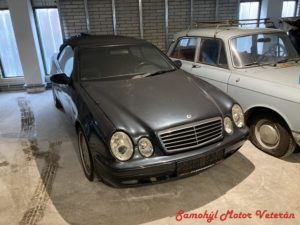
Mercedes-Benz SL 320 R129
Year of Manufacture: 1997
Power: 231 hp
Engine Displacement: 3,199 cm3
Number of Cylinders/Valves: 6/4
Weight: 1,775 kg
Condition: perfect
Catalog Number: 4
Introduction
Mercedes-Benz has been producing roadster-type cars since the mid-1950s. There were several predecessors to the “iron” (Žehlička), but the direct predecessor was the R107 generation.
Development
After the 1954 Gullwing, the world welcomed the Pagoda in the 1960s, followed by the R107 generation. This generation became famous not only for its coupe version but especially for maintaining production for the nearly unimaginable span of eighteen years. Each generation of the two-seat roadster always had a long lifecycle, but one of the most popular and best-selling was the fourth generation (R129), introduced at the Geneva Motor Show in 1989. It was the last Mercedes to carry the “gullwing” designation 300 SL.
The car’s design was created by Bruno Sacco, who aimed to craft a living legend. The then company director Werner Niefer was also deeply involved in development; he developed a fond attachment to the R129 and even called it his favorite. It’s no surprise—he spent an incredible amount of time and kilometers behind the wheel of the test prototypes, refining every detail.
Technical Specifications
The car boasted more than twenty patented components, the most interesting of which concerned the safety of the two-seat crew. For example, the pop-up rollover protection bar behind the seats—now common in open cars—made its debut with this “SL.” It could deploy in 0.3 seconds during a rollover, protecting occupants from head injuries on the asphalt. Compared to its predecessor, the torsional rigidity of the body was significantly increased by approximately 30%. It reached the same values as Mercedes sedans, and the car did not twist without the roof. Diagonal braces further improved driving dynamics.
Other production firsts in the “iron” included self-retracting three-point seat belts mounted in comfortable seats with a solid frame made from five magnesium castings, which partially absorbed unwanted forces on the occupants during side impacts.
The initial variant was the 300 SL with a 3.0-liter inline six-cylinder M103 engine, featuring a unique three-valve technology and outputting 190 hp at 5,700 rpm. Its top speed in 1989 was a respectable 228 km/h.
More powerful versions traditionally featured four-valve technology, exemplified by the 300 SL-24, powered by the M104 engine delivering up to 231 hp at 6,300 rpm and reaching 240 km/h. For more demanding customers, the 500 SL with a 32-valve V8 (M119) was available, producing 326 hp at 5,500 rpm. This version had a speed limiter set at the usual 250 km/h.
However, this was not yet the true peak, although power was certainly abundant. Three years after launch, Mercedes introduced the 600 SL with a 6.0-liter V12 engine producing 394 hp at 5,200 rpm. The following summer brought a facelift with updated badging and the discontinuation of the three-liter engines. The SL 280 version was powered by a 2.8-liter six-cylinder with 193 hp, and the SL 320 by a 3.2-liter unit with 231 hp. AMG also contributed with a 6.0-liter V8, the SL 60 AMG, producing 381 hp.
The facelift unveiled in 1995 at the Frankfurt IAA brought styling changes and better equipment. Features such as xenon headlights from the E-Class W210 (“masárek”) and cruise control were introduced. New five-speed automatic transmissions were installed in SL 500 and 600 models. From that time, even the weaker V8s could be ordered with ESP, while the V12 came with this electronic aid standard. Shortly thereafter (December 1996), SL received a revolutionary Brake Assist System (BAS).
The last facelift dated spring 1998 and included modernization of the six- and eight-cylinder engine lineup along with light design updates (new mirrors, 17-inch wheels, and modified bumpers). The lineup started again with the SL 280 at 204 hp, continued with the SL 320 at 224 hp, and culminated with the V8 in the SL 500 producing 306 hp. The newer 6.0-liter V12s were missing at that time; the strongest variant was the existing SL 60 AMG. One year later, the SL 55 AMG with a V8 producing 354 hp replaced it. The absolute pinnacle of the lineup was the brutal SL 73 AMG, astonishing with 525 hp from a 7.3-liter V12.
In July 2001, the last model of the R129 series rolled off the Bremen assembly line. In total, Mercedes-Benz produced 204,940 units of the fourth-generation SL. The most successful model was the 500 SL/SL 500 with the four-valve M119 V8 engine. Between launch and 1998, 79,827 units of this model were produced.