Showing 1–16 of 20 results

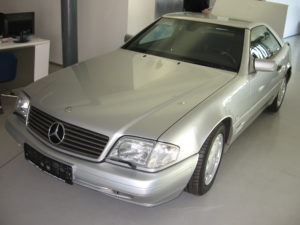
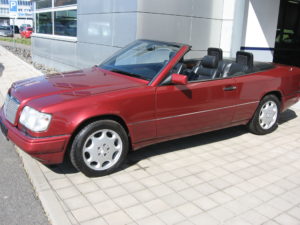
Mercedes Benz SL500 W129

Year of manufacture: 1996
Power: 320 hp
Displacement: 4,973 cm3

Number of cylinders/valves: 8/4
Weight: 1,840 kg

Condition: perfect
Catalog number: 24

The Mercedes-Benz SL R129, the 4th generation of the SL class, also known by the nickname “Iron,” is a magnificent car that brought many innovations to the world of automobiles. Already at its debut in 1989, Mercedes held 20 patents for the SL model. Among the most interesting features is the pop-up roll bar behind the occupants’ heads, which deploys in 0.3 seconds and protects passengers in case of a rollover. The car is also equipped with self-retracting three-point seat belts mounted in the seats with a solid frame made of five magnesium parts, which partly absorb forces acting during a side impact, and four-piston disc brakes. Last but not least, the vehicle includes an electro-hydraulically operated retractable roof, which can be opened or closed in 30 seconds. Another interesting feature is the multi-link rear suspension, which provides excellent handling at high speeds while also offering the desired comfort.

The legendary design was created by Bruno Sacco, and the then company director Werner Niefer, who called the R129 his favorite, also participated as a test driver during development.

The SL R129 went through two major facelifts, in 1995 and 1998. Each time, the appearance was subtly refreshed, some interesting equipment was added, and several engines were replaced or improved. With the last modernization, speed enthusiasts welcomed the AMG versions – initially the V8 SL 60, later complemented by the SL 70 and the powerful V12 SL 73, which also appeared in the Italian masterpiece Pagani Zonda. The last to appear before production ended was the SL 55 AMG, which later lent its technology to the newer SL 55 AMG R230 generation.

Over the entire 12 years of production, 213,089 cars rolled off the production line in Bremen.

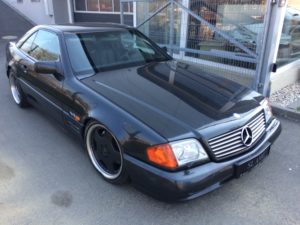
Mercedes Benz SL600 W129

Year of Manufacture: 1992
Power: 394 hp
Engine Displacement: 5,987 cm3

Number of Cylinders/Valves: 12/4
Weight: 1,980 kg

Condition:
Catalog Number: 25

The Mercedes-Benz SL R129, the 4th generation of the SL class, also known by the nickname “Iron”, is a magnificent car that brought many innovations to the automotive world. Already at its introduction in 1989, Mercedes had 20 patents on the SL model. Among the most interesting features is the pop-up rollover bar behind the occupants’ heads, which deploys in 0.3 seconds and protects passengers in case of a rollover. The car is also equipped with self-retracting three-point seat belts mounted in the seats with a solid magnesium frame made of five parts, which partially absorb forces during a side impact, and four-piston disc brakes. Not least, the vehicle features an electro-hydraulically operated retractable roof that can be folded or raised in 30 seconds. Another highlight is the multi-link rear suspension, which provides excellent handling at high speeds while also delivering the desired comfort.

The legendary design was crafted by Bruno Sacco, and the development included test driver Werner Niefer, the then company director, who called the R129 his favorite.

The SL R129 underwent two major facelifts, in 1995 and 1998. Each time, the exterior was subtly refreshed, some interesting features were added, and several engines were replaced or upgraded. With the last update, speed enthusiasts were rewarded with AMG versions – initially the V8 SL 60, later complemented by the SL 70 and the mighty V12 SL 73, which was even used in the Italian masterpiece Pagani Zonda. The last model before production ended was the SL 55 AMG, which later lent its technology to the newer SL 55 AMG R230 generation.

Over the entire 12 years of production, 213,089 units rolled off the factory line in Bremen.

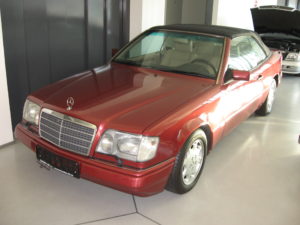
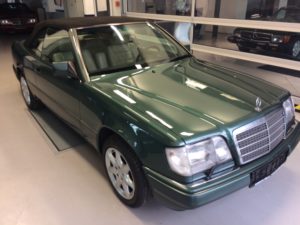
Mercedes Benz E220 W124

Year of Manufacture: 1993
Power: 150 hp
Engine Displacement: 2,199 cm3

Number of Cylinders/Valves: 4/4
Weight: 1,640 kg

Condition:
Catalog Number: 43

The Mercedes-Benz E-Class, internally designated as W 124, ranks among the most successful model series in the history of Mercedes-Benz. It was introduced to the market in 1985, and its production officially ended in 1997. A total of an incredible 2,562,143 units were produced in all variants.

This car belonged to the mid-size segment and was gradually produced in sedan, estate, coupé, and cabriolet versions. It featured the full range of engines—from basic four-cylinder carbureted petrol engines to the top-tier V8 engine in the 500E version. It also included all diesel engines produced by the company at the time. Some vehicles were equipped with four-wheel drive under the 4Matic designation, marking its debut with Mercedes-Benz. Even during development, great attention was paid to innovation, with the goal of setting a new standard in automotive design. It had outstanding aerodynamics and utilized chassis constructions previously reserved for higher-class vehicles. It excelled in safety and was renowned for its incredible reliability, owed to its precise workmanship, materials, and technology. Even today, the timelessness of its overall design is clearly evident.

And the most interesting model from the W 124 range? Without a doubt, the 500E sedan with a 5-liter V8 engine and 32 valves. Hidden in this inconspicuous sedan was a true sports car with excellent capabilities. Interestingly, Porsche collaborated on the development and production of this model, which says it all.

The chassis construction, even in standard versions, was among the best, and it was further improved in the 500E. Double wishbones in the front and elastokinematic five-link suspension in the rear. Even today, it’s hard to find anything better in this class. It provided a perfect foundation for building a high-performance model, which the 500E undoubtedly proved. Sitting in its superbly crafted interior, starting the engine, and driving off was a dream for many people in the early 1990s. On the road, the car felt rock-solid, like carved from granite. The chassis delivered excellent contact with the road while still filtering out bumps smoothly. It’s no wonder this car is considered the pinnacle of German engineering of its time. The overall workmanship is extremely precise.

The 500E could accelerate from 0 to 100 km/h in just 5.5 seconds. The engine not only delivered contemporary performance but was also technically advanced. It was fully aluminum, had variable intake valve timing, and featured a CAN-Bus control unit. Gear shifting was handled by a four-speed automatic transmission. Not all technical innovations were well received, however—until 1994, for example, the traction control system could not be deactivated, which understandably annoyed enthusiastic drivers.

Production of a single 500E took an honest 18 days, and due to strict quality control and the complexity of production, the car cost a hefty 2.5 million CZK when new—yet it still didn’t yield a profit.

And the cabriolet version? It debuted in September 1991. This four-seater cabriolet was the first of its kind in the series after nearly two decades. Designated with the code A124, it was structurally based on the coupé. The major weakness of open-top cars—chassis flex—was addressed using four vibration dampers. The entire body was reinforced and extensively modified.

As the cabriolet lacked both B and C pillars, the A pillars had to be appropriately reinforced. Roll-over safety was provided by a special system with two deployable segments behind the rear seats, which also served as headrests. If the electronics detected an imminent roll-over, the system would activate in just 0.3 seconds. These headrests could also be manually raised by the driver.

The convertible roof consisted of 27 parts and 34 joints, yet when folded, it took up only 80 liters of trunk space. Unless the owner paid extra for the electrohydraulic operation, the roof had to be operated manually. Initially, only the 300 CE-24 Cabriolet version was produced, starting in 1992. Later, other engine variants were added. Even by today’s standards, it remains a very beautiful and distinctive car.

Owners of W 124 series cars fondly remember them, and for many, they represent the last truly honest mechanical car before the rise of modern electronic and electric features in today’s vehicles.

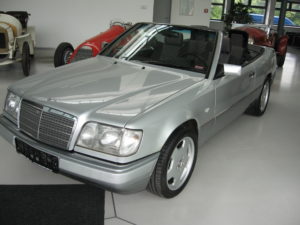
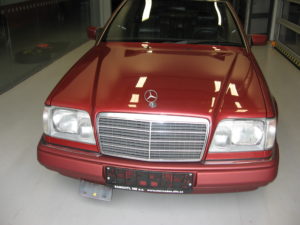
Mercedes Benz E 200 W124

Year of Manufacture: 1995
Power: 136 hp
Engine Displacement: 1,998 cm3

Number of Cylinders/Valves: 4/4
Weight: 1,630 kg

Condition: Excellent
Catalog Number: 37

The Mercedes-Benz E-Class, internally designated as the W 124, is one of the most successful model lines in Mercedes-Benz history. It was introduced to the market in 1985, with official production ending in 1997. An incredible total of 2,562,143 units were produced across all variants.

This vehicle belonged to the mid-size class and was produced as a sedan, estate (wagon), coupé, and cabriolet. It was equipped with a wide range of engines—from basic four-cylinder carbureted gasoline versions to the top-tier 500E with a V8 engine. All diesel engines made by the company at that time were also fitted into this model. Versions with four-wheel drive under the 4-Matic badge were also produced, marking a Mercedes-Benz first. During development, great care was taken to ensure the car was very advanced in many respects and set trends for automotive development. It featured excellent aerodynamics and chassis designs previously used only in higher-class vehicles. It stood out with a high level of safety. Its main strength was incredible reliability due to the quality of craftsmanship and the materials and technology used. When you look at these cars today in any version, the timelessness of their design is obvious.

And the most interesting model of the W 124 series? Definitely the 500E sedan with a 5-liter V8 engine and 32 valves. This unassuming sedan hid a pure sports car with excellent performance. Interestingly, Porsche was involved in its development and production, which speaks volumes.

The chassis design, which was already top-class in standard versions, was further improved here. Front double wishbones and elastokinematic five-link rear suspension are still hard to beat in this class today. It was an excellent base for building a powerful model, as the 500E clearly demonstrated. Sitting inside the impeccably finished interior, starting the engine, and driving off was a dream for many people in the early 1990s. The car’s rigidity is impressive, appearing carved from granite. The chassis offers great road contact yet filters out irregularities excellently. This car is rightly considered the pinnacle of German engineering of the time. The entire vehicle was crafted with extreme care.

It accelerates from zero to 100 km/h in 5.5 seconds. The engine not only offers contemporary performance but is also very advanced technically. It is made entirely of aluminum, has continuous variable intake valve timing, and a CAN-Bus control unit. A four-speed automatic transmission manages the shifting. Not all technical features were embraced by customers; for example, the traction control system was not switchable until 1994, which understandably annoyed driving enthusiasts.

Production of a single car took a solid 18 days, and due to strict quality controls and production complexity, the 500E cost a full 2.5 million CZK when new. Even at that price, it did not turn a profit.

And the cabriolet model? It premiered in September 1991. It was a four-seater convertible—the first in this series in nearly two decades. The car, internally coded A124, was structurally based on the coupé. The biggest weakness of open-top cars—body torsion—was eliminated with four vibration dampers. The entire body was reinforced and significantly modified.

Since the cabriolet lacked both B and C pillars, the front pillars had to be suitably strengthened. Safety in case of rollover was ensured by a special protective system of two deployable segments behind the rear seats, which also served as headrests. If the electronics detected an imminent rollover, these headrests deployed automatically within just 0.3 seconds. They could also be manually activated by the driver.

The folding roof consisted of 27 parts and 34 joints but occupied only 80 liters of trunk space when folded. The roof had to be operated manually unless the owner paid extra for electro-hydraulic control. Initially, only the 300 CE-24 Cabriolet version was produced, starting in 1992. Later, additional engine versions were added. Even today, it remains a very beautiful and unmistakable car.

Owners of all these W 124 series cars remember them fondly, and for many, they represent something like the last truly mechanical cars before the massive arrival of electronic and electric features in today’s automobiles.

Mercedes Benz 300 CE – 24 W124

Year of Manufacture: 1993
Power: 220 hp
Engine Displacement: 2,962 cm3

Number of Cylinders/Valves: 6/4
Weight: 1,710 kg

Condition: Excellent
Catalog Number: 38

The Mercedes-Benz E-Class, internally designated as the W 124, is one of the most successful model lines in Mercedes-Benz history. It was introduced to the market in 1985, with official production ending in 1997. A remarkable total of 2,562,143 units were produced across all variants.

This vehicle belonged to the mid-size class and was available as a sedan, estate (wagon), coupé, and cabriolet. It featured a wide range of engines—from basic four-cylinder carbureted gasoline versions to the top-tier 500E with a V8 engine. All diesel engines produced by the company at the time were also used in this model. Some versions were equipped with four-wheel drive under the 4-Matic badge, marking a Mercedes-Benz first. From its development stage, the car incorporated many advanced features and set benchmarks for future vehicles. It had excellent aerodynamics, and the chassis used design elements previously found only in higher classes. The car stood out for its high level of safety. Its greatest asset was incredible reliability, thanks to quality craftsmanship, premium materials, and advanced technology. When you look at these cars today, their timeless design is unmistakable.

The most interesting model of the W 124 series? Definitely the 500E sedan with a 5-liter V8 engine and 32 valves. This unassuming sedan hid a true sports car with excellent performance. Notably, Porsche participated in its development and production, which speaks volumes about its qualities.

The chassis construction, which was already top-notch in standard versions, was further improved here. Front double wishbones and elastokinematic five-link suspension at the rear are still hard to beat in this class today. The car provided a solid foundation for a powerful model, which the 500E clearly demonstrated. Sitting in its impeccably finished interior, starting the engine, and driving off was a dream for many in the early 1990s. The car’s rigidity is impressive, feeling like it was carved from granite. The chassis offers greater road contact while filtering out irregularities excellently. It is rightly regarded as the pinnacle of German engineering of that era. The entire vehicle was crafted with extreme care.

It accelerates from zero to 100 km/h in 5.5 seconds. The engine not only delivers modern power but is also highly advanced technically. It is made entirely of aluminum, features variable valve timing on the intake valves, and uses a CAN-Bus control unit. Gear shifting is managed by a four-speed automatic transmission. Not all technical features were welcomed by customers; for example, the traction control system was not switchable until 1994, which understandably annoyed driving enthusiasts.

Production of one vehicle took a thorough 18 days, and due to strict quality controls and the complexity of production, the 500E cost 2.5 million CZK when new. Despite this price, it was not profitable.

And what about the cabriolet model? It premiered in September 1991. It was a four-seater convertible—the first in this series in nearly two decades. The car, with the internal code A124, was based structurally on the coupé. The biggest challenge with open-top cars—body torsion—was countered with four vibration dampers. The entire body was reinforced and heavily modified.

Because the cabriolet lacked both the B and C pillars, the front pillars had to be reinforced. Safety during rollovers was ensured by a special system of two deployable roll bars behind the rear seats, which also served as headrests. If the electronics detected an imminent rollover, these bars deployed automatically within just 0.3 seconds. They could also be manually activated by the driver.

The folding roof consisted of 27 parts and 34 joints but occupied only 80 liters of trunk space when folded. The roof had to be operated manually unless the owner opted for the electro-hydraulic system. Initially, only the 300 CE-24 Cabriolet version was produced, starting in 1992. Later, additional engine variants were added. Even today, it remains a very beautiful and unmistakable car.

Owners of all W 124 series vehicles remember them fondly, and for many, they represent the last truly mechanical cars before the widespread arrival of electronic and electric technologies in today’s automobiles.

Mercedes Benz E200 W124

Year of manufacture: 1994 Power: 136 hp Displacement: 1,998 cm3

Number of cylinders/valves: 4/4 Weight: 1,630 kg

Condition: perfect Catalog number: 44

The Mercedes Benz E-Class, internally designated as W 124, is one of the most successful model series in the history of Mercedes Benz production. It was introduced in 1985 and officially ended production in 1997. In total, an incredible 2,562,143 units were produced in all versions.

The car belonged to the mid-size class and was gradually produced in sedan, station wagon, coupe, and cabriolet versions. It featured a wide range of engines, from basic four-cylinder carbureted gasoline engines to the top-of-the-line 500E V8 engine. All diesel engines produced by the company at the time were also installed. Models with four-wheel drive under the 4-Matic designation premiered with Mercedes–Benz. From the development stage, emphasis was placed on making it very advanced in many respects, setting the trend for future cars. It had excellent aerodynamics. The chassis incorporated constructions previously only used in higher-class cars. It excelled in safety. Its main advantages were incredible reliability due to the quality of workmanship, materials, and technology used. When you look at these cars in any version today, the timeless overall design is obvious.

And the most interesting model from the W 124 series? Definitely the 500E sedan with a 5-liter V8 engine and 32 valves. Hidden inside the inconspicuous sedan was a pure sports car with excellent performance. Interestingly, Porsche was involved in its development and production, which speaks volumes.

The chassis design in the regular versions was already top-notch, and here it was further improved. Front double wishbones and elastokinematic five-link rear suspension. It is hard to find anything better in this class even today. It was an excellent base for building a powerful model, which the 500E clearly proved. Sitting in the impeccably finished interior, starting the engine, and driving off was a dream for many in the early 1990s. The car’s rigidity is noticeable during driving, making it feel as if carved from granite. The chassis provides excellent road contact while filtering out bumps superbly. It’s no wonder this car is considered the pinnacle of German engineering of its time. The entire car’s workmanship is extremely meticulous.

This car accelerates from zero to one hundred in 5.5 seconds. Besides offering modern performance, the engine is also technically advanced. It is all-aluminum, has continuous variable valve timing on the intake valves, and features a CAN-Bus control unit. Gear shifting is handled by a four-speed automatic transmission. However, not all technical features were well received by customers. For example, the traction control system could not be disabled until 1994, which understandably annoyed driving enthusiasts. Manufacturing one car took a solid 18 days, and due to strict quality controls and demanding production, the 500E cost a full 2.5 million CZK new. Even at this price, it did not make a profit.

And the cabriolet model? It premiered in September 1991. It was a four-seater convertible, the first in this series after nearly two decades. The car with the code designation A124 was based structurally on the coupe. The biggest weakness of convertibles — body flexing — was eliminated by using four vibration dampers. The entire body was of course reinforced and significantly modified.

Since the convertible lacked both the central and rear pillars, the front ones had to be properly reinforced. A special protective system of two deployable segments behind the rear seats, which also served as headrests, guarded safety in case of rollover. If the electronics detected a rollover, these headrests activated automatically within just 0.3 seconds. They could also be manually activated by the driver.

The folding roof construction consisted of 27 parts and 34 joints, but when folded, it occupied only 80 liters of trunk space. The roof had to be operated manually unless the owner paid extra for electro-hydraulic control. Initially, only the 300 CE-24 Cabriolet version was produced. Its production started in 1992. Later, other engine versions were added. Even today, it remains a very beautiful and unmistakable car.

Owners of all W 124 series cars remember them fondly, and for many, they represent the last truly honest mechanical cars before the massive advent of electronic and electric features in today’s automobiles.

Mercedes Benz 300 CE – 24 W124

Year of Manufacture: 1993 Power: 220 hp Displacement: 2,962 cm3

Number of Cylinders/Valves: 6/4 Weight: 1,710 kg

Condition: perfect Catalogue Number: 46

The Mercedes-Benz E-Class, internal designation W 124, is one of the most successful model series in the history of Mercedes-Benz production. It was introduced to the market in 1985, and its production officially ended in 1997. In total, an incredible 2,562,143 units were produced across all variants.

The car belonged to the mid-size class and was gradually produced in sedan, estate, coupe, and cabriolet versions, featuring a wide range of engines. From simple four-cylinder, carbureted gasoline versions up to the top-range 500E V8 engine. It was also fitted with all diesel engines manufactured by the company at the time. Models with all-wheel drive under the 4-Matic badge, which marked a debut for Mercedes-Benz, were also produced. From development onwards, great care was taken to make it very advanced in many aspects and to set trends for the future of automobiles. It featured excellent aerodynamics. The chassis incorporated designs previously used only in higher-class cars. It excelled in safety. Its main advantage was incredible reliability, due to quality workmanship, materials, and technology. When you look at these cars in any variant today, the timelessness of the overall design is obvious.

And the most interesting model from the W 124 series? Definitely the 500E sedan with a 5-liter V8 engine and 32 valves. Hidden inside the understated sedan was a pure sports car with excellent performance. Fun fact: Porsche factory collaborated on its development and production, which says it all.

The chassis design was already top-notch in the regular versions and was further improved here. Front double wishbones, elastokinematic five-link suspension at the rear—hardly anything better can be found in this class even today. It was thus an excellent basis for building a powerful model, as the 500E clearly demonstrated. Sitting in the perfectly crafted interior, starting the engine, and driving off was the dream of many people in the early ’90s. During driving, the car’s rigidity stands out, as it feels like it was carved from granite. You feel more road contact from the chassis, yet it filters bumps exceptionally well. This car is rightly considered the pinnacle of German engineering of its time. The entire vehicle’s workmanship is extremely meticulous.

This car accelerates from zero to 100 km/h in 5.5 seconds. Besides offering truly contemporary performance, the engine is also very technically advanced. It is all-aluminum, features continuously variable intake valve timing, and has a CAN-Bus control unit. A four-speed automatic transmission handles the shifting. However, not all the car’s technical innovations were embraced by customers. For example, the anti-slip system could not be switched off until 1994, which understandably annoyed enthusiastic drivers.

Production of a single car took a solid 18 days, and due to strict quality controls and demanding production, a new 500E cost a full 2.5 million CZK. Even at that price, it was not profitable but enhanced the brand’s prestige, as the average customer was then a settled sixty-year-old gentleman, while the powerful 500E also attracted much younger buyers.

Owners of all W 124 series cars fondly remember them, and for many, these cars represent the last truly honest mechanical vehicles before the massive rise of electronic and electric gadgets in today’s cars.


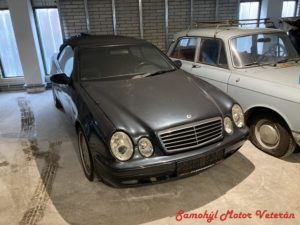
Mercedes-Benz CLK 230 A208

Year of manufacture: 1998
Power: 193 hp
Displacement: 2,295 cm3

Number of cylinders/valves: 4/4
Weight: 1,550 kg

Condition: operational
Catalogue number: 20


This model was the first generation of the Mercedes-Benz CLK, first showcased at the Geneva Motor Show in March 1993. Mercedes-Benz does not officially use the W208 designation since the CLK is not a sedan; however, W208 is commonly used as a collective term for the C208 (coupe) and A208 (convertible) models.

The Mercedes-Benz 208 series was produced as a coupe from mid-1997 until summer 2002, with around 100,000 units made. The convertible was produced from mid-1998 until spring 2003, with 21,000 units built. In September 1999, the model received a facelift with exterior updates.

Technically, the 208 series is based on the platform of the former C-Class (W202). Externally, the CLK derives from the CE 500 design study from the early 1990s, thus bearing a closer resemblance to the W210 series. The Mercedes CLK with a 2.3-liter supercharged engine delivers 142 kW at 5300 rpm. The top speed is 230 km/h. The CLK was equipped with 16-inch alloy wheels and 225/50 R16 tires, which combined with the suspension provided excellent driving dynamics.

Until September 1999, there were two equipment variants to choose from: Standard or Extra. The Standard equipment was further divided into two lines – Sport and Elegance. By the end of 1999, the Sport line was discontinued, and only the Elegance variant and the new Avantgarde line were available. Avantgarde was the successor to the Sport line but aimed to convey a sportier impression. In 2001, the Master Edition trim was introduced, and in the final production year, 2002, the Final Edition was available, which was offered only for the convertible.

Mercedes-Benz S430L V220

Year of manufacture: 1999
Power: 279 hp
Displacement: 4,266 cm3

Number of cylinders/valves: 8/3
Weight: 1,875 kg

Condition: operational
Catalogue number: 22


The Mercedes-Benz W220 was a flagship sedan model series representing the Mercedes-Benz S-Class from the early to mid-2000s. Development of the W220 began in 1992, with the final design approved by Steve Mattin in 1994. Completed prototypes were unveiled in June 1998.

Production of the W220 started on August 13, 1998, with the C215 CL-Class coupe launched in 1999. The W220 model replaced the earlier W140 S-Class after the 1998 model year. Compared to its predecessor, the W220 had somewhat smaller external dimensions but offered more interior space, especially in the long-wheelbase versions.

In 2000, a facelifted version of the S-Class was designed, which was introduced in September 2002. Production ended in 2006 when the W220 was replaced by the W221 S-Class, and the C215 was replaced by the C216 CL-Class in 2006. In many European countries, the most popular model was the S320 CDI diesel version, making it the first S-Class with a diesel engine to achieve widespread appeal.

Other engine options included various gasoline V6, V8, and V12 engines, with power ranging from 197 to 612 hp in the AMG versions. Both long and short wheelbase versions were available, as well as, for the first time in an S-Class, an all-wheel-drive variant. As is typical for S-Class vehicles, the W220 introduced significant technological advances, especially two types of suspension systems: the air suspension Airmatic and the more advanced hydropneumatic Active Body Control.

Our vehicle features an engine with 279 hp, classic front-engine, rear-wheel-drive layout. With a five-speed transmission, it reaches a top speed of 250 km/h. The total production of the S430L model was 75,328 units.

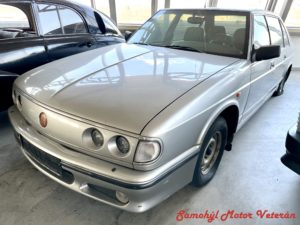
Tatra 700

Year of Manufacture: 1996
Power: 198 hp
Engine Displacement: 3,495 cm3

Number of Cylinders/Valves: 8/2
Weight: 1,840 kg

Condition: drivable
Catalog Number: 272


Introduction

The Tatra 700 was first introduced to the public on April 9, 1996, during a grand presentation at the Hilton Hotel in Prague. However, the vehicle did not bring the expected success to the company. Despite new body shapes and a more luxurious interior, it could not compensate for the already significantly outdated technical solutions at the time, combined with a relatively high price due to its limited production volume. The persistently negative image of Tatra passenger cars, associated with their typical longtime users from the Czechoslovak Communist Party, also played a role.


Development

The Tatra 700 was technically based on its predecessor, the Tatra 613-4 MiLong, inheriting not only the air-cooled engine concept mounted above the rear axle but was essentially the last developmental variant of this vehicle, although with a different designation. Due to the inheritance of original homologations, its official designation is Tatra 613-4 T 700.


Technical Specifications

The body of the Tatra 700 was based on the T 613 body designed between 1968 and 1969 by the Italian design firm Carrozzeria Vignale. It was significantly refreshed by British designer Geoff Wardie, who softened the strictly angular shapes of the previous model and incorporated some design elements from earlier Tatra passenger cars — for example, the chromed oval on the front inspired by the Tatra 603. The design was exclusively based on the long-wheelbase version T 613 Long.

Due to the factory’s complete lack of equipment for producing a new model, modified and reworked sheet metal parts from the original T613 were used for the new series. In 1996, significant design changes were made (mainly a raised rear part of the body and changes to the dashboard) by Jiří Španihel, an academic sculptor from Kopřivnice. A horizontal crease around the front grille emblem was also added. This updated T700 is considered the second series and is technically designated T700 M97.

The cars were equipped with a five-speed manual transmission and a 3,495 cm3 engine producing 147.6 kW (198 hp). Later, the Tatra 700-2 version had engines of 4,360 cm3 producing 172 kW (231 hp). However, not many of these vehicles were produced. The engines mainly differed by improved torque curves and were equipped with sequential fuel injection controlled by a British GEMS electronic unit.


Production

The Tatra 700 is a luxury upper-class car manufactured by Tatra from 1996 to 1999. Since production became unprofitable after the first year and was merely a prestige matter for the company, the model line was discontinued in 1999. A total of 75 cars of the T 700 series were produced, which quickly became collector’s items and objects of interest for Tatra enthusiasts after being retired from state service. Consequently, their market price is very high.


Market and Sales

Most T700s were used within state institutions, including district and regional offices, the Senate, Parliament, and the government. The best-known user was the current President of the Czech Republic, Miloš Zeman, who used the Tatra 700 as his official car from 1996 to 1998 as the Chairman of the Chamber of Deputies and later from 1998 to 2002 as Prime Minister. At the time of its production, any foreign car was already available on the market, and the T700 significantly lagged behind in this competition. Thus, sales to the private sector failed, and usage remained confined to state organs, explaining the low production numbers.


Trivia

This car was also owned by former Czech President Václav Klaus. It was the sixth prototype T700 delivered quickly by the Tatra factory after Klaus had an accident in his Tatra 613-4 Mi Long. The black 1998 model with 162,000 km is currently offered for 5,100,000 CZK.


Car in Our Collection

The car in our collection dates from 1996, is a sedan, and originally belonged to the Ministry of Agriculture.

Placeholder

Mercedes-Benz SL 320 R129

Year of Manufacture: 1997
Power: 231 hp
Engine Displacement: 3,199 cm3

Number of Cylinders/Valves: 6/4
Weight: 1,775 kg

Condition: perfect
Catalog Number: 4


Introduction

Mercedes-Benz has been producing roadster-type cars since the mid-1950s. There were several predecessors to the “iron” (Žehlička), but the direct predecessor was the R107 generation.


Development

After the 1954 Gullwing, the world welcomed the Pagoda in the 1960s, followed by the R107 generation. This generation became famous not only for its coupe version but especially for maintaining production for the nearly unimaginable span of eighteen years. Each generation of the two-seat roadster always had a long lifecycle, but one of the most popular and best-selling was the fourth generation (R129), introduced at the Geneva Motor Show in 1989. It was the last Mercedes to carry the “gullwing” designation 300 SL.

The car’s design was created by Bruno Sacco, who aimed to craft a living legend. The then company director Werner Niefer was also deeply involved in development; he developed a fond attachment to the R129 and even called it his favorite. It’s no surprise—he spent an incredible amount of time and kilometers behind the wheel of the test prototypes, refining every detail.


Technical Specifications

The car boasted more than twenty patented components, the most interesting of which concerned the safety of the two-seat crew. For example, the pop-up rollover protection bar behind the seats—now common in open cars—made its debut with this “SL.” It could deploy in 0.3 seconds during a rollover, protecting occupants from head injuries on the asphalt. Compared to its predecessor, the torsional rigidity of the body was significantly increased by approximately 30%. It reached the same values as Mercedes sedans, and the car did not twist without the roof. Diagonal braces further improved driving dynamics.

Other production firsts in the “iron” included self-retracting three-point seat belts mounted in comfortable seats with a solid frame made from five magnesium castings, which partially absorbed unwanted forces on the occupants during side impacts.

The initial variant was the 300 SL with a 3.0-liter inline six-cylinder M103 engine, featuring a unique three-valve technology and outputting 190 hp at 5,700 rpm. Its top speed in 1989 was a respectable 228 km/h.

More powerful versions traditionally featured four-valve technology, exemplified by the 300 SL-24, powered by the M104 engine delivering up to 231 hp at 6,300 rpm and reaching 240 km/h. For more demanding customers, the 500 SL with a 32-valve V8 (M119) was available, producing 326 hp at 5,500 rpm. This version had a speed limiter set at the usual 250 km/h.

However, this was not yet the true peak, although power was certainly abundant. Three years after launch, Mercedes introduced the 600 SL with a 6.0-liter V12 engine producing 394 hp at 5,200 rpm. The following summer brought a facelift with updated badging and the discontinuation of the three-liter engines. The SL 280 version was powered by a 2.8-liter six-cylinder with 193 hp, and the SL 320 by a 3.2-liter unit with 231 hp. AMG also contributed with a 6.0-liter V8, the SL 60 AMG, producing 381 hp.

The facelift unveiled in 1995 at the Frankfurt IAA brought styling changes and better equipment. Features such as xenon headlights from the E-Class W210 (“masárek”) and cruise control were introduced. New five-speed automatic transmissions were installed in SL 500 and 600 models. From that time, even the weaker V8s could be ordered with ESP, while the V12 came with this electronic aid standard. Shortly thereafter (December 1996), SL received a revolutionary Brake Assist System (BAS).

The last facelift dated spring 1998 and included modernization of the six- and eight-cylinder engine lineup along with light design updates (new mirrors, 17-inch wheels, and modified bumpers). The lineup started again with the SL 280 at 204 hp, continued with the SL 320 at 224 hp, and culminated with the V8 in the SL 500 producing 306 hp. The newer 6.0-liter V12s were missing at that time; the strongest variant was the existing SL 60 AMG. One year later, the SL 55 AMG with a V8 producing 354 hp replaced it. The absolute pinnacle of the lineup was the brutal SL 73 AMG, astonishing with 525 hp from a 7.3-liter V12.

In July 2001, the last model of the R129 series rolled off the Bremen assembly line. In total, Mercedes-Benz produced 204,940 units of the fourth-generation SL. The most successful model was the 500 SL/SL 500 with the four-valve M119 V8 engine. Between launch and 1998, 79,827 units of this model were produced.

Placeholder

Mercedes-Benz UNIMOG U 2450 L

Year of Manufacture: 1992
Power: 214 hp
Engine Displacement: 5,958 cm3

Number of Cylinders/Valves: 6/2
Weight: 6,825 kg

Condition: drivable
Catalog Number: 5


Introduction

The designation Unimog (an abbreviation of the German Universal-Motor-Gerät, meaning universal motor device) refers to a range of German universal light trucks produced by Mercedes-Benz (now part of Daimler AG).


Development

In the completely shattered post-war German economy, Mercedes-Benz aircraft engine designer Albert Friedrich began developing a vehicle that combined the advantages of an off-road vehicle and an agricultural tractor, seeking a suitable manufacturer. The first prototype U1, completed by the end of 1947, was introduced in 1948, but the history of the vehicle, originally intended for farmers, began in 1949. At that time, by mutual agreement, the Böhringer brothers built the first functional U5 model in their small workshop in the town of Göppingen, powered by the OM636 diesel four-cylinder engine from the Mercedes-Benz 170D passenger car.


Technical Specifications

The vehicle’s construction was simple — a robust rectangular frame, solid driven axles, transmissions, transfer cases, and economical Mercedes diesel engines. It offers up to 24 gear ratios for both road and off-road driving. The driver does not need to worry; the basic gearbox can also be automated by simply selecting the driving mode. Using the so-called crawler gear, the Unimog moves very slowly but can tow a train.

The Unimog is produced in several model series. The lighter U200 to U500 series with Euro 6 OM934 engines producing 140 kW (190 hp) are intended for agriculture and road maintenance.

Wheelbases are 2.8 or 3.0 meters. For the heaviest operating conditions, rescue services, or the military, the U4000 and U5000 series with OM934LA 5,132 cm3 engines, 170 kW (231 hp), and 900 Nm/1400 rpm are used. These vehicles have a base wheelbase of 3,850 mm, a climbing ability of 110%, a wading depth of 1.2 m, and their top speed is limited to 89 km/h. Their capabilities are tested at the Öttigheim test polygon near Wörth, which features natural and artificial obstacles such as slopes with various inclinations (60, 80, and 100%), deep fords, transverse and longitudinal unevenness, stairs, and curbs. A special section tests the operation of axle and inter-axle differentials with locks.

Shortly after the Unimog series was renewed between 1985 and 1988, Daimler-Benz launched a new innovative drive in 1992. New light and medium-heavy series 408 (U 90) and 418 (U 110, U 140) replaced their predecessors. Their most noticeable feature was a completely redesigned cab with a front section set at a very steep angle to provide the driver with excellent forward visibility. Optionally, the hood featured an asymmetric cutout on the driver’s side, allowing the best possible view of attachments and mounted tools. The Unimog’s handling and driving characteristics were improved by a new frame and progressively acting coil springs.

The proven ladder frame with tubular crossmembers welded to the longitudinal beams was retained. This frame construction allowed extreme twisting while remaining remarkably stiff overall. Together with the suspension, it offered excellent wheel load distribution in off-road conditions. The progressively acting coil springs ensured consistent and optimally adjusted suspension quality, whether loaded or unloaded. Rear telescopic shock absorbers also operated with a load- and stroke-dependent characteristic, reducing damping on an empty vehicle.

The completely redesigned cab with a raised roof provided significantly more space than before, clearly arranged controls, and an attractive working environment. Special technical features of the new Mercedes-Benz Unimog included a tire pressure control system operable on the move, an anti-lock braking system, new engines from the light U 90 series, and “Servolock,” a unit for hydraulic locking of working equipment.

The new Unimog U 300, U 400, and U 500, available from 2000, are also adapted for municipal work. The vehicles combine an impressive appearance with a practical and attractively designed cab made of fibrous composite materials, and the driver’s workplace called VarioPilot, which can be moved from left to right and back within seconds.

Since 1993, the range has been completed by the Unimog U 2450 L 6×6, a three-axle all-wheel-drive unit. The people who developed the first Unimog more than 40 years ago surely would not have dared dream of such models — and when you compare engine power, it is clear: from the first Unimog to the new top model, power increased nearly tenfold.

Placeholder

Mercedes-Benz 600 SL R129

Year of Manufacture: 1992
Power: 394 hp
Engine Displacement: 5,987 cm3

Number of Cylinders/Valves: 12/4
Weight: 1,980 kg

Condition: excellent
Catalog Number: 7


Introduction

Mercedes-Benz has been producing roadster-type cars since the mid-1950s. There were several predecessors to the “Pagoda,” but the direct predecessor was the R107 generation.


Development

After the 1954 Gullwing, the world welcomed the Pagoda in the 1960s, followed by the R107 generation. This model became famous not only as a coupe version but especially because it managed to stay in production for an astonishing eighteen years. The individual generations of the two-seat roadster always had a long lifecycle, but one of the most popular and best-selling was the fourth generation (R129), introduced at the Geneva Motor Show in 1989. It was the last Mercedes to carry the “gullwing” designation 300 SL.

The car was designed by Bruno Sacco, who aimed to create a living legend. The then company director Werner Niefer was also deeply involved in the development; he developed a warm relationship with the R129, even calling it his favorite. It’s no surprise – he spent an incredible amount of time and mileage behind the wheel of the test prototypes, fine-tuning every detail.


Technical Specifications

The car boasted over twenty patented features, the most interesting of which concerned the safety of the two-seat occupants. For example, the deployable rollover protection bar behind the seats, which today’s convertibles commonly have, made its debut in this “SL.” It could deploy within 0.3 seconds in the event of a rollover to protect the occupants’ heads from scraping the asphalt. Compared to its predecessor, the torsional rigidity of the body was significantly improved, reportedly by 30%. It reached the same levels as Mercedes sedans, so the roofless car did not twist. Diagonal struts further enhanced driving dynamics.

Other firsts in the production “Pagoda” included self-retracting three-point seat belts mounted in comfortable seats with a rigid support frame made of five magnesium castings, which partially absorbed unwanted forces acting on occupants during a side impact.

In summer 1992, Mercedes-Benz introduced a new top model: the 600 SL with a V12 engine producing 290 kW (394 hp). This was the first SL equipped with a twelve-cylinder engine. From the outside, only the model badge and the V12 emblem on the air outlet slits indicated the engine.

At the 1995 Frankfurt Motor Show (IAA), the Stuttgart brand presented a facelifted SL. Exterior changes included a grille with six slats, consistently white front lighting units, bichromatic rear lights, and new side skirt trims. Technical upgrades included a new electronically controlled five-speed automatic transmission for the 500 SL and 600 SL models. Under the motto “light from gas,” Mercedes-Benz introduced new xenon headlights, whose light output was twice that of conventional halogen bulbs.

The facelifted SL also premiered a new panoramic glass roof made of four panels of varying thicknesses, connected to a supporting aluminum structure. This option became available from 1996.

The last facelift came in spring 1998 and featured updates to the six- and eight-cylinder engine portfolio along with light design tweaks (new mirrors, 17-inch wheels, and modified bumpers). The lineup started again with the SL 280 producing 204 hp, continued with the SL 320 at 224 hp, and peaked with the V8 SL 500 at 306 hp. Missing at the time were newer six-liter V12 engines, while the strongest version was the existing SL 60 AMG. One year later, the SL 55 AMG with a V8 and 354 hp replaced it. The absolute top of the portfolio was the brutal SL 73 AMG, boasting 525 hp from a 7.3-liter V12.

In July 2001, the last model of the R129 series rolled off the production line in Bremen. Mercedes-Benz produced a total of 204,940 units of the fourth-generation SL. The most successful model was the 500 SL/SL 500 with the four-valve M119 V8 engine. Between launch and 1998, a total of 79,827 units of this model were produced.

Placeholder

Mercedes-Benz 190 E 1.8 W201

Year of Manufacture: 1991
Power: 109 hp
Engine Displacement: 1,797 cm3

Number of Cylinders/Valves: 4/2
Weight: 1,160 kg

Condition: excellent
Catalog Number: 9


Introduction

At the beginning of the 1980s, Mercedes offered only seven vehicles. Except for one coupe, one roadster, and one commercial model, there were four sedans – all targeted at a more demanding clientele. However, various factors gradually pushed the brand to enter entirely new segments aimed at much broader customer groups.

As a result, even before 1977, the future C-Class began to take shape in the minds of designers. It was introduced five years later, bearing the internal designation W201. However, it was better known to the public under the names 190 and 190E (or the nickname “baby Benz”), as the official C-Class designation only came in 1993.


Development

From January 1974 to January 1982, Mercedes spent more than 2.25 billion German marks on the research and development of the W201, subsequently declaring it “massively over-engineered,” as evidenced by features like ABS, seat belt pretensioners, multi-link rear suspension, and multi-point fuel injection. The company began testing early prototypes in 1978, with the final design approved on March 6, 1979. The W201 was officially unveiled at the Paris Motor Show in October 1982.


Technical Specifications

Besides refined engineering, the Mercedes 190 and 190E boasted incredible reliability. Most examples managed to cover 500,000 km without a single serious mechanical issue. This was true even for models powered by a turbodiesel engine, which in the 1980s was not exactly at the forefront of development.

In autumn 1983, the “whispering” two-liter diesel 190 D with 53 kW (72 hp) was introduced. It was truly quiet for its time and also economical. The company also launched a very different model: the 190 E 2.3-16. The 2.3-liter engine with a four-valve head by Cosworth produced 136 kW (185 hp). By summer 1983, three slightly aerodynamically optimized cars broke world records for long distances: 25,000 and 50,000 kilometers, and 25,000 miles (40,225 km). The 190 E 2.3-16 was also homologated in Group A.

The 190 series underwent two facelifts during its long lifetime: in 1988 and 1991. The portfolio gradually expanded. For example, Americans received versions 190 D 2.2 and 190 E 2.3. In 1985, the five-cylinder diesel 190 D 2.5 with 66 kW (90 hp) and the six-cylinder gasoline 190 E 2.6 with 122 kW (166 hp) debuted.

The sporting peak came with the truly sharp 190 E 2.5-16. The production car debuted in 1988 with 143 kW (195 hp). Development continued up to 173 kW (235 hp) and to the widely expanded and iconic Evolution II version. The homologation special for the German Touring Car Championship (DTM) was built in 1990 in just 502 copies for regular road use (minimum required was 500), and its four-cylinder produced 245 Nm of torque. AMG helped develop the race car, and Klaus Ludwig was the best driver in the 1992 season in this car.

The “190” was replaced in May 1993 by the first generation of the C-Class (W202). With it, Mercedes-Benz introduced a new naming system still used today. The W201 thus spent more than a decade on the production lines in Sindelfingen. Production there ended in February that year, but it continued in Bremen until August, mostly for export. A total of 1,879,629 cars left both plants.

Placeholder

Mercedes-Benz C 180 W202

Year of Manufacture: 1997
Power: 122 hp
Engine Displacement: 1,799 cm3

Number of Cylinders/Valves: 4/4
Weight: 1,410 kg

Condition: excellent
Catalog Number: 13


Introduction

In 1982, the Mercedes-Benz 190/190 E from the 201 series created the third family of passenger cars under the E-Class (upper mid-range) and S-Class (luxury) categories. This marked the beginning of a product initiative and subsequently opened a new dimension of motoring for Mercedes-Benz. Since then, the C-Class has continued its successful story marked by innovations across five more generations – model series 202 (1993 to 2000), 203 (2000 to 2007), 204 (2007 to 2014), 205 (2014 to 2021), and 206 (2021 to present).


Development

The team around chief designer Bruno Sacco styled the 190 and 190 E models as straightforward modern sedans. The clear and elegant lines expressed the uncompromising modern concept of the car. In the 201 series, engineers succeeded in transferring Mercedes-Benz’s high standards of safety, comfort, and handling into a more compact segment.

From May 1993, Mercedes-Benz further developed the strengths of the W201 in the 202 series – the first C-Class to truly bear that name. Although the new sedan was barely larger than the original W201, designers and engineers managed to significantly increase interior space as well as improve both passive and active safety. Among other innovations was the introduction of Mercedes-Benz’s first turbo diesel engine with common-rail direct injection (introduced in 1997 in the C 220 CDI).


Technical Specifications

New to the lineup was the offer of four trims: Classic, fresh Esprit, luxurious Elegance, and finally dynamic Sport. The variants differed not only in exterior styling and interior equipment but also technically. The engine range spanned from a two-liter diesel delivering 55 kW to a 142 kW inline six-cylinder gasoline engine. For those wanting more power, shortly after the series launch, the AMG C36 was available with a mighty 206 kW output.

Better value for money and excellent quality from the start made people forget earlier problems faced when launching the larger W124 series. Thanks to the offered comfort, safety typical for larger models, and a classically timeless yet not boring design, the smallest Mercedes quickly became the best-selling model series – until 1998 when the A-Class was introduced and briefly took the lead.

Placeholder

Mercedes-Benz SLK 200 R170

Year of manufacture:  1997
Power:  136 hp
Displacement:  1,998 cm3

Number of cylinders/valves:  4/4
Weight:  1,620 kg

Condition:  perfect
Catalogue number:  23


Introduction

The Mercedes-Benz SLK class is the first generation of a series of compact luxury roadsters produced from 1996 to 2004. The name SLK can be easily decoded: S for „sportlich“ – sporty, L for „leicht“ – light, and K for „kurz“ – short. Essentially, it was a small and more affordable complement to the luxury SL convertible, based on the shortened W202 Mercedes C-Class platform.


Development

The SLK design, created by Michael Mauer and Murat Günak, was presented to the public on April 22, 1996, at the Turin Motor Show, where the automaker promoted it as a modern reincarnation of the 190SL model. Like its predecessor, the SLK features a four-cylinder engine and the same 2,400 mm wheelbase (the 300SL model, which the SLK also references with the double bulge on the hood, had the same).

Technical specifications

When Mercedes-Benz started serial production of the first SLK R170 model in June 1996, this roadster attracted attention not only for its attractive design, which bore the original signature of chief designer Bruno Sacco, but also for its completely new and revolutionary folding all-metal roof construction – the sporty coupe transforms into a convertible in just 25 seconds. This solution was openly copied by many other manufacturers. The basic principle of the hydroelectric roof mechanism was used not only in the successors SLK R171 and SLK R172 but also in the SL R230 and R231 models.

The foundation of the first generation SLK was a naturally aspirated two-liter engine without a supercharger, producing 100 kW, which however did not sell very well. The core of pre-facelift sales in 2000 was the 2.3-liter supercharged version with 142 kW, known as the SLK230. After the facelift, the 200K and 320 versions were added. For the former, the automaker added a supercharger, boosting power to 120 kW. The 320 version featured a naturally aspirated 3.2-liter V6 engine producing 160 kW. In 2001, the top offer SLK 32 AMG was introduced, which added a supercharger to the six-cylinder engine, increasing power to a very respectable 260 kW.

At the start of production, Mercedes was aware that in certain countries, taxes or insurance fees depended on engine displacement. This could be problematic because fees jumped significantly over two liters of displacement. The main 2.3-liter engine was therefore too large. Hence, for Italy, Portugal, Turkey, and Greece, Mercedes offered a two-liter engine taken from the naturally aspirated 200 version but fitted with a larger supercharger (Eaton M62) than the 2.3-liter version (Eaton M45) to compensate for the smaller displacement.

This version produced 141 kW instead of 142 kW from the larger engine. At the same time, the smaller engine had to have lower fuel consumption and emissions. Technicians therefore designed this version with an electrically controlled supercharger clutch that engaged around 1,500 rpm to prevent the engine from driving the entire supercharger unnecessarily at idle.

A total of 311,222 units of the first generation Mercedes SLK were sold, of which only 4,333 were in the AMG version.