
Showing 17–20 of 20 results

Placeholder

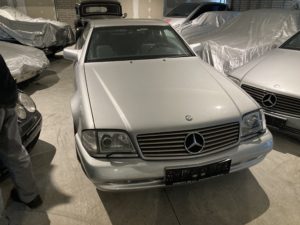
Mercedes-Benz SL 500 R129

Year of Manufacture: 1996
Power: 320 hp
Displacement: 4,973 cm3

Number of Cylinders/Valves: 8/4
Weight: 1,835 kg

Condition: perfect
Catalog Number: 26


Introduction

Mercedes-Benz has been producing roadsters since the mid-1950s, with several predecessors to the “iron,” but the direct predecessor was the R107 generation.


Development

After the 1954 Gullwing, the world welcomed the Pagoda in the 1960s, followed by the aforementioned R107 generation. The latter became famous both for its coupe version and especially for its unprecedented production run of eighteen years.

Engineers at the Stuttgart automaker began work on the new generation SL successor at the beginning of the 1980s. The brief was: “Independent and sporty design, compact dimensions combined with improved interior space and a comfortable interior to achieve maximum comfort and drivability.” The new car premiered again at the Geneva Motor Show, this time in 1989. The new R129 SL attracted extraordinary attention. Mercedes-Benz’s chief designer Bruno Sacco stated that the new SL is a living legend as well as a young and fresh sports car. Sacco aimed for the design of the legendary series successor to clearly symbolize power and innovation.

Technical Specifications

The car boasted more than twenty patented parts, the most interesting relating to the safety of the two-seat crew. For example, the pop-up roll bar behind the seats, which is now common in open cars, debuted with this “SL.” It could deploy in 0.3 seconds in the event of a rollover to protect the occupants’ heads from the asphalt. The 1989 SL was also the first production car to feature seat-integrated automatic seatbelt retractors.

Director Werner Niefer himself was involved in testing and improvements, even acting as the chief test driver. He developed a personal attachment to the R129 and called it his favorite.

The roadster improved ride comfort by adding diagonal braces that optimized vibrations and torsional stiffness typical for open-top cars. The engineers’ expertise paid off: the new roadster’s torsional rigidity was 30% greater than its predecessor, matching Mercedes sedan values and preventing body twist without the roof.

The suspension with front multi-link struts and independent rear suspension matched that of the W201 and W124 models. SLs came standard with 16-inch alloy wheels and large, generously sized brakes typical for a sports car. Racing disc brakes with dual pistons of different diameters were used for the first time in a passenger car. The ABS anti-lock braking system was also standard.

The 1995 facelift at the Frankfurt IAA introduced stylistic changes and better equipment, including xenon headlights from the “E-class” W210 and cruise control. The SL 500 and 600 models gained a new five-speed automatic transmission. ESP became optional for the less powerful V8, while the V12 came standard with it. Shortly after, in December 1996, the SL received a revolutionary Brake Assist System (BAS).

The base model was the 300 SL with a 3.0-liter inline-six M103 engine, unique for its three-valve technology and outputting 190 hp at 5,700 rpm. Its top speed was a solid 228 km/h in 1989.

The more powerful version had a traditional four-valve setup, known as the 300 SL-24, equipped with the M104 unit delivering up to 231 hp at 6,300 rpm and reaching 240 km/h. For demanding clients, the 500 SL with a 32-valve V8 (M119) produced 326 hp at 5,500 rpm, with a speed limiter set at 250 km/h.

However, the pinnacle came three years later with the 600 SL, powered by a 6.0-liter V12 engine producing 394 hp at 5,200 rpm. The following summer, a facelift changed designations and discontinued the 3.0-liter engines. The SL 280 was powered by a 2.8-liter six-cylinder producing 193 hp, the SL 320 had a 3.2-liter unit with 231 hp. AMG contributed a 6.0-liter V8 in the SL 60 AMG, delivering 381 hp.

In July 2001, the last R129 model rolled off the Bremen production line. Mercedes-Benz produced a total of 204,940 units of the fourth-generation SL. The most successful model was the 500 SL/SL 500 with the four-valve M119 V8 engine. Between its launch and 1998, a total of 79,827 units of this model were made.
Placeholder

Mercedes-Benz E 220 A124

Year of Manufacture:  1995
Power:  150 hp
Displacement:  2,199 cm3

Number of Cylinders/Valves:  4/4
Weight:  1,640 kg

Condition:  perfect
Catalog Number:  41


Introduction

In November 1984, Mercedes-Benz introduced the eagerly awaited new mid-size sedan. The new W124 series was launched with models 200 D, 250 D, 300 D, 200, 230 E, 260 E, and 300 E. Additionally, the 200 E model was built for export to Italy.


Development

The successor to the W123 series was often referred to as the “Mercedes mid-size class.” This reflected the era of strategic model initiatives within the Mercedes-Benz product lineup, to which the 190 model (W201) was added again in 1982. As a predecessor to the C-Class, this model was placed below the E-Class in the market segment Mercedes-Benz designated as the compact class.

The W124 adopted elements from this young, sporty, compact car, but set standards for design and construction. Parallels to the compact class were evident, for example, in the use of high-strength steel sheets and other materials that reduced weight.


Technical Specifications

The design of the “four” was created by the trio of stylists — Bruno Sacco, Josef Gallitzendörfer, and Peter Pfeiffer. They achieved a true masterpiece that has not aged even after nearly thirty years. Especially characteristic was the rounded rear corners — the trunk lid was trapezoidal and extended down to the lower edge of the headlights, which still featured the traditional “teeth” design in this generation. Newly introduced was a long single-arm windshield wiper, capable of cleaning 86 percent of the windshield surface! The body shapes were of course designed to achieve the lowest possible drag coefficient and thus reduce fuel consumption.

In September 1989, the redesigned W124 series premiered at the Frankfurt IAA. It changed both externally and internally, but the stylistic adjustments were subtle, as befits the Mercedes-Benz brand. The most noticeable were the large plastic strips on the sides, which had already been added to the coupe two and a half years earlier. In our latitudes, these cars are nicknamed “plasťák” (plastic one) thanks to these strips, while the older version is called “lišťák” (strip one). Above them was a new narrow chrome strip, the same metal appeared inside on door handles and also on the wheel covers, where it bore the company emblem. The exterior mirrors grew larger and were also painted in the body color.

On all 124 series models except the 4Matic all-wheel-drive versions, a Sportline package was newly offered. It included sporty suspension with stiffer springs and dampers, lowering the ride height. It was equipped with 205/60 R 15 tires on 7 J x 15 alloy or steel wheels. The steering wheel and gear lever were covered with leather upholstery, and different seats with sportier shaping and better lateral support were standard. The modernized W124 did not only have stylistic changes but also a novelty under the hood. It was a 3.0-liter four-valve six-cylinder petrol engine. In the models 300 E-24 (sedan), 300 CE-24 (coupe), and 300 TE-24 (wagon), it produced 162 kW (220 hp). It came from the SL roadster of the R129 series, where it had 11 hp more, but a different catalytic converter was used in the W124, which reduced the power.

At Frankfurt in 1989, a fourth body style also appeared — a long-wheelbase limousine, which had been missing from this series for four years. Mercedes closely collaborated on the development with the coachbuilder Binz. The wheelbase was extended by a full 80 cm to 3.60 meters, and the overall length grew accordingly. The “Dachshund” (jezevčík) based on the W124 had six doors for the first time and was produced with a 2.5-liter turbo diesel and a 2.6-liter petrol engine.

June 1993 marked a crucial turning point in the W124 series history. The second visual facelift arrived. The grille underwent a subtle redesign to match the current S-Class — especially the chrome strips were narrowed. The facelifted models can be immediately distinguished by the front and rear indicator lenses — their covering plastic was no longer orange but white, and tinted at the rear. Changes also took place on the trunk lid, which was aerodynamically optimized and received a smaller chrome handle instead of a wide plastic strip. The protective strips on the bumpers were newly painted in the same color as the other plastic panels — the rear ones were extended all the way to the wheel arches.

The design of the standard steel wheels also changed, receiving six holes. A more significant novelty was the change of the designation. It was adjusted to correspond with the new C-Class W202, produced since spring 1993. Thus, the W124 became the E-Class. This designation again complemented the three-digit engine displacement number, but it was now placed after the letters instead of before. Mercedes-Benz still uses this system today. The company also stopped marking individual body styles with letters (C for coupe, T for wagon).

Mercedes Benz SL600 W129

Year of Manufacture: 1995
Power Output: 394 hp
Engine Displacement: 5,987 cm3

Number of Cylinders/Valves: 12/4
Weight: 1,980 kg

Catalogue Number: 11

The Mercedes-Benz SL R129, the 4th generation of the SL-Class—also known by the nickname “The Iron” (Žehlička)—is a magnificent vehicle that introduced numerous innovations to the automotive world. At its debut in 1989, Mercedes had filed no less than 20 patents for the SL model. Among the most interesting features is the pop-up roll bar behind the occupants’ heads, which deploys in just 0.3 seconds to protect passengers in the event of a rollover.

The car is also equipped with self-tensioning three-point seat belts mounted directly into the seats, which are built with a rigid frame made from five magnesium components capable of absorbing some of the forces during a side impact. In addition, it features four-piston disc brakes.

Notably, the car includes an electro-hydraulically operated convertible roof, which can retract or extend in 30 seconds. Another highlight is the multi-link rear suspension, providing excellent handling at high speeds while maintaining the desired level of comfort.

The legendary design was created by Bruno Sacco, and then-company director Werner Niefer, who also participated as a test driver, referred to the R129 as his personal favorite.

The SL R129 underwent two major facelifts, in 1995 and 1998.

In 1994, the car received minor updates that were reflected in the 1995 model range. For example, the odometer changed from mechanical to electronic, and the vehicle featured an option for a portable mobile phone with voice-activated dialing. US-spec models also received newly designed clear indicators for the front turn signals.

Each facelift brought subtle visual updates, additional new equipment, and engine improvements or replacements. With the final update, driving enthusiasts were treated to AMG versions—starting with the V8-powered SL 60, later joined by the SL 70 and the mighty SL 73 with a V12 engine, which also appeared in the Italian supercar Pagani Zonda. The last model before production ended was the SL 55 AMG, which later lent its technology to the next generation SL 55 AMG R230.

Over its 12-year production run, a total of 213,089 units were manufactured at the Bremen plant.

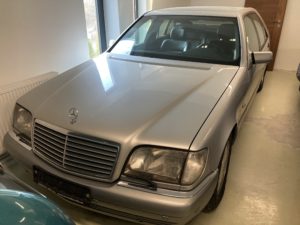
Mercedes Benz SE 600 sedan

Year of Manufacture: 1996
Power Output: 394 hp
Engine Displacement: 5,987 cm3

Number of Cylinders/Valves: 12/4
Weight: 2,180 kg

Catalogue Number: 6

History

This is a series of key vehicles manufactured between 1991 and 1998. This class was introduced at the Geneva Motor Show in March 1991.

Development of the W140 began as early as 1981. Over the following years, the models were tested, and in 1986, the design by Olivier Boulay was ultimately selected. The original concept required two different grille designs to distinguish between lower and upper models—similar to the use of round and rectangular headlights on the W123 model. Due to its uncompromising bulk and performance, the car earned the nickname “Mammoth.”

In 1998, the S140 S-Class series was replaced by the W220 sedans and the C215 CL-Class coupés.

Models

There were three body types carried over from the W126 model: a four-door sedan with two different wheelbase lengths, and a two-door coupé. The designation W140 was assigned to the standard wheelbase, V140 to the long wheelbase, and C140 to the coupé.

In 1996, the S-Class coupé was renamed to the CL-Class, effectively separating it from the S-Class line.

The longer Pullman version featured a 4,140 mm wheelbase and was introduced in 1995 with two engine options – the S500 Pullman and the S600 Pullman.

In 1997, a Landaulet Papamobile was produced for Pope John Paul II.

The engines included inline six-cylinders, V8s, and the top-of-the-line V12 with a displacement of 6 liters. All engines were newly developed, and for the first time, the series featured a diesel engine with four valves per cylinder. At the beginning of production, manual transmissions were still available for the smallest six-cylinder engines—this was the last time manual gearboxes appeared in the “S” class. Eventually, all models were fitted with either four- or five-speed automatic transmissions.

W140 Features

This model introduced several innovations and enhancements that later became standard across other Mercedes-Benz models. For example:

– Sound-insulated double-glazed windows, a new S-Class innovation first used on this model.

– The W140 featured rear parking guide rods. These rods extended from the rear corners of the trunk lid while reversing, providing a visual guide for parking. In 1995, this system was replaced with the Parktronic system, based on sonar, which measured the bumper’s distance from surrounding obstacles.

– Later models included rain-sensing windshield wipers, also known as a rain sensor.

– The vehicle boasted dual-zone climate control.

– In 1995, the S600 Coupé became the first Mercedes-Benz vehicle equipped with a GPS navigation system, called the Auto Pilot System.

– In 1996, the Linguatronic voice control system and the sonar-based Parktronic parking system were introduced.

– Xenon headlights.

– ESP (Electronic Stability Program) chassis system.

– ADS damping system.

And many other features, especially those enhancing passenger comfort and convenience.

A total of 432,732 W140 vehicles were produced, including 406,710 sedans and 26,022 coupés. The model became an icon of luxury vehicles and inspired other manufacturers. At Mercedes-Benz, it was particularly followed by later C-Class and E-Class models. Even today, this model is highly valued—especially the V12 version, which has retained a reputation for technical excellence and a sense of superiority.