Showing 129–144 of 146 results

Placeholder

Mercedes-Benz CL 600 C215

Year of Manufacture: 2000
Power: 367 hp
Engine Displacement: 5,786 cm3

Number of Cylinders/Valves: 12/3
Weight: 1,880 kg

Condition: excellent
Catalog Number: 12


Introduction

“When you come back down to earth after a trip in the CL Coupé, it’s like waking up from a beautiful dream. Make sure to find a firm point of reference – you will need it. Because you have returned from another world of CL Coupés.” This is how the official CL brochure summed up the essence of the large coupe.


Development

The C215 series was introduced in March 1999 at the Geneva Motor Show. Sales in Europe and Japan began in the autumn of the same year.


Technical Specifications

Amazing, elegant, and pioneering – the CL-Class is a masterpiece of the Mercedes-Benz brand. Its distinctive appearance is no accident; nearly 90% of assembly work is done by hand, partly using genuine craftsmanship techniques. A select group of mechanics ensures that every part, every trim element, and every seam is perfectly placed. They are responsible for the flawless design of the CL-Class interior and exterior.

The powerful appearance of the CL was matched by the engines Mercedes-Benz offered for the coupe. The flagship CL 600 featured a newly developed twelve-cylinder engine with smooth operation, generating 270 kW and 530 Nm of torque. Lightweight construction, three-valve technology, dual ignition with alternating voltage ignition system and ion current diagnostics, automatic cylinder deactivation – so-called Active Cylinder Control (reduces fuel consumption under partial load, i.e., when six cylinders can be used efficiently), six catalytic converters, and eight oxygen sensors – these are just a few examples of the sophisticated technical equipment of this ultramodern unit.

Standard equipment of the large coupe included an extensive safety package with front and side airbags in the front seats, window airbags, electronic stability program (ESP), acceleration slip regulation (ASR), anti-lock braking system (ABS), brake assist system (BAS), new bi-xenon headlights with washing/wiping system, and Parktronic system. The top position of this coupe was confirmed by features such as a multifunction steering wheel, adjustable steering column, five-speed automatic with one-touch shifting, cruise control with smooth speed adjustment Speedtronic, automatic climate control with active charcoal filter, electrically adjustable leather seats with memory function, Mercedes-Benz Audio 30 radio, leather trim on the dashboard and doors, and fine wood trim.

At its market introduction, the new large Mercedes-Benz coupe featured a world-first: the new Active Body Control (ABC) suspension system, which provided an unprecedented combination of sporty dynamics and comfort. Based on sensor signals and using special hydraulic cylinders on the axles, “ABC” almost completely compensates for body roll and pitch movements during acceleration, cornering, or braking.

All this sounds like the perfect car – and it is certainly true that the C215 series came close to this ideal. However, there is always room for improvement, as shown by the completely newly developed C216 series launched in June 2006. By 2006, a total of 47,984 C215 coupes had been sold.
Placeholder

Mercedes-Benz C 180 W202

Year of Manufacture: 1997
Power: 122 hp
Engine Displacement: 1,799 cm3

Number of Cylinders/Valves: 4/4
Weight: 1,410 kg

Condition: excellent
Catalog Number: 13


Introduction

In 1982, the Mercedes-Benz 190/190 E from the 201 series created the third family of passenger cars under the E-Class (upper mid-range) and S-Class (luxury) categories. This marked the beginning of a product initiative and subsequently opened a new dimension of motoring for Mercedes-Benz. Since then, the C-Class has continued its successful story marked by innovations across five more generations – model series 202 (1993 to 2000), 203 (2000 to 2007), 204 (2007 to 2014), 205 (2014 to 2021), and 206 (2021 to present).


Development

The team around chief designer Bruno Sacco styled the 190 and 190 E models as straightforward modern sedans. The clear and elegant lines expressed the uncompromising modern concept of the car. In the 201 series, engineers succeeded in transferring Mercedes-Benz’s high standards of safety, comfort, and handling into a more compact segment.

From May 1993, Mercedes-Benz further developed the strengths of the W201 in the 202 series – the first C-Class to truly bear that name. Although the new sedan was barely larger than the original W201, designers and engineers managed to significantly increase interior space as well as improve both passive and active safety. Among other innovations was the introduction of Mercedes-Benz’s first turbo diesel engine with common-rail direct injection (introduced in 1997 in the C 220 CDI).


Technical Specifications

New to the lineup was the offer of four trims: Classic, fresh Esprit, luxurious Elegance, and finally dynamic Sport. The variants differed not only in exterior styling and interior equipment but also technically. The engine range spanned from a two-liter diesel delivering 55 kW to a 142 kW inline six-cylinder gasoline engine. For those wanting more power, shortly after the series launch, the AMG C36 was available with a mighty 206 kW output.

Better value for money and excellent quality from the start made people forget earlier problems faced when launching the larger W124 series. Thanks to the offered comfort, safety typical for larger models, and a classically timeless yet not boring design, the smallest Mercedes quickly became the best-selling model series – until 1998 when the A-Class was introduced and briefly took the lead.

Placeholder

Mercedes-Benz 500 SEC C126

Year of Manufacture: 1985
Power: 231 hp
Engine Displacement: 4,973 cm3

Number of Cylinders/Valves: 8/2
Weight: 1,610 kg

Condition: excellent
Catalog Number: 14


Introduction

After the debut of the W116 S-Class in 1972, Mercedes-Benz began preparing for the next generation in October 1973. The goal of the project codenamed “Project W126” was to provide improved driving experience, better handling, and greater fuel efficiency. The 1973 oil crisis and increasingly strict emissions and safety regulations in the United States had an important impact on the development of the W126 to reduce emissions and increase fuel efficiency.


Development

After six years of development, the W126 model was introduced at the Frankfurt Motor Show in September 1979. At launch, the S-Class was available in two wheelbase lengths (standard and long) and three variants of gasoline engines, including one inline-six and two inline-eight engines. A diesel engine option was introduced in September 1981 exclusively for the North American market.

Two years after the debut of the original W126 sedans, in September 1981 at the Frankfurt IAA, the range was expanded with a luxury coupe with the factory code C126. The design was again the work of Daimler-Benz’s then chief designer Bruno Sacco, who completed it as early as March 1977. In October of the same year, patents were approved for both body versions. Initially, it was available in two versions: 380 SEC and 500 SEC. The abbreviation meaning? S stood for “Sonderklasse” (special class), E for engines with fuel injection (Einspritzmotor), and C for “coupé”.


Technical Specifications

The two-door elegant model was never offered with six-cylinder engines, as they were not prestigious enough. It was thus the first series-produced Mercedes coupe with a V8. However, it inherited safety features from the S-Class sedans: optional driver’s airbag with seatbelt pretensioner on the front right, limited-slip differential, and anti-slip regulation ASR (from September 1986), and later also a passenger airbag from late 1987.

For the coupe’s introduction, the eight-cylinder engines from the W126 sedans were improved with intense efforts to reduce the significant fuel consumption. The V8 hearts saw increased compression, camshafts with modified valve timing – the injection valves were air-cooled. Idle speed was now electronically controlled.

Four years after its premiere, at the 1985 Frankfurt IAA, alongside the four-door W126 classics, a modernized coupe appeared. It received improved aerodynamics: new bumpers, smoothed side strips, and different larger wheels – on the 560 SEC, alloy wheels with 215/65 VR15 tires. These wheels were available as an option for others. The highest-performance versions also had larger wheel arch openings. The brakes were enlarged, and the rear axle setup was modified for greater comfort. The airbag became a standard feature in the driver’s steering wheel head as in the sedans.

A three-way catalytic converter with oxygen sensor was offered on request, and all models were prepared for its later installation including the appropriately modified ignition system. It became a fixed part of the exhaust system only in September 1986, but until August 1989, customers could still choose whether to have it or not.

The SEC models were produced for a full ten years. Their production, already with dual airbags as standard equipment, was stopped between September and October 1991. Considering the luxury concept and production period, the total number of 74,060 units is relatively high. The most popular variant was logically the 500 SEC model, which was produced throughout the entire period. A total of 30,184 units were sold worldwide.

Placeholder

Mercedes-Benz A 140 W168

Year of Manufacture: 2002
Power: 82 hp
Engine Displacement: 1,397 cm3

Number of Cylinders/Valves: 4/2
Weight: 1,090 kg

Condition: excellent
Catalog Number: 16


Introduction

With the introduction of the A-Class in 1997, Mercedes-Benz entered the compact car segment with a vehicle that featured innovative design, a fresh look, and all the qualities that belong to a Mercedes. Nothing smaller has ever been produced under this brand, and it probably never will be again.


Development

The desire for a car with very small exterior dimensions but all Mercedes-Benz values began to take shape in the early 1990s. Mercedes-Benz introduced the so-called sandwich principle, where the body is divided into two horizontal layers: the powertrain is placed in front and below the floor panel, so in the event of a collision it moves downwards and does not intrude into the interior.


Technical Specifications

Two models, the A 140 and A 160 with petrol engines, were the first A-Class variants introduced in October 1997. The A 140 had a 1,397 cm3 engine producing 82 hp (60 kW), while the A 160 with a 1,598 cm3 engine generated 102 hp (75 kW). Top speeds were 170 km/h and 182 km/h, respectively.

The A-Class lineup followed the proven concept of different design and equipment lines. In 1997, three variants were available – Classic, Elegance, and Avantgarde. These three design and equipment lines were presented at the 57th International Motor Show in Frankfurt several weeks before the market launch.

All series shared a comprehensive standard equipment package. Compared to the basic Classic version, the Elegance offered a number of optional extras related to the interior and exterior: alloy wheels, radiator grille and exterior mirror covers painted in the body color, chrome inserts on door handles, and two-tone rear light covers. Avantgarde was the technically progressive model variant, featuring alloy wheels with wide tires, a silver-painted radiator grille and exterior mirror covers painted in the body color, and monochromatic rear light lenses.

More than 20 technical innovations were incorporated in the model range that were previously unavailable in this category of cars. The newly developed and implemented unique sandwich body concept, where the engine and transmission are placed in front and below the passenger space, had many advantages. In the event of a frontal collision, the powertrain unit submerged beneath the passenger compartment in the A-Class. The model achieved safety levels of larger Mercedes sedans despite a vehicle length of only 3.57 meters (about 50 centimeters shorter than comparable competitors) and a weight of just 1,090 kilograms.

In terms of passive safety, the model line reached practically the same level as the Mercedes-Benz E-Class. Besides the sandwich principle, standard installed restraint systems specially adapted to the A-Class concept with short deformation zones contributed to this result. These included full airbags for the driver and front passenger, seat belts with pretensioners and force limiters on front and outer rear seats. Since February 1998, electronic stability program (ESP) and automatic brake assist system (BAS) have been standard equipment in the A-Class, placing the model at the top of its market segment.

The choice of powertrain systems for the A-Class was expanded in 1998 with two diesel models. The A 160 CDI and A 170 CDI, with fuel consumption of 4.5 and 4.9 liters per 100 kilometers (according to NEDC methodology), respectively, were among the most environmentally friendly cars worldwide. The diesel A-Class models featured new common rail direct injection (CDI), which significantly reduced fuel consumption combined with dynamic handling and smooth operation compared to older diesel engines. The Öko-Trend Institute in Wuppertal, Germany, awarded the A 160 CDI the title “Most ecological German car.”

The year 2001 was characterized not only by the introduction of the long-wheelbase version but also by improvements to the A-Class. This upgrade enhanced the true bestseller: since production began in 1997, Mercedes-Benz had sold over 550,000 units of the model series, and the A-Class was among the best-selling cars in its category in Germany and other European countries.

From spring 2001, the model was available at dealers with new body elements, new interior materials, more powerful CDI engines, and ESP with hydraulic brake assist. The facelift was especially noticeable in the revised front and rear design. Fresh design elements emphasized the model’s dynamics. The new design included updated bumpers front and rear and a radiator grille with four slats instead of three. Thanks to these changes, the body appeared wider and more athletic, and the A-Class also received clear glass headlights.

The interior featured a redesigned cockpit equipped in part with new materials, some borrowed from the Mercedes-Benz S-Class. Engineers and designers modified or redesigned about 980 components of the innovative vehicle. The fourth generation of ESP® collaborated for the first time with an even more powerful hydraulic brake assist. The A-Class thus provided the latest and most effective dynamic driving system as standard at that time.

More than 1.1 million first-generation A-Class cars were produced in total.

Placeholder

Mercedes-Benz 300 CE C124

Year of manufacture: 1988
Power: 180 hp
Displacement: 2,962 cm3

Number of cylinders/valves: 6/2
Weight: 1,340 kg

Condition: perfect
Catalogue number: 18


Introduction

Considered by many to be the last classic Mercedes-Benz, the W124 model directly follows the now legendary “piano” W123 and remained in production for a remarkable thirteen years.


Development

Several body variants were created. Besides the sedan and the traditional estate called the T-Model, the early 1990s saw the arrival of an elegant coupe, from which a four-seat convertible was derived. The production program started with petrol variants 200, 230 E, 260 E, and 300 E, while diesel versions included 200 D, 250 D, and 300 D. The early 1990s brought the pinnacle of the line, the 500 E (later E 500) with 356 hp, with the most powerful version being the later E 60 AMG, offering 380 hp. Both variants are highly prized youngtimers today.


Technical specifications

The design of the W124 was led by Bruno Sacco, Joseph Gallitzendörfer, and Peter Pfeiffer. For example, the characteristic rear section, tapering towards the back and strongly rounded along the upper edges of the sides, had a particularly favorable effect on wind resistance and resulted from aerodynamic tunnel testing. These aerodynamic improvements significantly reduced fuel consumption compared to the previous model. Two other typical design features are the trapezoidal trunk lid with its rear edge pulled to the right and the slanted inner edges of the nearly square rear lights. This allowed for a particularly low loading sill for the large trunk space.

Most engines were completely new. For example, the six-cylinder M 103: the weaker 260 E delivered 125 kW (170 hp) from 2.6 liters, while the stronger 3.0-liter 300 E offered 140 kW (190 hp). The same applied to the diesel units, although the weakest non-turbocharged 2.0-liter OM 602 with 53 kW (72 hp) had already appeared in the small 190 D of the W201 series. The new 2.5-liter five-cylinder 250 D, without a turbocharger, designated OM 602, offered 66 kW (90 hp). The 3.0-liter OM 603, again without turbo and badged 300 D on the car’s rear, offered 80 kW (109 hp). The carbureted petrol 4-cylinder 200 with 80 kW (109 hp) and the 2.3-liter injected version with 100 kW originated from the “piano,” as did the 200 E versions of the M 102 series.

In September 1989, the revised W124 range premiered at the Frankfurt IAA. Both exterior and interior were updated, though stylistic changes were subtle, as befits Mercedes-Benz. The most noticeable were the large plastic strips on the sides, which the coupe had received two and a half years earlier. In Central Europe, these cars are nicknamed “plasťák” (plastic one) because of them, while the older version is called “lišťák” (strip one). Above these strips was a new narrow chrome band, appearing also inside on door handles and on wheel covers bearing the company emblem. The exterior mirrors were enlarged and painted in body color. New front and rear seats were installed inside. All W124 models except the 4Matic four-wheel drives offered a Sportline package with sport suspension featuring stiffer springs and dampers, lowering the ride height. The car wore 205/60 R 15 tires on 7 J x 15 alloy or steel wheels. The steering wheel and gear lever received leather upholstery, and sportier-shaped seats with better lateral support became standard.

The 1989 Frankfurt show also introduced the fourth body variant – a long-wheelbase limousine, missing for four years in this series. Mercedes cooperated closely with the coachbuilder Binz for its development. The wheelbase increased by a full 80 cm to 3.60 meters, with overall length growing accordingly. The “Dachshund” based on the W124 had six doors for the first time and was available with a 2.5-liter turbo diesel and a 2.6-liter petrol engine. While the four-door predecessors had only emergency middle seats, the limousine based on the later E-Class featured a full-size middle seat with a cushion and backrest comparable to the rear third-row seat. Serial production of this variant began in May 1990.

June 1993 marked a crucial milestone for the W124 series. The second facelift featured a slightly revised grille to resemble the current S-Class – especially the chrome strips were narrowed. Facelifted models can be distinguished by their front and rear turn signals, which now had clear (white) lenses instead of orange, and smoked rear lenses.

Standard steel wheels were redesigned with six openings. A more important novelty was the change in nomenclature, aligning with the new W202 C-Class launched in spring 1993. The W124 became the E-Class. This designation always included a three-digit number approximating engine displacement but was moved after the letter, not before. Mercedes-Benz still uses this system today. The letter E originally stood for fuel injection and was chosen because carbureted engines no longer appeared under the W124’s hood. The automaker also abandoned body variant letters (C for coupe, T for estate) externally, though internal coding remained. For naturally aspirated and turbocharged diesels, the letter D replaced the word Diesel, so 300 D became E 300 Diesel. The manufacturer accommodated customer wishes, so badges could be omitted entirely if desired.

In total, 2,213,167 sedans, 340,503 estates, 141,498 coupes, 33,952 convertibles, 2,342 long-wheelbase sedans, 6,398 partially coachbuilt bodies, and 73 large chassis for special purposes were produced.

Mercedes-Benz 260 D W138

Year of manufacture:  1940
Power:  45 hp
Displacement:  2,545 cm3

Number of cylinders/valves:  4/2
Weight:  1,550 kg

Condition:  drivable
Catalogue number:  19


Introduction

The diesel engine, which had already proven its advantages in commercial vehicles, seemed a natural step towards developing a passenger car with this engine. The development strategy for diesel engines intended for light commercial vehicles and passenger cars was set by technical director Hans Nibel. However, he did not live to see the series production of the 260 D model in November 1935, passing away almost exactly one year earlier. Under his leadership, the development of small-capacity diesels by the tandem Albert Heess and Eckart Schmidt was carried out at Untertürkheim. The 260 D was introduced on February 21, 1936, at the 26th International Automobile and Motorcycle Exhibition (IAMA) in Berlin.


Development

In the autumn of 1933, the first experimental engines were installed in test vehicles – 3.8-liter six-cylinder units producing 80 hp. However, engine vibrations were so strong that they made the chassis unusable for passenger cars.

Subsequently, a four-cylinder diesel engine with identical cylinder dimensions but lower power density was developed. This 2.6-liter engine with 45 hp was installed in the long-wheelbase 200 version. After a prolonged testing program, production maturity was reached in mid-1935. In February 1936, at the Berlin Motor Show, Daimler-Benz presented the 260 D model as a six-seater Pullman landaulet, with 13 units produced since July 1935. The Hanomag Rekord, another passenger car with a diesel engine, was also shown in Berlin, but as it entered serial production only in 1938, the 260 D was the world’s first mass-produced passenger car with a diesel engine.


Technical specifications

A year after its debut in Berlin, the 260 D model, like the 230 which replaced the long-wheelbase 200, was presented in an improved version. The facelifted variant was recognizable by modifications to the radiator’s appearance. The headlights were reduced in size and mounted on the fenders instead of on a chrome strip in front of the radiator. Large Pullman limousines received more spacious bodies, adding greater prestige to their owners.

More importantly, the track width was increased. The front widened from 1,340 to 1,370 mm, and the rear from 1,380 to 1,390 mm. This allowed for wider wheels and tires (5.50 x 17 instead of the original 5.25 x 17). All four wheels were equipped with hydraulic drum brakes. The fuel tank for precious diesel grew from 45 to exactly 50 liters and was relocated from the engine compartment to the rear of the vehicle. This increased the driving range to at least 500 km. Customers welcomed this modification, as fuel stations were still very sparse in the late 1930s.

In February 1938, the previous gearbox with an overdrive was replaced by a fully synchronized four-speed gearbox with direct drive on the fourth gear. Another important innovation introduced in early 1938 was an electrically heated glow plug, which facilitated cold starts. Lastly, the 1938 model year also brought robust-looking bumpers, replacing the elegant design from 1936/37.

By December 1940, 1,967 units of the 260 D W 138 were produced. The advantages of the diesel engine – durability and economy – were thus finally utilized in a passenger car, and the 260 D laid the foundation for the lasting success of passenger cars with diesel engines. The fact that the first examples were almost exclusively used as taxis was due not only to the engine’s exceptional economy but also to the spacious six-seater body, which was launched in early 1934 as the long-wheelbase version.

Placeholder

Mercedes-Benz SLK 200 R170

Year of manufacture:  1997
Power:  136 hp
Displacement:  1,998 cm3

Number of cylinders/valves:  4/4
Weight:  1,620 kg

Condition:  perfect
Catalogue number:  23


Introduction

The Mercedes-Benz SLK class is the first generation of a series of compact luxury roadsters produced from 1996 to 2004. The name SLK can be easily decoded: S for „sportlich“ – sporty, L for „leicht“ – light, and K for „kurz“ – short. Essentially, it was a small and more affordable complement to the luxury SL convertible, based on the shortened W202 Mercedes C-Class platform.


Development

The SLK design, created by Michael Mauer and Murat Günak, was presented to the public on April 22, 1996, at the Turin Motor Show, where the automaker promoted it as a modern reincarnation of the 190SL model. Like its predecessor, the SLK features a four-cylinder engine and the same 2,400 mm wheelbase (the 300SL model, which the SLK also references with the double bulge on the hood, had the same).

Technical specifications

When Mercedes-Benz started serial production of the first SLK R170 model in June 1996, this roadster attracted attention not only for its attractive design, which bore the original signature of chief designer Bruno Sacco, but also for its completely new and revolutionary folding all-metal roof construction – the sporty coupe transforms into a convertible in just 25 seconds. This solution was openly copied by many other manufacturers. The basic principle of the hydroelectric roof mechanism was used not only in the successors SLK R171 and SLK R172 but also in the SL R230 and R231 models.

The foundation of the first generation SLK was a naturally aspirated two-liter engine without a supercharger, producing 100 kW, which however did not sell very well. The core of pre-facelift sales in 2000 was the 2.3-liter supercharged version with 142 kW, known as the SLK230. After the facelift, the 200K and 320 versions were added. For the former, the automaker added a supercharger, boosting power to 120 kW. The 320 version featured a naturally aspirated 3.2-liter V6 engine producing 160 kW. In 2001, the top offer SLK 32 AMG was introduced, which added a supercharger to the six-cylinder engine, increasing power to a very respectable 260 kW.

At the start of production, Mercedes was aware that in certain countries, taxes or insurance fees depended on engine displacement. This could be problematic because fees jumped significantly over two liters of displacement. The main 2.3-liter engine was therefore too large. Hence, for Italy, Portugal, Turkey, and Greece, Mercedes offered a two-liter engine taken from the naturally aspirated 200 version but fitted with a larger supercharger (Eaton M62) than the 2.3-liter version (Eaton M45) to compensate for the smaller displacement.

This version produced 141 kW instead of 142 kW from the larger engine. At the same time, the smaller engine had to have lower fuel consumption and emissions. Technicians therefore designed this version with an electrically controlled supercharger clutch that engaged around 1,500 rpm to prevent the engine from driving the entire supercharger unnecessarily at idle.

A total of 311,222 units of the first generation Mercedes SLK were sold, of which only 4,333 were in the AMG version.

Placeholder

Mercedes-Benz SL 500 R129

Year of Manufacture: 1996
Power: 320 hp
Displacement: 4,973 cm3

Number of Cylinders/Valves: 8/4
Weight: 1,835 kg

Condition: perfect
Catalog Number: 26


Introduction

Mercedes-Benz has been producing roadsters since the mid-1950s, with several predecessors to the “iron,” but the direct predecessor was the R107 generation.


Development

After the 1954 Gullwing, the world welcomed the Pagoda in the 1960s, followed by the aforementioned R107 generation. The latter became famous both for its coupe version and especially for its unprecedented production run of eighteen years.

Engineers at the Stuttgart automaker began work on the new generation SL successor at the beginning of the 1980s. The brief was: “Independent and sporty design, compact dimensions combined with improved interior space and a comfortable interior to achieve maximum comfort and drivability.” The new car premiered again at the Geneva Motor Show, this time in 1989. The new R129 SL attracted extraordinary attention. Mercedes-Benz’s chief designer Bruno Sacco stated that the new SL is a living legend as well as a young and fresh sports car. Sacco aimed for the design of the legendary series successor to clearly symbolize power and innovation.

Technical Specifications

The car boasted more than twenty patented parts, the most interesting relating to the safety of the two-seat crew. For example, the pop-up roll bar behind the seats, which is now common in open cars, debuted with this “SL.” It could deploy in 0.3 seconds in the event of a rollover to protect the occupants’ heads from the asphalt. The 1989 SL was also the first production car to feature seat-integrated automatic seatbelt retractors.

Director Werner Niefer himself was involved in testing and improvements, even acting as the chief test driver. He developed a personal attachment to the R129 and called it his favorite.

The roadster improved ride comfort by adding diagonal braces that optimized vibrations and torsional stiffness typical for open-top cars. The engineers’ expertise paid off: the new roadster’s torsional rigidity was 30% greater than its predecessor, matching Mercedes sedan values and preventing body twist without the roof.

The suspension with front multi-link struts and independent rear suspension matched that of the W201 and W124 models. SLs came standard with 16-inch alloy wheels and large, generously sized brakes typical for a sports car. Racing disc brakes with dual pistons of different diameters were used for the first time in a passenger car. The ABS anti-lock braking system was also standard.

The 1995 facelift at the Frankfurt IAA introduced stylistic changes and better equipment, including xenon headlights from the “E-class” W210 and cruise control. The SL 500 and 600 models gained a new five-speed automatic transmission. ESP became optional for the less powerful V8, while the V12 came standard with it. Shortly after, in December 1996, the SL received a revolutionary Brake Assist System (BAS).

The base model was the 300 SL with a 3.0-liter inline-six M103 engine, unique for its three-valve technology and outputting 190 hp at 5,700 rpm. Its top speed was a solid 228 km/h in 1989.

The more powerful version had a traditional four-valve setup, known as the 300 SL-24, equipped with the M104 unit delivering up to 231 hp at 6,300 rpm and reaching 240 km/h. For demanding clients, the 500 SL with a 32-valve V8 (M119) produced 326 hp at 5,500 rpm, with a speed limiter set at 250 km/h.

However, the pinnacle came three years later with the 600 SL, powered by a 6.0-liter V12 engine producing 394 hp at 5,200 rpm. The following summer, a facelift changed designations and discontinued the 3.0-liter engines. The SL 280 was powered by a 2.8-liter six-cylinder producing 193 hp, the SL 320 had a 3.2-liter unit with 231 hp. AMG contributed a 6.0-liter V8 in the SL 60 AMG, delivering 381 hp.

In July 2001, the last R129 model rolled off the Bremen production line. Mercedes-Benz produced a total of 204,940 units of the fourth-generation SL. The most successful model was the 500 SL/SL 500 with the four-valve M119 V8 engine. Between its launch and 1998, a total of 79,827 units of this model were made.

Placeholder

Mercedes-Benz 300 SL R107

Year of manufacture:  1986
Power:  188 hp
Displacement:  2,962 cm3

Number of cylinders/valves:  6/2
Weight:  1,620 kg

Condition:  perfect
Catalog number:  30


Introduction

The Mercedes-Benz 107 series (R107) was produced from 1971 to 1989. It was the second longest-produced series by the German automaker Mercedes-Benz after the off-road vehicle Mercedes-Benz G-Class. For the first time, the serial car bearing the SL designation was equipped with a V8 engine, specifically a 3.5 L V8, which delivered a full 200 horsepower with fuel injection.


Development

The R107 and C107 adopted chassis components from the mid-sized Mercedes-Benz W114 model from 1968 and originally paired them with V8 M116 and M117 engines used in the W108, W109, and W111 series. The body styles of the R107 and C107 changed very little from their introduction in 1971 until the end of production in 1981 (coupe) and 1989 (soft-top).


Technical Specifications

The decision to produce the R107 series (the SL line received the internal designation “R” for Roadster instead of “W” for Wagen = car for the first time) was made by the board after intensive discussions on June 18, 1968. A major point of debate was whether to offer a Targa roof version (a removable roof panel) instead of the soft-top version. Due to stricter safety standards, alarming reports about licensing cars with open roofs from the USA were considered.

The final decision in favor of the roadster with a soft-top and an additional removable hardtop is credited to Hans Scherenberg, head of development, who fought for it fiercely.

Karl Wilfert, then head of design in Sindelfingen, developed a coupe based on the R107 and one day presented it to the board as a “rough draft.” Wilfert, initially rejected, eventually managed to push through his idea of a sporty coupe with the toughness that was so characteristic of him.

Just six months after the premiere, the SL lineup was expanded in October 1971 by the comfortable four-seat 350 SLC sports coupe, whose unconventional lines found many fans worldwide over the years. Internally, the series was designated C107 (“C” means “coupe”). Up to the windshield, its appearance matched the open-roof variant; behind the windshield, the overall height and length increased. The flat roof spanned the four-seat passenger compartment in a gentle curve and transitioned into a large and very steep rear window, which curved in two directions. Unlike the SL, the trunk lid had a slightly convex shape.

Besides elegance and quality, the vehicles boasted timeless safety features; for example, the crash response of the open two-seater was far ahead of its time. Technically, this was reflected in carefully defined body deformation behavior and vehicle frame construction, a high-strength A-pillar, and an interior uncompromisingly designed according to strict safety criteria.

In 1973, the fuel crisis hit Europe, and Stuttgart had to respond. From summer 1974, a more economical R107 roadster called the 280 SL was offered (there were three SL engine options – common nowadays but extraordinary back then), which had an inline six-cylinder OHC engine producing 185 hp (136 kW). It could exceed 200 km/h while consuming 3 to 5 liters less fuel per 100 km than the V8.

After fourteen years, the R107 roadsters received their last facelift in autumn 1985, including interior updates. The lineup was led by the six-cylinder 300 SL with a 3.0-liter engine producing 188 hp; the role of the 380 SL was taken over by the new 420 SL with a V8 engine delivering 218 hp. The crown jewel remained the 500 SL roadster, whose 5.0-liter engine with new injection produced 245 hp. Thanks to this, the car could reach speeds up to 225 km/h and accelerate from 0 to 100 km/h in 7.5 seconds. All updated models were also offered with a catalytic converter and slightly reduced power.

A special model produced only for export to the USA (and in small numbers to Japan and Australia) was the 560 SL from 1985–89, powered by an environmentally friendly V8 engine derived from the 5.0-liter V8. The long-stroke engine delivered 231 hp from 5.6 L displacement; the roadster, with specifically chosen gear ratios, topped over 220 km/h and accelerated from 0 to 100 km/h in under 8 seconds.

An important distinction between “European” and “American” cars is that models for the American market had larger bumpers, making the roadster 250 mm longer, and their front ends were adorned with two pairs of round headlights.

Throughout its long production “life” and great success, the SL was equipped with various six- and eight-cylinder engines. Its model designations were thus equally diverse. Over time, all engines underwent modifications (and slightly adjusted power outputs) to better comply with tightening emission standards in most European countries.

Production of the R107 series ended in August 1989, more than 18 years after the launch of the 350 SL. This SL series set an internal record that will likely never be broken. In the company’s entire history, no other passenger car series has been produced for such a long time, except for the G-Class. A total of 237,287 vehicles were produced in Sindelfingen, a figure that impressively demonstrates the great popularity of the 107 series. A total of 62,888 coupes were made between 1971 and 1981.

Mercedes-Benz 220 SE W111

Year of manufacture:  1964
Power:  120 hp
Displacement:  2,195 cm3

Number of cylinders/valves:  6/2
Weight:  1,410 kg

Condition:  drivable
Catalogue number: 31


Introduction

In August 1959, the company introduced a thoroughly redesigned line of passenger cars. Under the slogan: “New six-cylinders – a class of their own” and as successors to the existing six-cylinder models, three completely redesigned models were launched – 220 b, 220 Sb, and 220 SEb of the W111 series, the so-called large tailfins.


Development

Mercedes-Benz has been using one of the automotive safety features – crumple zones – for more than half a century. They first appeared in the six-cylinder W111 series in August 1959. However, their history is a decade older and is the work of one of the most famous engineers in the field – the Hungarian-born Béla Barényi.

He worked for Daimler-Benz AG between 1939-1946 and signed a new contract with the company two years later, in August 1948. He was the first to realize that kinetic energy during a crash must be absorbed so passengers inside the car would not be endangered. Therefore, he logically divided the car body into three parts, with a rigid safety cell in the center for passengers. The front and rear were soft crumple zones.


Technical specifications

The large tailfins were designed according to the fashion of the time, clearly inspired from overseas, although their rear part could not compare with the huge fins of American highway cruisers. The design was also inherited by the smaller W110 series launched in 1961. The cars offered sufficient comfort as well as sporty driving characteristics – according to the standards of the time. Modern passive safety features were implemented during the development of the Mercedes-Benz W111 and W112 series.

The steering wheel was padded to reduce the risk of head injury in a crash – customers of the three-pointed star had to wait more than two decades longer for airbags. The doors were for the first time equipped with locks on the inside (so-called pins). These were useful not only in theft attempts but also in case of an accident. The pioneer of three-point seat belts for front seats was Swedish Volvo. Stuttgart was not far behind and offered them to its clients as well. The 300 SE model, which entered production two years after the basic types 220 b, 220 Sb, and 220 SEb, featured disc brakes, air suspension, and was also available with a long wheelbase (SEL). New additions included a four-speed automatic transmission and power steering.

Why did the letter b appear in the names? Internal codes were not used in commercial designations, and the new large tailfins had to be distinguished from the previous large Pontons with the same names. However, the W111/112 series was spacious and elegant – not a “b” (béčko). For example, the dashboard partially recessed some controls – safety was given the highest priority during development.

The basic 220b version with two carburetors differed externally from its more luxurious siblings – it lacked most of the chrome. The 220 Sb and 220 SEb models featured chrome strips on both sides of the grille. This metal also adorned the air intake grilles in the front of the windshield, wheel centers, strip above the rear window, and decorative strips on the trunk lid. The fins were also chromed, not only at the rear but also on the upper edge. The 220b had simpler bumpers, while the Sb and SEb had two-piece bumpers. They also had larger rear lights with integrated license plate lighting.

The engines were inherited from the predecessor but with minor modifications. The six-cylinder 2.2-liter engines received new valve control linkages and sharper camshafts. The basic 220 b had two carburetors and 70 kW (95 hp), while the 220 Sb had 81 kW (110 hp). The SE in 220 SEb stood for “Einspritzmotor” – meaning “injection engine” – and produced up to 88 kW (120 hp).

The chassis also saw changes. The self-supporting body with front auxiliary frame remained, but the simple cross member was attached to the floor only at two points. The rear single-joint swing axle additionally received a compensating spring placed horizontally above the pivot. This ensured even load distribution on the driven rear axle. Shock absorbers were mounted externally both front and rear, making shock and vibration absorption more effective. The braking system underwent two modifications during production. The more luxurious Sb and SEb got front disc brakes in April 1962. The basic 220 b received the same upgrade in August 1963, along with an effective power booster, which had been optional before. At that time, the entire series received a dual-circuit deceleration system, allowing safe stopping even if one circuit failed.

At the Geneva Motor Show in March 1963, Daimler-Benz unveiled another novelty – the long version of the 300 SE with the suffix L (lang – long). It had a 100 mm longer wheelbase, significantly increasing rear passenger legroom. The doors were also wider. As an option, the front compartment could be separated by a partition with electrically operated glass. The exterior was distinguished by the C-pillar – ventilation was redesigned and no decorative trims or openings were present. The extended version also introduced a four-speed manual transmission.

The turn of July and August 1965 marked the farewell of the large tailfins with 2.2 and 3.0 L engines. The successor models 250 S, 250 SE, and 300 SE featured a new, more modern body and belonged to the W108 series. However, this did not mean the definitive end. The basic 220 b (W111) successor was the 230 S. Despite the unusual designation, it was a familiar face, differing only by the badge on the rear. However, the powertrain was modified: the bore was increased, bringing displacement close to 2.3 liters. Compression also rose, with the engine delivering 88 kW (120 hp). The rear axle featured a hydropneumatic spring replacing the traditional coil spring and maintaining constant ground clearance. By January 1968, 41,107 units of the 230 S were produced. Of these, 341 were chassis for special bodies. One deserves a brief mention: a wagon built by Belgian coachbuilder IMA. It was sold directly through Daimler-Benz dealers under the supplementary designation Universal from August 1966. A similar model was offered in the smaller W110 series as well.

From 1959 to 1968, a total of 344,751 sedans and separate chassis of the W111 and W112 series were produced in Sindelfingen.

Placeholder

Mercedes-Benz E 220 A124

Year of Manufacture:  1995
Power:  150 hp
Displacement:  2,199 cm3

Number of Cylinders/Valves:  4/4
Weight:  1,640 kg

Condition:  perfect
Catalog Number:  41


Introduction

In November 1984, Mercedes-Benz introduced the eagerly awaited new mid-size sedan. The new W124 series was launched with models 200 D, 250 D, 300 D, 200, 230 E, 260 E, and 300 E. Additionally, the 200 E model was built for export to Italy.


Development

The successor to the W123 series was often referred to as the “Mercedes mid-size class.” This reflected the era of strategic model initiatives within the Mercedes-Benz product lineup, to which the 190 model (W201) was added again in 1982. As a predecessor to the C-Class, this model was placed below the E-Class in the market segment Mercedes-Benz designated as the compact class.

The W124 adopted elements from this young, sporty, compact car, but set standards for design and construction. Parallels to the compact class were evident, for example, in the use of high-strength steel sheets and other materials that reduced weight.


Technical Specifications

The design of the “four” was created by the trio of stylists — Bruno Sacco, Josef Gallitzendörfer, and Peter Pfeiffer. They achieved a true masterpiece that has not aged even after nearly thirty years. Especially characteristic was the rounded rear corners — the trunk lid was trapezoidal and extended down to the lower edge of the headlights, which still featured the traditional “teeth” design in this generation. Newly introduced was a long single-arm windshield wiper, capable of cleaning 86 percent of the windshield surface! The body shapes were of course designed to achieve the lowest possible drag coefficient and thus reduce fuel consumption.

In September 1989, the redesigned W124 series premiered at the Frankfurt IAA. It changed both externally and internally, but the stylistic adjustments were subtle, as befits the Mercedes-Benz brand. The most noticeable were the large plastic strips on the sides, which had already been added to the coupe two and a half years earlier. In our latitudes, these cars are nicknamed “plasťák” (plastic one) thanks to these strips, while the older version is called “lišťák” (strip one). Above them was a new narrow chrome strip, the same metal appeared inside on door handles and also on the wheel covers, where it bore the company emblem. The exterior mirrors grew larger and were also painted in the body color.

On all 124 series models except the 4Matic all-wheel-drive versions, a Sportline package was newly offered. It included sporty suspension with stiffer springs and dampers, lowering the ride height. It was equipped with 205/60 R 15 tires on 7 J x 15 alloy or steel wheels. The steering wheel and gear lever were covered with leather upholstery, and different seats with sportier shaping and better lateral support were standard. The modernized W124 did not only have stylistic changes but also a novelty under the hood. It was a 3.0-liter four-valve six-cylinder petrol engine. In the models 300 E-24 (sedan), 300 CE-24 (coupe), and 300 TE-24 (wagon), it produced 162 kW (220 hp). It came from the SL roadster of the R129 series, where it had 11 hp more, but a different catalytic converter was used in the W124, which reduced the power.

At Frankfurt in 1989, a fourth body style also appeared — a long-wheelbase limousine, which had been missing from this series for four years. Mercedes closely collaborated on the development with the coachbuilder Binz. The wheelbase was extended by a full 80 cm to 3.60 meters, and the overall length grew accordingly. The “Dachshund” (jezevčík) based on the W124 had six doors for the first time and was produced with a 2.5-liter turbo diesel and a 2.6-liter petrol engine.

June 1993 marked a crucial turning point in the W124 series history. The second visual facelift arrived. The grille underwent a subtle redesign to match the current S-Class — especially the chrome strips were narrowed. The facelifted models can be immediately distinguished by the front and rear indicator lenses — their covering plastic was no longer orange but white, and tinted at the rear. Changes also took place on the trunk lid, which was aerodynamically optimized and received a smaller chrome handle instead of a wide plastic strip. The protective strips on the bumpers were newly painted in the same color as the other plastic panels — the rear ones were extended all the way to the wheel arches.

The design of the standard steel wheels also changed, receiving six holes. A more significant novelty was the change of the designation. It was adjusted to correspond with the new C-Class W202, produced since spring 1993. Thus, the W124 became the E-Class. This designation again complemented the three-digit engine displacement number, but it was now placed after the letters instead of before. Mercedes-Benz still uses this system today. The company also stopped marking individual body styles with letters (C for coupe, T for wagon).

Placeholder

Mercedes-Benz 560 SL R107

Year of Manufacture: 1988
Power Output: 230 hp
Engine Displacement: 5,547 cm3

Number of Cylinders/Valves: 8/2
Weight: 1,715 kg

Condition: Perfect
Catalogue Number: 47

 
Introduction

The Mercedes-Benz 107 Series (R107) was produced from 1971 to 1989. It was the second-longest production series of the German carmaker Mercedes-Benz, surpassed only by the G-Class off-roader. For the first time, a series-production SL model featured a V8 engine—specifically a 3.5L V8 with fuel injection, producing a full 200 hp.

 
Development

The R107 (convertible) and C107 (coupé) adopted chassis components from the mid-size Mercedes-Benz W114 model (1968), initially paired with V8 engines M116 and M117 used in models W108, W109, and W111. The body design of the R107 and C107 remained largely unchanged from their debut in 1971 until the end of production in 1981 (coupé) and 1989 (soft-top).

 
Technical Specifications

The decision to produce the R 107 series (first time the SL series received an internal “R” designation for Roadster instead of “W” for Wagen) was made after intense board-level discussions on June 18, 1968. One debated topic was whether a Targa roof version (with a removable roof panel) should be offered instead of the traditional soft-top. Due to increasing safety standards, there were concerns from the U.S. about certifying open-top cars.

Ultimately, the decision favored a roadster with a soft top and an additional removable hardtop, thanks to Hans Scherenberg, head of development, who passionately supported the concept.

Karl Wilfert, then head of design in Sindelfingen, developed a coupé based on the R107 and one day presented it to the board as a “rough draft.” Initially rejected, Wilfert eventually won approval with his signature determination, leading to the creation of the elegant four-seat sports coupé 350 SLC just six months after the roadster’s premiere in October 1971.

Internally designated C 107 (“C” for coupé), it matched the roadster in design up to the windshield, then extended in height and length. The flat roof arched gently over the four-seat cabin, ending in a steeply sloped rear window. The trunk lid had a slightly convex shape, unlike the SL’s.

Aside from elegance and build quality, the vehicles boasted timeless safety features. The open-top two-seater’s crash response was ahead of its time—seen in the carefully engineered deformation zones, high-strength A-pillars, and interior designed to strict safety standards.

In 1973, the oil crisis hit Europe, prompting Stuttgart to act. By summer 1974, a more economical R107 roadster called the 280 SL was introduced (at a time when having three engine options for an SL was unprecedented). It featured a 2.8L inline-six OHC engine producing 185 hp (136 kW), capable of exceeding 200 km/h while consuming 3–5 liters less fuel per 100 km than the V8s.

After fourteen years on the market, the R107 roadsters underwent their final facelift in fall 1985, which also brought interior updates. The new entry-level model was the 300 SL with a 3.0L six-cylinder engine making 188 hp. The 380 SL was replaced by the new 420 SL with a V8 engine producing 218 hp.

The flagship remained the 500 SL roadster with its five-liter engine and new injection system delivering 245 hp, enabling speeds up to 225 km/h and 0–100 km/h acceleration in just 7.5 seconds. All facelifted models were available with catalytic converters, which slightly reduced engine output.

A special model made exclusively for export to the U.S. (and in small numbers to Japan and Australia) was the 560 SL, built between 1985–89. Powered by an eco-friendlier V8 derived from the 5.0L engine, it produced 231 hp. With specific gear ratios, the roadster reached over 220 km/h and accelerated from 0 to 100 km/h in under 8 seconds.

It’s important to note that U.S. market models were fitted with larger bumpers, increasing the car’s length by 250 mm. Their front ends also featured two pairs of round headlights for distinction.

Over its long production run and massive success, the SL was fitted with various six- and eight-cylinder engines, resulting in a wide range of model designations. Over time, engines were updated slightly to comply with increasingly strict emissions regulations across Europe.

Production of the R107 series ended in August 1989, more than 18 years after the debut of the 350 SL. The SL set an internal record for longevity unlikely ever to be surpassed—no other passenger car series, apart from the G-Class, had such a long production run. A total of 237,287 units were manufactured in Sindelfingen, a figure that underscores the immense popularity of the 107 series. Additionally, 62,888 coupés were produced between 1971 and 1981.

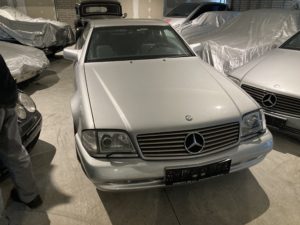
Mercedes Benz SL600 W129

Year of Manufacture: 1995
Power Output: 394 hp
Engine Displacement: 5,987 cm3

Number of Cylinders/Valves: 12/4
Weight: 1,980 kg

Catalogue Number: 11

The Mercedes-Benz SL R129, the 4th generation of the SL-Class—also known by the nickname “The Iron” (Žehlička)—is a magnificent vehicle that introduced numerous innovations to the automotive world. At its debut in 1989, Mercedes had filed no less than 20 patents for the SL model. Among the most interesting features is the pop-up roll bar behind the occupants’ heads, which deploys in just 0.3 seconds to protect passengers in the event of a rollover.

The car is also equipped with self-tensioning three-point seat belts mounted directly into the seats, which are built with a rigid frame made from five magnesium components capable of absorbing some of the forces during a side impact. In addition, it features four-piston disc brakes.

Notably, the car includes an electro-hydraulically operated convertible roof, which can retract or extend in 30 seconds. Another highlight is the multi-link rear suspension, providing excellent handling at high speeds while maintaining the desired level of comfort.

The legendary design was created by Bruno Sacco, and then-company director Werner Niefer, who also participated as a test driver, referred to the R129 as his personal favorite.

The SL R129 underwent two major facelifts, in 1995 and 1998.

In 1994, the car received minor updates that were reflected in the 1995 model range. For example, the odometer changed from mechanical to electronic, and the vehicle featured an option for a portable mobile phone with voice-activated dialing. US-spec models also received newly designed clear indicators for the front turn signals.

Each facelift brought subtle visual updates, additional new equipment, and engine improvements or replacements. With the final update, driving enthusiasts were treated to AMG versions—starting with the V8-powered SL 60, later joined by the SL 70 and the mighty SL 73 with a V12 engine, which also appeared in the Italian supercar Pagani Zonda. The last model before production ended was the SL 55 AMG, which later lent its technology to the next generation SL 55 AMG R230.

Over its 12-year production run, a total of 213,089 units were manufactured at the Bremen plant.

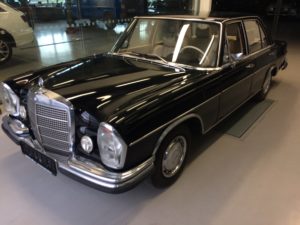
Mercedes Benz S280 W108

Year of Manufacture: 1972
Power Output: 140 hp
Engine Displacement: 2,778 cm3

Number of Cylinders/Valves: 6/2
Weight: 1,470 kg

Catalogue Number: 8

These are luxury vehicles produced from 1965 to 1973. The cars were successful not only in West Germany but also in export markets including North America and Southeast Asia.

Difference between W108 and W109

Due to the success of the long-wheelbase model 300 SE Lang, Mercedes-Benz continued to offer two wheelbase lengths for the W108 and W109. Initially, the W108 designation referred to the standard wheelbase, and the W109 to the long wheelbase. In the 1968 model range, this distinction changed with the introduction of the 280 SEL, which retained the W108 chassis designation instead of W109, and the longer wheelbase was identified by the letter “L” in the model name. This designation has remained standard for all future Mercedes-Benz models.

First Series

The W108/W109 model debuted at the Frankfurt Motor Show in 1965. The initial model lineup consisted of three W108 models (250 S, 250 SE, and 300 SEb) and one W109 model (300 SEL).

– The 250 S model was equipped with the M108 engine with a displacement of 2,496 cm3, featuring dual downdraft two-barrel carburetors, producing 96 kW at 5,400 rpm. It reached a top speed of 182 km/h.

– The 250 SE model had the same engine as the 250 S, except for fuel injection and a different engine designation. The output increased to 110 kW at 5,500 rpm.

– The 300 SEb and 300 SEL models were equipped with a 2,996 cm3 engine, delivering 125 kW at 5,400 rpm. These models reached a top speed of 200 km/h and accelerated to 100 km/h in 6.2 seconds.

Second Series

In 1967, the six-cylinder engine range was revised. The 2.5L engine was increased to 2.8L.

The 250 S and 250 SE models were renamed 280 S and 280 SE in November 1967.

In January 1968, the long-wheelbase 280 SEL was introduced for the first time.

The 280 S model reached 100 km/h in 12.5 seconds with a top speed of 185 km/h.

The 280 SE and 280 SEL models accelerated to 100 km/h in 10.5 seconds and reached a maximum speed of 193 km/h.

Vehicles sold in Europe were equipped with a standard four-speed manual transmission. A four-speed automatic transmission was also available, which was quite unusual among car manufacturers at the time. A five-speed manual transmission was offered for inline-six engines, but only between 1969 and 1972.

In 1966, engineer Erich Waxenberger installed the massive 6.3L Mercedes-Benz M100 V8 engine from the company’s flagship 600 (W100) into the W109 chassis, creating the first large Mercedes-Benz sedan with a V8 engine. Full production of the 300 SEL 6.3 began in December 1967. The 300 SEL 6.3 reached 100 km/h in 6.5 seconds and a top speed of 220 km/h (137 mph), making it the fastest production sedan of its time—a title it held for many years.

When the 3.5L V8 engine was introduced in 1969, the only available transmission was a four-speed automatic with a fluid coupling. This model was aimed mainly at the North American market, where V8 engines were the dominant powertrain for large sedans. By the end of the series’ production run, it gave rise to the 450 SE model, symbolically concluding this highly successful series of large limousines—vehicles in which Mercedes-Benz would go on to dominate the segment for years to come.

A total of 383,361 units were produced during the seven-year production period.

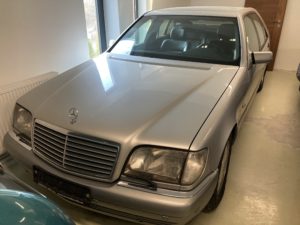
Mercedes Benz SE 600 sedan

Year of Manufacture: 1996
Power Output: 394 hp
Engine Displacement: 5,987 cm3

Number of Cylinders/Valves: 12/4
Weight: 2,180 kg

Catalogue Number: 6

History

This is a series of key vehicles manufactured between 1991 and 1998. This class was introduced at the Geneva Motor Show in March 1991.

Development of the W140 began as early as 1981. Over the following years, the models were tested, and in 1986, the design by Olivier Boulay was ultimately selected. The original concept required two different grille designs to distinguish between lower and upper models—similar to the use of round and rectangular headlights on the W123 model. Due to its uncompromising bulk and performance, the car earned the nickname “Mammoth.”

In 1998, the S140 S-Class series was replaced by the W220 sedans and the C215 CL-Class coupés.

Models

There were three body types carried over from the W126 model: a four-door sedan with two different wheelbase lengths, and a two-door coupé. The designation W140 was assigned to the standard wheelbase, V140 to the long wheelbase, and C140 to the coupé.

In 1996, the S-Class coupé was renamed to the CL-Class, effectively separating it from the S-Class line.

The longer Pullman version featured a 4,140 mm wheelbase and was introduced in 1995 with two engine options – the S500 Pullman and the S600 Pullman.

In 1997, a Landaulet Papamobile was produced for Pope John Paul II.

The engines included inline six-cylinders, V8s, and the top-of-the-line V12 with a displacement of 6 liters. All engines were newly developed, and for the first time, the series featured a diesel engine with four valves per cylinder. At the beginning of production, manual transmissions were still available for the smallest six-cylinder engines—this was the last time manual gearboxes appeared in the “S” class. Eventually, all models were fitted with either four- or five-speed automatic transmissions.

W140 Features

This model introduced several innovations and enhancements that later became standard across other Mercedes-Benz models. For example:

– Sound-insulated double-glazed windows, a new S-Class innovation first used on this model.

– The W140 featured rear parking guide rods. These rods extended from the rear corners of the trunk lid while reversing, providing a visual guide for parking. In 1995, this system was replaced with the Parktronic system, based on sonar, which measured the bumper’s distance from surrounding obstacles.

– Later models included rain-sensing windshield wipers, also known as a rain sensor.

– The vehicle boasted dual-zone climate control.

– In 1995, the S600 Coupé became the first Mercedes-Benz vehicle equipped with a GPS navigation system, called the Auto Pilot System.

– In 1996, the Linguatronic voice control system and the sonar-based Parktronic parking system were introduced.

– Xenon headlights.

– ESP (Electronic Stability Program) chassis system.

– ADS damping system.

And many other features, especially those enhancing passenger comfort and convenience.

A total of 432,732 W140 vehicles were produced, including 406,710 sedans and 26,022 coupés. The model became an icon of luxury vehicles and inspired other manufacturers. At Mercedes-Benz, it was particularly followed by later C-Class and E-Class models. Even today, this model is highly valued—especially the V12 version, which has retained a reputation for technical excellence and a sense of superiority.

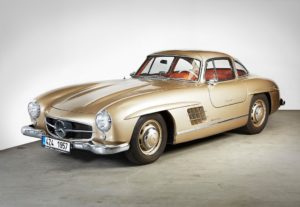
Mercedes Benz 300 SL Gullwing W198

Year of Manufacture: 1957
Power Output: 215 hp
Engine Displacement: 2,996 cm3

Number of Cylinders/Valves: 6/2
Weight: 1,310 kg

Condition: Perfect
Catalogue Number: 3


The Mercedes-Benz 300 SL of the W198 series is rightfully considered one of the most charismatic—indeed, iconic—models in the 130-year history of gasoline-powered automobile development. At the same time, it ranks among the most desirable and expensive historic vehicles ever made.

The prototype of the 300 SL, based on the coupé made famous by its success in the 1952 Panamericana race in Latin America, was created in the spring of the following year. However, its spiritual father was neither an engineer nor a manager at the German car manufacturer, but rather Mercedes-Benz’s U.S. dealer Edwin Hoffman. He saw great sales potential for the sports coupé (and later the roadster) in the North American market—and history proved him absolutely right.

The vehicle’s public debut took place in February 1954 at the International Motor Sports Show in New York—before it was even shown in Europe. Production ran from 1954 to 1957.

The engine, gearbox, front and rear axles, and steering were derived from the touring model 300 and were not originally designed for a sports car. However, they underwent significant modifications. Particularly advanced was the mechanical direct fuel injection system, which increased power output to 215 hp and later to 240 hp. The vehicle could reach speeds of up to 260 km/h. It was equipped with a four-speed gearbox.

A masterpiece by engineer Rudolf Uhlenhaut, the car featured a lightweight yet torsionally and flexurally rigid space frame made of welded steel tubing. The need for high structural rigidity required significantly raised door sills, leading to the development of the car’s distinctive “gullwing” doors, which were hinged at the roof centerline and opened upwards. The shape of the open doors resembled the wings of a seagull in flight. To reduce weight, aluminum was extensively used in the bodywork.

In 1957, an open-top roadster version was introduced, and it remained in production until 1963.

A total of 3,258 vehicles in both versions were produced, of which only about 2,600 survive to this day. This car is undoubtedly among the most sought-after historic vehicles ever.

The vehicle in the Samohýl family collection is a gold-painted coupé from 1957. It represents the final model from the last year of production. It is also notable for being one of only 209 cars equipped with a special crankcase made from an aluminum alloy.

In recent years, the legacy of this vehicle has been echoed by models such as the SLS AMG and the SLR McLaren. Together with the original, they form the so-called “Holy Trinity” of Mercedes-Benz vehicles featuring this type of door. All three can be seen in the Samohýl family’s historic car collection.