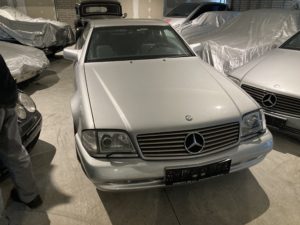
Mercedes-Benz 560 SL R107
Year of Manufacture: 1988
Power Output: 230 hp
Engine Displacement: 5,547 cm3
Number of Cylinders/Valves: 8/2
Weight: 1,715 kg
Condition: Perfect
Catalogue Number: 47
Introduction
The Mercedes-Benz 107 Series (R107) was produced from 1971 to 1989. It was the second-longest production series of the German carmaker Mercedes-Benz, surpassed only by the G-Class off-roader. For the first time, a series-production SL model featured a V8 engine—specifically a 3.5L V8 with fuel injection, producing a full 200 hp.
Development
The R107 (convertible) and C107 (coupé) adopted chassis components from the mid-size Mercedes-Benz W114 model (1968), initially paired with V8 engines M116 and M117 used in models W108, W109, and W111. The body design of the R107 and C107 remained largely unchanged from their debut in 1971 until the end of production in 1981 (coupé) and 1989 (soft-top).
Technical Specifications
The decision to produce the R 107 series (first time the SL series received an internal “R” designation for Roadster instead of “W” for Wagen) was made after intense board-level discussions on June 18, 1968. One debated topic was whether a Targa roof version (with a removable roof panel) should be offered instead of the traditional soft-top. Due to increasing safety standards, there were concerns from the U.S. about certifying open-top cars.
Ultimately, the decision favored a roadster with a soft top and an additional removable hardtop, thanks to Hans Scherenberg, head of development, who passionately supported the concept.
Karl Wilfert, then head of design in Sindelfingen, developed a coupé based on the R107 and one day presented it to the board as a “rough draft.” Initially rejected, Wilfert eventually won approval with his signature determination, leading to the creation of the elegant four-seat sports coupé 350 SLC just six months after the roadster’s premiere in October 1971.
Internally designated C 107 (“C” for coupé), it matched the roadster in design up to the windshield, then extended in height and length. The flat roof arched gently over the four-seat cabin, ending in a steeply sloped rear window. The trunk lid had a slightly convex shape, unlike the SL’s.
Aside from elegance and build quality, the vehicles boasted timeless safety features. The open-top two-seater’s crash response was ahead of its time—seen in the carefully engineered deformation zones, high-strength A-pillars, and interior designed to strict safety standards.
In 1973, the oil crisis hit Europe, prompting Stuttgart to act. By summer 1974, a more economical R107 roadster called the 280 SL was introduced (at a time when having three engine options for an SL was unprecedented). It featured a 2.8L inline-six OHC engine producing 185 hp (136 kW), capable of exceeding 200 km/h while consuming 3–5 liters less fuel per 100 km than the V8s.
After fourteen years on the market, the R107 roadsters underwent their final facelift in fall 1985, which also brought interior updates. The new entry-level model was the 300 SL with a 3.0L six-cylinder engine making 188 hp. The 380 SL was replaced by the new 420 SL with a V8 engine producing 218 hp.
The flagship remained the 500 SL roadster with its five-liter engine and new injection system delivering 245 hp, enabling speeds up to 225 km/h and 0–100 km/h acceleration in just 7.5 seconds. All facelifted models were available with catalytic converters, which slightly reduced engine output.
A special model made exclusively for export to the U.S. (and in small numbers to Japan and Australia) was the 560 SL, built between 1985–89. Powered by an eco-friendlier V8 derived from the 5.0L engine, it produced 231 hp. With specific gear ratios, the roadster reached over 220 km/h and accelerated from 0 to 100 km/h in under 8 seconds.
It’s important to note that U.S. market models were fitted with larger bumpers, increasing the car’s length by 250 mm. Their front ends also featured two pairs of round headlights for distinction.
Over its long production run and massive success, the SL was fitted with various six- and eight-cylinder engines, resulting in a wide range of model designations. Over time, engines were updated slightly to comply with increasingly strict emissions regulations across Europe.
Production of the R107 series ended in August 1989, more than 18 years after the debut of the 350 SL. The SL set an internal record for longevity unlikely ever to be surpassed—no other passenger car series, apart from the G-Class, had such a long production run. A total of 237,287 units were manufactured in Sindelfingen, a figure that underscores the immense popularity of the 107 series. Additionally, 62,888 coupés were produced between 1971 and 1981.