Showing all 8 results

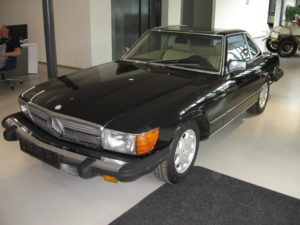
Mercedes Benz SL 380 W107

Year of manufacture: 1985
Power: 157 hp
Engine displacement: 3,839 cm3

Number of cylinders/valves: 8/2
Weight: 1,650 kg

Condition: drivable
Catalogue number: 42

History

The Mercedes Benz 107, also nicknamed the Timeless Endurer, was produced from 1971 to 1989. It was the second longest-produced series by the German automaker Mercedes-Benz, after the Mercedes-Benz G-Class off-road vehicle. The cars were sold under the model designations SL (R107) and SLC (C107).

Development

The R107 and C107 adopted chassis components from the mid-sized W 114 model and originally paired them with M116 and M117 engines used in the W108, W109, and W111 series.

Mass production of the R107 350 SL began in April 1971, available with an optional four-speed hydraulic automatic transmission. Acceleration from 0 to 100 km/h took 8 seconds.

In March 1973, the 450 SL/SLC was introduced to the North American market. The car featured a 4.5-liter 8-cylinder engine.

In September 1977, the 450 SLC 5.0 joined the lineup. This was a homologation version of the large coupe with a new aluminum 5.0-liter engine.

Starting in 1980, the 350, 450, and 450 SLC 5.0 were replaced by the 380 and 500 SLC models. At the same time, the cars were slightly updated, with the three-speed automatic replaced by a four-speed unit.

Production of the 280, 380, and 500 SL models ended in 1981, replaced by the new W126 380 and 500 SEC series.

From September 1985, the 280 SL was replaced by the new 300 SL and 380 SL, the 500 SL continued, and the 560 SL was introduced for some non-European markets, especially the USA, Australia, and Japan.

Technical specifications

Mercedes-Benz engineers and developers focused on small details with the W107. For example, this model was the first to use well-known rear lights, previously used only on trucks, with horizontal ribs preventing dirt buildup.

The chassis, with a closed tunnel necessary for the installation of the transmission and driveshaft, had a floor frame with longitudinal and cross members, onto which the body of a two-seat roadster or coupe for two adults and two children was welded. The steel used varied in thickness, and carefully designed crumple zones, patented by Béla Barényi, absorbed most of the impact energy during collisions, resulting in less injury to occupants in the so-called safety cell. The four-spoke steering wheel was equipped with a telescopic shaft and a polyurethane-filled hub. The dashboard was padded with foam to protect against impacts. The fuel tank, located above the rear axle, did not rupture during collisions.

All American models used the 4.5-liter engine and were called 450 SL / SLC.

Interesting facts

Let’s return to Germany, though staying a bit in America, albeit further south. Teaching a 4.75-meter-long car to race was a tough challenge, but it succeeded. The SLC coupe recorded great success mainly in competitions. In 1978, Andrew Cowan and Colin Malkin won the grueling Vuelta a la América del Sud marathon. After five weeks on the roads—and especially off-road—of South America, the two drivers finished first in their heavy 5.0-liter Mercedes 450 SLC. Only 22 crews out of 56 completed the route of over 28,500 kilometers.

Record holder

Thanks to its long career, the R107 still holds the record for the highest number of units produced among all generations of “eselka” models. By August 1989, 237,287 units had been made in Sindelfingen. The SLC coupe ended its ten-year career with only 62,888 units built and is now relatively rare. Its career is also a record, as no personal Mercedes model has been produced so long (the G-Class is not exactly personal). The successor to the R107 series was the SL R129, first introduced in March 1989. Although it had a shorter production run, by today’s standards it was still long, lasting a full twelve years.
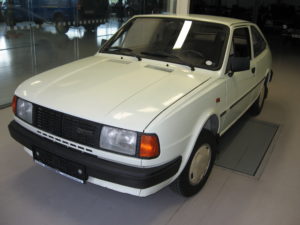


Škoda 130 Rapid

Year of manufacture: 1987 Power: 58 hp Displacement: 1,289 cm3

Number of cylinders/valves: 4/2 Weight: 890 kg

Condition: drivable Catalogue number: 100

The description of the Škoda 1000 MB car, with catalogue number 107 in our collection, details the development and journey of Škoda automobiles with the “all rear” concept from production to the customers. At its market introduction in 1964, it was truly a very good car. It was well received by experts and represented a major breakthrough in applied technologies and manufacturing methods in Czechoslovakia. It was produced in a new, modern factory and pushed Škoda forward significantly.

In the centrally planned socialist economy, few further innovations or adaptations to global trends in this area were expected or considered. This concept remained in Škoda’s production for an incredible 26 years, with the engine design lasting almost 40 years. It cannot be said that cars in this concept were not innovated; it soon became clear that these were mostly cosmetic modifications rather than real development.

Between 1969 and 1977, the 100/110 series was produced, with a total of 1,079,000 units made. This series included the quite successful and especially popular Škoda 110R coupe.

In 1976, the last major innovation of Škoda cars with a rear engine was introduced under the designation 105/120. It was produced until the end of this concept in 1990, when it was replaced by the entirely new Favorit model with a front engine and front-wheel drive. A total of 2,020,000 units of the 105/120 series were produced, with some partial innovations and improvements carried out.

The final developmental stage of this concept was the coupe initially named Garde and later, until 1990, known as Rapid.

The Rapid 130 was truly the peak of the rear-engine Škoda line. A short episode at the very end of production was the 135/136 model, which used the same engine as the Favorit. Our vehicle is designated Škoda 130 Rapid, meaning it had an enlarged engine displacement of 1,289 cm3 producing 58 hp, a trailing rear axle, a five-speed gearbox, and worm steering. It was based on the 120 sedans, but after the M modification, which increased the track width and slightly modernized the body compared to the original 120 series. It followed the famous 110R coupe and was also produced in the Kvasiny plant and to a lesser extent in the new Bratislava automobile factory. A total of 22,000 units were produced between 1984 and 1988.

The very last Škoda vehicles with this concept were produced in early 1990, marking the end of an era and an idea. In conclusion, it can be said that the concept of a people’s car was ultimately fulfilled, as by the end of production the car had become a part of everyday life for many families in socialist Czechoslovakia, allowing ordinary citizens to travel on vacation in their own vehicle.


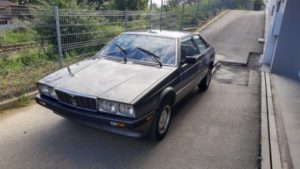
Maserati Biturbo

Year of manufacture: 1984
Power: 190 hp
Engine displacement:2,491 cm3

Number of cylinders/valves: 6/3
Weight: 2,180 kg

Catalog number: 106

This is a two-door 2+2 coupe. It was introduced in December 1981.

History

The car was designed by Pierangelo Andreani, who was also the head of Maserati’s Centro Stile. All Maserati models introduced from the launch of the Biturbo in 1981 until 1997 were based on the original Biturbo architecture.

When Alejandro de Tomaso acquired Maserati in 1976, he had ambitious plans. He wanted to combine Maserati’s prestige with a sports car that would still be affordable and replace the cheaper models that traditionally made up the Maserati lineup during the period when the company was owned by Citroën.

Engines

It was the first mass-produced car to use a twin-turbocharged engine. It also represented the first mass-produced engine with three valves per cylinder in this specification.

In 1984 and 1985, the 2.5 L V6 models used a single Weber carburetor under a pressurized smooth aluminum alloy intake fed by twin turbochargers.

Maserati, American dealers, and sports car enthusiasts began experimenting with intercoolers.

Development

222

In May 1988, the models received a facelift, and the Biturbo name was dropped in favor of “222,” which stands for two doors, a two-liter engine, and second generation. The car bore visual traces of Gandini’s signature design language but featured a more rounded grille and hood like the 430 model, different side mirrors, and a spoiler. The 222 made its debut in 1988 at the Turin Motor Show.

2.24v

In December 1988, Maserati introduced the most powerful variant of the two-liter models, powered by a four-valve-per-cylinder engine. This was the first model to feature modern wraparound front and rear bodywork with integrated fog lights and deep side skirts.

Racing version

This is a more powerful variant of the 2.24v with increased output. It was first introduced in December 1990. Between 1991 and 1992, only 230 units were produced, all intended for the Italian market.

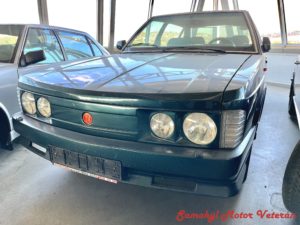
Tatra 613

Year of Manufacture: 1988
Power: 167 hp
Engine Displacement: 3,495 cm3

Number of Cylinders/Valves: 8/2
Weight: 1,690 kg

Condition: drivable
Catalog Number: 273


Introduction

In 1974, Tatra introduced a new luxury four-door limousine that dramatically changed the company’s previous design direction. This was the model 613, designed by the Italian coachbuilder Vignale, and it bore almost no resemblance to its predecessor, the 603, except perhaps for being produced at the subsidiary plant in Příbor. The high degree of handcrafting in production made the Tatra expensive and, due to slow and regulated production, also rare.


Development

The appearance, however, changed and modernized several times during its long production. Already in 1980, a more economical version 613-2 was introduced, and in 1985 the 613-3 version came with a design updated by Mr. Ladislav Výborný. It is recognizable by a different grille, lights, bumpers, and typical smooth plastic hubcaps. Plastic was used more than chrome, earning it the nickname “plasťák” (the “plastic one”).


Technical Specifications

The Tatra 613 was also known as a fast, spacious, and comfortable vehicle with a flexible carbureted 2×2 OHC engine of 3.5 liters producing 168 hp, reaching speeds up to 190 km/h. Later engines offered better performance, higher displacement, and near the end of production even fuel-injected engines with 200 hp. These cars could reach speeds up to 230 km/h. The transmission was initially 4-speed, later 5-speed in the newest models. Its curb weight was 1,690 kg.


Production

Besides the limousine, there were extended-wheelbase sedans, rescue versions, and a coupe prototype that was never produced.


Sales

This car is a piece of Czech automotive history, and today its price would rise to around 2.5 million CZK.


Interesting Facts

The Tatra 613 was not available to just anyone. New cars were distributed mainly to politicians, then company directors, rescue and armed forces, and also the police, where it was used for covert road traffic monitoring with a built-in speed radar.


Car in Our Collection

The car in our collection dates from 1988 and is in fully functional and drivable condition.

Placeholder

Mercedes-Benz 500 SEC C126

Year of Manufacture: 1985
Power: 231 hp
Engine Displacement: 4,973 cm3

Number of Cylinders/Valves: 8/2
Weight: 1,610 kg

Condition: excellent
Catalog Number: 14


Introduction

After the debut of the W116 S-Class in 1972, Mercedes-Benz began preparing for the next generation in October 1973. The goal of the project codenamed “Project W126” was to provide improved driving experience, better handling, and greater fuel efficiency. The 1973 oil crisis and increasingly strict emissions and safety regulations in the United States had an important impact on the development of the W126 to reduce emissions and increase fuel efficiency.


Development

After six years of development, the W126 model was introduced at the Frankfurt Motor Show in September 1979. At launch, the S-Class was available in two wheelbase lengths (standard and long) and three variants of gasoline engines, including one inline-six and two inline-eight engines. A diesel engine option was introduced in September 1981 exclusively for the North American market.

Two years after the debut of the original W126 sedans, in September 1981 at the Frankfurt IAA, the range was expanded with a luxury coupe with the factory code C126. The design was again the work of Daimler-Benz’s then chief designer Bruno Sacco, who completed it as early as March 1977. In October of the same year, patents were approved for both body versions. Initially, it was available in two versions: 380 SEC and 500 SEC. The abbreviation meaning? S stood for “Sonderklasse” (special class), E for engines with fuel injection (Einspritzmotor), and C for “coupé”.


Technical Specifications

The two-door elegant model was never offered with six-cylinder engines, as they were not prestigious enough. It was thus the first series-produced Mercedes coupe with a V8. However, it inherited safety features from the S-Class sedans: optional driver’s airbag with seatbelt pretensioner on the front right, limited-slip differential, and anti-slip regulation ASR (from September 1986), and later also a passenger airbag from late 1987.

For the coupe’s introduction, the eight-cylinder engines from the W126 sedans were improved with intense efforts to reduce the significant fuel consumption. The V8 hearts saw increased compression, camshafts with modified valve timing – the injection valves were air-cooled. Idle speed was now electronically controlled.

Four years after its premiere, at the 1985 Frankfurt IAA, alongside the four-door W126 classics, a modernized coupe appeared. It received improved aerodynamics: new bumpers, smoothed side strips, and different larger wheels – on the 560 SEC, alloy wheels with 215/65 VR15 tires. These wheels were available as an option for others. The highest-performance versions also had larger wheel arch openings. The brakes were enlarged, and the rear axle setup was modified for greater comfort. The airbag became a standard feature in the driver’s steering wheel head as in the sedans.

A three-way catalytic converter with oxygen sensor was offered on request, and all models were prepared for its later installation including the appropriately modified ignition system. It became a fixed part of the exhaust system only in September 1986, but until August 1989, customers could still choose whether to have it or not.

The SEC models were produced for a full ten years. Their production, already with dual airbags as standard equipment, was stopped between September and October 1991. Considering the luxury concept and production period, the total number of 74,060 units is relatively high. The most popular variant was logically the 500 SEC model, which was produced throughout the entire period. A total of 30,184 units were sold worldwide.

Placeholder

Mercedes-Benz 300 CE C124

Year of manufacture: 1988
Power: 180 hp
Displacement: 2,962 cm3

Number of cylinders/valves: 6/2
Weight: 1,340 kg

Condition: perfect
Catalogue number: 18


Introduction

Considered by many to be the last classic Mercedes-Benz, the W124 model directly follows the now legendary “piano” W123 and remained in production for a remarkable thirteen years.


Development

Several body variants were created. Besides the sedan and the traditional estate called the T-Model, the early 1990s saw the arrival of an elegant coupe, from which a four-seat convertible was derived. The production program started with petrol variants 200, 230 E, 260 E, and 300 E, while diesel versions included 200 D, 250 D, and 300 D. The early 1990s brought the pinnacle of the line, the 500 E (later E 500) with 356 hp, with the most powerful version being the later E 60 AMG, offering 380 hp. Both variants are highly prized youngtimers today.


Technical specifications

The design of the W124 was led by Bruno Sacco, Joseph Gallitzendörfer, and Peter Pfeiffer. For example, the characteristic rear section, tapering towards the back and strongly rounded along the upper edges of the sides, had a particularly favorable effect on wind resistance and resulted from aerodynamic tunnel testing. These aerodynamic improvements significantly reduced fuel consumption compared to the previous model. Two other typical design features are the trapezoidal trunk lid with its rear edge pulled to the right and the slanted inner edges of the nearly square rear lights. This allowed for a particularly low loading sill for the large trunk space.

Most engines were completely new. For example, the six-cylinder M 103: the weaker 260 E delivered 125 kW (170 hp) from 2.6 liters, while the stronger 3.0-liter 300 E offered 140 kW (190 hp). The same applied to the diesel units, although the weakest non-turbocharged 2.0-liter OM 602 with 53 kW (72 hp) had already appeared in the small 190 D of the W201 series. The new 2.5-liter five-cylinder 250 D, without a turbocharger, designated OM 602, offered 66 kW (90 hp). The 3.0-liter OM 603, again without turbo and badged 300 D on the car’s rear, offered 80 kW (109 hp). The carbureted petrol 4-cylinder 200 with 80 kW (109 hp) and the 2.3-liter injected version with 100 kW originated from the “piano,” as did the 200 E versions of the M 102 series.

In September 1989, the revised W124 range premiered at the Frankfurt IAA. Both exterior and interior were updated, though stylistic changes were subtle, as befits Mercedes-Benz. The most noticeable were the large plastic strips on the sides, which the coupe had received two and a half years earlier. In Central Europe, these cars are nicknamed “plasťák” (plastic one) because of them, while the older version is called “lišťák” (strip one). Above these strips was a new narrow chrome band, appearing also inside on door handles and on wheel covers bearing the company emblem. The exterior mirrors were enlarged and painted in body color. New front and rear seats were installed inside. All W124 models except the 4Matic four-wheel drives offered a Sportline package with sport suspension featuring stiffer springs and dampers, lowering the ride height. The car wore 205/60 R 15 tires on 7 J x 15 alloy or steel wheels. The steering wheel and gear lever received leather upholstery, and sportier-shaped seats with better lateral support became standard.

The 1989 Frankfurt show also introduced the fourth body variant – a long-wheelbase limousine, missing for four years in this series. Mercedes cooperated closely with the coachbuilder Binz for its development. The wheelbase increased by a full 80 cm to 3.60 meters, with overall length growing accordingly. The “Dachshund” based on the W124 had six doors for the first time and was available with a 2.5-liter turbo diesel and a 2.6-liter petrol engine. While the four-door predecessors had only emergency middle seats, the limousine based on the later E-Class featured a full-size middle seat with a cushion and backrest comparable to the rear third-row seat. Serial production of this variant began in May 1990.

June 1993 marked a crucial milestone for the W124 series. The second facelift featured a slightly revised grille to resemble the current S-Class – especially the chrome strips were narrowed. Facelifted models can be distinguished by their front and rear turn signals, which now had clear (white) lenses instead of orange, and smoked rear lenses.

Standard steel wheels were redesigned with six openings. A more important novelty was the change in nomenclature, aligning with the new W202 C-Class launched in spring 1993. The W124 became the E-Class. This designation always included a three-digit number approximating engine displacement but was moved after the letter, not before. Mercedes-Benz still uses this system today. The letter E originally stood for fuel injection and was chosen because carbureted engines no longer appeared under the W124’s hood. The automaker also abandoned body variant letters (C for coupe, T for estate) externally, though internal coding remained. For naturally aspirated and turbocharged diesels, the letter D replaced the word Diesel, so 300 D became E 300 Diesel. The manufacturer accommodated customer wishes, so badges could be omitted entirely if desired.

In total, 2,213,167 sedans, 340,503 estates, 141,498 coupes, 33,952 convertibles, 2,342 long-wheelbase sedans, 6,398 partially coachbuilt bodies, and 73 large chassis for special purposes were produced.

Placeholder

Mercedes-Benz 300 SL R107

Year of manufacture:  1986
Power:  188 hp
Displacement:  2,962 cm3

Number of cylinders/valves:  6/2
Weight:  1,620 kg

Condition:  perfect
Catalog number:  30


Introduction

The Mercedes-Benz 107 series (R107) was produced from 1971 to 1989. It was the second longest-produced series by the German automaker Mercedes-Benz after the off-road vehicle Mercedes-Benz G-Class. For the first time, the serial car bearing the SL designation was equipped with a V8 engine, specifically a 3.5 L V8, which delivered a full 200 horsepower with fuel injection.


Development

The R107 and C107 adopted chassis components from the mid-sized Mercedes-Benz W114 model from 1968 and originally paired them with V8 M116 and M117 engines used in the W108, W109, and W111 series. The body styles of the R107 and C107 changed very little from their introduction in 1971 until the end of production in 1981 (coupe) and 1989 (soft-top).


Technical Specifications

The decision to produce the R107 series (the SL line received the internal designation “R” for Roadster instead of “W” for Wagen = car for the first time) was made by the board after intensive discussions on June 18, 1968. A major point of debate was whether to offer a Targa roof version (a removable roof panel) instead of the soft-top version. Due to stricter safety standards, alarming reports about licensing cars with open roofs from the USA were considered.

The final decision in favor of the roadster with a soft-top and an additional removable hardtop is credited to Hans Scherenberg, head of development, who fought for it fiercely.

Karl Wilfert, then head of design in Sindelfingen, developed a coupe based on the R107 and one day presented it to the board as a “rough draft.” Wilfert, initially rejected, eventually managed to push through his idea of a sporty coupe with the toughness that was so characteristic of him.

Just six months after the premiere, the SL lineup was expanded in October 1971 by the comfortable four-seat 350 SLC sports coupe, whose unconventional lines found many fans worldwide over the years. Internally, the series was designated C107 (“C” means “coupe”). Up to the windshield, its appearance matched the open-roof variant; behind the windshield, the overall height and length increased. The flat roof spanned the four-seat passenger compartment in a gentle curve and transitioned into a large and very steep rear window, which curved in two directions. Unlike the SL, the trunk lid had a slightly convex shape.

Besides elegance and quality, the vehicles boasted timeless safety features; for example, the crash response of the open two-seater was far ahead of its time. Technically, this was reflected in carefully defined body deformation behavior and vehicle frame construction, a high-strength A-pillar, and an interior uncompromisingly designed according to strict safety criteria.

In 1973, the fuel crisis hit Europe, and Stuttgart had to respond. From summer 1974, a more economical R107 roadster called the 280 SL was offered (there were three SL engine options – common nowadays but extraordinary back then), which had an inline six-cylinder OHC engine producing 185 hp (136 kW). It could exceed 200 km/h while consuming 3 to 5 liters less fuel per 100 km than the V8.

After fourteen years, the R107 roadsters received their last facelift in autumn 1985, including interior updates. The lineup was led by the six-cylinder 300 SL with a 3.0-liter engine producing 188 hp; the role of the 380 SL was taken over by the new 420 SL with a V8 engine delivering 218 hp. The crown jewel remained the 500 SL roadster, whose 5.0-liter engine with new injection produced 245 hp. Thanks to this, the car could reach speeds up to 225 km/h and accelerate from 0 to 100 km/h in 7.5 seconds. All updated models were also offered with a catalytic converter and slightly reduced power.

A special model produced only for export to the USA (and in small numbers to Japan and Australia) was the 560 SL from 1985–89, powered by an environmentally friendly V8 engine derived from the 5.0-liter V8. The long-stroke engine delivered 231 hp from 5.6 L displacement; the roadster, with specifically chosen gear ratios, topped over 220 km/h and accelerated from 0 to 100 km/h in under 8 seconds.

An important distinction between “European” and “American” cars is that models for the American market had larger bumpers, making the roadster 250 mm longer, and their front ends were adorned with two pairs of round headlights.

Throughout its long production “life” and great success, the SL was equipped with various six- and eight-cylinder engines. Its model designations were thus equally diverse. Over time, all engines underwent modifications (and slightly adjusted power outputs) to better comply with tightening emission standards in most European countries.

Production of the R107 series ended in August 1989, more than 18 years after the launch of the 350 SL. This SL series set an internal record that will likely never be broken. In the company’s entire history, no other passenger car series has been produced for such a long time, except for the G-Class. A total of 237,287 vehicles were produced in Sindelfingen, a figure that impressively demonstrates the great popularity of the 107 series. A total of 62,888 coupes were made between 1971 and 1981.

Placeholder

Mercedes-Benz 560 SL R107

Year of Manufacture: 1988
Power Output: 230 hp
Engine Displacement: 5,547 cm3

Number of Cylinders/Valves: 8/2
Weight: 1,715 kg

Condition: Perfect
Catalogue Number: 47

 
Introduction

The Mercedes-Benz 107 Series (R107) was produced from 1971 to 1989. It was the second-longest production series of the German carmaker Mercedes-Benz, surpassed only by the G-Class off-roader. For the first time, a series-production SL model featured a V8 engine—specifically a 3.5L V8 with fuel injection, producing a full 200 hp.

 
Development

The R107 (convertible) and C107 (coupé) adopted chassis components from the mid-size Mercedes-Benz W114 model (1968), initially paired with V8 engines M116 and M117 used in models W108, W109, and W111. The body design of the R107 and C107 remained largely unchanged from their debut in 1971 until the end of production in 1981 (coupé) and 1989 (soft-top).

 
Technical Specifications

The decision to produce the R 107 series (first time the SL series received an internal “R” designation for Roadster instead of “W” for Wagen) was made after intense board-level discussions on June 18, 1968. One debated topic was whether a Targa roof version (with a removable roof panel) should be offered instead of the traditional soft-top. Due to increasing safety standards, there were concerns from the U.S. about certifying open-top cars.

Ultimately, the decision favored a roadster with a soft top and an additional removable hardtop, thanks to Hans Scherenberg, head of development, who passionately supported the concept.

Karl Wilfert, then head of design in Sindelfingen, developed a coupé based on the R107 and one day presented it to the board as a “rough draft.” Initially rejected, Wilfert eventually won approval with his signature determination, leading to the creation of the elegant four-seat sports coupé 350 SLC just six months after the roadster’s premiere in October 1971.

Internally designated C 107 (“C” for coupé), it matched the roadster in design up to the windshield, then extended in height and length. The flat roof arched gently over the four-seat cabin, ending in a steeply sloped rear window. The trunk lid had a slightly convex shape, unlike the SL’s.

Aside from elegance and build quality, the vehicles boasted timeless safety features. The open-top two-seater’s crash response was ahead of its time—seen in the carefully engineered deformation zones, high-strength A-pillars, and interior designed to strict safety standards.

In 1973, the oil crisis hit Europe, prompting Stuttgart to act. By summer 1974, a more economical R107 roadster called the 280 SL was introduced (at a time when having three engine options for an SL was unprecedented). It featured a 2.8L inline-six OHC engine producing 185 hp (136 kW), capable of exceeding 200 km/h while consuming 3–5 liters less fuel per 100 km than the V8s.

After fourteen years on the market, the R107 roadsters underwent their final facelift in fall 1985, which also brought interior updates. The new entry-level model was the 300 SL with a 3.0L six-cylinder engine making 188 hp. The 380 SL was replaced by the new 420 SL with a V8 engine producing 218 hp.

The flagship remained the 500 SL roadster with its five-liter engine and new injection system delivering 245 hp, enabling speeds up to 225 km/h and 0–100 km/h acceleration in just 7.5 seconds. All facelifted models were available with catalytic converters, which slightly reduced engine output.

A special model made exclusively for export to the U.S. (and in small numbers to Japan and Australia) was the 560 SL, built between 1985–89. Powered by an eco-friendlier V8 derived from the 5.0L engine, it produced 231 hp. With specific gear ratios, the roadster reached over 220 km/h and accelerated from 0 to 100 km/h in under 8 seconds.

It’s important to note that U.S. market models were fitted with larger bumpers, increasing the car’s length by 250 mm. Their front ends also featured two pairs of round headlights for distinction.

Over its long production run and massive success, the SL was fitted with various six- and eight-cylinder engines, resulting in a wide range of model designations. Over time, engines were updated slightly to comply with increasingly strict emissions regulations across Europe.

Production of the R107 series ended in August 1989, more than 18 years after the debut of the 350 SL. The SL set an internal record for longevity unlikely ever to be surpassed—no other passenger car series, apart from the G-Class, had such a long production run. A total of 237,287 units were manufactured in Sindelfingen, a figure that underscores the immense popularity of the 107 series. Additionally, 62,888 coupés were produced between 1971 and 1981.