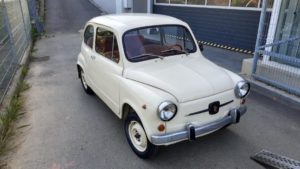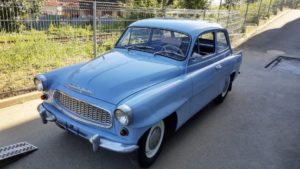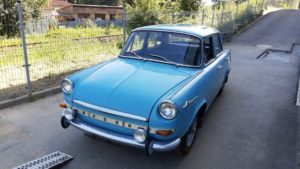
Škoda 1000 MB
Year of manufacture: 1968 Power: 42 hp Displacement: 988 cm3
Number of cylinders/valves: 4/2 Weight: 765 kg
Condition: good Catalogue number: 107
After the nationalization of industry in 1948, all affairs in society were controlled by the central committee of the Communist Party. This included decisions about when a new car would be produced, its specifications, and how much investment would be put into its development and manufacturing technology.
So it was not easy at all, and other party committees had decisive authority—not engineers or customers…
So what was the story behind the Škoda 1000 MB?
In 1954, a commission for a people’s car was established, tasked with recommending the basic characteristics of the proposed car for mass production.
In 1955, the Ministry of Automotive Industry and Agricultural Machinery officially approved these recommendations. The car was to be at least a four-seater, have a curb weight around 700 kg, and fuel consumption between 6 and 7 liters per 100 km.
It was the first Škoda serial production car with a unibody structure and also the first with the “all rear” drive concept (engine in the rear and rear-wheel drive). From early 1956, the first prototypes of the people’s car were developed. By May of that year, AZNP had three prototypes: 976, 977/I, and 978. Remaining prototypes were to be built by the end of the year.
The first prototype bodies were characterized by two-door designs and somewhat modest dimensions, reflecting caution due to limited experience with unibody construction. Engineer Rudolf Vykoukal, creator of the Jawa Minor I and II, worked on project 976.
Driving tests took place throughout 1956. Results indicated a decision would be made between the “all rear” and “all front” concepts. The primary consideration was, naturally, manufacturing cost. The motto was “a lot of music for little money.” At that time, company leadership was caught between customer expectations and the demands of party and government bodies, which had a fundamental requirement: no import of parts, no foreign currency purchases, everything must be produced domestically.
After long deliberations, they favored the rear engine and rear-wheel drive option while maintaining low weight. Proponents of this concept in the late 1950s and early 1960s included Volkswagen, Fiat, Renault, and NSU. At that time, rear-engine small European cars made up more than 50% of the lower-class vehicle production. However, this concept limited product variability—no station wagons, pickups, or other utility versions.
In 1957, a four-door “panel” body appeared for the first time. This was a unibody skeleton onto which fenders, doors, hood, and trunk lid were mounted. This principle was tested on two variants: a classic sedan and a wagon. The 989 model had almost no front end. Although this solution met aerodynamic goals, its aesthetics were lacking.
In 1958, it was decided the future car would have a four-door sedan body with an appealing basic shape. Early in 1959, the first prototype embodying all prior requirements was created. Further modifications led to a prototype so close to the final shape it was named Favorit. In 1963 and 1964, the body was adjusted to accommodate subcontractors, enabling presentation of the final version. Reportedly, coachbuilder Jaroslav Kindl modified the fender shape for the main headlights at the last moment, moving them back 120 mm to improve stability in crosswinds. The overall body development required half a million man-hours. The body was ultimately resolved to general satisfaction, being spacious and comfortable despite small dimensions.
The Mladá Boleslav technicians achieved a very high level in a short time. The new Škoda had a four-cylinder water-cooled engine with a displacement of 988 cm3 and 42 hp. Its top speed reached up to 120 km/h. The finally chosen OHV four-cylinder was among the most modern 1-liter engines in Europe at the time, mainly due to the production technology of the block and other parts manufactured by aluminum die casting. It was developed by Ing. Josef Polák, who came from a Czech landowner family and patented this principle in 1922. Unfortunately, the planned OHC engine was dropped at the last moment, which would have made the car even better. Even so, the engine was very advanced for its time and was used by Škoda with various modifications for nearly 40 years.
The car was finally named Škoda 1000 MB, not Favorit (which came later). It was a balanced and modern design for its time. To meet production targets, a brand-new factory was built in Mladá Boleslav specifically for this model. Škoda achieved something remarkable again: the factory was state-of-the-art and would be competitive anywhere in Europe. For the first time in history, all necessary operations and technologies were concentrated within the company, eliminating the need to import many components from subcontractors.
The car was officially introduced in mid-1964 and was very well received. It was also highly regarded abroad. Alongside the car’s market launch, the new factory was completed, and full-scale production started in 1965. In 1968, when the plant began three-shift operation, 111,386 “MB” cars were produced. In total, between 1964 and 1969, 443,141 units were built.
This type was originally intended as a people’s car to significantly contribute to motorization of socialist society. It succeeded, though not fully. A substantial portion of production was exported to earn foreign currency for the national economy. Domestic buyers had to wait, often camping out at dealerships overnight with sleeping bags. The main problem was the car’s concept, which quickly became outdated, and the regime’s inflexibility prevented timely and adequate response. Thus, the “all rear” concept persisted for many years after the global automotive industry moved in a different direction. But that is another chapter of history.