Showing 65–80 of 146 results

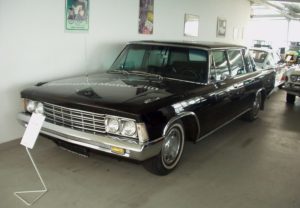
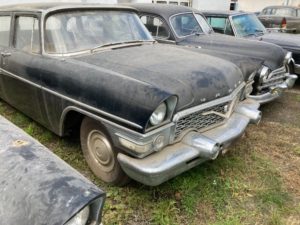
GAZ M13A Čajka

Year of Manufacture: 1963
Power: 195 hp
Displacement:4,890 cm3

Number of cylinders/valves: 8/2

Weight: 2,050 kg

Condition: drivable

Catalog Number: 246

The automobile factory in Gorky needed to replace the somewhat outdated, chunky GAZ M-12 ZIM from the 1950s, even though its production had only started at the beginning of that decade. The new luxury car, a less ostentatious contemporary of the Moscow ZIL 111 (1959–1967), was intended primarily for Soviet state organs and the country’s diplomatic missions abroad, as well as for the KGB secret police. It also made its way to “friendly” Eastern Bloc countries, including Czechoslovakia. It complemented the mentioned ZILs and was very similar to them, though smaller.

This vehicle was used exclusively by prominent communist regime figures. In the USSR, it was driven by the most important officials and representatives of the era; the same applied to allied communist countries. A few cars were gifted to artists and cosmonauts as well.

The car was modeled on some American automobiles of the time and bears many resemblances to them.

It had a modern all-aluminum 5-liter V8 engine producing 195 hp, with a top speed of 160 km/h. A special feature was the three-speed automatic transmission controlled by buttons next to the steering wheel.

Great emphasis was placed on space and passenger comfort in the rear seats. There was an above-average amount of room and several technical features not yet seen in normal Eastern Bloc cars – electric windows, remote radio control, and similar amenities. The car could also operate with three rows of seats in a 2+2+3 arrangement.

Several other body variants were produced over time, mainly four-seat convertibles for military parades and official visits. Some station wagons served as ambulances or hearses.

Production ended in 1982. A total of 3,179 units were produced, and today these cars are highly valued collectors’ items.
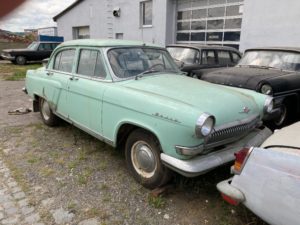
GAZ Volha 21

Year of Manufacture: 1964
Power: 71 hp
Displacement:2,445 cm3

Number of cylinders/valves: 4/2

Weight: 1,300 kg

Condition: good

Catalog Number: 250

This car was a Soviet upper-middle-class vehicle produced between 1956 and 1970. Nobody called it anything but Volga, and its most famous nickname was “Tsarevna.”

It was the successor to the Pobeda, which was the first Soviet car with a unibody construction. Development began in 1954, and production started in 1956. The design was inspired by some American cars of the time, and the Volga was indeed a good car for its era. It is a four-door sedan with a spacious interior.

The engine in the first series was only a modified Pobeda engine. From 1957 onwards, it received a completely new engine with an aluminum block and OHV valve train. It had a displacement of 2,445 cm3 and produced 71 hp. The car reached a top speed of 130 km/h. The transmission had 3 speeds, and thanks to the excellent flexibility of the engine, the car could handle almost everything in third gear. The front axle had independent suspension, while the rear axle was rigid.

The car underwent three modernizations, and from 1962 it was known as the so-called 3rd series. The modernizations mainly involved changes to the exterior bodywork, especially the radiator grille. It also received a new carburetor, and its power increased to between 75 and 85 hp.

It was also produced as a station wagon under the designation GAZ-22 Universal.

The car from our collection is a 3rd series model.

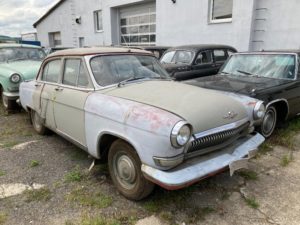
GAZ Volha 21

Year of Manufacture: 1964
Power: 71 hp
Displacement:2,445 cm3

Number of cylinders/valves: 4/2

Weight: 1,300 kg

Condition: good

Catalog Number: 249

This car was a Soviet upper-middle-class vehicle produced between 1956 and 1970. Nobody called it anything but Volga, and its most famous nickname was “Tsarevna” (The Tsarina).

It was the successor to the Pobeda, which was the first Soviet car with a unibody construction. Development started in 1954, and production began in 1956. The design was inspired by some American cars of that time, and the Volga was indeed a good car for its era. It is a four-door sedan with a spacious interior.

The engine in the first series was only a modified Pobeda engine. From 1957 onward, it received a completely new engine with an aluminum block and OHV valve train. It featured a displacement of 2,445 cm3 and produced 71 hp. The car could reach a top speed of 130 km/h. The transmission had 3 speeds, and due to the excellent flexibility of the engine, the car could handle almost everything in third gear. The front axle had independent suspension, while the rear axle was rigid.

The car underwent three modernizations, with the so-called 3rd series introduced from 1962. The updates mainly involved exterior modifications, especially the radiator grille. It also received a new carburetor, and its power increased to 75 to 85 hp.

It was also produced as a station wagon under the designation GAZ-22 Universal.

The car from our collection is a 3rd series model.

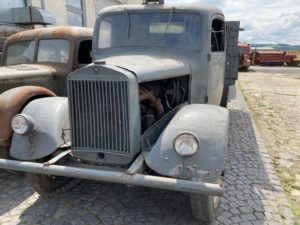
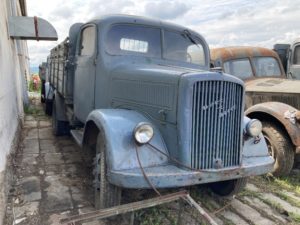
Mercedes Benz L 3000 LKW

Year of Manufacture: 1940
Power: 75 hp
Displacement:4,849 cm3

Number of cylinders/valves: 4/2

Weight: 7,000 kg

Catalog Number: 238

The Mercedes-Benz L 3000 is a two-axle truck manufactured by the German company Daimler-Benz AG, produced between 1938 and 1944. From 1939 onward, models with rear-wheel drive were produced and designated as L 3000 S. Models with all-wheel drive were called L 3000 A, and these were only built between 1939 and 1942.

This model was a key cargo vehicle in the arsenal of the German army during World War II. Countless different superstructures were installed on the basic chassis for broad use in military operations.

In all versions, more than 27,000 units of these trucks were ultimately built.

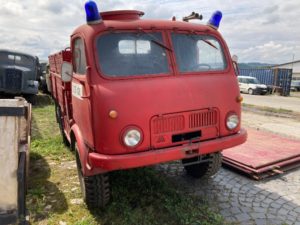
Tatra 805

Year of Manufacture: 1955
Power: 75 hp
Displacement:2,545 cm3

Number of cylinders/valves: 8/2

Weight: 4,450 kg

Condition: Operational

Catalog Number: 235

This light off-road truck, colloquially nicknamed “Duck,” “Squealer,” or “Whistler” due to the characteristic whining sound of the engine under load and during gear shifts, was manufactured by Tatra between 1952 and 1960.

The vehicle was developed specifically for military needs, requiring a vehicle capable of driving in difficult terrain with high towing power.

The chassis of the T 805 model was structurally based on the previous prototypes T 803 and T 804. The main innovation was the “trambus” cab, which required repositioning the driver’s seat.

Engine

The Tatra 805 was powered by an air-cooled, gasoline, V8 engine type T 603A with a displacement of 2,545 cm3. The engine differed from the passenger car versions by using a single carburetor, a lower compression ratio, forced cooling fans, and a “dry” crankcase with dual oil pumps.

Transmission

The four-speed transmission was supplemented by a two-speed auxiliary gearbox, allowing better adaptation to off-road conditions.

Chassis

The chassis was designed as a prime example of off-road construction. The torsion bar suspension on both axles ensured a comfortable ride even at higher speeds on paved roads. A weak point was the single-circuit hydraulic drum brakes without power assistance.

Usage

In the civilian sector, the Tatra 805 was used as delivery or street-sweeping vehicles, or with various special box body modifications such as a silver-painted van, known from Czechoslovak films.

The most famous application was the expedition vehicles used by travelers Zikmund and Hanzelka. These special vehicles featured a light-reflecting paint, thermal insulation, reinforced steering wheels, taller windshields, and trailer carts.

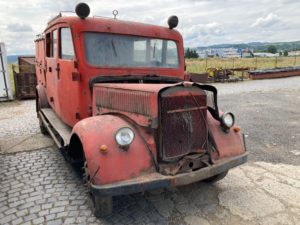
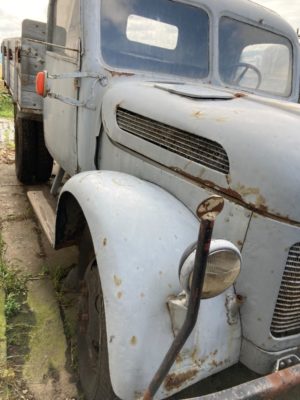
Opel Blitz fire truck body

Year of manufacture: 1942
Power: 75 hp
Displacement:3,626 cm3

Number of cylinders/valves: 6/2

Weight: 5,800 kg

Condition: Damaged

Catalog number: 243

Before World War II, Opel was the largest German manufacturer of trucks. The name Blitz was first used for a new Opel truck introduced in November 1930. As part of the Nazi economy and Germany’s rearmament efforts, authorities ordered the construction of the Opelwerk Brandenburg factory. Between 1935 and 1944, more than 130,000 trucks and chassis of various designs and load capacities were produced.

The original factory in Rüsselsheim could not keep up with the required production volume, so the German leadership decided to build a new factory on a “greenfield” site. Construction of the factory, from groundbreaking to the assembly of the first vehicle, took an incredible 7 months. On August 6, 1944, the factory was largely destroyed by an RAF air raid, and production was moved to the Mercedes Benz factory, where it replaced the MB L3000 model.

The Opel Blitz was a medium-duty truck intended in the 1930s and 1940s mainly for tasks related to offensive military operations. It was used both in Africa and on the Eastern Front. Countless versions were made, including various bodies, flatbeds, and it also served as a tractor for artillery and trailers.

The base design was a 4×2 with rear-wheel drive and two wheelbase lengths. Later, an all-wheel-drive version was added. The engine was initially a flat six-cylinder. However, the majority of production was equipped with an inline six-cylinder engine with displacements of 2.5, 3.4, and 3.7 liters producing 55, 64, and 75 hp. The total weight ranged from 2,300 kg up to 6,000 kg.

It was the most widespread truck of the German Wehrmacht during World War II. After Germany’s defeat, the Opel factories in Brandenburg fell into the Soviet zone and were completely dismantled, with equipment shipped east. Production of the Blitz did not continue in the USSR. Production in Rüsselsheim was soon resumed, and the first post-war Blitz was completed on July 15, 1946.

This vehicle has a fire-fighting body.


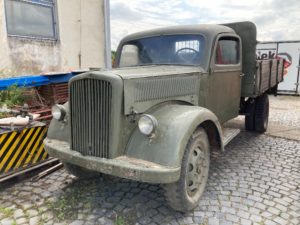
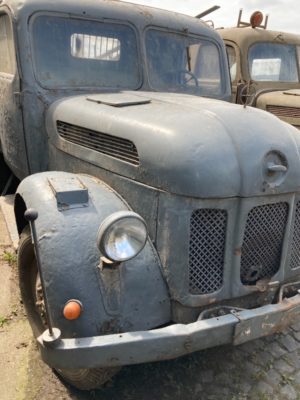
Opel Blitz flatbed

Year of manufacture: 1942
Power: 75 hp
Displacement:3,626 cm3

Number of cylinders/valves: 6/2

Weight: 5,800 kg

Condition: Damaged

Catalog number: 242

Before World War II, Opel was the largest German manufacturer of trucks. The name Blitz was first used for a new Opel truck introduced in November 1930. As part of the Nazi economy and Germany’s rearmament efforts, authorities ordered the construction of the Opelwerk Brandenburg factory. Between 1935 and 1944, more than 130,000 trucks and chassis of various designs and load capacities were produced.

The original factory in Rüsselsheim could not keep up with the required production volume, so the German leadership decided to build a new factory on a “greenfield” site. Construction of the factory, from groundbreaking to the assembly of the first vehicle, took an incredible 7 months. On August 6, 1944, the factory was largely destroyed by an RAF air raid, and production was moved to the Mercedes Benz factory, where it replaced the MB L3000 model.

The Opel Blitz was a medium-duty truck intended in the 1930s and 1940s mainly for tasks related to offensive military operations. It was used both in Africa and on the Eastern Front. Countless versions were made, including various bodies, flatbeds, and it also served as a tractor for artillery and trailers.

The base design was a 4×2 with rear-wheel drive and two wheelbase lengths. Later, an all-wheel-drive version was added. The engine was initially a flat six-cylinder. However, the majority of production was equipped with an inline six-cylinder engine with displacements of 2.5, 3.4, and 3.7 liters producing 55, 64, and 75 hp. The total weight ranged from 2,300 kg up to 6,000 kg.

It was the most widespread truck of the German Wehrmacht during World War II. After Germany’s defeat, the Opel factories in Brandenburg fell into the Soviet zone and were completely dismantled, with equipment shipped east. Production of the Blitz did not continue in the USSR. Production in Rüsselsheim was soon resumed, and the first post-war Blitz was completed on July 15, 1946.

This vehicle is a classic flatbed truck for transporting materials.


Opel Blitz flatbed

Year of manufacture: 1942
Power: 75 hp
Displacement:3,626 cm3

Number of cylinders/valves: 6/2

Weight: 5,800 kg

Condition: Damaged

Catalog number: 236

Before World War II, Opel was the largest German manufacturer of trucks. The name Blitz was first used for a new Opel truck introduced in November 1930. As part of the Nazi economy and Germany’s rearmament efforts, authorities ordered the construction of the Opelwerk Brandenburg factory. Between 1935 and 1944, more than 130,000 trucks and chassis of various designs and load capacities were produced.

The original factory in Rüsselsheim could not keep up with the required production volume, so the German leadership decided to build a new factory on a “greenfield” site. Construction of the factory, from groundbreaking to the assembly of the first vehicle, took an incredible 7 months. On August 6, 1944, the factory was largely destroyed by an RAF air raid, and production was moved to the Mercedes Benz factory, where it replaced the MB L3000 model.

The Opel Blitz was a medium-duty truck intended in the 1930s and 1940s mainly for tasks related to offensive military operations. It was used both in Africa and on the Eastern Front. Countless versions were made, including various bodies, flatbeds, and it also served as a tractor for artillery and trailers.

The base design was a 4×2 with rear-wheel drive and two wheelbase lengths. Later, an all-wheel-drive version was added. The engine was initially a flat six-cylinder. However, the majority of production was equipped with an inline six-cylinder engine with displacements of 2.5, 3.4, and 3.7 liters producing 55, 64, and 75 hp. The total weight ranged from 2,300 kg up to 6,000 kg.

It was the most widespread truck of the German Wehrmacht during World War II. After Germany’s defeat, the Opel factories in Brandenburg fell into the Soviet zone and were completely dismantled, with equipment shipped east. Production of the Blitz did not continue in the USSR. Production in Rüsselsheim was soon resumed, and the first post-war Blitz was completed on July 15, 1946.

This vehicle is a flatbed truck designed for transporting soldiers, including seats in the cargo bed.


Steyr 1 500A flatbed truck

Year of manufacture: 1941
Power: 85 hp
Displacement:3,517 cm3

Number of cylinders/valves: 8/2
Weight: 2,480 kg

Condition: not drivable

Catalog number: 241

This vehicle was a light truck used by Germany during World War II. Its designer was Ferdinand Porsche. It had an air-cooled V8 engine with a displacement of 3.5 liters and a power output of 85 hp. An interesting feature is the front axle suspended on torsion bars, while the rear axle was a conventional rigid type with leaf springs. This model allowed for mounting various superstructures and had wide use by ground forces. It had a payload capacity of 1.6 tons and could reach speeds up to 100 km/h on roads.

Approximately 18,000 vehicles were produced between 1941 and 1944.

The vehicle shown from our collection is a standard flatbed truck.

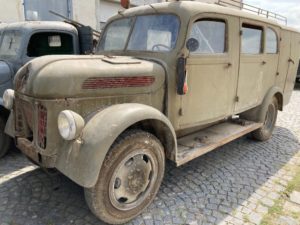
Steyr 1 500A

Year of manufacture: 1941
Power: 85 hp
Displacement:3,517 cm3

Number of cylinders/valves: 8/2
Weight: 2,480 kg

Condition: not drivable

Catalog number: 240

This vehicle was a light truck used by Germany during World War II. Its designer was Ferdinand Porsche. It had an air-cooled V8 engine with a displacement of 3.5 liters and a power output of 85 hp. An interesting feature is the front axle, which was suspended on torsion bars, while the rear axle was a conventional rigid type with leaf springs. This model allowed for the mounting of various superstructures and had a wide range of uses for ground forces. Its payload capacity was 1.6 tons, and it could reach speeds of up to 100 km/h on roads.

Approximately 18,000 vehicles were produced between 1941 and 1944.

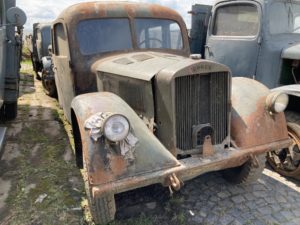
The vehicle shown from our collection is a box-type radio station.


Steyr 1 500A

Year of manufacture: 1941
Power: 85 hp
Displacement:3,517 cm3

Number of cylinders/valves: 8/2
Weight: 2,480 kg

Condition: not drivable

Catalog number: 239

This vehicle was a light truck used by Germany during World War II. Its designer was Ferdinand Porsche. It had an air-cooled V8 engine with a displacement of 3.5 liters and a power output of 85 hp. An interesting feature is the front axle, which was suspended on torsion bars, while the rear axle was a conventional rigid type with leaf springs. This model allowed for the mounting of various superstructures and had a wide range of uses for ground forces. Its payload capacity was 1.6 tons, and it could reach speeds of up to 100 km/h on roads.

Approximately 18,000 vehicles were produced between 1941 and 1944.

The vehicle shown from our collection is a box-type radio station.


Steyr 1 500A

Year of manufacture: 1941
Power: 85 hp
Displacement:3,517 cm3

Number of cylinders/valves: 8/2
Weight: 2,480 kg

Condition: drivable

Catalog number: 231

This vehicle was a light truck used by Germany during World War II. Its designer was Ferdinand Porsche. It had an air-cooled V8 engine with a displacement of 3.5 liters and a power output of 85 hp. An interesting feature is the front axle, which was suspended by torsion bars, while the rear was a classic rigid axle with leaf springs. This type allowed the installation of various superstructures and had wide use in ground forces. Its payload capacity was 1.6 tons, and it could reach speeds of up to 100 km/h on roads.

Approximately 18,000 vehicles were produced between 1941 and 1944.

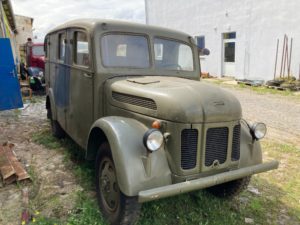
The vehicle pictured from our collection has a box body superstructure.


Horch 901

Year of manufacture: 1938
Power: 80 hp
Displacement:3,500 cm3

Number of cylinders/valves: 8/2
Weight: 3,000 kg

Condition: drivable

Catalog number: 237

The Horch 901 was a mid-class military personnel and cargo vehicle. It was primarily used by the German Wehrmacht army as a multipurpose vehicle for various tasks. It was deployed on all battlefields of World War II. The engine was derived from the civilian Horch 830, and the chassis met very strict requirements for off-road operation. Approximately 28,000 units of this vehicle were produced.

The vehicle from our collection is a closed box version used as a radio station.

Mercedes Benz 1500 S LLG

Year of Manufacture: 1942
Power: 60 horsepower
Displacement:2,594 cm3

Number of Cylinders/Valves: 6/2
Weight: 4,080 kg

Condition: damaged

Catalogue Number: 234

The Mercedes-Benz L 1500 S is a light-duty truck. Daimler-Benz built it for the German Wehrmacht and, especially, in large numbers for fire brigades during World War II.

It was available in two versions: the L 1500 S with rear-wheel drive only, and the L 1500 A with all-wheel drive. Most of the produced vehicles were ultimately used as transporters for infantry troops, and about one-third of the vehicles served as special fire trucks.

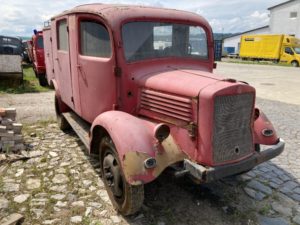
Our vehicle features the classic fire brigade box body.

Horch 951 cabrio

Year of Manufacture: 1938
Power: 120 horsepower
Displacement:4,944 cm3

Number of Cylinders/Valves: 8/2
Weight: 3,000 kg

Condition:

Catalogue Number: 102

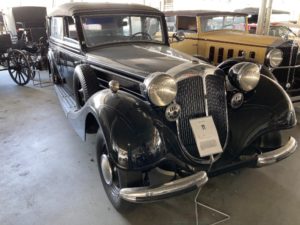
This is the black pearl from Alois Samohýl’s collection. You cannot escape the history behind this five-liter eight-cylinder engine.

The machine undoubtedly boasts both technical and aesthetic qualities, ingenious solutions, and interesting features. At first glance, you are struck by the wide radiator with the four-ring logo. Yet this is not an Audi, but an older and more elite brand from the same founder, August Horch.

Between 1926 and 1937, 25,000 eight-cylinder cars of this brand were produced. In the category over 5,000 cm3, their sales far outpaced those of competing Mercedes-Benz and their serious rivals were essentially only large-scale American cars with more modern design and lower prices. Horch was designed for more demanding conditions, which it could handle thanks to its sturdy chassis.

The car has an inline eight-cylinder engine with a 5-liter displacement and 120 horsepower. It features a four-speed gearbox and, despite weighing almost 3.5 tons, could reach speeds up to 150 km/h. The chassis is a frame construction, with independent front suspension and a De Dion rear axle. On this chassis sits a true gem.

The Dresden specialist Gläser meticulously crafted the Pullman convertible body. The roof is made of six layers, with a thick padding (“houna”) in the middle. Two to three passengers on the rear bench will appreciate the pair of heating vents in the floor, regulated by rotary dampers. The coachbuilders used plenty of longitudinal space not only to install folding emergency seats for children or subordinates. In this last series of these 951 cars, only three such bodies were made, making it a true unique piece.

And the history of this car? It came to Czechoslovakia in 1939 and served the first man of the Protectorate of Bohemia and Moravia, Konstantin von Neurath. His successor, Reinhard Heydrich, preferred Mercedes-Benz cars, so this vehicle was assigned to his deputy, Karl Hermann Frank. Frank used it until the end of the war. There is even evidence that Frank drove in this very car to inspect the burning of the village of Lidice. Thus, the car left a very dark mark in our history. However, after the war, none of that prevented Klement Gottwald from using it for some time. Eventually, it ended up with firefighters in the East Bohemian town of Chroustovice and was modified as a fire engine tractor.

In November 1968, an article appeared in Rudé Právo urging whether the National Technical Museum in Prague should take care of the unique vehicle. However, the museum showed little interest. The opportunity was then seized by the collector from Zlín and the manager of the AZNP brand dealership, Alois Samohýl. He acquired the vehicle in 1977 after lengthy negotiations, during which he promised the firefighters to restore the Horch and not to sell it abroad. The result of three years and 6,200 hours of workshop work today ranks among the most valuable exhibits in the Zlín collection of the Samohýl family.

Zil 117

Year of Manufacture: 1978
Power: 300 horsepower
Displacement:6,959 cm3

Number of Cylinders/Valves: 8/2
Weight: 2,880 kg

Condition: Operational

Catalogue Number: 248

First, it transported communist party elites — later, it chauffeured a British secret agent on the silver screen.

The size of the car is not the main issue — it’s the handling that requires attention. The brakes must be approached with respect. The early ZIL 114 models were equipped with drum brakes, later replaced by disc brakes. The car can accelerate from 0 to 100 km/h in 13 seconds. Average fuel consumption hovers around 30 liters per 100 km — sometimes even up to 40 liters.

The representative ZIL 117 was manufactured between 1971 and 1983. It was a shortened version of the ZIL 114 limousine. This four-door, four- to five-seater sedan had a front-mounted engine and rear-wheel drive. It delivered 300 horsepower at 4,400 rpm. It came with a two-speed automatic transmission and reached a top speed of 200 km/h.

Upon sitting inside, one is surprised by the deeply cushioned seats. At first glance, the seats may appear uncomfortable — but quite the opposite is true. The driving comfort is exceptional. The performance of the three-speed transmission is impressive. Modern systems would envy its smoothness — it keeps the engine at low revs without over-revving during gear changes.

The Samohýl family collection includes 17 ZIL and Chaika state limousines — cars that were never meant to be preserved. After being decommissioned from the Ministry of the Interior in the 1980s, they were supposed to be scrapped for security reasons. However, the Samohýl family guaranteed the vehicles would be used solely for exhibition purposes. After the Velvet Revolution, they were able to acquire a stockpile of spare parts in Kralupy at a favorable price.

It’s worth noting that this particular ZIL also appeared in the James Bond film *Casino Royale*, where its trunk was used to hide two corpses.