Showing 97–112 of 146 results

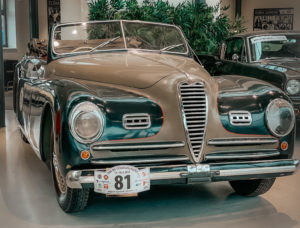
Alfa Romeo 6C 2500

Year of manufacture: 1948
Power: 95 hp
Displacement: 2,443 cm3

Number of cylinders/valves: 6/2
Weight: 1,430 kg

Condition: operational
Catalogue number: 196

The history of the legendary Alfa Romeo model with the designation 6C dates back to the early 1920s. At that time, Vittorio Jano, Alfa’s chief engineer, was tasked with creating, alongside successful racing cars, a brilliant, powerful, and lightweight car that would win races, command admiration, and conquer new markets as a commercial product. The first car bearing the 6C designation was introduced in 1925 but started production in 1927. The production of this type, after many innovations and improvements, ended only in 1954.

The Alfa Romeo 6C 2500 was introduced in 1938 and is the last road car of the 6C series. It represents a significant moment in the history of one of the most popular motor brands. It is the best and most advanced evolution of the great pre-war lineup. Immediately after World War II, it continued this tradition and was among the absolute best and most expensive cars available at that time. With its Pinin Farina body, this rare sports convertible is a unique proof of that.

This car, called the “Last Great Alfa,” marked the end of a long series of six-cylinder Alfa Romeo cars. It was produced between 1938 and 1952, with a total of 1,313 units made. During this period, this model bridged two radically different eras for the brand.

The first era was before World War II, characterized by large, exclusive, hand-built cars produced in relatively small numbers. They attracted a worldwide clientele of celebrities, especially those who loved highly sought-after top models. The Alfa Romeo 6C 2500, one of the most expensive luxury cars of its era, was popular among legends such as Rita Hayworth, Tyrone Power, and many others. This trend lasted into the early 1950s.

The second era appeared after the war and consisted of smaller, more modern, and more affordable sports cars. This production shift was necessitated by the post-war situation and market demands.

The factory mostly supplied complete chassis, while the bodies came from renowned Italian coachbuilders, primarily Bertone, Zagato, and of course Pinin Farina. The Alfa Romeo 6C 2500 was available in Turismo, Sport, and Super Sport versions, differing partly in technical details and power output. Many of the Pinin Farina-built cars were made in Sport and Super Sport versions.

The vehicles had only hand-assembled chassis and gearbox parts on the production line, but the body and interior design, which was perfect, was done by the Italian design studio Pinin Farina. The interior was upholstered with beautiful red leather. Key interior features included an ivory-colored steering wheel, wooden trim, and bright yellow control knobs. The car ran on chromed wire wheels with two-eared “discs” bearing the Alfa Romeo brand. The trunk held a fifth, spare wire wheel.

“6C” in the model name referred to six cylinders, with an engine capacity of 2,443 cm3, equipped with single, double, or triple carburetors. This Alfa Romeo could reach a maximum speed of 160 km/h with a 4-speed manual gearbox, producing 95 hp. The model had rear-wheel drive, independent suspension on all four wheels inherited from the 6C 2300 model, with double wishbones up front, coil springs, and hydraulic drum brakes on all four wheels. The two-door Alfa Romeo had a wheelbase of 3,000 mm and external dimensions of 5200x1800x1500 mm. The estimated weight is about 1,430 kg.

The car from our collection is in fully functional and perfect condition, as evidenced by its recent participation in historic car races.
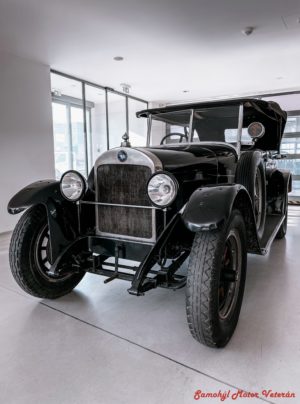
Laurin & Klement 110

Year of manufacture: 1925
Power: 25 hp
Displacement: 1,791 cm3

Number of cylinders/valves: 4/2
Weight: 1,250 kg

Condition: operational
Catalogue number: 135

In the mid-1920s, the automotive industry experienced rapid development. Our oldest car manufacturer, Laurin & Klement in Mladá Boleslav, produced and successfully sold a range of passenger and commercial vehicles. However, to further develop production, they needed capital. Therefore, in 1925, they merged with the industrial Škoda Plzeň concern, which became the sole owner of the Mladá Boleslav manufacturer. This brought about production reorganization, and the concern’s companies began cooperating closely. According to the agreement between the former Laurin & Klement and the Škoda concern, machines designed before August 1925 bore the L & K – Škoda badge, so the popular four-cylinder model type 110 could feature logos of both companies on the radiator grille. Machines designed after this date were labeled only Škoda.

Between 1925 and 1929, the L&K-Škoda 110 was produced. The bore was 72 mm and the stroke 110 mm. Ten series were produced; the first and second had a 1,791 cm3 inline four-cylinder engine with SV valve timing and a power output of 18 kW, with a top speed of 80 km/h. From the third series in 1926, a 1,944 cm3 engine with 22 kW power and a maximum speed of 85 km/h was used, again an inline four-cylinder engine also used in the passenger L&K 120, as well as the commercial Škoda 115 and 125. The overall construction reflects mid-1920s technology. The chassis was a riveted steel ladder frame made from U-profiles. Both front and rear axles were rigid and suspended with longitudinal semi-elliptical leaf springs. The steering operated by a screw and nut mechanism. The engine was coupled to a dry, multi-plate clutch, which connected to a four-speed unsynchronized gearbox housed in the same block as the engine. The rear axle was driven via a driveshaft. The vehicle’s external dimensions were 4200x1600x1300 mm.

It was produced in several body styles, such as sedan, phaeton, limousine, roadster, coupe, estate, commercial truck, and ambulance.

A total of 2,550 units of this L&K 110 type were produced. The model was based on the previous Laurin & Klement 150 and was replaced by the Škoda 4R.

An interesting fact is that the Laurin & Klement brand was the most famous and drove on the roads of the First Czechoslovak Republic, with one of the cars even owned by the first president, Tomáš Garrigue Masaryk.

The car from our collection is in fully operational condition.


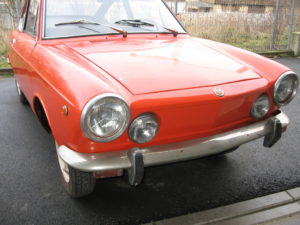
Fiat 850 Sport Coupé

Year of manufacture: 1971
Power: 52 hp
Displacement: 903 cm3

Number of cylinders/valves: 4/2
Weight: 715 kg

Condition: operational
Catalogue number: 50


Introduction
The FIAT brand originally stood for Fabbrica Italiana Automobili Torino, now Fiat Automobiles S.p.A., an automaker founded in Turin, Italy, in 1899, making it one of the oldest in Europe.

Development
The predecessor of this model was the Fiat 600 of similar concept. In 1964, its successor, the Fiat 850, was introduced, which was later replaced by the Fiat 127, a completely different concept. All these models made a significant mark in automotive history.

Technical Specifications
The Fiat 850 is a small two-door passenger car with a rear-mounted engine and rear-wheel drive. It features a four-cylinder inline OHV engine with a displacement of 903 cm3, bore of 65 mm and stroke of 68 mm, compression ratio of 9.5, producing 38 kW (52 hp) at 6,500 rpm, and torque of 66 Nm at 4,000 rpm.
It has a four-speed manual transmission, wheelbase of 2,030 mm, external dimensions 3650x1500x1300 mm, weight 700 kg, top speed of 145 km/h, and acceleration to 100 km/h in 17.7 seconds.

Production
The Fiat 850 was produced until 1971, with a total of 342,873 units made. The model was based on the earlier Fiat 600. It was intended to serve as an affordable family car accessible to the general public, with a focus on increased usability through more rear passenger space.
For enhanced safety, the body was reinforced, and the fuel tank was relocated from the front to behind the rear seat backrest, significantly increasing the luggage space.
The interior featured a wooden dashboard surface, a large dual-circuit racing-style instrument panel reminiscent of Ferrari anni cinquanta, and sport-type seats that were comfortable for long journeys with foldable backrests.

Market
After its launch, this model became popular due to its low price, ease of maintenance, and relatively solid utility value compared to its costs.

Models
In 1965 at the Geneva Motor Show, the Fiat 850 Coupé and Fiat 850 Spider versions were introduced. The Spider gained the greatest success in the USA, where it remains sought-after to this day.
In 1968, disc brakes were introduced in the 850 Berlina Special, which featured a different gearbox that provided excellent acceleration for the 47 hp engine, although fuel consumption increased due to shorter gear ratios.
That same year, the Coupé was replaced by the newer Sport Coupé with four round headlights on the front. The main upgrade was the 903 cm3 engine, later used in the Fiat 127 models until the early 1990s.
Also notable were the “large space” Fiat 850 transporter and Familiare station wagon with three rows of seats, replaced in the mid-1970s by the Fiat 900 E featuring body elements from the Fiat 127.

Interesting Fact
An interesting fact about this car is its engine’s left-hand rotation, which originated from the gearbox design history. The gearbox was originally intended for Simca’s new front-engine, front-wheel-drive 1100 model, but after that plan was abandoned, Italian engineers used the gearbox in the 850 model. They had to reverse the crankshaft rotation to prevent the car from having one forward gear and four reverse gears.


The car in our collection is a Fiat 850 Sport Coupé in fully operational and preserved condition. The Sport Coupé was, at its time, a beautiful example of a sports car built on the basis of an ordinary passenger car, and it remains so to this day.

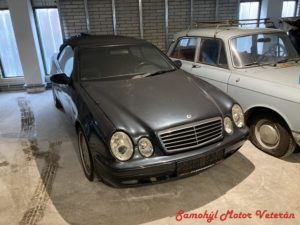
Mercedes-Benz CLK 230 A208

Year of manufacture: 1998
Power: 193 hp
Displacement: 2,295 cm3

Number of cylinders/valves: 4/4
Weight: 1,550 kg

Condition: operational
Catalogue number: 20


This model was the first generation of the Mercedes-Benz CLK, first showcased at the Geneva Motor Show in March 1993. Mercedes-Benz does not officially use the W208 designation since the CLK is not a sedan; however, W208 is commonly used as a collective term for the C208 (coupe) and A208 (convertible) models.

The Mercedes-Benz 208 series was produced as a coupe from mid-1997 until summer 2002, with around 100,000 units made. The convertible was produced from mid-1998 until spring 2003, with 21,000 units built. In September 1999, the model received a facelift with exterior updates.

Technically, the 208 series is based on the platform of the former C-Class (W202). Externally, the CLK derives from the CE 500 design study from the early 1990s, thus bearing a closer resemblance to the W210 series. The Mercedes CLK with a 2.3-liter supercharged engine delivers 142 kW at 5300 rpm. The top speed is 230 km/h. The CLK was equipped with 16-inch alloy wheels and 225/50 R16 tires, which combined with the suspension provided excellent driving dynamics.

Until September 1999, there were two equipment variants to choose from: Standard or Extra. The Standard equipment was further divided into two lines – Sport and Elegance. By the end of 1999, the Sport line was discontinued, and only the Elegance variant and the new Avantgarde line were available. Avantgarde was the successor to the Sport line but aimed to convey a sportier impression. In 2001, the Master Edition trim was introduced, and in the final production year, 2002, the Final Edition was available, which was offered only for the convertible.

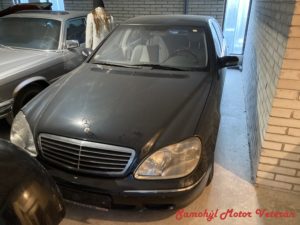
Mercedes-Benz S430L V220

Year of manufacture: 1999
Power: 279 hp
Displacement: 4,266 cm3

Number of cylinders/valves: 8/3
Weight: 1,875 kg

Condition: operational
Catalogue number: 22


The Mercedes-Benz W220 was a flagship sedan model series representing the Mercedes-Benz S-Class from the early to mid-2000s. Development of the W220 began in 1992, with the final design approved by Steve Mattin in 1994. Completed prototypes were unveiled in June 1998.

Production of the W220 started on August 13, 1998, with the C215 CL-Class coupe launched in 1999. The W220 model replaced the earlier W140 S-Class after the 1998 model year. Compared to its predecessor, the W220 had somewhat smaller external dimensions but offered more interior space, especially in the long-wheelbase versions.

In 2000, a facelifted version of the S-Class was designed, which was introduced in September 2002. Production ended in 2006 when the W220 was replaced by the W221 S-Class, and the C215 was replaced by the C216 CL-Class in 2006. In many European countries, the most popular model was the S320 CDI diesel version, making it the first S-Class with a diesel engine to achieve widespread appeal.

Other engine options included various gasoline V6, V8, and V12 engines, with power ranging from 197 to 612 hp in the AMG versions. Both long and short wheelbase versions were available, as well as, for the first time in an S-Class, an all-wheel-drive variant. As is typical for S-Class vehicles, the W220 introduced significant technological advances, especially two types of suspension systems: the air suspension Airmatic and the more advanced hydropneumatic Active Body Control.

Our vehicle features an engine with 279 hp, classic front-engine, rear-wheel-drive layout. With a five-speed transmission, it reaches a top speed of 250 km/h. The total production of the S430L model was 75,328 units.

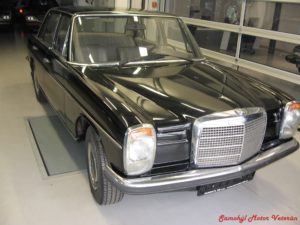
Mercedes-Benz 230 W114

Year of manufacture: 1972
Power: 135 hp
Displacement: 2,292 cm3

Number of cylinders/valves: 6/2
Weight: 1,355 kg

Condition: operational
Catalogue number: 97

The Mercedes-Benz W114 and W115 (nicknamed the “shorty”) was the internal designation used by Mercedes-Benz for a generation of classic sedans and coupes with a front-mounted engine and rear-wheel drive, introduced in 1968. At that time, Mercedes sold sedans in two classes: the mid-range W114/W115 and the larger S-Class.

The W114/W115 models were distinguished on the market by engine size badges. The W114 models had six-cylinder engines and were sold as 230, 250, and 280. Conversely, the W115 models had four-cylinder engines and were labeled 200 and 220. These also included brand-new diesel engines under the designations 200D and 220D. The cars were widely exported to North America, where they had differences mainly in body design.

The W114/W115 models were the first post-war Mercedes-Benz vehicles to use newly designed suspension, not derived from previous models. The new semi-trailing rear arms and front suspension with ball joints, first applied on the W114, were used on all new Mercedes passenger cars until the development of multi-link rear suspension in the 1980s.

The Mercedes-Benz W114/W115 was a mid-sized sedan positioned below the S-Class in the lineup. The company introduced its very first 5-cylinder diesel engine OM617 in this model. The car was designed by French automotive designer Paul Bracq, who was Mercedes-Benz’s chief designer for models from 1957 to 1967.

In 1969, Mercedes introduced the W114 coupe variant with a longer trunk lid and either a 2.5 or 2.8-liter six-cylinder engine. The W114 underwent a facelift in 1973 – featuring a lower hood line, a lower and wider grille, a simple front bumper replacing the previous double bumpers, lower headlight placement, modified A-pillars for better side window visibility, removal of the quarter windows in front doors, ribbed tail lights to minimize dirt coverage, and larger side mirrors. The interior received retractable seat belts and a new padded steering wheel with a four-hole design.

This model became crucial for Mercedes-Benz at the time, earning a reputation for incredible quality and near indestructibility. However, the company charged a premium for these qualities; the model was certainly not cheap. In total, 1,919,056 units were produced, including 67,048 coupes. At that time, it was the most successful model in the company’s history. The successor, introduced in 1976, was the new W123, the legendary “piano,” which eventually surpassed it in every way, including production numbers.

The car in our collection is a fairly well-preserved classic sedan with a 2.3-liter six-cylinder engine.

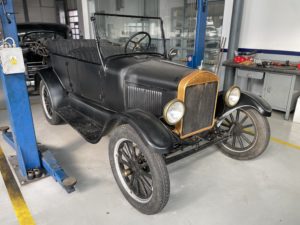
Ford T

Year of manufacture: 1925
Power: 22 hp
Displacement: 2,895 cm3

Number of cylinders/valves: 4/2
Weight: 750 kg

Condition: operational
Catalogue number: 116

Introduction
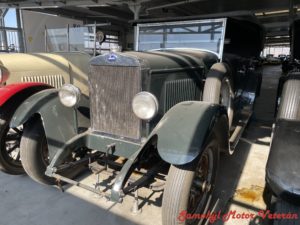
The Ford Model T was a car manufactured by the Ford Motor Company of Henry Ford from 1908 to 1927. The Model T is generally regarded as the first affordable automobile that “put America on wheels.”

Development
The series started with the Model A, but there were not 19 produced models (from A to T), as some remained only prototypes. Immediately before the Model T, the Ford Model S was produced, an improved version of the then most successful Ford Model N.

Contrary to expectations, the Ford T was not followed by Model U, but by the Ford Model A. The company publicly declared that the new car was so much better than the old one that Henry Ford wanted to start again from the letter A. In 1999, the Ford Model T was named Car of the Century, and a year later, the Model T engine was included among the top 10 engines of the century.

Technical specifications
The Model T had a front-mounted four-cylinder inline gasoline engine with a displacement of 2.9 liters producing 15 kW, with a top speed of 64–72 km/h. This small four-cylinder engine was known for its SV valve timing with an L-head design. According to Ford Motor Company, the Model T had a fuel consumption of approximately 11.1 to 18.7 liters per 100 km. The engine could run on gasoline or ethanol.

The car was rear-wheel drive. The transmission was called a three-speed, but in reality had 2 forward speeds and one reverse gear. It was operated using three pedals and a lever located by the driver’s seat. Throttle was controlled by a lever on the steering column. The left pedal was used for gear selection. When pressed and held forward, low (slow) gear was engaged. Held in the middle position was neutral. Neutral could also be engaged by pulling the lever into a vertical position. When the lever was pushed forward and the driver lifted their foot off the left pedal, the Model T engaged the higher gear. The car could drive this way even without any pedal pressed. There was no clutch pedal.

Wooden, spoked steel wheels were available in 1926 and 1927. Tires had a diameter of about 76 cm; front tires were 5 cm wide, rear tires 8.9 cm wide. The wheelbase was approximately 2,515 mm.

Production
When the model was introduced, it used the production methods of its time, being assembled by hand, and production was small. It took 12.5 hours to build one car; after the assembly line was introduced, it took 1 hour and 33 minutes using less labor. In 1914, Ford produced more cars than all other manufacturers combined. The Model T was a huge commercial success and when Henry produced his 10 millionth car, 9 out of 10 cars worldwide bore the Ford brand. It was so successful that Ford did not need to spend on advertising between 1917 and 1923. A total of 15,007,033 Model T vehicles were produced, more than almost any other model of the century.

During production, several major design changes occurred. One of the first changes involved using brass for the radiator and headlights. The horn and some other details were also brass. Many early cars had open bodies, which were cheaper to produce than closed ones. Until the 1911 model year, American-made cars had no doors for the driver. Later model years included closed bodies such as sedans, coupes, and in 1917, a truck chassis. The truck chassis, called the Ford Model TT, differed mainly by having a reinforced frame and a wheelbase extended by two feet. Many companies built bodies on these chassis, resulting in various tankers, buses, fire trucks, and other superstructures.

It is often said that Ford was only produced in black because black paint dried faster than other colors, allowing faster production—no need to wait long for paint to dry. Over 30 different types of black paint were available. Henry Ford famously said, “Any customer can have a car painted any color that he wants so long as it is black.” The Model T was produced in other colors, but only from 1908 to 1914 and again in 1926 and 1927. The different types of paint were justified by the need to meet various conditions for applying paint on different parts and different drying times depending on paint color and method used. Ford’s technical records indicate black was chosen for its cost and durability.

Market
The standard four-seat open tourer for the 1909 model year cost $850; comparable cars at that time cost $2,000 to $3,000. In 1913, the price dropped to $550, and in 1915, it reached $440. In the 1920s, the price fell as low as $300.

Sales
The Ford Model T was the first automobile produced simultaneously in multiple locations worldwide. The first Model Ts outside America rolled off the lines in the United Kingdom, followed by production in Germany and various South American countries, including Argentina and Brazil.

Trivia
The Model T appeared in many Laurel and Hardy films. In the 2006 film Cars, one of the residents of Radiator Sp

Chevrolet Six

Year of manufacture: 1936
Power: 70 hp
Displacement: 3,389 cm3

Number of cylinders/valves: 6/2
Weight: 1,520 kg

Condition: operational
Catalogue number: 227

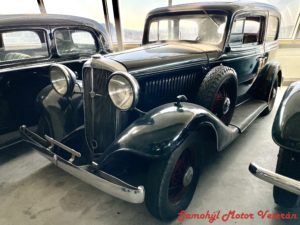
The Chevrolet Standard was introduced to the market in 1933 and was produced from 1934 to 1937.

It was offered in many body styles, such as sedan, roadster, touring car, and convertible.

All models were powered by a six-cylinder engine mounted in the front with rear-wheel drive. The power output was 70 hp with a top speed of 120 km/h.

An interesting fact is that the car was owned by Mr. Rudolf Baťa, who worked as a sales representative for Chevrolet in Zlín. It is now preserved in its original condition in our historic vehicle collection. Specifically, it is a sedan model from the year 1936.

Simplex 90HP

Year of manufacture: 1907
Power: 90 hp
Displacement: 9,750 cm3

Number of cylinders/valves: 4/3
Weight: 1,700 kg

Condition: operational
Catalogue number: 216

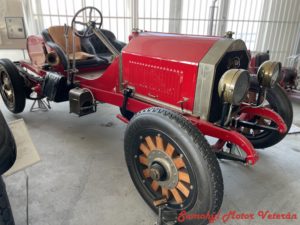
The creation of the Simplex brand was actually driven by the economic conditions of passenger car sales in the USA before World War I. Import duties accounted for 40% of the car price, making vehicles nearly inaccessible for the intended clientele.

Therefore, the owners of companies importing European cars simply calculated that if they manufactured the cars themselves in the USA, they could sell them at roughly half the price. And as they said, so they did…

They took high-quality European cars as a model and tried to compete with both performance and especially quality with their products. Although the original owners of the Simplex brand were successfully fulfilling their plans, the company went bankrupt in 1907. The new owner and savior of the brand became Herman Broesel. He began developing the original ideas behind these cars, and the company started to prosper. The most successful car in the short history of Simplex was the 50HP model. It achieved both commercial and racing successes. It was mainly made from German components and stood out for the quality of materials and workmanship.

This was followed by the 90HP model with greater displacement and mainly power. It participated in various races in the USA and was very successful. At the peak of Simplex car production, there were a total of 5 types and 17 versions of these cars. Unfortunately, Broesel died in 1912, the original buildings in New York were sold, and under new ownership, the company moved to New Jersey.

The company continued to experience turbulent developments with changing owners and production programs. It was not until 1918 that the then owners decided to stop car production and continue only with aircraft engine manufacturing. The very last car was sold on February 27, 1920.

Despite its short presence on the automotive scene, Simplex made its mark in automotive history primarily by proving that it was possible to manufacture cars from European components on American soil and thus achieve the quality of European cars. This approach was later continued by other car manufacturers, especially Japanese ones.

Mercedes-Benz 170 S (W136)

Year of manufacture: 1950
Power: 45 hp
Displacement: 1,767 cm3

Number of cylinders/valves: 4/2
Weight: 1,185 kg

Condition: restored
Catalogue number: 223

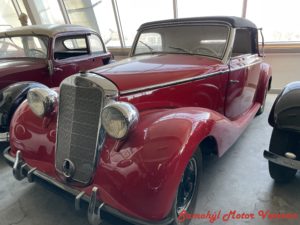
The Mercedes-Benz 170 V was first introduced on February 15, 1936, at the Berlin Motor Show. It was the W136 model, which almost immediately became the standard for a modern European car at the end of the pre-war years. Although it was the smallest car of Daimler-Benz A.G., with its 1.7-liter engine and spacious interior for its time, it also ranked among the “better” mid-range cars. By 1942, this model was the best-selling, with over 75,000 units sold. Its direct predecessor was the Mercedes-Benz 170 type W15, produced between 1931 and 1935. It had an engine of the same displacement, even a six-cylinder, but with six horsepower less.

Both two- and four-door sedans, cabriolets, two-seat roadsters, as well as modified utility versions such as ambulances or cars for the police, mountain rescue, and military were produced. For military use, Mercedes-Benz manufactured over 19,000 units with the “Kübelwagen” body type.

The vehicle’s body was very advanced—fully metal. Unlike previous practice, no wooden frames covered with sheet metal were used. The engine was front-mounted, and the rear-wheel drive was powered by a driveshaft. It used an inline four-cylinder with SV valve timing, a displacement of 1,697 cm³, bore of 73.5 mm, and stroke of 100 mm. The manufacturer specified a compression ratio of 6.5. The engine was equipped with a Solex carburetor. During and after the war, some cars were converted to run on generator wood gas. However, this reduced engine power and caused various operational issues.

The Mercedes-Benz 170 V was gradually improved and enhanced. After the war, this model became the core offering of Mercedes, mainly in the sedan version.

From May 1949, a diesel engine with 38 horsepower was even used. The car reached a top speed of 116 km/h.

In 1949, at the Hannover Fair, the 170 S model was presented for the first time. The engine had a larger displacement and increased power to 52 hp, and it mainly received better equipment in the passenger compartment. Cabriolets of types A and B were produced from 1949 to 1951, and the sedan until 1955. Especially the cabriolet A was considered a luxury car and became somewhat a predecessor of today’s S-Class.

The car from our collection is a type B cabriolet, fully restored and operational, and can be seen every year at the Bugatti GP during the Barum rally in Zlín.

Škoda 4R

Year of manufacture: 1930
Power: 32 hp
Displacement: 1,944 cm3

Number of cylinders/valves: 4/2
Weight: 1,350 kg

Condition: drivable
Catalogue number: 219

Introduction
In September 1928, the Škoda 4R and 6R models powered by a four-cylinder and six-cylinder engine with Ricardo combustion chambers debuted at the Prague motor show. That is why the letter R appears in their designation.

Development
Since summer 1925, the Mladá Boleslav automobile factory was part of the Pilsen-based Škoda concern. Existing vehicle types continued to be produced and sold under the combined designation Škoda Laurin & Klement. The first new vehicles developed after this merger were precisely the 4R and 6R types, carrying only the Škoda brand. At the opening of the Prague motor show, the manufacturer issued a press release at the beginning of September 1928, which several newspapers published almost unchanged. Let us quote its main points: “The principles guiding Škoda Works in their automotive production program can be summarized as follows: Increasing operational performance, readiness, and safety of the vehicle. Simplifying vehicle operation. Reducing production costs and thus sales prices.” The first point was to be fulfilled by new engines and transmissions, the second by switching to unified operation of the service brakes by pedal (instead of the previous lever-pedal combination), and the third related to the unification of the production program and a new organization of vehicle assembly on the production line.

Technical specifications
The new engines of the 4R and 6R types differed in the number of cylinders but had the same concept and a number of shared parts. Both had an SV valve gear with a camshaft driven by a silent gear, a removable head with Ricardo combustion chambers, and the same valves, pistons, and connecting rods. With the same bore of 75 mm and stroke of 110 mm, the four-cylinder had a displacement of 1944 cm3 and, with one carburetor, delivered 32 hp (23.5 kW) at 2800 rpm, while the six-cylinder fitted with two carburetors offered 50 hp (37 kW) from a volume of 2916 cm3. The four-speed gearbox connected to the engine was the same for both types; only the fixed gear in the rear axle differential differed. Both cars had a classic ladder frame riveted from steel profiles and rigid axles suspended by longitudinal semi-elliptical leaf springs. The rear axle of the “banjo” type with a silent Gleason bevel gear was a new design and the same for the 4R and 6R. Drum brakes on all four wheels were mechanically operated by the mentioned pedal; steering used a screw and nut mechanism. Both types were standardly fitted with Rudge-Whitworth wire wheels with a central nut. The four-cylinder had 30 x 5.25 SS tires, and the six-cylinder had larger 32 x 6.00 SS tires. Customers could also order steel disc wheels, later also steel spoke wheels with split rims. The fuel tank was located between the frame longitudinal members behind the rear axle. It held 60 or 70 liters of gasoline and was fed forward to the engine by a fuel pump.

Production
The Škoda R4 model was produced from 1928 to 1930, with a total of 975 units built. By 1930, production reached 25 units per day, later increasing to 85 units per day in three shifts.

Market
The Škoda 4R and 6R cars were produced only until 1930 and did not achieve significant commercial success. Towards the end of their production, prices were significantly reduced; for example, the 4R phaeton was sold for 55,000 Kč in 1930, and the 6R Weymann limousine for 78,000 Kč. The commonly cited number of 975 Škoda 4R units produced must be reduced to 970 after detailed examination of factory records. Three serial numbers were assigned only to 4R engines delivered in November 1930 to the Stratílek company in Vysoké Mýto for driving fire engines, and two serial numbers remained entirely unrecorded. Several vehicles of this type were exported to Poland, and as many as 22 went to Yugoslavia.

Sales
In the 1929 season, Škoda 4R car prices ranged from 60,000 Kč for a four-seat phaeton to 82,500 Kč for a six-seat limousine with six side windows. The manufacturer also offered the 4R chassis alone for 55,000 Kč, with a custom body costing about an additional 20,000 Kč. The sales brochure also featured a two-seat 4R roadster with a folding emergency seat in the rounded rear and a coupe with a short roof and two folding seats placed sideways behind the driver’s and passenger’s seats, although the number of such bodied cars was likely very small.

Interesting facts
The 6R and 4R engines are also mounted in trucks. For example, the Škoda 154 had the same engine as the 4R.

Car in our collection
The vehicle from our historic collection is specifically from the year 1930.

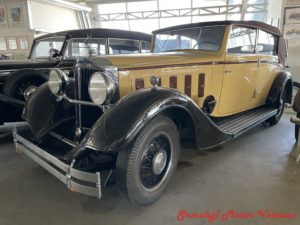
PACKARD Standard Eight 902

Year of Manufacture: 1932
Power: 110 hp
Displacement: 5,231 cm3

Number of cylinders/valves: 8/2
Weight: 1,870 kg

Condition: restored
Catalog Number: 91

Packard was an American luxury automobile brand produced by the Packard Motor Car Company in Detroit, Michigan, and later by the Studebaker-Packard Corporation in South Bend, Indiana.

In 1954, the company merged with Studebaker, creating the Studebaker-Packard Corporation. The last original Packard car rolled off the factory line in 1956, but due to declining sales, production was discontinued two years later.

However, throughout its history, the company made a significant mark on automotive development, especially in the USA.

While the Great Depression had a huge negative impact on American premium car manufacturers in the early 1930s, Packard’s reputation helped it maintain a strong market share. The ninth series models, introduced in June 1931, are still considered among the best Packards of the classic era.

The basis of this series was cars with an inline eight-cylinder engine of classic design producing 110 hp. The pinnacle of the ninth series offerings were models 905 and 906 with V12 engines. These cars stood out for their high standards and were among the best American cars available at the time. Notably, even American presidents used these cars.

The car from our collection has undergone a complete restoration and is in excellent condition.

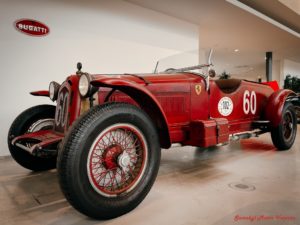
Alfa Romeo 8C 2300

Year of Manufacture: 1931
Power: 200 hp
Displacement: 2,336 cm3

Number of cylinders/valves: 8/2
Weight: 1,000 kg

Condition: drivable
Catalog Number: 262

Sport and racing cars Alfa Romeo 8C 2300 were iconic racing and sports specials in the 1930s and have left an indelible mark in motor history. These cars were powered by 2.3-liter inline eight-cylinder DOHC engines. They achieved numerous victories in races such as Le Mans, Mille Miglia, Targa Florio, and Grand Prix events.

Alfa 8C was designed by the famous genius engineer Vittorio Jano in 1930. The inline eight-cylinder engine with a very long hood was supercharged. The original engine produced around 165 hp, but over time the power of the 8C engine was increased. A special feature of the engine is the split crankshaft.

The first 8C engine debuted in 1931 at the Mille Miglia road race in the Alfa Romeo 8C 2300. The pair Tazio Nuvolari – Battista Guidotti finished 9th (won by Caracciola in a Mercedes SSKL). The inline eight-cylinder had a common crankcase now divided into two four-cylinder blocks including cylinder heads. The bore and stroke were the same as the six-cylinder 6C 1750 engine, so it used the same pistons and connecting rods. The 8C engine did not have a detachable cylinder head, which avoided head gasket issues but made valve maintenance difficult. By increasing bore and stroke, the engine displacement eventually rose to 2905 cm3, which powered Alfa Romeo 8C 2900 sports and touring cars from 1936 to 1941.

Originally, Alfa Romeo did not plan for the 8C 2300 models to be sold to private customers, but eventually made 188 chassis in Lungo (long) with a 3099 mm wheelbase or Corto (short) with a 2751 mm wheelbase, on which coachbuilders Zagato, Touring, Castagna, Pinin Farina, and Brianza built bodies. In addition, Alfa Romeo made their own bodies. Several chassis were “dressed” by Swiss coachbuilders Graber, Worblaufen, Tuscher, and also French Figoni. The shortest 2649 mm wheelbase chassis (Monza) were intended for racing cars. Some racing cars were converted by Alfa Romeo into touring cars and sold to customers.

The 8C 2300 Spider Corsa, also called the “Corto Mille Miglia,” had a two-seater Touring body. In front of the traditional Greek temple-shaped radiator were three headlights and at the rear two partially covered spare wheels. The front and rear fenders were elegantly connected by running boards. Small doors had cutouts allowing the driver to stick elbows out while cornering. The car had a frameless front window with two side windows.

The Mille Miglia name was given to the car after its success in the “1000 miles” race in 1932. In 1933, Alfa Romeo 8C 2300 cars finished first eight places at Mille Miglia, mostly with Italian crews. Nuvolari with Compagnoni won. The racing 8C 2300 Spider driven by Tazio Nuvolari won the 1931 Italian Grand Prix at Monza, with the team Minoia – Borzacchini finishing second. In honor of this success, the two-seater Spider was named Monza.

Prospero Gianferrari, Alfa Romeo’s general manager in 1931, decided to conquer the prestigious international 24 Hours of Le Mans race. To meet the rules, he chose a four-seater long-wheelbase car with an open Touring Spider Corsa body. The rear seats were covered with a tarp during races, and the front windshield was foldable.

The Alfa Romeo 8C 2300 Le Mans convertible weighed exactly one ton, was less than 4 meters long, and 1.65 meters wide. The DOHC inline eight-cylinder engine with 2,336 cm3 displacement and Roots supercharger produced 155 hp (114 kW) and could reach speeds of up to 200 km/h. Later, its power was increased to 200 hp. From 1931 to 1934, only nine Le Mans versions were built, differing in details (e.g., shapes of battery and tool boxes).

The 8C 2300 Le Mans earned its name thanks to its unique success at the 24 Hours of Le Mans in France, winning four times in a row between 1931 and 1934 with different crews, and in 1933 Alfa Romeos took the top three places.

The Alfa in our collection is a rare car. It is the Monza version, but on the longer Le Mans chassis.

The chassis number ends with 14 and is traceable in original Alfa Romeo factory records. The car was originally ordered by Enzo Ferrari when he operated his racing team with these cars before Ferrari cars existed. That is why the Ferrari badge is on the car.

Mr. Ladislav Samohýl found the chassis in a private British collection depot, where it had been since the late 1960s, while searching for parts for the Alfa Romeo 6C. After three years of negotiations, he bought and renovated the chassis. The original engine was found in Argentina, where it was taken after the war. This created an original car, fully functional and participating in various veteran races.

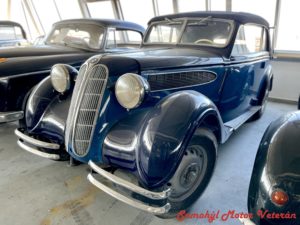
BMW 326 convertible

Year of Manufacture:  1937 Power:  50 hp Engine Displacement:  1,971 cm3

Number of Cylinders/Valves:  6/2 Weight:  1,700 kg

Condition:  excellent Catalog Number: 265


Introduction

The company BMW (Bayerische Motoren Werke) did not initially manufacture automobiles. Instead, it entered automobile production somewhat indirectly, starting as a manufacturer of aircraft engines and motorcycles. In the field of cars, BMW first produced and improved Dixi vehicles after acquiring a competing factory. The first car fully designed and developed by BMW was the 3/20 PS model powered by a four-cylinder engine.

The first inline six-cylinder engine, now so typical of the brand, was introduced by the Bavarian automaker in 1933. The BMW 303 model was the first to feature the characteristic “kidney” grille covering the radiator. This model later led to the development of four-cylinder models 309, 315, and 319. Three years later, a larger and more luxurious car with a sturdier construction appeared on the market—the four-door sedan BMW 326. A shortened version of its chassis was used in the 320, 321, and BMW 327 coupe models. The highlight of this series based on the 326 was the sporty and racing model 328, which achieved excellent sporting results shortly before the war.


Development

The BMW 326 was introduced at the Berlin Motor Show in 1936 and was offered for sale in May of the same year. The model was designed by Fritz Fiedler, an outstanding automotive engineer. It was produced until 1941, with a total of 15,949 units made. It was available as a four-door sedan, but also as two- or four-door convertible versions.


Technical Specifications

The inline six-cylinder engine with a displacement of 1,971 cm3 was a version of the original 319 engine with the bore increased from 65 mm to 66 mm while retaining the unchanged stroke of 96 mm. The BMW 326 was equipped with two Solex carburetors, producing a maximum power of 50 hp at 3,750 rpm.

The four-speed gearbox featured a freewheel and synchronization on the top two gears. The car had an excellent chassis design for its time and very good driving characteristics. The quality of the model is demonstrated by the fact that many of these cars have survived to this day and actively participate in various sporting events and vintage car meetings.

The car from our collection is a convertible with a custom body by the famous Gläser coachbuilder, fully restored and in excellent condition.

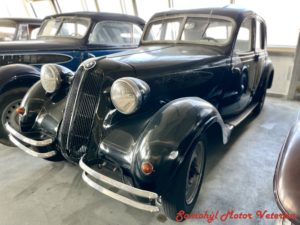
BMW 326 limousine

Year of Manufacture:  1936 Power:  50 hp Engine Displacement:  1,971 cm3

Number of Cylinders/Valves:  6/2 Weight:  1,700 kg

Condition:  drivable Catalog Number: 266


Introduction

The company BMW (Bayerische Motoren Werke) did not initially manufacture automobiles. Instead, it entered automobile production somewhat indirectly, starting as a manufacturer of aircraft engines and motorcycles. In the field of cars, BMW first produced and improved Dixi vehicles after acquiring a competing factory. The first car fully designed and developed by BMW was the 3/20 model, powered by a four-cylinder engine. The first inline six-cylinder engine, now so typical of the brand, was introduced by the Bavarian automaker in 1933.


Development

The BMW 303 model was the first to feature the characteristic “kidney” grille covering the radiator. This model later led to the development of four-cylinder models 309, 315, and 319. Three years later, a larger and more luxurious car with a sturdier construction appeared on the market—the four-door sedan BMW 326. A shortened version of its chassis was used in the 320, 321, and BMW 327 coupe models. The highlight of this series based on the 326 was the sporty and racing model 328, which achieved excellent sporting results shortly before the war.

The BMW 326 was introduced at the Berlin Motor Show in 1936 and was offered for sale in May of the same year. The model was designed by Fritz Fiedler, an outstanding automotive engineer. It was produced until 1941, with a total of 15,949 units made. It was available as a four-door sedan, but also as two- or four-door convertible versions.


Technical Specifications

The inline six-cylinder engine with a displacement of 1,971 cm3 was a version of the original 319 engine with the bore increased from 65 mm to 66 mm while retaining the unchanged stroke of 96 mm. The BMW 326 engine was fed by dual Solex carburetors, producing a maximum power of 50 hp at 3,750 rpm. The top speed was therefore 115 km/h.

The four-speed gearbox featured a freewheel and synchronization on the top two gears. The car had an excellent chassis design for its time and very good driving characteristics. The quality of the model is demonstrated by the fact that many of these cars have survived to this day and actively participate in various sporting events and vintage car meetings.

This car from our collection is a classic four-door limousine in original condition.

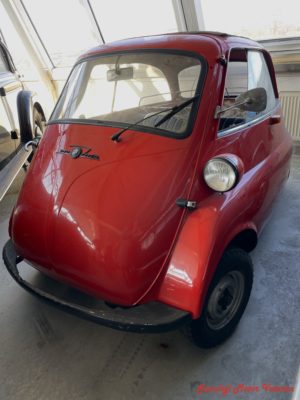
BMW ISETTA

Year of Manufacture:  1955 Power:  12 hp Engine Displacement:  247 cm3

Number of Cylinders/Valves: 1/2 Weight:  360 kg

Condition:  drivable Catalog Number: 263


Introduction

The car was designed by the Italian company Iso SpA. In the early 1950s, the company manufactured refrigerators, motor scooters, and small three-wheeled trucks. Iso’s owner, Renzo Rivolta, decided to build a small car for mass distribution. In 1952, engineers Ermenegildo Preti and Pierluigi Raggi designed a small car powered by the Iso Moto 200 motorcycle engine and named it Isetta.


Development

The Isetta caused a sensation when introduced to the automotive press in Turin in November 1953. It resembled nothing seen before. The small egg-shaped car featured bubble-type windows and a front end that hinged outward to allow entry.


Technical Specifications

The original Isetta was powered by a 236 cm3 motorcycle engine producing 9.5 hp, with a top speed of 75 km/h. It took more than 30 seconds to reach 50 km/h. The engine was started by a combined generator-starter called Dynastart. The fuel tank held only 13 liters. The manual gearbox offered four forward speeds and one reverse. A chain drive connected the gearbox to the fixed rear axle with a pair of closely spaced rear wheels 25 cm in diameter. Early prototypes had only one rear wheel, but the car was prone to tipping, so the rear wheels were spaced 48 cm apart. This narrow track eliminated the need for a differential.


Production

The car was produced from 1953 to 1958. In 1954, Iso entered several Isettas in the legendary Mille Miglia, achieving the top three positions in the economy class. Over a distance of 1,600 km, drivers averaged 70 km/h. Despite initial success, the Isetta’s popularity waned at home, mainly due to renewed competition from Fiat with the 500C model. Renzo Rivolta focused on developing his new sports car, the Iso Rivolta (later Iso Grifo), and sought to sell licenses for Isetta production. Factories in Spain and Belgium began assembling Isettas using components made by Iso in Italy.

BMW began negotiations with Rivolta and in mid-1954 purchased not only the license but also the complete tooling for the Isetta body. BMW was struggling to sell its expensive six- and eight-cylinder models, so it took the opposite approach by licensing the production of a small people’s car. BMW fitted the car with a single-cylinder four-stroke 247 cm3 engine producing 12 hp and extensively reworked much of the car, making parts non-interchangeable with the original Isetta. Given the post-war German market conditions, the car sold very well. It was the first car with a fuel consumption of 3 l/100 km. Yet in 1956, BMW introduced the Isetta 300 with a larger engine and other improvements.

The peak of these cars was the BMW 600, which was almost a fully-fledged car. It had four wheels and four seats like a normal car but still featured front-hinged front doors. The engine was a two-cylinder from the R67 motorcycle. This model marked the end of the era of small, specialized Isetta vehicles. The car left an indelible mark on automotive history and attracted many customers in its time and under the given conditions. Over 200,000 Isettas were produced in total, with BMW manufacturing 161,230 units alone.


Market

The car became very popular due to its affordable price and low fuel consumption. It was cheap, simple, and very economical in times of fuel shortages. It was perfectly timed for the market.


Trivia

The model appeared in the films *Smiling Face* and *Lisbon Story*.


Car in Our Collection

The car in our collection dates from 1955 and is in fully functional drivable condition.