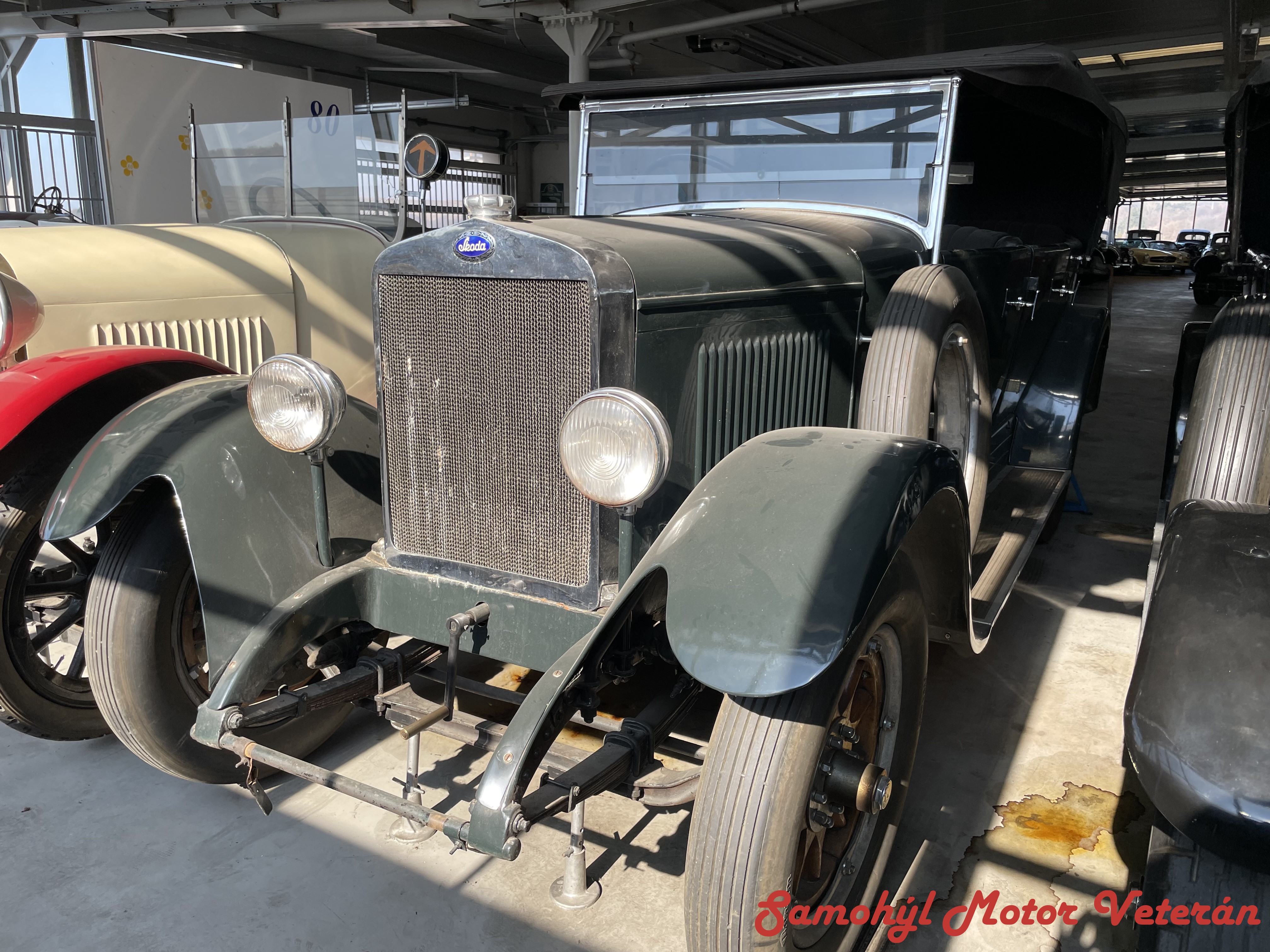
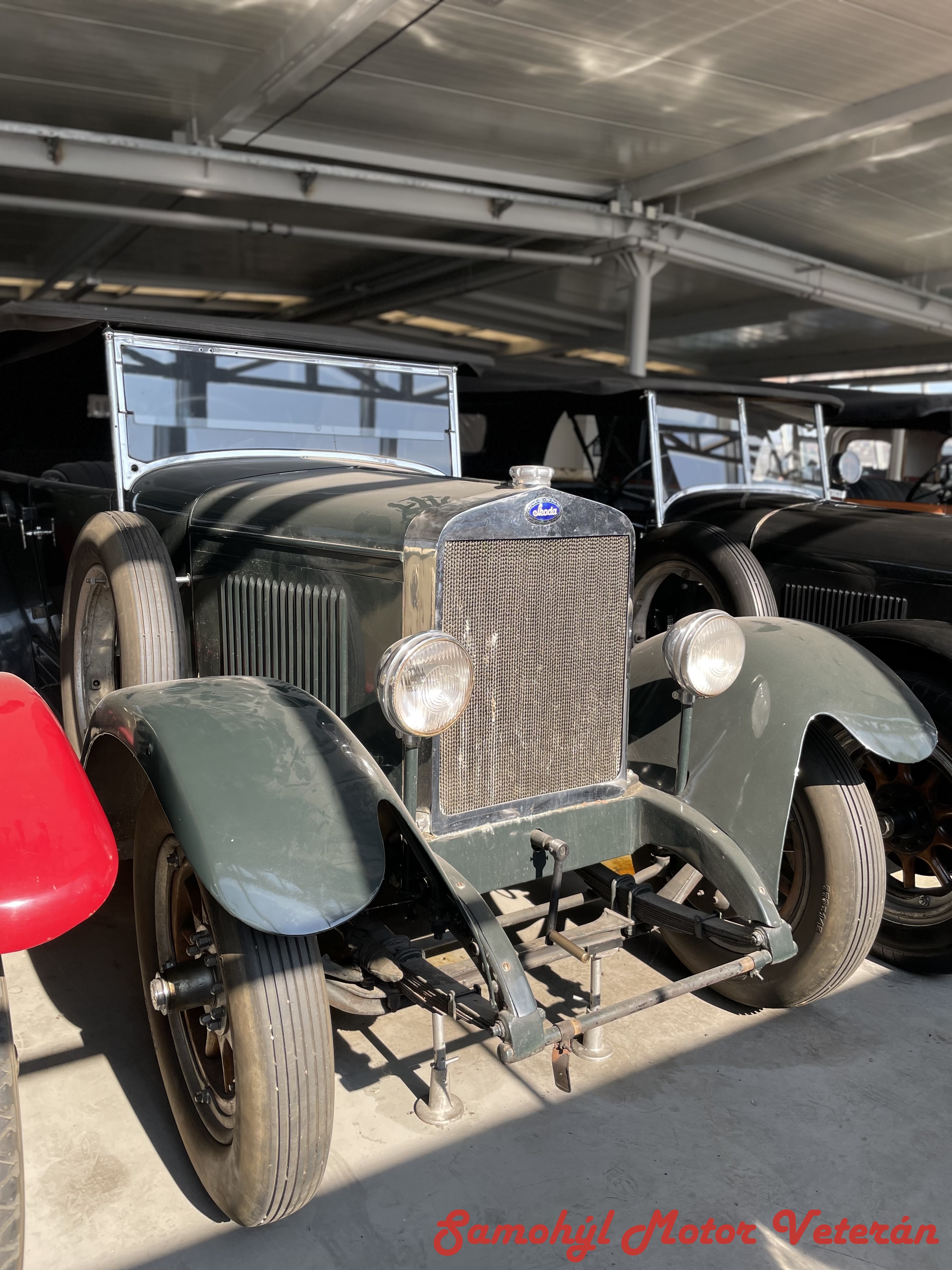
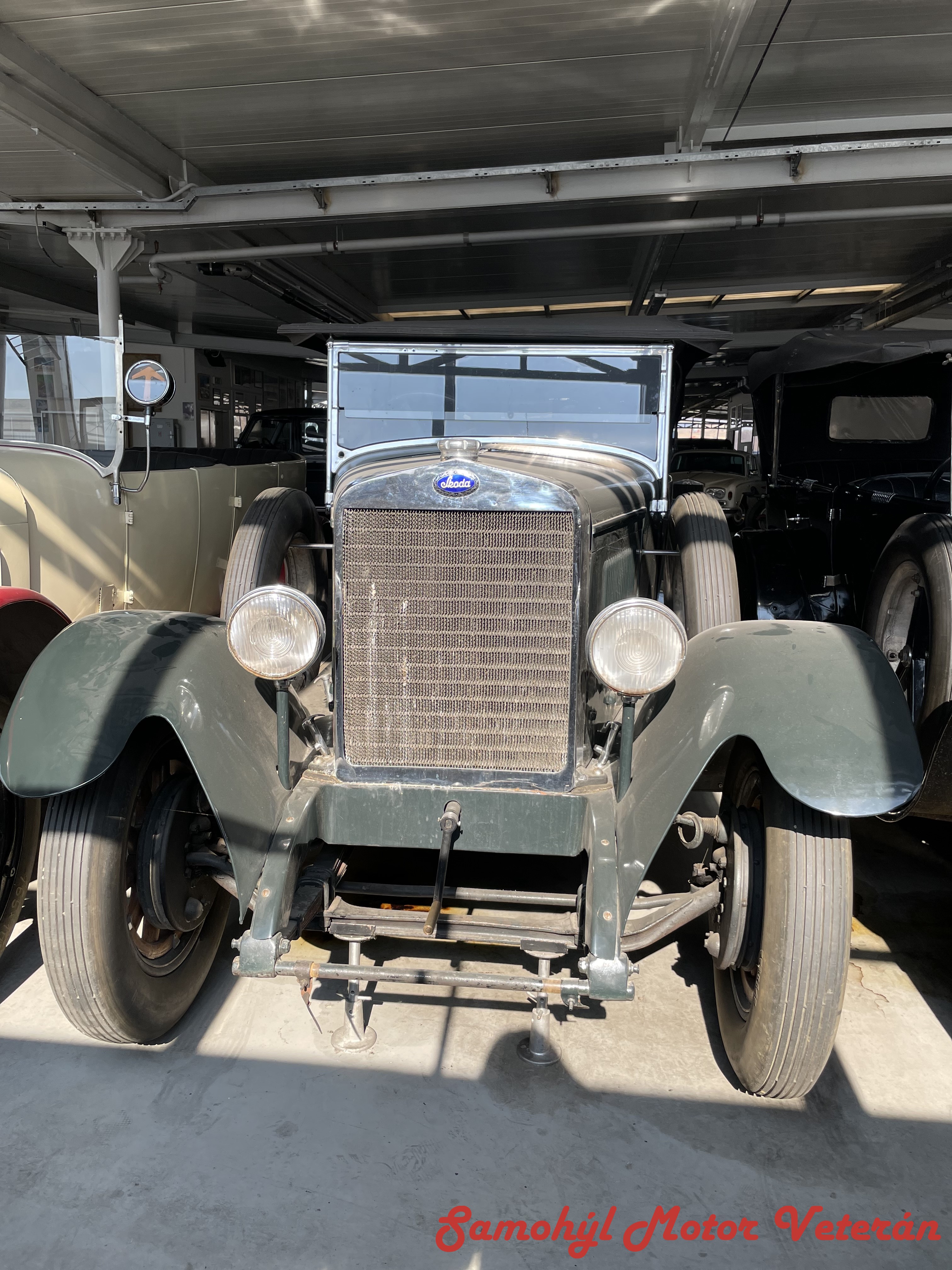
Škoda 4R
Year of manufacture: 1930
Power: 32 hp
Displacement: 1,944 cm3
Number of cylinders/valves: 4/2
Weight: 1,350 kg
Condition: drivable
Catalogue number: 219
Introduction
In September 1928, the Škoda 4R and 6R models powered by a four-cylinder and six-cylinder engine with Ricardo combustion chambers debuted at the Prague motor show. That is why the letter R appears in their designation.
Development
Since summer 1925, the Mladá Boleslav automobile factory was part of the Pilsen-based Škoda concern. Existing vehicle types continued to be produced and sold under the combined designation Škoda Laurin & Klement. The first new vehicles developed after this merger were precisely the 4R and 6R types, carrying only the Škoda brand. At the opening of the Prague motor show, the manufacturer issued a press release at the beginning of September 1928, which several newspapers published almost unchanged. Let us quote its main points: “The principles guiding Škoda Works in their automotive production program can be summarized as follows: Increasing operational performance, readiness, and safety of the vehicle. Simplifying vehicle operation. Reducing production costs and thus sales prices.” The first point was to be fulfilled by new engines and transmissions, the second by switching to unified operation of the service brakes by pedal (instead of the previous lever-pedal combination), and the third related to the unification of the production program and a new organization of vehicle assembly on the production line.
Technical specifications
The new engines of the 4R and 6R types differed in the number of cylinders but had the same concept and a number of shared parts. Both had an SV valve gear with a camshaft driven by a silent gear, a removable head with Ricardo combustion chambers, and the same valves, pistons, and connecting rods. With the same bore of 75 mm and stroke of 110 mm, the four-cylinder had a displacement of 1944 cm3 and, with one carburetor, delivered 32 hp (23.5 kW) at 2800 rpm, while the six-cylinder fitted with two carburetors offered 50 hp (37 kW) from a volume of 2916 cm3. The four-speed gearbox connected to the engine was the same for both types; only the fixed gear in the rear axle differential differed. Both cars had a classic ladder frame riveted from steel profiles and rigid axles suspended by longitudinal semi-elliptical leaf springs. The rear axle of the “banjo” type with a silent Gleason bevel gear was a new design and the same for the 4R and 6R. Drum brakes on all four wheels were mechanically operated by the mentioned pedal; steering used a screw and nut mechanism. Both types were standardly fitted with Rudge-Whitworth wire wheels with a central nut. The four-cylinder had 30 x 5.25 SS tires, and the six-cylinder had larger 32 x 6.00 SS tires. Customers could also order steel disc wheels, later also steel spoke wheels with split rims. The fuel tank was located between the frame longitudinal members behind the rear axle. It held 60 or 70 liters of gasoline and was fed forward to the engine by a fuel pump.
Production
The Škoda R4 model was produced from 1928 to 1930, with a total of 975 units built. By 1930, production reached 25 units per day, later increasing to 85 units per day in three shifts.
Market
The Škoda 4R and 6R cars were produced only until 1930 and did not achieve significant commercial success. Towards the end of their production, prices were significantly reduced; for example, the 4R phaeton was sold for 55,000 Kč in 1930, and the 6R Weymann limousine for 78,000 Kč. The commonly cited number of 975 Škoda 4R units produced must be reduced to 970 after detailed examination of factory records. Three serial numbers were assigned only to 4R engines delivered in November 1930 to the Stratílek company in Vysoké Mýto for driving fire engines, and two serial numbers remained entirely unrecorded. Several vehicles of this type were exported to Poland, and as many as 22 went to Yugoslavia.
Sales
In the 1929 season, Škoda 4R car prices ranged from 60,000 Kč for a four-seat phaeton to 82,500 Kč for a six-seat limousine with six side windows. The manufacturer also offered the 4R chassis alone for 55,000 Kč, with a custom body costing about an additional 20,000 Kč. The sales brochure also featured a two-seat 4R roadster with a folding emergency seat in the rounded rear and a coupe with a short roof and two folding seats placed sideways behind the driver’s and passenger’s seats, although the number of such bodied cars was likely very small.
Interesting facts
The 6R and 4R engines are also mounted in trucks. For example, the Škoda 154 had the same engine as the 4R.
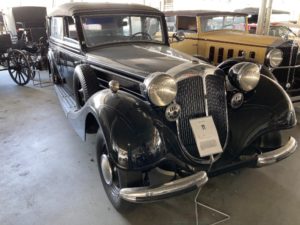
Car in our collection
The vehicle from our historic collection is specifically from the year 1930.