Showing 1–16 of 28 results

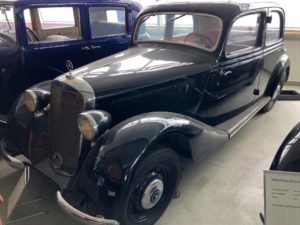
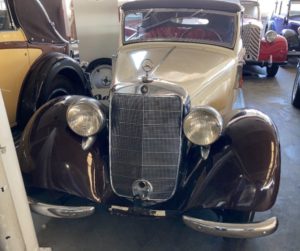
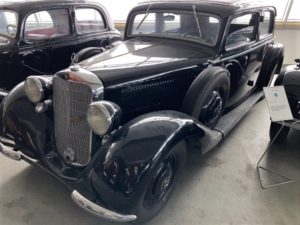
Mercedes-Benz 260 D

Year of manufacture: 1938
Power: 45 hp
Displacement: 2,543 cm3

Number of cylinders/valves: 4/2
Weight: 1,550 kg

Condition: restored
Catalog number: 226


Rudolf Diesel patented his revolutionary engine already in 1893. Due to its size, it was primarily used for industrial purposes and ship propulsion. Gradually, as the engine was downsized, it found its way into commercial vehicles. Passenger cars resisted diesel engines for a long time. Experiments in this field were conducted by Peugeot. Already in the early 1920s, experimental vehicles of types 153 and 156 ran with a two-stroke diesel twin-cylinder engine. The German company Stoewer developed a prototype in 1927. A few years later, Citroen equipped its Rosalie 11UD with an engine from the Englishman Harry Ricardo. However, mass production did not start.

The Mercedes Benz 260 D became the world’s first truly mass-produced passenger car with a diesel engine. It was introduced in February 1936 at the Internationale Automobil und Motorrad – Ausstellung in Berlin. The official premiere was preceded by a long development process. The manufacturer gradually tested various diesel engines and conducted extensive experiments but without success. The inline six-cylinder diesel engine type Manheim, which debuted in autumn 1933, suffered from such vibrations that further development was abandoned.

In November 1934, engineers chose a modified version of the inline six-cylinder engine originally used in commercial vehicles. The result was a smaller two-valve four-cylinder unit with a 100 mm stroke. It was designated OM 138 with a displacement of 2,545 cm3. The commercial designation “260” came from this engine. The ignition system was taken from the original engine. Other key technical solutions also remained the same, including the OHV pushrod valve train and the crankshaft mounted in five main bearings. The construction basis of the car was the extended chassis of the gasoline model 200 from the W21 series.

Modern turbodiesels are known for their fuel efficiency and long range per tank. The 260 D’s fuel tank allowed a range of approximately 400 km. This revolutionary vehicle began serial production at the end of 1935, before its official premiere. The so-called zero series consisted of 170 six-seat landaulets and Pullman limousines. The first 13 semi-open models featured a partition between front and rear passengers. It featured a three-speed manual gearbox with an overdrive but no synchronization for first gear.

In September 1936, new body styles appeared, including sedans and Cabriolet B models, which accommodated four to five passengers. February 1937 saw a more significant facelift. The second series adopted the chassis from the 230 Lang W143 models. The improved version had a new grille. The headlights were reduced in size and were no longer mounted on a chrome strip in front of the radiator but newly positioned on the fenders.

Between 1935 and 1940, a total of 1,967 units of the 260D model were produced, after which wartime production took precedence. The car from our collection is from the second series, in very good condition after a complete restoration.
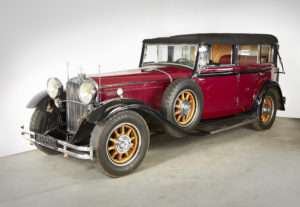
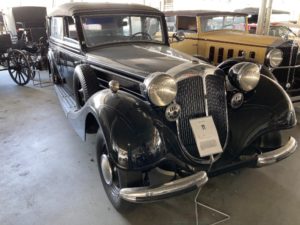
Mercedes Benz 230 W143

Year of Manufacture: 1938
Power: 55 hp
Engine Displacement: 2,229 cm3

Number of Cylinders/Valves: 6/2
Weight: 1,450 kg

Condition: For restoration
Catalog Number: 49

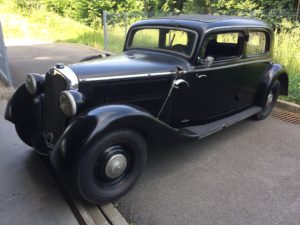
Mercedes-Benz 230 W143, limousine version, was produced between 1937 and 1941. This particular vehicle was manufactured in 1938.

It has a 6-cylinder petrol engine with a displacement of 2.2 liters and an output of 55 horsepower. The gearbox is a 4-speed and the drive is to the rear wheels. The car is almost in its original, very well-preserved condition. The bodywork has been partially repaired and newly painted. The vehicle is in operational condition. This type was one of the core production models in the interwar period and achieved great commercial success.

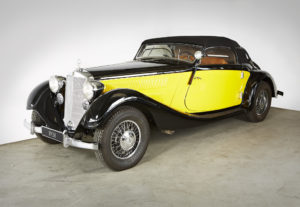
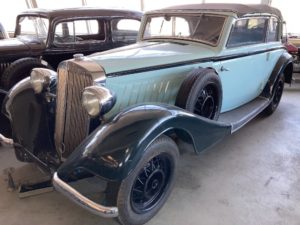
Bugatti Type 57 Graber

Year of manufacture: 1938
Power: 135 hp
Engine displacement: 3,257 cm3

Number of cylinders/valves: 8/2
Weight: 1,400 kg

Condition: perfect
Catalogue number: 61

History

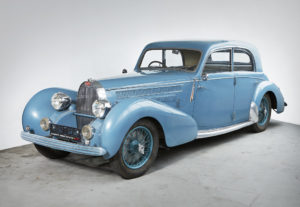
The development, design, and testing of the Type 57 model were the work of Jean Bugatti, the son of the company founder. Thanks to him, a new generation of cars was created – powerful, quiet, and well-handling sports and touring vehicles. On the Type 57 chassis (which themselves weighed around one ton), countless different bodies were created, ranging from convertibles and coupes to two- and four-door sedans. There were also purely sporty roadsters inspired by Grand Prix racing cars.

Factory coachbuilt versions were named after Alpine mountain passes: Galibier (sedan), Aravis, Ventoux (coupe), Stelvio (convertible), and Atalante. The last three were designed by Jean Bugatti. The chassis were bodied directly in Molsheim under the leadership of Joseph Walter. Based on this type, a very successful racing model with a low aerodynamic body nicknamed the “tank” was created, which won many races, including the famous 24-hour Le Mans race. Unfortunately, vehicle development was interrupted both by World War II and by the tragic death of Jean Bugatti during a test of a new Bugatti model.

Technical specifications

The Bugatti Type 57 has an inline eight-cylinder engine made of light alloy with DOHC. Two valves per cylinder were used here, instead of the previously common trio (two intake and one exhaust valve). The technology mostly originated from racing circuits. The camshafts were driven by an original gear train, not a chain. The crankshaft was mounted six times, and from the 3,257 cm3 engine displacement, the Type 57 produced from 92 kW to 103 kW (125 – 140 hp). Since 1936, engines also received a supercharger, raising the power up to 230 hp.

The transmission was four-speed, and the brakes were originally mechanical drum brakes, later replaced by hydraulic ones. The car reached truly high speeds and was difficult to slow down. The chassis had classic rigid axles and suspension with modified leaf springs.

Interesting facts

And why Graber? At that time, it was common for car manufacturers to deliver only a complete chassis, and the customer would have a body built according to their wishes.

Therefore, this probably most famous Swiss coachbuilder created a conservatively styled but proportionally and detail-wise attractive body for this car.

Its driving force, Hermann Graber (1904–1970), was born into a family operating a carriage business. At the beginning of the 1920s, he realized that horse-drawn carriages were definitively becoming obsolete, and the future belonged to automobile bodies. In Wichtrach, he mainly built on Italian, French, and German chassis. He bodied at least ten Bugatti 57s, mostly as luxury convertibles.

Production

The Bugatti 57 model was produced between 1934 and 1940, with a total of 710 cars built, including derivative types. The base Type 57 model had 630 units produced. This car was purchased for the collection in its current, original condition. Like many similar cars, it has a turbulent history but was never rebuilt or modified.


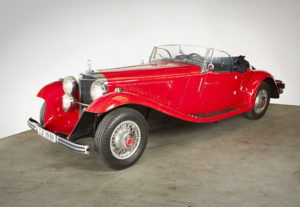
Mercedes Benz 500K

Sure! Here is the English translation with the original HTML formatting preserved:

Year of Manufacture: 1934
Power: 115 / 170 hp
Displacement: 5,401 cm3

Number of Cylinders/Valves: 8 / 2
Weight: 1,950 kg

Condition: undergoing restoration
Catalogue Number: 77

In our collection, we also have one of the most famous cars in automotive history – the Mercedes-Benz 500 K (K stands for Kompressor). Our example is truly exclusive, with an interesting history and remarkable technology.

During the 1930s, the automotive industry experienced a tremendous boom, especially in Germany. These years were marked by Adolf Hitler’s rise to power and the overall easing of economic blockades following the defeat in World War I. The automotive industry, car racing, and all related activities served the emerging fascist regime primarily as a showcase of the economic miracle and prosperity of the “new Germany” under its new leadership.

There was never enough ostentation, and appropriate cars were needed for the ruling elite to publicly present themselves. In February 1933, the model 380 was introduced, but it quickly became apparent that it did not meet performance requirements – due to its weight, it lacked sufficient power. Therefore, work on its further development started immediately.

At the Berlin International Motor Show in March 1934, the Mercedes-Benz 500 K model was presented. This model was developed under the leadership of Technical Director and Chief Designer Dr. Hans Nibel, a Czech native from Olšany near Šumperk. The chassis was slightly modified from the 380 model, but the engine was redesigned. It was again an inline eight-cylinder with an OHV valve train, but with increased displacement to 5,019 cm3. Equipped with a Roots supercharger, it produced 100 hp naturally aspirated and 160 hp with the supercharger engaged.

The car featured a four-speed transmission with an overdrive and, weighing 1,950 kg, could reach speeds of up to 170 km/h. At the time, it represented the pinnacle of automotive technology, and some of its technical solutions remain impressive even today. The 500 K was essentially an interim model produced only from 1934 to 1936. It was followed by the more famous 540 K, but that is another story. Only 354 units of the 500 K were produced, offering great variability in body styles and chassis. Among the most prized were the “Spezial Roadster,” of which only 20 were made.

Today, these cars are extremely valuable, with auction prices reaching several million dollars.

And what about the car in our collection? It was one of the first produced and made specifically for one of the prominent figures of the fascist regime – Adolf Hühnlein (not to be confused with Konrad Henlein). Hühnlein was responsible in Germany for everything related to cars – motorsport, highway construction, driver training, and something akin to today’s automobile club. He was a close collaborator and protégé of Adolf Hitler. Many photographs from that era show him alongside or in the company of Hitler.

In the late 1930s, as leader of the NSAK (National Socialist Automobile Corps), he gained enormous influence over affairs in Germany and contributed significantly to the country’s preparation for war. He died at the height of his power in 1942 after a serious illness and was given a state funeral with full honors attended by the entire government elite of the time.

In his official capacity, he used this car to participate in popular long-distance rallies and hill climbs. He appears in many photographs, and his activities served primarily to promote the German automotive industry. The car bore the license plate IIA-28998, and its participation in these events is documented in contemporary records.

What is most interesting about this car? According to Mercedes-Benz’s business records, it was sold directly to A. Hühnlein on July 26, 1934, and on August 21, 1934, the original engine was replaced with a new 5.4-liter engine. The car thus had a power output of 115 hp and 170 hp with the supercharger engaged. However, this engine officially did not yet exist at the time (the 540 K model was introduced only in 1936), so Hühnlein had a still-in-development engine installed in his car. Given his position, the manufacturer fulfilled any of his requests. By coincidence, a true automotive unique was created – the only one of its kind.

After Hühnlein’s death, the car ended up under somewhat unclear circumstances in Prague. It was likely assigned by Heinrich Himmler to people around Reinhard Heydrich during his time in Prague. Later, when Albert Speer brought the car to Panenské Břežany in 1944, it was used by Heydrich’s widow, Lina Heydrich.

After the war, the car was confiscated and ended up in the National Recovery Fund, along with many other cars from the German occupiers. It was here that Mr. Otto Langer from Olomouc acquired it as compensation for his originally confiscated Opel. He took great care of the car, used it for normal travel, and participated in many veteran car events.

He also tried to gather as much information about the car as possible, corresponding during the deep socialist period with the Mercedes-Benz museum, including Alfred Neubauer himself, the most famous racing manager who was in charge of the museum at that time. This allowed him to obtain additional documentation and technical information.

Later in life, Mr. Langer sold the car to Mr. Alois Samohýl, father of today’s owner. The car immediately became a centerpiece of the private collection, and the Samohýl family participated in various automotive events with it.

Where can the car be seen today? It is currently undergoing partial restoration and is disassembled in the workshop. Over time, it had undergone various modifications, so it was decided to return it to its original condition. The restoration will include repainting in the original color, new interior upholstery, and other adjustments. Once completed, this unique and very rare car will be exhibited in a suitably honorable place. We will inform fans and enthusiasts so they can admire it in its full restored glory.

Mercedes Benz 500 N Nurburg

Catalogue Number: 84

It was the first luxury car from Mercedes-Benz equipped with a V8 engine. It was introduced in 1928 at the Paris Motor Show. It was produced in various versions and modernizations until the summer of 1939, making it the longest-produced Mercedes-Benz model.

Nürburg 460

The model was produced from 1928 to 1929. It was developed by Ferdinand Porsche, who was a board member responsible for new product development. The new eight-cylinder Mercedes-Benz was meant to become a serious competitor to the luxury cars from Horch. The car had a traditional chassis with the frame placed above the axles, which gave the vehicle an antique and tall appearance.

The car was powered by a straight-eight engine with a displacement of 4,622 cm3. It produced a maximum power of 80 hp, enabling a top speed of 100 km/h. The car’s size was similar to the Horch 8, which essentially served as a model for its development.

The 1928 Horch limousine was 5,000 mm long and weighed 2,100 kg. The Mercedes-Benz Nürburg 460 limousine measured 4,890 mm and was extended to 5,200 mm by adding a rear trunk. The Mercedes weighed 2,150 kg. Both cars had a height of 1,900 mm. The large, old-fashioned, and very expensive Mercedes-Benz W08 produced in 1928 found only a few customers and was therefore replaced the following year by a more elegant version with a lower chassis.

Nürburg 460/460 K

This car was produced between 1929 and 1932. For the 1929 season, the company largely redesigned its first eight-cylinder model. The result was a car with a more modern chassis, where the longitudinal frame rails were positioned below the axles. The wheelbase remained unchanged. The engine and most other technical details also stayed the same. Despite all efforts and modifications made in 1929, the Mercedes-Benz W08 was less successful than the competing Horch 8, which was well established on the German luxury car market at that time. The 460 model was also the first popemobile. In 1930, Daimler-Benz presented Pope Pius XI with a specially modified vehicle of this type.

Nürburg 500

1931–1933 – This version had a wheelbase of 3,670 mm and was equipped with a new 4,918 cm3 engine with a twin downdraft carburetor. Maximum power was increased to 100 hp and top speed to 110 km/h.

1932–1936 – In 1932 the car lost the “Nürburg” name and was sold simply as the Mercedes-Benz 500N. It was equipped with the same 4,918 cm3 engine with side-valve (SV) timing and twin downdraft carburetors, as well as a four-speed gearbox and unchanged chassis dimensions. Visible changes included the shape of the radiator and front windshield. Slightly larger wheels allowed speeds up to 120 km/h.

1936–1939 – In 1936 the engine power was increased to 110 hp. The displacement remained the same, but the compression ratio was raised. The highest reported speed was 123 km/h. Visually, the 1936 models differed by a steeper front grille and windshield angle. The competitor Horch 8 disappeared from the market in 1935. Production of the model ended in 1939 without a direct successor. Another V8 appeared in the Mercedes-Benz lineup only in 1963. Between 1928 and 1939, 3,824 vehicles were produced. Its competitor Horch sold approximately 12,000 Horch 8 cars between 1926 and 1934.

All these models primarily served as luxury and representative vehicles for bankers, industrialists, and high-ranking politicians. This type was also used by Adolf Hitler. They were renowned for incredible reliability and durability. The bodywork itself was among the peak of luxury that customers could afford at that time. Interestingly, throughout the entire 11 years of production, it retained wooden spoked wheels and a very conservative chassis with rigid axles.

The car from our collection has an interesting history. It was bodied by the famous Glässer coachbuilder in Dresden as a “Type F” cabriolet. This open body had 4 doors, 6 side windows, and was one of the most luxurious versions ever made on this chassis. During the First Republic, the car served as a backup vehicle for President T.G. Masaryk. After the war, it was rebuilt as a limousine. Many elements of the original bodywork were preserved, and after a long and demanding restoration, it was returned to the original Type F cabriolet condition. Today it is one of the highlights of our vintage car collection.

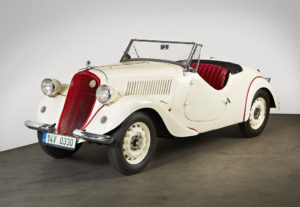
Škoda Popular roadster

Year of Manufacture: 1936
Power: 22 hp
Displacement: 995 cm3

Number of Cylinders / Valves: 4 / 4
Weight: 750 kg

Condition: excellent
Catalogue Number: 86


Development

Škoda 420 Standard

Produced between 1933–1934, this model introduced a new design concept derived from Tatra’s layout. This change brought Škoda great success, propelling the company from third place on the domestic market to the top spot after the economic crisis. The car featured a three-speed gearbox with synchronization on the 2nd and 3rd gears and lacked a differential. It had a four-stroke, water-cooled four-cylinder engine with a displacement of 995 cm3 and an output of 20 horsepower. Most vehicles were bodied as four-seater Tudors or open military cars. The top speed was 85 km/h with a fuel consumption of 7 l/100 km.

Škoda 418 Popular

This version was produced in 1934. The only difference compared to the 420 was the use of a smaller engine and a shorter chassis. The engine displacement was reduced to 903 cm3, resulting in 18 horsepower and a top speed of 80 km/h.

Škoda 420 Popular (Types 906/907, 916/917)

Manufactured from 1934 to 1937, this was the first model to bear the name “Popular” and also introduced a differential—though only available as an optional extra. Compared to the Škoda 420, the power slightly increased to 22 horsepower.

Škoda 420 Popular Sport (Type 908)

Produced in 1935, this car was developed specifically for the endurance race “1000 Miles of Czechoslovakia,” which ultimately did not take place. Only 20 vehicles were made on the 906 chassis.

Škoda Popular Sport Monte Carlo (Type 909)

Manufactured between 1935–1938, this model was named after one of the world’s most famous automobile races. It was created by replacing the standard Popular engine with a more powerful one from the larger Škoda Rapid (901). The combination proved to be excellent, leading the company to produce this model with Roadster, Roadster De Luxe, and Coupé Sport bodies. The car reached a top speed of 110 km/h with a consumption of 10 l/100 km.

Škoda Sagitta (Type 911)

Produced from 1936 to 1937, this was a prototype mini car built on a chassis derived from the Škoda 418. It featured a completely new air-cooled V-twin engine with a displacement of 845 cm3. The car could reach speeds of up to 70 km/h.

Škoda Popular was the brand’s most successful pre-war model, helping the company reach the top of the automotive industry.

Mercedes Benz 380

Year of Manufacture: 1933
Power Output: 120 hp
Displacement: 3769 cm3

Number of Cylinders/Valves: 8/2
Weight: 2050 kg

Condition: Operational
Catalog Number: 94

It should be emphasized that the Mercedes-Benz 380 is a true rarity, with this particular body style reportedly produced in only two units. Its elegance was recognized in 1933 at the Concours d’Elegance in Barcelona, among other accolades. According to foreign expert literature, only about five examples of all versions of this model have survived in European collections.

The era of a new generation of high-performance sports cars powered by supercharged inline OHV eight-cylinder engines—immortalized particularly in the form of the sleek Mercedes-Benz 500 K and 540 K roadsters—began in February 1933 with the introduction of the Type 380, internally designated as W 22.

Technical Specifications

This is a liquid-cooled inline petrol OHV eight-cylinder engine with a displacement of 3,769 cm3. It featured a four-speed manual transmission with overdrive. The operational weight was approximately 2,050 kg, and the top speed reached up to 137 km/h. Average fuel consumption was around 25 liters per 100 km. From summer 1933, a more powerful version with increased supercharger pressure was offered, delivering up to 140 hp.

Development

The model was based on the modular design of the Type 290. This intermediate model inherited, among other things, solid axles and mechanically operated brakes from the original Mannheim.

The next stage of development, designated W19, featured a significantly more modern chassis with independent suspension on all wheels and a hydraulic braking system. Twenty units were produced, none of which appeared in official catalogs or price lists—similarly to the fourteen subsequent W20 vehicles.

The public first saw the Type 380 W22, which mainly differed by its OHV valve system, twin carburetors of in-house design, and an optional supercharger. When activated, the supercharger temporarily increased power output from 90 to 120 hp during acceleration. Unlike its visually similar successors—the 500 K series—the W22 is easily distinguishable by the absence of the signature “flying goose necks” (external exhaust manifold covers). The engine was also positioned further forward in the chassis compared to its predecessors.

Interesting Facts

The manufacturer anticipated demand for custom-built bodies in this upper-class vehicle segment. On a chassis costing 13,000 Reichsmarks, a number of unique creations were made.

Vehicles with factory bodies were priced uniformly at 19,500 Reichsmarks—equivalent to the cost of four Type 200 sedans.

However, it became evident that the 3.8-liter engine was not quite sufficient for the expectations of a vehicle in this class. This soon led to further development of the model line—ushering in the legendary pre-war Mercedes models, the 500K and especially the 540K. But those belong to another chapter.


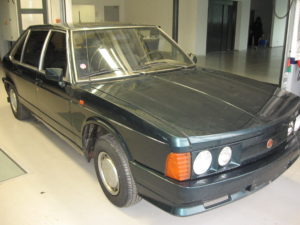
Tatra 613

Power: 167 hp
Displacement: 3,495 cm3

Number of cylinders/valves: 8/2
Weight: 1,690 kg

Condition: operational
Catalogue number: 99

This is a representative limousine of the upper-middle class, produced by the Tatra car manufacturer between 1974 and 1995 as the successor to the second-generation Tatra 603. The first prototypes were built as early as 1969.

History

It is among automotive legends and is exceptional both in its design and its history. The car was developed in Czechoslovakia as a representative vehicle intended primarily for top state officials and members of the ruling Communist Party. The vehicle was not available to the general public. It was manufactured in small series in Tatra’s branch plant in Příbor, which also made production very expensive. After the development ended in 1973, the car entered production and, in a modernized version, was manufactured until 1995, when it was replaced by the last passenger car of the Tatra brand, the Tatra 700.

Technical Specifications

The Tatra was known as a fast, spacious, and comfortable vehicle with a responsive 2×2 OHC carbureted engine with a displacement of 3.5 liters and a power output of 168 hp. It could reach speeds of up to 190 km/h. Later, small numbers of more powerful engines with higher displacement appeared. Toward the end of production, engines with fuel injection and outputs of up to 200 hp were introduced. These cars could reach speeds of up to 230 km/h. Initially, the gearbox was four-speed, and in the final models, a five-speed transmission was used. Most of the vehicles had sedan-type bodies, but other versions were also made, such as coupés, two-seaters for rescuers and firefighters, ambulances, utility vehicles, police cars, and special ceremonial landaulettes.

Prototypes

Many sports-bodied prototypes were also built based on the Tatra 613’s technical platform. The most famous of these is the MTX Tatra V8 from 1991. Another attempt at modernizing the model line was the Tatra Prezident prototype.

Production

In total, only about ten thousand vehicles of all versions were produced, which, along with its original technical concept, makes the Tatra 613 unique.

However, with the change in the political system and, most importantly, the unrestricted availability of vehicles produced west of our borders, the exclusivity of these representative Tatra cars came to an end. That doesn’t change the fact that, in its time, this was the most luxurious car produced in socialist countries, and it’s a pity that it was also the last model, effectively ending Tatra’s production of passenger cars.


Mercedes Benz 320A cabrio

ChatGPT řekl:
Year of Manufacture: 1938
Power: 78 hp
Displacement: 3,207 cm3

Number of Cylinders/Valves: 6/2
Weight: 1,900 kg

Condition: excellent
Catalogue Number: 76

History

In the mid-1930s, Stuttgart faced a problem. There was no sufficiently representative six-cylinder model to effectively bridge the mostly four-cylinder mid-range models with the top eight-cylinder series. The market offered premium models 500 K, 540 K, and 770 K, but they were very expensive and inaccessible to many customers.

The 290 series existed but had become somewhat outdated since 1933 and offered limited performance. Moreover, there was a need to develop an engine that could run on synthetic gasoline made from coal. Germany had no access to crude oil and was preparing for this fuel alternative.

Therefore, at the Berlin Motor Show in 1937, the new Mercedes-Benz 320 model, internally designated W142 with a six-cylinder engine, was introduced. It was eventually produced in all possible body variations.

Technical Specifications

The engine had a displacement of 3,207 cm3. It was an inline six-cylinder with an overhead valve (SV) configuration. Maximum power was 78 hp. The engine ran at 4,000 rpm and produced 220 Nm of torque at 1,700 rpm, achieving a top speed of 130 km/h. The engine was traditionally mounted at the front and drove the rear wheels. The transmission was a synchronized four-speed gearbox. Brakes were hydraulic drum brakes with a booster on all four wheels.

The chassis was of a classic frame design, with transverse control arms and transverse leaf springs in front, and a swing axle (half-shafts) with coil springs at the rear.

The Mercedes-Benz 320 (W142) was available with two wheelbase lengths: a standard 3,300 mm and a shortened 2,880 mm, with the longer wheelbase being by far the more successful commercially. The chassis was a modification of the older W18 design, whose roots date back to the 1920s W11 series. An immense number of body variants and custom coachwork were built on both chassis types, some of them unique. The chassis also served as the basis for a military off-road vehicle.

Production

The Mercedes-Benz 320 was produced in four series between 1937 and 1942. Series I, II, and III, produced until 1939, had the engine and wheelbases described above. The fourth series received a larger 3.4-liter engine but retained the same power output.

Approximately 7,000 units of the MB 320 were produced in total, of which about 1,800 were for military use.

This Mercedes model also holds a significant place in history. It was in a Mercedes-Benz 320 Cabriolet B (two-door, four-seat car) on May 27, 1942, that the Reich Protector Reinhard Heydrich was riding when Czechoslovak paratroopers carried out an assassination attempt on him.

The car in our collection is a classic “A” type cabriolet, meaning a 2+1 seating configuration on the short wheelbase. The restoration was performed from an incomplete wreck of the original vehicle, and today it is in excellent, fully operational condition and is a true highlight of our collection.

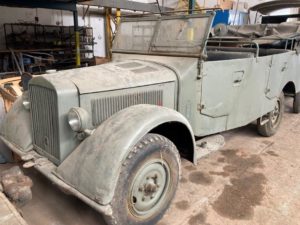
Horch 901

Year of manufacture: 1938
Power: 80 hp
Engine displacement:3,500 cm3

Number of cylinders/valves: 8/2
Weight: 3,000 kg

Condition: operational

Catalog number: 255

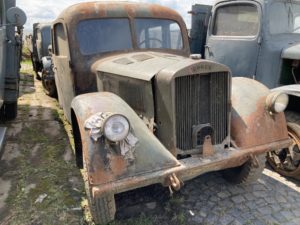
The Horch 901 was a mid-size military personnel vehicle. It primarily served the needs of the German Wehrmacht army as a multipurpose vehicle for various tasks. It was used on all battlefields of World War II. The engine was derived from the civilian Horch 830 model, and the chassis met very strict requirements for off-road operation. Approximately 28,000 units of this vehicle were produced.

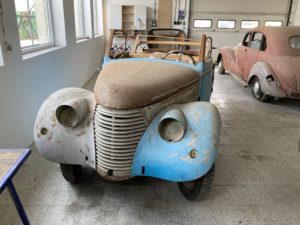
Škoda Rapid 922 cabrio de luxe

Year of manufacture: 1940
Power: 42 hp
Engine displacement:1,564 cm3

Number of cylinders/valves: 4/2

Weight: 960 kg

Condition: before restoration

Catalog number: 252

The Škoda Rapid OHV (type 922) was a passenger car produced from 1938 to 1947. It featured an engine with a displacement of 1,564 cm³ and an output of 30.9 kW (42 hp). The maximum speed was 110 km/h. It was manufactured in two versions – sedan and convertible. A total of 1,800 units of this model were produced.

Horch 901

Year of manufacture: 1938
Power: 80 hp
Displacement:3,500 cm3

Number of cylinders/valves: 8/2
Weight: 3,000 kg

Condition: drivable

Catalog number: 237

The Horch 901 was a mid-class military personnel and cargo vehicle. It was primarily used by the German Wehrmacht army as a multipurpose vehicle for various tasks. It was deployed on all battlefields of World War II. The engine was derived from the civilian Horch 830, and the chassis met very strict requirements for off-road operation. Approximately 28,000 units of this vehicle were produced.

The vehicle from our collection is a closed box version used as a radio station.

Horch 951 cabrio

Year of Manufacture: 1938
Power: 120 horsepower
Displacement:4,944 cm3

Number of Cylinders/Valves: 8/2
Weight: 3,000 kg

Condition:

Catalogue Number: 102

This is the black pearl from Alois Samohýl’s collection. You cannot escape the history behind this five-liter eight-cylinder engine.

The machine undoubtedly boasts both technical and aesthetic qualities, ingenious solutions, and interesting features. At first glance, you are struck by the wide radiator with the four-ring logo. Yet this is not an Audi, but an older and more elite brand from the same founder, August Horch.

Between 1926 and 1937, 25,000 eight-cylinder cars of this brand were produced. In the category over 5,000 cm3, their sales far outpaced those of competing Mercedes-Benz and their serious rivals were essentially only large-scale American cars with more modern design and lower prices. Horch was designed for more demanding conditions, which it could handle thanks to its sturdy chassis.

The car has an inline eight-cylinder engine with a 5-liter displacement and 120 horsepower. It features a four-speed gearbox and, despite weighing almost 3.5 tons, could reach speeds up to 150 km/h. The chassis is a frame construction, with independent front suspension and a De Dion rear axle. On this chassis sits a true gem.

The Dresden specialist Gläser meticulously crafted the Pullman convertible body. The roof is made of six layers, with a thick padding (“houna”) in the middle. Two to three passengers on the rear bench will appreciate the pair of heating vents in the floor, regulated by rotary dampers. The coachbuilders used plenty of longitudinal space not only to install folding emergency seats for children or subordinates. In this last series of these 951 cars, only three such bodies were made, making it a true unique piece.

And the history of this car? It came to Czechoslovakia in 1939 and served the first man of the Protectorate of Bohemia and Moravia, Konstantin von Neurath. His successor, Reinhard Heydrich, preferred Mercedes-Benz cars, so this vehicle was assigned to his deputy, Karl Hermann Frank. Frank used it until the end of the war. There is even evidence that Frank drove in this very car to inspect the burning of the village of Lidice. Thus, the car left a very dark mark in our history. However, after the war, none of that prevented Klement Gottwald from using it for some time. Eventually, it ended up with firefighters in the East Bohemian town of Chroustovice and was modified as a fire engine tractor.

In November 1968, an article appeared in Rudé Právo urging whether the National Technical Museum in Prague should take care of the unique vehicle. However, the museum showed little interest. The opportunity was then seized by the collector from Zlín and the manager of the AZNP brand dealership, Alois Samohýl. He acquired the vehicle in 1977 after lengthy negotiations, during which he promised the firefighters to restore the Horch and not to sell it abroad. The result of three years and 6,200 hours of workshop work today ranks among the most valuable exhibits in the Zlín collection of the Samohýl family.

Horch 830 cabrio

Year of Manufacture: 1939
Power: 92 horsepower
Displacement:3,823 cm3

Number of Cylinders/Valves: 8/2
Weight: 1,960 kg

Condition: after renovation

Catalogue Number: 228

Horch automobiles were among the most prestigious representatives of the top class between the wars and in some respects even surpassed Mercedes-Benz vehicles.

The Horch 830 featured a V8 engine with a displacement ranging from 3.0 to 3.8 liters. Initially, inline six- and eight-cylinder engines were used. Horch was one of the few manufacturers daring enough to produce a V12 engine. However, this engine was very complex, expensive, and had limited use. The new V8 engine was structurally derived from the V12. It was completed in 1932 and introduced in a production vehicle the following year. It was simpler and more affordable in design. Among the unique features borrowed from the V12 were the “horizontal” valves driven by a camshaft located between the cylinders, which formed a 66-degree angle. The engine had only three crankshaft bearings and was significantly shorter than an inline-eight or V12 engine. The original engine had a displacement of 3.0 liters, and the final version from 1938–1940 increased it to 3.8 liters.

The Horch 830 was a luxury-class car, sold in several versions, including a short sedan, an extended Pullman version, and various cabriolet body styles.

The vehicle was produced for a relatively long period, from 1933 to 1940, when the war halted its production. As the engine evolved, the chassis and other components were gradually improved as well. The engine was located in the front, and power was delivered to the rear wheels via an original four-speed transmission, later upgraded with a fifth gear as an overdrive. The axles were initially rigid, and the brakes mechanical and cable-operated. Later, the front axle was replaced with independent suspension, and the rear with a De Dion axle. Hydraulic brakes were also introduced.

A total of 11,625 units of types 830 and 930 were produced. Additionally, 4,536 off-road 830 R Kübelwagen vehicles were built for the German army with all-wheel drive.

At the end of the war, the production plant in Zwickau was heavily damaged by Allied bombing and after the war fell into the Soviet zone. Later, instead of Horch vehicles, the Trabant was produced there—a paradox of war.

In parallel with the 830, the 930 model was produced, which differed mainly in body design. In 1940, improved versions of the 830 and 930 were ready for production, but due to wartime events, they were never realized.

The vehicle from our collection is a two-door, four-seat convertible. It has been renovated and is in operable condition. It has appeared in several films and TV series.

Mercedes-Benz 170V (W136)

Year of manufacture: 1938
Power: 38 hp
Displacement: 1,697 cm3

Number of cylinders/valves: 4/2
Weight: 1,160 kg

Condition: restored
Catalog number: 225


The Mercedes-Benz 170 V was first introduced on February 15, 1936, at the Berlin Motor Show. This was the W136 model, which almost immediately became a benchmark for a modern European car in the late pre-war period. Although it was the smallest car from Daimler-Benz A.G., its 1.7-liter engine and relatively spacious interior for the time placed it among the “better” mid-range cars. By 1942, it was the best-selling model, with over 75,000 units sold. Its direct predecessor was the Mercedes-Benz 170 type W15, produced from 1931 to 1935. That model had an engine of the same displacement, even a six-cylinder, but with 6 hp less power.

The 170 V was produced in two- and four-door sedans, cabriolets, two-seat roadsters, as well as adapted utility versions such as ambulances and vehicles for police, mountain rescue, and the military. For military purposes, Mercedes-Benz built over 19,000 units with the so-called “Kübelwagen” body.

The car’s body was very advanced and fully made of metal. Unlike previous practice, no wooden frames covered with sheet metal were used. The engine was front-mounted, and power was transmitted to the rear wheels via a driveshaft. The engine was an inline four-cylinder with side valve (SV) design, displacing 1,697 cm³, with a bore of 73.5 mm and stroke of 100 mm. It was equipped with a Solex carburetor. During and after the war, some cars were converted to run on wood gas generators, which reduced engine performance and caused various operational issues.

The 170 V was continuously improved over time. From May 1949, a diesel engine with 38 hp was also introduced. The car reached a top speed of 116 km/h. With standard fuel, the engine produced 28 kW at 3,400 rpm. A four-speed gearbox transmitted power to the rear axle equipped with a differential. The wheelbase was 2,850 mm, and the weight was 1,120 kg. Popular optional accessories included practical fog lamps, which were not commonly fitted at the time.

The car in our collection is a classic four-door, four-seat limousine that has been fully restored and is in running condition.

Mercedes-Benz 170V W136

Year of manufacture: 1939
Power: 38 hp
Displacement: 1,697 cm3

Number of cylinders/valves: 4/2
Weight: 1,160 kg

Condition: restored
Catalog number: 221


The Mercedes-Benz 170 V was first introduced on February 15, 1936, at the Berlin Motor Show. It was the W136 model, which almost immediately became the benchmark for a modern European car at the end of the pre-war era. Although it was the smallest car from Daimler-Benz A.G., with its 1.7-liter engine and for its time spacious interior, it also ranked among the “better” mid-range cars. By 1942, this model was the best-selling vehicle, with over 75,000 units sold. Its direct predecessor was the Mercedes-Benz 170 type W15, produced between 1931 and 1935. That model had an engine of the same displacement, even a six-cylinder, but with 6 hp less power.

The model was produced as two- and four-door sedans, cabriolets, two-seat roadsters, and also adapted utility versions such as ambulances or cars for police, mountain rescue, and the military. For military use, Mercedes-Benz produced over 19,000 units with the so-called “Kübelwagen” body.

The vehicle’s body was very advanced, made entirely of metal. Unlike previous practice, no wooden frames covered with sheet metal were used. The engine was front-mounted, and rear-wheel drive was delivered by a driveshaft. It featured an inline four-cylinder SV (side valve) engine with a displacement of 1,697 cm³, bore of 73.5 mm, and stroke of 100 mm. During and after the war, some cars were converted to run on gas generator wood gas, which reduced engine power and caused various operational issues.

The Mercedes-Benz 170 V was gradually improved and refined. Starting in May 1949, a diesel engine with 38 hp was even offered. The car reached a top speed of 116 km/h. With normal fuel, the engine delivered 28 kW at 3,400 rpm. The four-speed gearbox transmitted power to the rear axle equipped with a differential. The wheelbase was 2,850 mm, and the weight was 1,120 kg. Popular optional accessories included practical fog lamps, which were not commonly installed at that time.

The car from our collection is a Cabriolet type B and has been fully restored and is in operational condition.