Showing 17–28 of 28 results

Mercedes-Benz 200 (W21)

Year of manufacture: 1933
Power: 40 hp
Displacement: 1,961 cm3

Number of cylinders/valves: 6/2
Weight: 1,160 kg

Condition: restored
Catalog number: 224


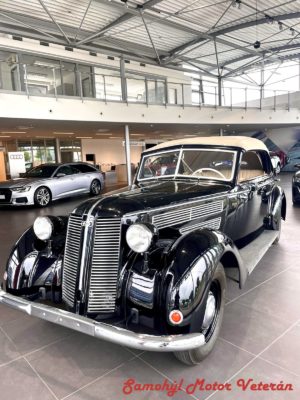
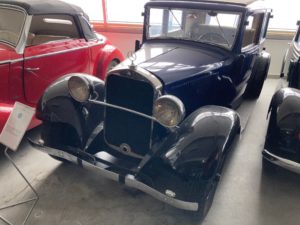
The Mercedes-Benz 200, designated by factory number W21 and introduced in February 1933, was the successor to the previous type 170, which had slightly less power and interior space. At the International Motor Show in Berlin, the more powerful and somewhat roomier versions 200 (W21), 290 (W18), and 380 (W22) were presented.

The six-cylinder side-valve engine had a displacement of 1,961 cm3 and produced a maximum power output of 29 kW, or 40 hp, at 3,200 rpm. The power was transmitted to the rear wheels through a four-speed manual gearbox, where the highest gear functioned practically as an overdrive. The two highest gears were synchronized. The brakes operated on all four wheels via hydraulic linkage. The engine shared its 85 mm (3.3 inch) piston stroke with a smaller six-cylinder unit. However, the manufacturer increased the bore by 5 mm (0.20 inches) to 70 mm (2.8 inches) for the W21.

During the last year of this model, in June 1936, Mercedes-Benz announced the availability of a more powerful 2,229 cm3 engine delivering 55 hp, which was seen as a necessary response to criticism about the car’s relatively low power output.

In 1933, the choice of body styles was still modest, consisting of a four-door sedan with an integrated trunk, optionally available from the factory with a sunroof, a Cabriolet C, and a two-seat special roadster.

In its second model year starting February 1934, the 200 underwent a significant modernization. The flat radiator gave way to a more stylish, gently wedge-shaped variant, which became the face of common Mercedes-Benz passenger cars for decades. The body style selection also expanded. Besides Cabriolet A, the lineup included two four-seat touring cars: a two-door version with a body by another coachbuilder and a four-door version with a body made in Sindelfingen. The roadster and Cabriolet A had a 2,600 mm wheelbase, the same as the 170 (W15), and 100 mm shorter than the four-seat versions. The price tag of 7,800 RM made the Cabriolet A the most expensive 200 variant.

The addition of a longer 3,050 mm wheelbase version proved to be a wise move. This same wheelbase served as the basis for generously sized limousines until the arrival of the 300 in 1951. The longer wheelbase was used for the four-seat Cabriolet B as well as three six-seat coach-built variants: besides the Pullman sedan and Pullman landaulet, there was an open tourer originally available with a body from another coachbuilder, and from June 1934 it could be ordered with a body made in Sindelfingen. Thanks to the spacious interior, the Pullman sedan was especially suitable for use as a taxi.

In February 1935, a year after introducing the long-wheelbase version, prices for both chassis types and most body variants were reduced. The body selection was also expanded with three new long-wheelbase variants. The four/five-seat four-door sedan was aimed at satisfying the growing customer demand for space. The target group for the aerodynamically styled progressive sedan with excellent quality was avant-garde clients. However, the price was an additional 3,700 RM. The price was even higher for the equally new “Special Cabriolet A,” which at 11,500 RM became by far the most expensive W21 variant — at the same price, two four/five-seat sedans of the two-liter swing-axle version could be purchased.

February 1935 brought a greatly expanded offer for customers who wanted a sedan but did not want to give up the advantages of an open roof. The standard-wheelbase limousine was optionally available not only with a sunroof made in Sindelfingen but also alternatively with a sliding roof by Happich. The long-wheelbase limousine could be ordered optionally with a sliding roof by Happich or Webasto, while the Pullman sedan was optionally available with either a standard or special version of the Webasto sliding roof.

Other changes for the 1935 model year included larger dials on the instrument panel, a stiffer front end with a metal bulkhead to reduce body vibrations, and a reinforced frame. In April 1935, the option to order a sedan with a sunroof made in Sindelfingen was discontinued. Instead, as an alternative to the Happich sliding roof, a roof from Webasto could be ordered.

A total of 15,622 units of the 200 model were produced — the car in our collection is from 1933, from the first series, and is a classic sedan. It has been fully restored and is in drivable condition.
Mercedes-Benz 130H cabrio

Year of manufacture: 1934
Power: 26 hp
Displacement: 1,308 cm3

Number of cylinders/valves: 4/2

Condition: restored
Catalog number: 222


At the beginning of the 1930s, attempts were increasing in Europe to create more aerodynamic car designs, including relocating the engine from the front to the rear. Between 1931 and 1939, Daimler-Benz AG produced the Mercedes-Benz 130, 150, and 170 H models. Production numbers for each of these models remained relatively low, especially compared to the output of classic front-engine Mercedes-Benz cars.

The 130 H was introduced at the International Motor Show in Berlin in 1934. Not only was it the smallest mass-produced car and the first four-cylinder model by Daimler-Benz, but it was also the first large-scale German car with a rear engine, if we exclude various miniature vehicles.

This model was inspired by Edmund Rumpler’s car called the Rumpler Tropfenwagen, which ran from 1923 to 1926. Hans Nibel, Mercedes’ chief engineer, drew inspiration from the Tropfenwagen (teardrop-shaped car) designed in 1921 by the Austrian-born engineer Edmund Rumpler. Nibel began developing the 130 in 1931 and chose a 1.3-liter four-cylinder SV engine mounted at the rear to drive the rear wheels.

The letter H, indicating engine placement (from the German word Heck, meaning rear), was not yet used. The car had a synchronized three-speed transmission with a semi-automatic fast-shift (no clutch required) and a final drive housed in the same unit as the engine. The car featured a backbone chassis with a central tube; the front wheels were independently suspended on two transverse leaf springs, and the rear swing axle was sprung by two coil springs.

The engine produced 26 hp (19 kW) and could propel the small two-door sedan to a top speed of 92 km/h. The synchronized four-speed gearbox was located ahead of the rear axle, balanced by coil springs. The front axle had two transverse leaf springs. The two-door Mercedes-Benz 130 H had a wheelbase of 2,500 mm and overall dimensions of 4,050 x 1,520 x 1,510 mm.

The car was sold as a sedan, a sedan with an open roof, or a convertible (with or without a convertible top and without side windows), each equipped with two doors. Nearly 4,300 units were sold before production ended in 1936.

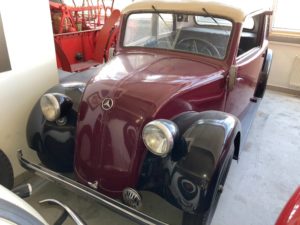
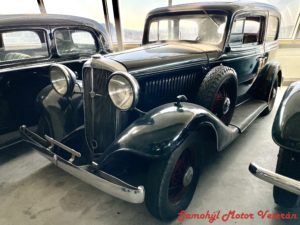
The car in our collection is a beautifully fully restored cabriolet.

Chevrolet Six

Year of manufacture: 1936
Power: 70 hp
Displacement: 3,389 cm3

Number of cylinders/valves: 6/2
Weight: 1,520 kg

Condition: operational
Catalogue number: 227

The Chevrolet Standard was introduced to the market in 1933 and was produced from 1934 to 1937.

It was offered in many body styles, such as sedan, roadster, touring car, and convertible.

All models were powered by a six-cylinder engine mounted in the front with rear-wheel drive. The power output was 70 hp with a top speed of 120 km/h.

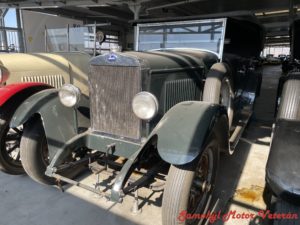
An interesting fact is that the car was owned by Mr. Rudolf Baťa, who worked as a sales representative for Chevrolet in Zlín. It is now preserved in its original condition in our historic vehicle collection. Specifically, it is a sedan model from the year 1936.

Škoda 4R

Year of manufacture: 1930
Power: 32 hp
Displacement: 1,944 cm3

Number of cylinders/valves: 4/2
Weight: 1,350 kg

Condition: drivable
Catalogue number: 219

Introduction
In September 1928, the Škoda 4R and 6R models powered by a four-cylinder and six-cylinder engine with Ricardo combustion chambers debuted at the Prague motor show. That is why the letter R appears in their designation.

Development
Since summer 1925, the Mladá Boleslav automobile factory was part of the Pilsen-based Škoda concern. Existing vehicle types continued to be produced and sold under the combined designation Škoda Laurin & Klement. The first new vehicles developed after this merger were precisely the 4R and 6R types, carrying only the Škoda brand. At the opening of the Prague motor show, the manufacturer issued a press release at the beginning of September 1928, which several newspapers published almost unchanged. Let us quote its main points: “The principles guiding Škoda Works in their automotive production program can be summarized as follows: Increasing operational performance, readiness, and safety of the vehicle. Simplifying vehicle operation. Reducing production costs and thus sales prices.” The first point was to be fulfilled by new engines and transmissions, the second by switching to unified operation of the service brakes by pedal (instead of the previous lever-pedal combination), and the third related to the unification of the production program and a new organization of vehicle assembly on the production line.

Technical specifications
The new engines of the 4R and 6R types differed in the number of cylinders but had the same concept and a number of shared parts. Both had an SV valve gear with a camshaft driven by a silent gear, a removable head with Ricardo combustion chambers, and the same valves, pistons, and connecting rods. With the same bore of 75 mm and stroke of 110 mm, the four-cylinder had a displacement of 1944 cm3 and, with one carburetor, delivered 32 hp (23.5 kW) at 2800 rpm, while the six-cylinder fitted with two carburetors offered 50 hp (37 kW) from a volume of 2916 cm3. The four-speed gearbox connected to the engine was the same for both types; only the fixed gear in the rear axle differential differed. Both cars had a classic ladder frame riveted from steel profiles and rigid axles suspended by longitudinal semi-elliptical leaf springs. The rear axle of the “banjo” type with a silent Gleason bevel gear was a new design and the same for the 4R and 6R. Drum brakes on all four wheels were mechanically operated by the mentioned pedal; steering used a screw and nut mechanism. Both types were standardly fitted with Rudge-Whitworth wire wheels with a central nut. The four-cylinder had 30 x 5.25 SS tires, and the six-cylinder had larger 32 x 6.00 SS tires. Customers could also order steel disc wheels, later also steel spoke wheels with split rims. The fuel tank was located between the frame longitudinal members behind the rear axle. It held 60 or 70 liters of gasoline and was fed forward to the engine by a fuel pump.

Production
The Škoda R4 model was produced from 1928 to 1930, with a total of 975 units built. By 1930, production reached 25 units per day, later increasing to 85 units per day in three shifts.

Market
The Škoda 4R and 6R cars were produced only until 1930 and did not achieve significant commercial success. Towards the end of their production, prices were significantly reduced; for example, the 4R phaeton was sold for 55,000 Kč in 1930, and the 6R Weymann limousine for 78,000 Kč. The commonly cited number of 975 Škoda 4R units produced must be reduced to 970 after detailed examination of factory records. Three serial numbers were assigned only to 4R engines delivered in November 1930 to the Stratílek company in Vysoké Mýto for driving fire engines, and two serial numbers remained entirely unrecorded. Several vehicles of this type were exported to Poland, and as many as 22 went to Yugoslavia.

Sales
In the 1929 season, Škoda 4R car prices ranged from 60,000 Kč for a four-seat phaeton to 82,500 Kč for a six-seat limousine with six side windows. The manufacturer also offered the 4R chassis alone for 55,000 Kč, with a custom body costing about an additional 20,000 Kč. The sales brochure also featured a two-seat 4R roadster with a folding emergency seat in the rounded rear and a coupe with a short roof and two folding seats placed sideways behind the driver’s and passenger’s seats, although the number of such bodied cars was likely very small.

Interesting facts
The 6R and 4R engines are also mounted in trucks. For example, the Škoda 154 had the same engine as the 4R.

Car in our collection
The vehicle from our historic collection is specifically from the year 1930.

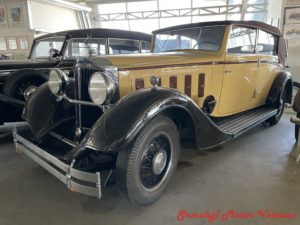
PACKARD Standard Eight 902

Year of Manufacture: 1932
Power: 110 hp
Displacement: 5,231 cm3

Number of cylinders/valves: 8/2
Weight: 1,870 kg

Condition: restored
Catalog Number: 91

Packard was an American luxury automobile brand produced by the Packard Motor Car Company in Detroit, Michigan, and later by the Studebaker-Packard Corporation in South Bend, Indiana.

In 1954, the company merged with Studebaker, creating the Studebaker-Packard Corporation. The last original Packard car rolled off the factory line in 1956, but due to declining sales, production was discontinued two years later.

However, throughout its history, the company made a significant mark on automotive development, especially in the USA.

While the Great Depression had a huge negative impact on American premium car manufacturers in the early 1930s, Packard’s reputation helped it maintain a strong market share. The ninth series models, introduced in June 1931, are still considered among the best Packards of the classic era.

The basis of this series was cars with an inline eight-cylinder engine of classic design producing 110 hp. The pinnacle of the ninth series offerings were models 905 and 906 with V12 engines. These cars stood out for their high standards and were among the best American cars available at the time. Notably, even American presidents used these cars.

The car from our collection has undergone a complete restoration and is in excellent condition.

Alfa Romeo 8C 2300

Year of Manufacture: 1931
Power: 200 hp
Displacement: 2,336 cm3

Number of cylinders/valves: 8/2
Weight: 1,000 kg

Condition: drivable
Catalog Number: 262

Sport and racing cars Alfa Romeo 8C 2300 were iconic racing and sports specials in the 1930s and have left an indelible mark in motor history. These cars were powered by 2.3-liter inline eight-cylinder DOHC engines. They achieved numerous victories in races such as Le Mans, Mille Miglia, Targa Florio, and Grand Prix events.

Alfa 8C was designed by the famous genius engineer Vittorio Jano in 1930. The inline eight-cylinder engine with a very long hood was supercharged. The original engine produced around 165 hp, but over time the power of the 8C engine was increased. A special feature of the engine is the split crankshaft.

The first 8C engine debuted in 1931 at the Mille Miglia road race in the Alfa Romeo 8C 2300. The pair Tazio Nuvolari – Battista Guidotti finished 9th (won by Caracciola in a Mercedes SSKL). The inline eight-cylinder had a common crankcase now divided into two four-cylinder blocks including cylinder heads. The bore and stroke were the same as the six-cylinder 6C 1750 engine, so it used the same pistons and connecting rods. The 8C engine did not have a detachable cylinder head, which avoided head gasket issues but made valve maintenance difficult. By increasing bore and stroke, the engine displacement eventually rose to 2905 cm3, which powered Alfa Romeo 8C 2900 sports and touring cars from 1936 to 1941.

Originally, Alfa Romeo did not plan for the 8C 2300 models to be sold to private customers, but eventually made 188 chassis in Lungo (long) with a 3099 mm wheelbase or Corto (short) with a 2751 mm wheelbase, on which coachbuilders Zagato, Touring, Castagna, Pinin Farina, and Brianza built bodies. In addition, Alfa Romeo made their own bodies. Several chassis were “dressed” by Swiss coachbuilders Graber, Worblaufen, Tuscher, and also French Figoni. The shortest 2649 mm wheelbase chassis (Monza) were intended for racing cars. Some racing cars were converted by Alfa Romeo into touring cars and sold to customers.

The 8C 2300 Spider Corsa, also called the “Corto Mille Miglia,” had a two-seater Touring body. In front of the traditional Greek temple-shaped radiator were three headlights and at the rear two partially covered spare wheels. The front and rear fenders were elegantly connected by running boards. Small doors had cutouts allowing the driver to stick elbows out while cornering. The car had a frameless front window with two side windows.

The Mille Miglia name was given to the car after its success in the “1000 miles” race in 1932. In 1933, Alfa Romeo 8C 2300 cars finished first eight places at Mille Miglia, mostly with Italian crews. Nuvolari with Compagnoni won. The racing 8C 2300 Spider driven by Tazio Nuvolari won the 1931 Italian Grand Prix at Monza, with the team Minoia – Borzacchini finishing second. In honor of this success, the two-seater Spider was named Monza.

Prospero Gianferrari, Alfa Romeo’s general manager in 1931, decided to conquer the prestigious international 24 Hours of Le Mans race. To meet the rules, he chose a four-seater long-wheelbase car with an open Touring Spider Corsa body. The rear seats were covered with a tarp during races, and the front windshield was foldable.

The Alfa Romeo 8C 2300 Le Mans convertible weighed exactly one ton, was less than 4 meters long, and 1.65 meters wide. The DOHC inline eight-cylinder engine with 2,336 cm3 displacement and Roots supercharger produced 155 hp (114 kW) and could reach speeds of up to 200 km/h. Later, its power was increased to 200 hp. From 1931 to 1934, only nine Le Mans versions were built, differing in details (e.g., shapes of battery and tool boxes).

The 8C 2300 Le Mans earned its name thanks to its unique success at the 24 Hours of Le Mans in France, winning four times in a row between 1931 and 1934 with different crews, and in 1933 Alfa Romeos took the top three places.

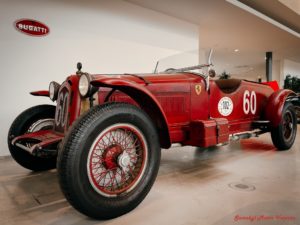
The Alfa in our collection is a rare car. It is the Monza version, but on the longer Le Mans chassis.

The chassis number ends with 14 and is traceable in original Alfa Romeo factory records. The car was originally ordered by Enzo Ferrari when he operated his racing team with these cars before Ferrari cars existed. That is why the Ferrari badge is on the car.

Mr. Ladislav Samohýl found the chassis in a private British collection depot, where it had been since the late 1960s, while searching for parts for the Alfa Romeo 6C. After three years of negotiations, he bought and renovated the chassis. The original engine was found in Argentina, where it was taken after the war. This created an original car, fully functional and participating in various veteran races.

BMW 326 convertible

Year of Manufacture:  1937 Power:  50 hp Engine Displacement:  1,971 cm3

Number of Cylinders/Valves:  6/2 Weight:  1,700 kg

Condition:  excellent Catalog Number: 265


Introduction

The company BMW (Bayerische Motoren Werke) did not initially manufacture automobiles. Instead, it entered automobile production somewhat indirectly, starting as a manufacturer of aircraft engines and motorcycles. In the field of cars, BMW first produced and improved Dixi vehicles after acquiring a competing factory. The first car fully designed and developed by BMW was the 3/20 PS model powered by a four-cylinder engine.

The first inline six-cylinder engine, now so typical of the brand, was introduced by the Bavarian automaker in 1933. The BMW 303 model was the first to feature the characteristic “kidney” grille covering the radiator. This model later led to the development of four-cylinder models 309, 315, and 319. Three years later, a larger and more luxurious car with a sturdier construction appeared on the market—the four-door sedan BMW 326. A shortened version of its chassis was used in the 320, 321, and BMW 327 coupe models. The highlight of this series based on the 326 was the sporty and racing model 328, which achieved excellent sporting results shortly before the war.


Development

The BMW 326 was introduced at the Berlin Motor Show in 1936 and was offered for sale in May of the same year. The model was designed by Fritz Fiedler, an outstanding automotive engineer. It was produced until 1941, with a total of 15,949 units made. It was available as a four-door sedan, but also as two- or four-door convertible versions.


Technical Specifications

The inline six-cylinder engine with a displacement of 1,971 cm3 was a version of the original 319 engine with the bore increased from 65 mm to 66 mm while retaining the unchanged stroke of 96 mm. The BMW 326 was equipped with two Solex carburetors, producing a maximum power of 50 hp at 3,750 rpm.

The four-speed gearbox featured a freewheel and synchronization on the top two gears. The car had an excellent chassis design for its time and very good driving characteristics. The quality of the model is demonstrated by the fact that many of these cars have survived to this day and actively participate in various sporting events and vintage car meetings.

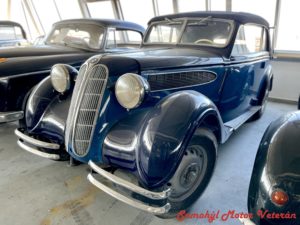
The car from our collection is a convertible with a custom body by the famous Gläser coachbuilder, fully restored and in excellent condition.

BMW 326 limousine

Year of Manufacture:  1936 Power:  50 hp Engine Displacement:  1,971 cm3

Number of Cylinders/Valves:  6/2 Weight:  1,700 kg

Condition:  drivable Catalog Number: 266


Introduction

The company BMW (Bayerische Motoren Werke) did not initially manufacture automobiles. Instead, it entered automobile production somewhat indirectly, starting as a manufacturer of aircraft engines and motorcycles. In the field of cars, BMW first produced and improved Dixi vehicles after acquiring a competing factory. The first car fully designed and developed by BMW was the 3/20 model, powered by a four-cylinder engine. The first inline six-cylinder engine, now so typical of the brand, was introduced by the Bavarian automaker in 1933.


Development

The BMW 303 model was the first to feature the characteristic “kidney” grille covering the radiator. This model later led to the development of four-cylinder models 309, 315, and 319. Three years later, a larger and more luxurious car with a sturdier construction appeared on the market—the four-door sedan BMW 326. A shortened version of its chassis was used in the 320, 321, and BMW 327 coupe models. The highlight of this series based on the 326 was the sporty and racing model 328, which achieved excellent sporting results shortly before the war.

The BMW 326 was introduced at the Berlin Motor Show in 1936 and was offered for sale in May of the same year. The model was designed by Fritz Fiedler, an outstanding automotive engineer. It was produced until 1941, with a total of 15,949 units made. It was available as a four-door sedan, but also as two- or four-door convertible versions.


Technical Specifications

The inline six-cylinder engine with a displacement of 1,971 cm3 was a version of the original 319 engine with the bore increased from 65 mm to 66 mm while retaining the unchanged stroke of 96 mm. The BMW 326 engine was fed by dual Solex carburetors, producing a maximum power of 50 hp at 3,750 rpm. The top speed was therefore 115 km/h.

The four-speed gearbox featured a freewheel and synchronization on the top two gears. The car had an excellent chassis design for its time and very good driving characteristics. The quality of the model is demonstrated by the fact that many of these cars have survived to this day and actively participate in various sporting events and vintage car meetings.

This car from our collection is a classic four-door limousine in original condition.

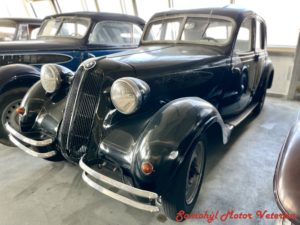
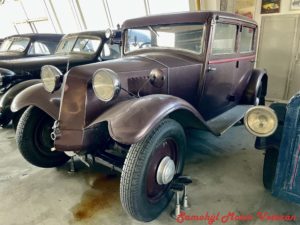
Tatra 54

Year of Manufacture: 1935
Power: 22 hp
Displacement: 1,463 cm3

Number of Cylinders/Valves: 4/2
Weight: 1,350 kg

Condition: drivable
Catalog Number: 267


Introduction

The Tatra 54 is a mid-range passenger car manufactured between 1931 and 1934 by the Czechoslovak automaker Tatra.


Development

The Tatra 54 was an economical version of the Tatra 52. It was considered “one of the most durable and reliable cars of the Kopřivnice manufacturer.” In 1934, it was replaced by the Tatra 75 model.


Technical Specifications

The Tatra 54 was available as a four-door, four-seat sedan equipped with the T30 engine, which had a bore 5 mm larger than the predecessor with the same stroke, resulting in a displacement of 1,463 cm3. The engine was front-mounted and powered the rear wheels with a conventional drivetrain layout. The body measured 4,000 mm in length, 1,650 mm in width, and 1,700 mm in height. With a wheelbase of 2,820 mm, the track width was 1,300 mm both front and rear, and the ground clearance was 220 mm. All four solid disc wheels were 18″ in size and equipped with mechanical drum brakes; hydraulic brakes were available as an option.

The front rigid axle was suspended by transverse semi-elliptical leaf springs, as were the two rear swinging half-axles. Torque was transmitted to these half-axles via a dry four-plate clutch and a directly-shifted, non-synchronized four-speed gearbox with a reverse shaft housed within a supporting tube forming the vehicle’s central backbone. This was the so-called “Tatra concept,” designed by the chief designer Hans Ledwinka. The engine was a flat, four-stroke, air-cooled boxer four-cylinder mounted longitudinally at the front.

The Tatra 54 featured mechanical worm steering and, with a curb weight between 1,000 and 1,090 kg, could reach speeds up to 80 km/h. Fuel capacity was 45 liters with 5 liters of oil. The car was equipped with a 12 V electric starter Bosch BGC 0.6/12 l z7 or Scintilla 12 V.


Production

Four- and six-seat sedan bodies with two or four doors were offered on the market.


Sales

During four years of production, a total of 1,510 vehicles were sold.


Car in Our Collection

The car in our collection is in fully functional and drivable condition.

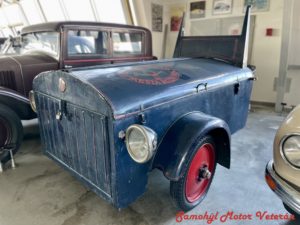
Tatra 49

Year of Manufacture: 1936
Power: 7 hp
Engine Displacement: 528 cm3

Number of Cylinders/Valves: 1/2
Weight: 515 kg

Condition: drivable
Catalog Number: 268


Introduction

The Tatra 49 is a three-wheeled two-seater delivery vehicle produced between 1929 and 1939 by the Kopřivnice automobile factory in northern Moravia.


Development

The development of the Tatra 49 was inspired by the Tatra 12 and Tatra 30 models.


Technical Specifications

The three-wheeler adopted a rigid front axle suspended on a transverse leaf spring and equipped with mechanically operated drum brakes from the four-cylinder Tatra 30. The front axle was mounted at the front end of a backbone frame made from a circular steel tube, to the rear end of which the drivetrain was attached. Ahead of the driven rear wheel was a transversely mounted, air-cooled, upright single-cylinder OHV engine with a displacement of 528 cm3, having the same bore (82 mm) and stroke (100 mm) as the horizontally opposed cylinders of the Tatra 12 two-cylinder engine. The single-cylinder engine was cooled by a blade fan and produced 7 hp at 2,500 rpm. It was started by a foot pedal in motorcycle style.

To the right of the engine was a two-plate clutch, and to the left a three-speed gearbox controlled by a lever operated by the driver’s left hand. The single rear wheel was cantilevered on the left side on a hollow swing arm through which a driveshaft passed. Torque was transmitted from the gearbox output to the driveshaft and then to the rear wheel by a pair of bevel gears.

The utility version of the tricycle had the driver’s seat above the engine and a steering column with a steering wheel positioned centrally in front of the driver. The cargo space was located above and behind the front axle, usually in the form of a metal box with double-wing doors in the front wall and on top. The box measured 1,640 mm long, 1,100 mm wide, and 950 mm high and could carry up to 400 kg of cargo.

Between the cargo area and the driver was a double partition wall, with the fuel tank (12 liters) on the left and the battery on the right. The simple dashboard carried an ignition switch and a speedometer with an odometer, although period photos suggest that some three-wheelers might have lacked a speedometer. The cargo tricycle had a wheelbase of 2,265 mm and a front track of 1,300 mm. Its overall length was 3,300 mm, width 1,600 mm, and height up to the top of the steering wheel 1,300 mm. It weighed 515 kg and reportedly reached a top speed of 55 km/h with fuel consumption between 6 and 8 liters per 100 km.

The chassis of the passenger version was modified in several ways. The steering wheel was moved forward and to the right, and the gearshift lever was relocated forward and to the center, requiring a new shifting mechanism. On Tatra 49 passenger tricycle prototypes, the foot brake acted only on the front axle, while the hand brake controlled the rear wheel brake.


Production

The passenger tricycle resembled its four-wheeled sister Tatra 12, including a shortened front end shaped like Kopřivnice’s “iron.” The two-seat cabin was made of wood covered with artificial leather, with doors on both sides fitted with sliding windows. The windshield had a manual wiper. The engine was equipped with an electric starter, and the exhaust with a silencer exited near the rear wheel. The equipment included an electric horn, but the driver still had the classic bulb horn at hand. The spare wheel was mounted on the rear fender.

The passenger version was 3,100 mm long, 1,600 mm wide over the front fenders, and 1,680 mm tall. Its weight was around 600 kg, with a top speed estimated not to exceed 50 km/h. Probably only two passenger Tatra 49 tricycles were made, which remained prototypes. However, in March 1930 the magazine Auto announced that Tatra had completed a small series of utility three-wheelers type 49 and would soon launch them on the market for less than 20,000 Kč.

According to factory records, the first series included 100 utility three-wheelers T 49 in several variants, mainly with metal boxes but also with open wooden beds. For an additional fee, the factory offered a second seat in tandem behind the driver on the rear fender, a protective windshield in front of the driver, and a simple fabric roof.


Market

Nearly twenty T 49 chassis were delivered in 1930 and 1931 to the Austro-Tatra company in Vienna, where they received utility superstructures. In October 1930 and again the following year, Tatra 49 three-wheelers were repeatedly displayed at the Prague Motor Show in the Kopřivnice commercial vehicle exhibit—two each time, one with a closed and one with an open cargo box.

The second 100-unit series of Kopřivnice three-wheelers began production in 1934. Their exclusive dealer from spring 1934 was the Prague firm Bratří Šulcové, which also represented British BSA motorcycles and Strakonice ČZ machines. The single-seat delivery tricycle with a metal box was offered for 12,300 Kč; the two-seat version was available at an extra charge.

“The ideal vehicle of today that truly reduces transport overhead to a minimum is the Tatra cargo tricycle,” proclaimed a Bratří Šulcové advertisement published in early April 1934 in Národní listy.

The last of the 200 utility Tatra 49 three-wheelers were reportedly assembled and sold in the late 1930s, after which these uniquely designed vehicles nearly faded into oblivion. Only a few examples have survived to this day and enjoy great interest and affection among vintage vehicle enthusiasts.


Sales

Over 9 years of production, the company sold nearly 210 units.


Trivia

An interesting fact is that on May 1, 1931, the same advertisement featuring drawings of the Tatra 49 delivery tricycle and the slogan “A helper that pays off for you. Tatra tricycle.” appeared simultaneously in three major newspapers: Národní listy, Národní politika, and Lidové noviny. The ad did not state the selling price.


Vehicle in Our Collection

The vehicle in our collection is in fully drivable condition.

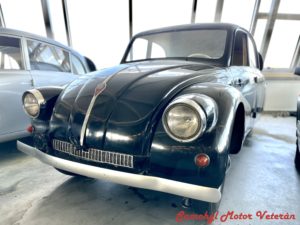
Tatra 97

Year of Manufacture: 1937
Power: 40 hp
Engine Displacement: 1,749 cm3

Number of Cylinders/Valves: 4/2
Weight: 1,150 kg

Condition: drivable
Catalog Number: 159


Introduction

The Tatra 97, also known as the Tatra T97, was a Czechoslovak limousine produced by the Tatra automobile company. It was created as a less powerful alternative to the Tatra 87, sharing most components but being smaller and less equipped.


Technical Specifications

The Tatra 97 is a four-door, five-seat sedan with a rear-mounted engine and rear-wheel drive. It is equipped with a spark-ignition, air-cooled flat four-cylinder engine with a displacement of 1,749 cm³ and a Zenith carburetor without supercharging. The vehicle produces 29 kW (40 hp) at 3,500 rpm and has a curb weight of 1,150 kg. The front wheels are suspended on two transverse leaf springs, and the rear features a swing axle (half-axles) with oblique leaf springs. Both front and rear brakes are drum brakes.


Production

Production of this model lasted only three years, from 1937 to 1939. After World War II, production briefly resumed in 1946 but was soon definitively stopped to make way for the Tatra 600 – Tatraplan.


Sales

Only 510 units were produced during the entire production period, making it a highly valued collector’s car.


Trivia

An interesting fact is that the Tatra 97 resembled the Volkswagen Beetle, which was created at Adolf Hitler’s behest. Hitler wanted an affordable people’s car for all citizens, and the task was given to Ferdinand Porsche, a native of the Czech town Vratislavice nad Nisou. Porsche had strong support from Hitler at the time but later became known as the “devil’s engineer.”

So where does Tatra fit in? The Beetle and the Tatra 97 share several design similarities. The Beetle had a strikingly similar aerodynamic body and a rear-mounted, air-cooled four-cylinder engine, just like the Tatra 97. It could be said that Porsche copied Hans Ledwinka, the Tatra designer, but it was not that simple. The engineers were friends and often consulted each other’s designs. Nevertheless, German production was accused of plagiarism. The lawsuit, however, did not concern the appearance but the chassis concept with independent suspension. Ferdinand Porsche confided the lawsuit to Adolf Hitler, who said he would solve the problem.

When the Tatra 97 had been in production for a year, the occupation of Czechoslovakia began in 1938. In 1939, the Beetle and Tatra appeared together at the Berlin Motor Show, where Hitler himself noticed the visual similarity. He ordered the production of the Tatra 97 to be stopped, but that was not the end. Nazi forces confiscated all documentation related to the car and transported it to Germany. According to some sources, the documentation is still somewhere in Stuttgart. When the war started later that year, Tatra’s lawsuit was dropped. It was revived only after the war ended, and in 1961 Volkswagen was forced to pay one million West German marks.


Car in Our Collection

The car in our collection is from 1937, fully restored, and in perfect working condition.

Audi 920

Year of Manufacture: 1939
Power: 75 hp
Engine Displacement: 3,281 cm3

Number of Cylinders/Valves: 6/2
Weight: 1,640 kg

Condition: drivable
Catalog Number: 270


Introduction

The Audi 920 is an upper mid-range passenger car with rear-wheel drive, introduced by the Audi brand, part of the Auto Union group, at the end of 1938 as the successor to the front-wheel-drive Audi 225 model.


Development

The German car manufacturer Audi was founded in 1910 in Zwickau by August Horch and his partners. In 1928 it became part of DKW, and finally in 1932 the four German automakers DKW, Audi, Horch, and Wanderer officially merged into the Auto Union conglomerate.

Since most of the holding remained in East Germany after the war, the West German Auto Union resumed production only under the DKW brand. In 1965 Volkswagen took over the company, and within the Volkswagen Group, Audi gained a position as a producer of advanced and well-equipped vehicles.


Technical Specifications

The Audi 920 is a two-door, four-seat convertible with a front-mounted engine driving the rear wheels. The ignition, liquid-cooled inline six-cylinder engine with an OHC valve train has a displacement of 3.3 liters and produces 75 hp (55 kW) at 3,000 rpm, equipped with a Solex carburetor. The chassis has a wheelbase of 3,100 mm, track widths of 1,435/1,465 mm, external dimensions: length 4,900 mm, width 1,720 mm, height 1,620 mm, curb weight 1,640 kg, and a top speed of 130 km/h.

The vehicle features a ladder frame chassis with a hydraulically operated foot brake (“oil pressure brake”) from ATE (licensed from Lockheed) and a fully synchronized four-speed gearbox with a central gear lever. The front wheels are suspended on double wishbones; the lower arm is a transverse leaf spring, while the upper arm controls the shock absorber. At the rear, there is a rigid “floating axle” guided by trailing arms and a high-mounted transverse leaf spring.


Production

The Audi 920 was produced from 1938 to 1940. Like its predecessor, the UW 225, it was manufactured at the Horch factories. The car was available as a 4-door sedan or a 2-door convertible — the bodies were made by Gläser Dresden.


Market

The car was originally intended to be launched as a smaller Horch model, but Auto Union management decided to place it between the large Horch models and smaller Wanderer models under the Audi brand.


Sales

The unit in our collection was manufactured in 1939, with the original price of 8,750 Reichsmarks. A total of 1,281 units were sold, including 795 convertibles.


Interesting Facts

It was the last pre-war model of the Audi brand, production of which ceased due to the war.


Car in Our Collection

The car in our collection is a convertible from 1939 and is in fully functional and drivable condition.