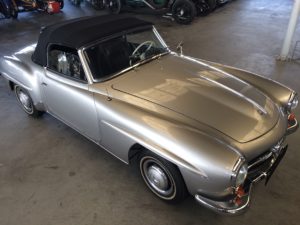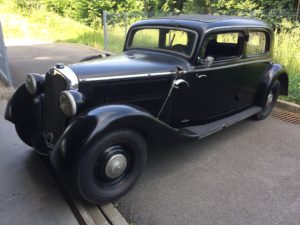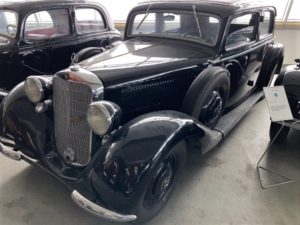
Mercedes-Benz 260 D
Year of manufacture: 1938
Power: 45 hp
Displacement: 2,543 cm3
Number of cylinders/valves: 4/2
Weight: 1,550 kg
Condition: restored
Catalog number: 226
Rudolf Diesel patented his revolutionary engine already in 1893. Due to its size, it was primarily used for industrial purposes and ship propulsion. Gradually, as the engine was downsized, it found its way into commercial vehicles. Passenger cars resisted diesel engines for a long time. Experiments in this field were conducted by Peugeot. Already in the early 1920s, experimental vehicles of types 153 and 156 ran with a two-stroke diesel twin-cylinder engine. The German company Stoewer developed a prototype in 1927. A few years later, Citroen equipped its Rosalie 11UD with an engine from the Englishman Harry Ricardo. However, mass production did not start.
The Mercedes Benz 260 D became the world’s first truly mass-produced passenger car with a diesel engine. It was introduced in February 1936 at the Internationale Automobil und Motorrad – Ausstellung in Berlin. The official premiere was preceded by a long development process. The manufacturer gradually tested various diesel engines and conducted extensive experiments but without success. The inline six-cylinder diesel engine type Manheim, which debuted in autumn 1933, suffered from such vibrations that further development was abandoned.
In November 1934, engineers chose a modified version of the inline six-cylinder engine originally used in commercial vehicles. The result was a smaller two-valve four-cylinder unit with a 100 mm stroke. It was designated OM 138 with a displacement of 2,545 cm3. The commercial designation “260” came from this engine. The ignition system was taken from the original engine. Other key technical solutions also remained the same, including the OHV pushrod valve train and the crankshaft mounted in five main bearings. The construction basis of the car was the extended chassis of the gasoline model 200 from the W21 series.
Modern turbodiesels are known for their fuel efficiency and long range per tank. The 260 D’s fuel tank allowed a range of approximately 400 km. This revolutionary vehicle began serial production at the end of 1935, before its official premiere. The so-called zero series consisted of 170 six-seat landaulets and Pullman limousines. The first 13 semi-open models featured a partition between front and rear passengers. It featured a three-speed manual gearbox with an overdrive but no synchronization for first gear.
In September 1936, new body styles appeared, including sedans and Cabriolet B models, which accommodated four to five passengers. February 1937 saw a more significant facelift. The second series adopted the chassis from the 230 Lang W143 models. The improved version had a new grille. The headlights were reduced in size and were no longer mounted on a chrome strip in front of the radiator but newly positioned on the fenders.
Between 1935 and 1940, a total of 1,967 units of the 260D model were produced, after which wartime production took precedence. The car from our collection is from the second series, in very good condition after a complete restoration.