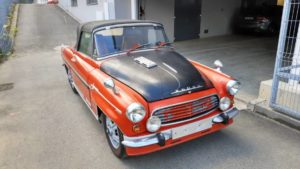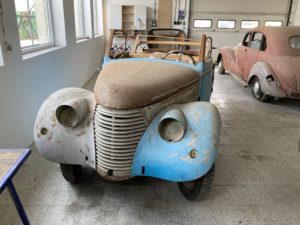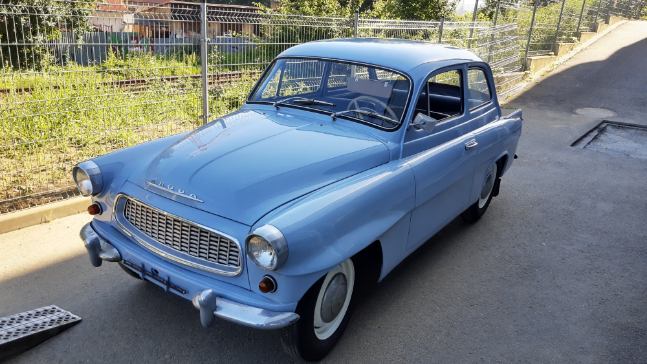
Škoda Octávia
Year of Manufacture: 1963
Power: 40 hp
Displacement: 1,089 cm3
Number of Cylinders/Valves: 4/2
Weight: 920 kg
Condition: fully functional
Catalogue Number: 109
Introduction
The first Škoda Octavia rolled out of Mladá Boleslav in 1959, marking a significant modernization of the Škoda 440 and Škoda 445 models, which were called Spartak. The company implemented not only visual changes and technical innovations but also a name change.
Development
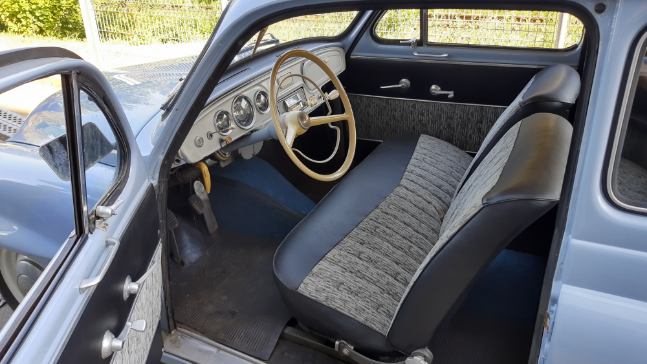
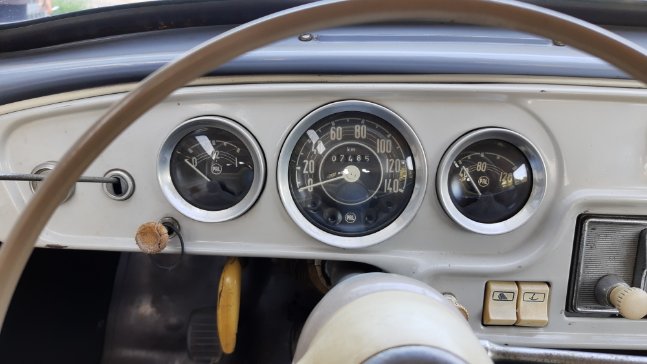
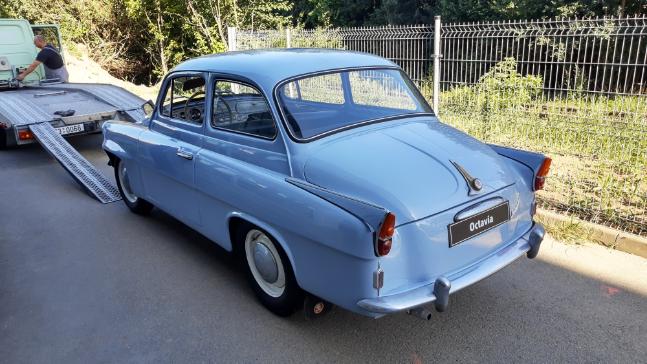
At first glance, one might say that the Octavia does not differ much from the Spartak. Indeed, designers opted for a simpler grille, slightly modified rear lights, and the “Octavia” badge on the front fender, as well as a new instrument panel and steering wheel.
Technical Specifications
From a technical point of view, the engineers introduced a new front axle with a transverse torsion stabilizer and coil springs — the predecessor used leaf springs. Although coil springs were tested, leaf springs remained on the rear axle. During 1959, the model also received more effective asymmetric front headlights and a split front bumper.
The modification of the front axle narrowed the track to 1,200 mm, and the wheelbase of the two-door tudor body was shortened by 10 mm to 2,390 mm. The backbone frame with independently suspended wheels remained the basis of the Octavia, and its length stayed at 4,065 mm. Under the hood was the same inline four-cylinder 1.1-liter engine as in the 440, producing 29.4 kW (40 hp), with a top speed of 110 km/h. Its curb weight was 920 kg. The stronger Octavia Super inherited the larger 1.2-liter engine with 33 kW from the 445 series.
In both cases, power was transmitted to the rear wheels via a four-speed manual gearbox. Combined with the front-mounted engine, the Octavia was one of the last Škoda models with a classic rear-wheel-drive layout. By the way, buyers in Czechoslovakia needed a special permit to purchase this model.
Production
Production lasted 12 years, from 1959 to 1971.
The Octavia Super, with a more powerful 1.2-liter engine producing 33 kW (45 hp), was also offered. The Octavia series enjoyed high demand both in Czechoslovakia and abroad.
The Geneva Motor Show on March 10, 1960, saw the debut of the Škoda Octavia Touring Sport sports version, with power increased to 37 kW (50 hp). FIA homologation for participation in races and competitions in the group of unmodified touring cars opened the way for the car’s motorsport career — for example, from 1961 to 1963, the Octavia TS achieved a hat-trick in its class at the Monte Carlo Rally.
Market
The Škoda Octavia was available as a sedan and station wagon, as the Octavia Super, and as the Touring Sport and Touring Sport 1200. The last original two-door Octavia left the Mladá Boleslav production line on April 11, 1964, to make way for the successor — the completely new Škoda 1000/1100 MB series with a unibody and rear engine.
Sales
About 229,531 cars were sold in total, with the Škoda Octavia sedan being the most popular at 79,489 units, and the Octavia TS the least at 2,273 units.
The last Octavia station wagon left the Kvasiny plant on December 21, 1971, marking the end of Octavia production and sales.
Interesting Facts
An interesting fact is that the name Octavia has symbolic meaning — in Latin, octavia means “eighth.” This model was the eighth car produced by the brand after World War II, and also the eighth car in a row with independent suspension on all wheels.
Car in Our Collection
Our collection includes both Škoda Octavia sedan and station wagon, both fully restored and in fully functional and drivable condition.