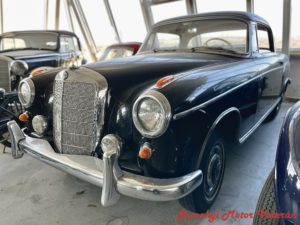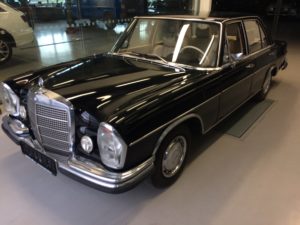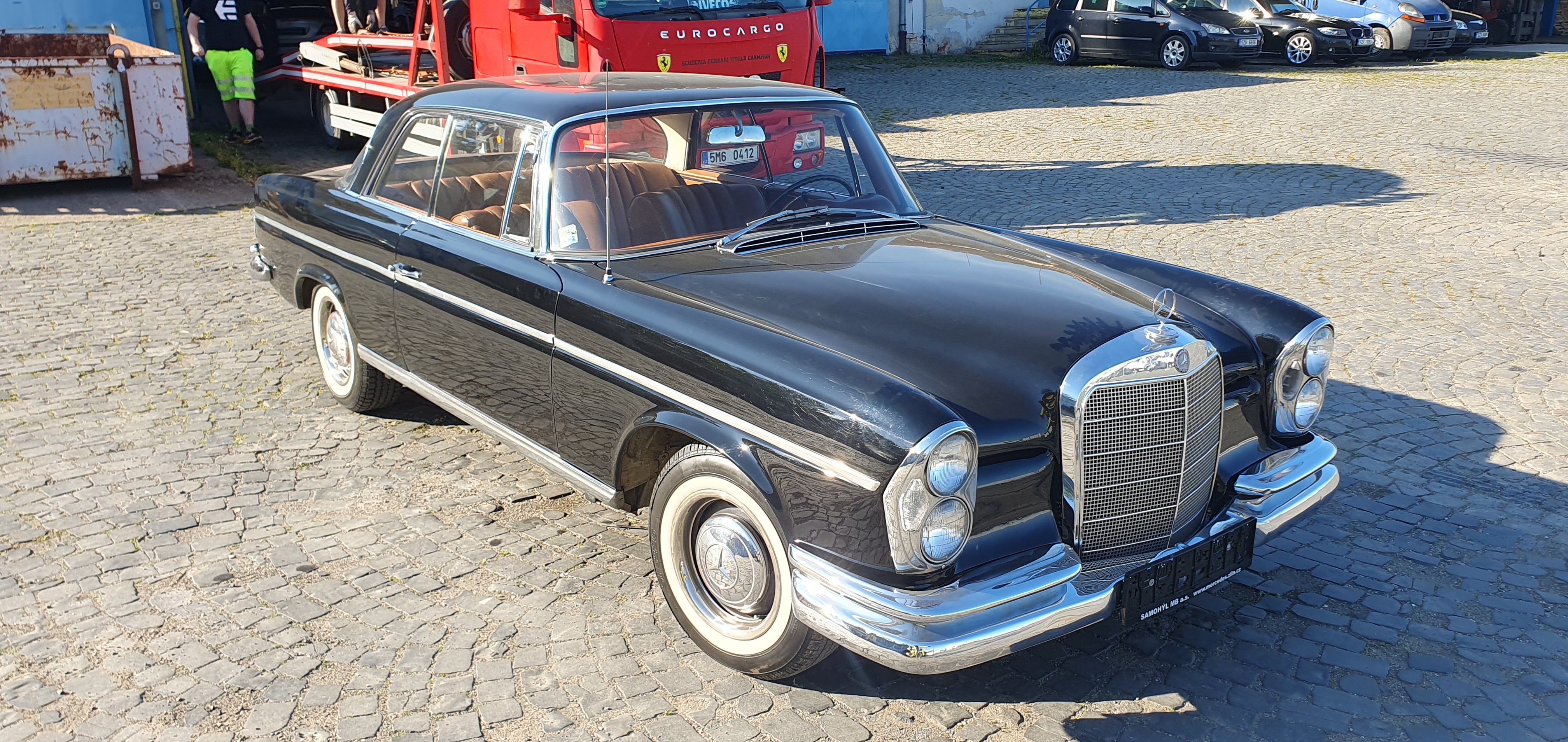
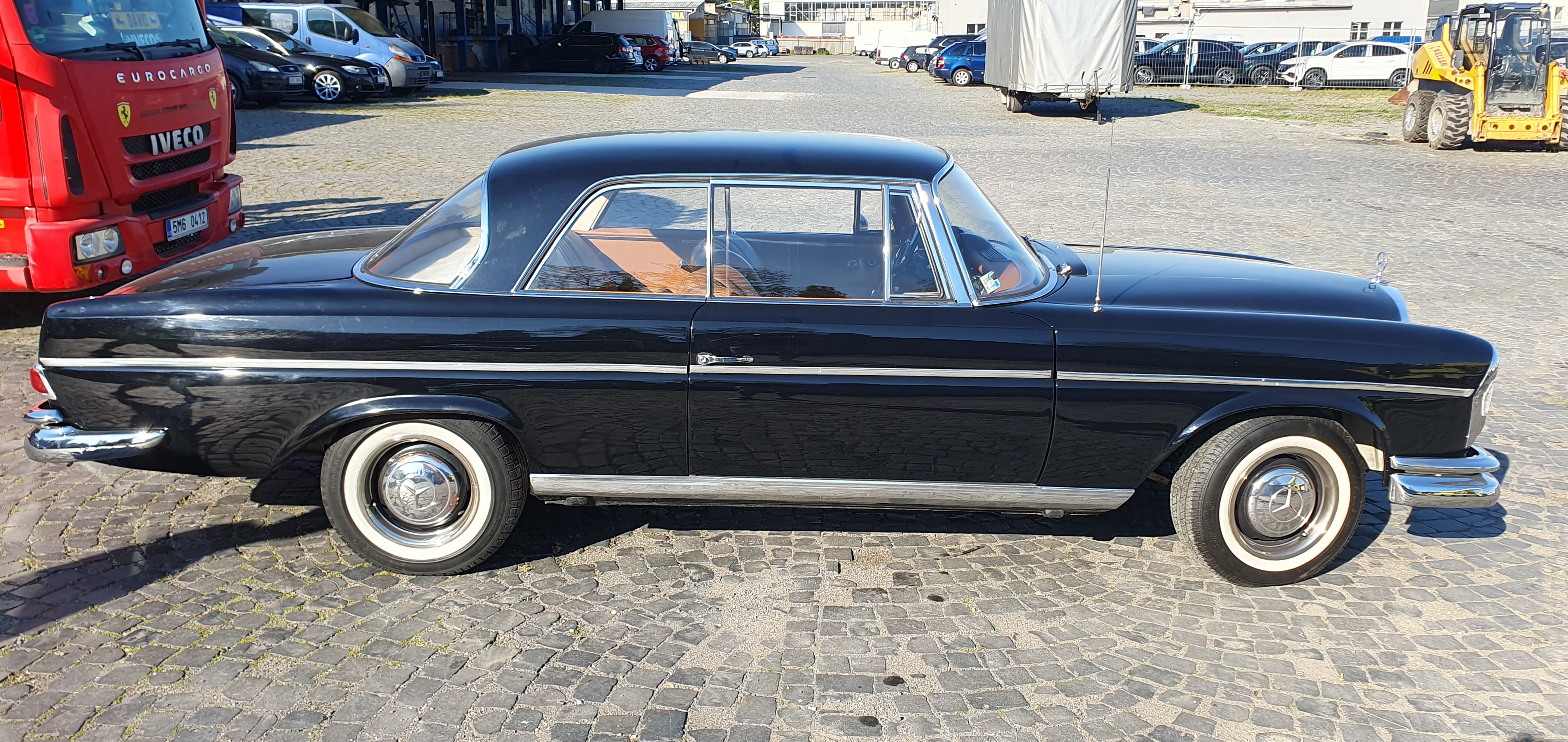
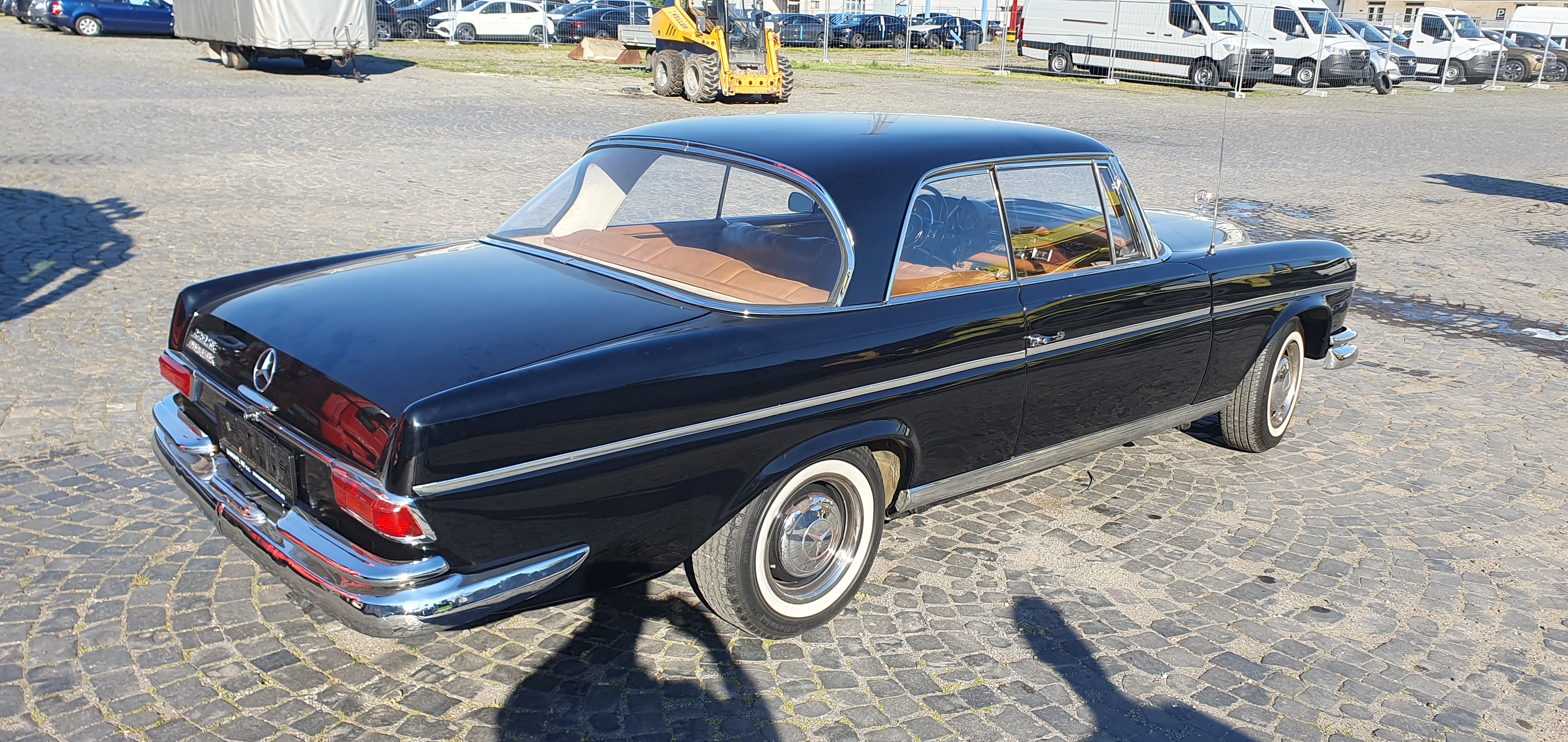
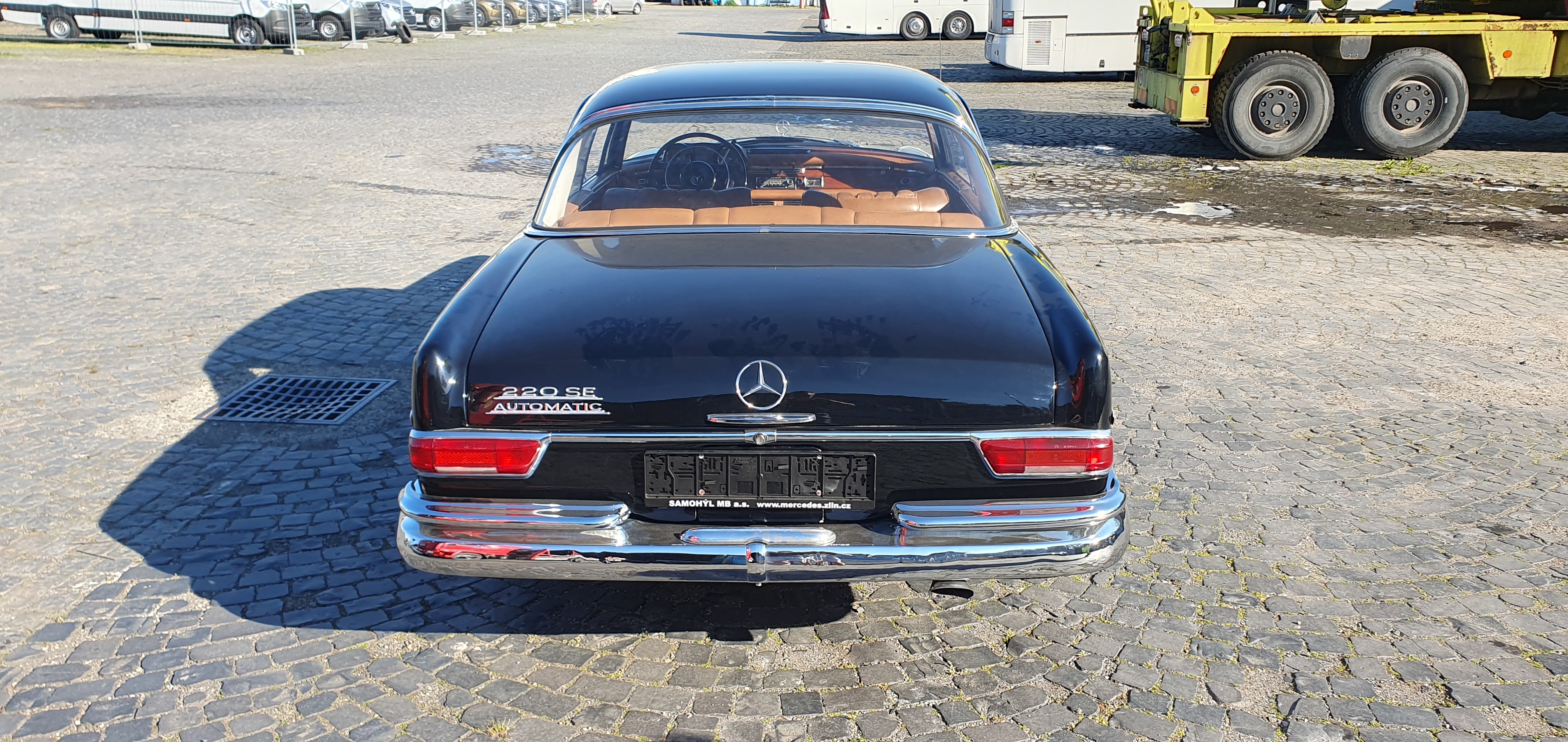
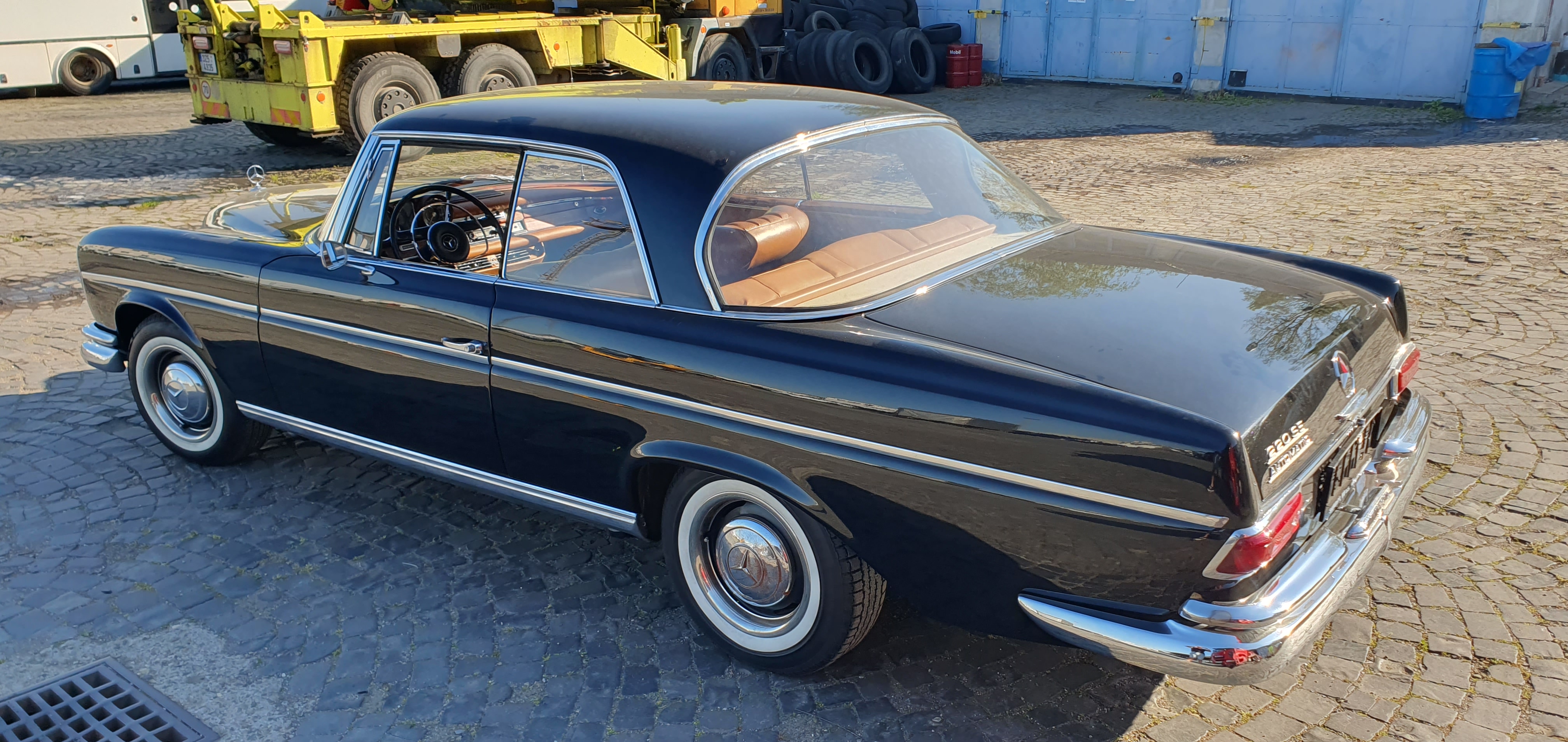
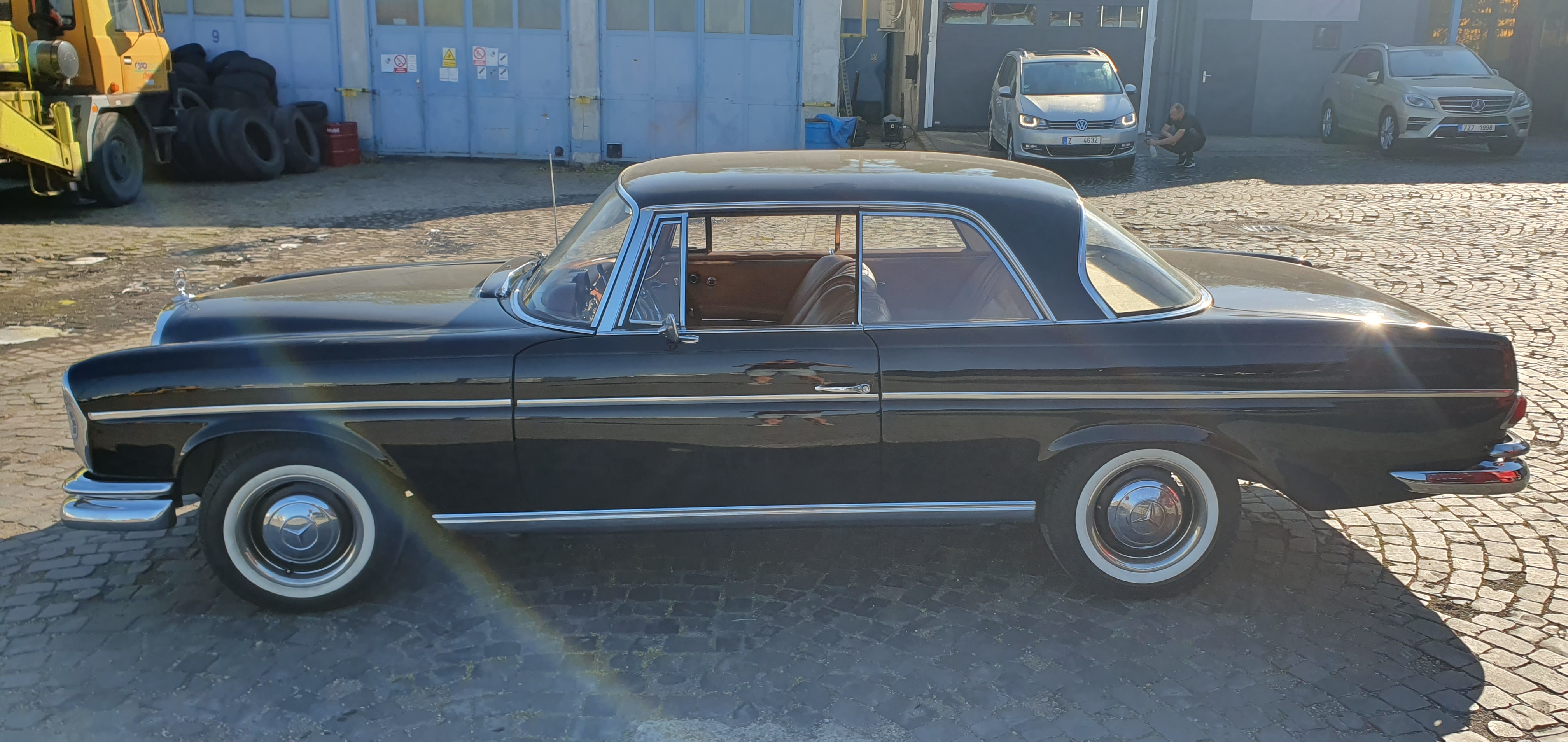
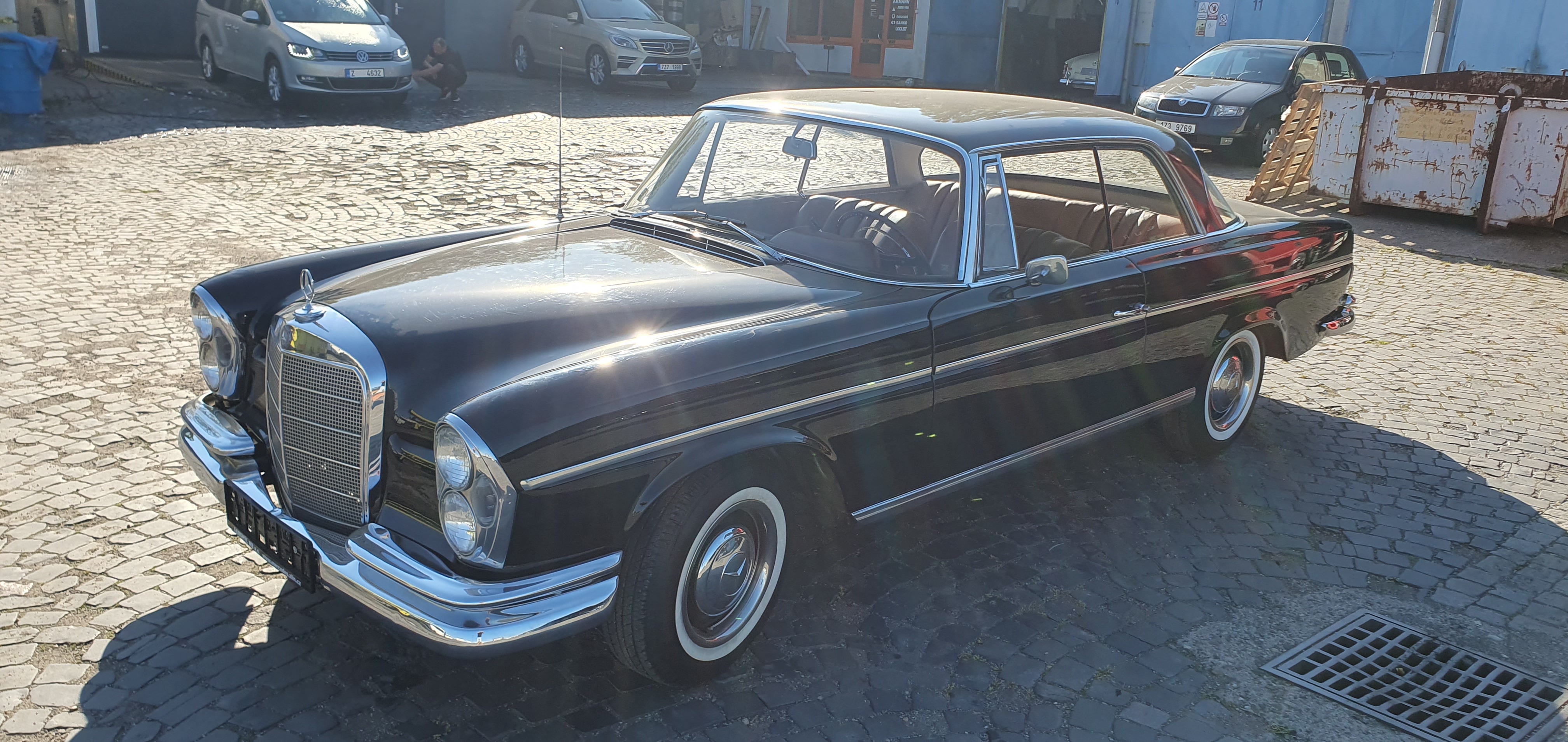
Mercedes-Benz 220 SE W111
Year of manufacture: 1964
Power: 120 hp
Displacement: 2,195 cm3
Number of cylinders/valves: 6/2
Weight: 1,410 kg
Condition: drivable
Catalogue number: 31
Introduction
In August 1959, the company introduced a thoroughly redesigned line of passenger cars. Under the slogan: “New six-cylinders – a class of their own” and as successors to the existing six-cylinder models, three completely redesigned models were launched – 220 b, 220 Sb, and 220 SEb of the W111 series, the so-called large tailfins.
Development
Mercedes-Benz has been using one of the automotive safety features – crumple zones – for more than half a century. They first appeared in the six-cylinder W111 series in August 1959. However, their history is a decade older and is the work of one of the most famous engineers in the field – the Hungarian-born Béla Barényi.
He worked for Daimler-Benz AG between 1939-1946 and signed a new contract with the company two years later, in August 1948. He was the first to realize that kinetic energy during a crash must be absorbed so passengers inside the car would not be endangered. Therefore, he logically divided the car body into three parts, with a rigid safety cell in the center for passengers. The front and rear were soft crumple zones.
Technical specifications
The large tailfins were designed according to the fashion of the time, clearly inspired from overseas, although their rear part could not compare with the huge fins of American highway cruisers. The design was also inherited by the smaller W110 series launched in 1961. The cars offered sufficient comfort as well as sporty driving characteristics – according to the standards of the time. Modern passive safety features were implemented during the development of the Mercedes-Benz W111 and W112 series.
The steering wheel was padded to reduce the risk of head injury in a crash – customers of the three-pointed star had to wait more than two decades longer for airbags. The doors were for the first time equipped with locks on the inside (so-called pins). These were useful not only in theft attempts but also in case of an accident. The pioneer of three-point seat belts for front seats was Swedish Volvo. Stuttgart was not far behind and offered them to its clients as well. The 300 SE model, which entered production two years after the basic types 220 b, 220 Sb, and 220 SEb, featured disc brakes, air suspension, and was also available with a long wheelbase (SEL). New additions included a four-speed automatic transmission and power steering.
Why did the letter b appear in the names? Internal codes were not used in commercial designations, and the new large tailfins had to be distinguished from the previous large Pontons with the same names. However, the W111/112 series was spacious and elegant – not a “b” (béčko). For example, the dashboard partially recessed some controls – safety was given the highest priority during development.
The basic 220b version with two carburetors differed externally from its more luxurious siblings – it lacked most of the chrome. The 220 Sb and 220 SEb models featured chrome strips on both sides of the grille. This metal also adorned the air intake grilles in the front of the windshield, wheel centers, strip above the rear window, and decorative strips on the trunk lid. The fins were also chromed, not only at the rear but also on the upper edge. The 220b had simpler bumpers, while the Sb and SEb had two-piece bumpers. They also had larger rear lights with integrated license plate lighting.
The engines were inherited from the predecessor but with minor modifications. The six-cylinder 2.2-liter engines received new valve control linkages and sharper camshafts. The basic 220 b had two carburetors and 70 kW (95 hp), while the 220 Sb had 81 kW (110 hp). The SE in 220 SEb stood for “Einspritzmotor” – meaning “injection engine” – and produced up to 88 kW (120 hp).
The chassis also saw changes. The self-supporting body with front auxiliary frame remained, but the simple cross member was attached to the floor only at two points. The rear single-joint swing axle additionally received a compensating spring placed horizontally above the pivot. This ensured even load distribution on the driven rear axle. Shock absorbers were mounted externally both front and rear, making shock and vibration absorption more effective. The braking system underwent two modifications during production. The more luxurious Sb and SEb got front disc brakes in April 1962. The basic 220 b received the same upgrade in August 1963, along with an effective power booster, which had been optional before. At that time, the entire series received a dual-circuit deceleration system, allowing safe stopping even if one circuit failed.
At the Geneva Motor Show in March 1963, Daimler-Benz unveiled another novelty – the long version of the 300 SE with the suffix L (lang – long). It had a 100 mm longer wheelbase, significantly increasing rear passenger legroom. The doors were also wider. As an option, the front compartment could be separated by a partition with electrically operated glass. The exterior was distinguished by the C-pillar – ventilation was redesigned and no decorative trims or openings were present. The extended version also introduced a four-speed manual transmission.
The turn of July and August 1965 marked the farewell of the large tailfins with 2.2 and 3.0 L engines. The successor models 250 S, 250 SE, and 300 SE featured a new, more modern body and belonged to the W108 series. However, this did not mean the definitive end. The basic 220 b (W111) successor was the 230 S. Despite the unusual designation, it was a familiar face, differing only by the badge on the rear. However, the powertrain was modified: the bore was increased, bringing displacement close to 2.3 liters. Compression also rose, with the engine delivering 88 kW (120 hp). The rear axle featured a hydropneumatic spring replacing the traditional coil spring and maintaining constant ground clearance. By January 1968, 41,107 units of the 230 S were produced. Of these, 341 were chassis for special bodies. One deserves a brief mention: a wagon built by Belgian coachbuilder IMA. It was sold directly through Daimler-Benz dealers under the supplementary designation Universal from August 1966. A similar model was offered in the smaller W110 series as well.
From 1959 to 1968, a total of 344,751 sedans and separate chassis of the W111 and W112 series were produced in Sindelfingen.