Volkswagen Karmann-Ghia
Year of Manufacture: 1971
Power: 50 hp
Engine Displacement: 1,600 cm3
Number of Cylinders/Valves: 4/2
Weight: 820 kg
Condition: drivable
Catalog Number: 271
Introduction
The Karmann-Ghia prototype premiered at the Paris Motor Show in 1953 and was created completely outside Wolfsburg. It carries the name of two coachbuilders, and rightly so. The German Karmann had asked the Italian studio Carrozzeria Ghia whether they could design something sexier, more attractive, and more interesting on the Beetle chassis. The Karmann coachworks in Osnabrück was already producing the open version of the legend, the classic cabriolet. The market would surely welcome such a car, so there was room for something new and fresh.
Important figures behind the creation of this model are the coachbuilder founder Wilhelm Karmann and the designer Luigi Segre, who worked at the Ghia studio in Turin. It was between these two men that a prestigious conversation took place at the Paris show. Segre and his team eventually designed a new coupe — why a convertible was not made first is unfortunately unknown. He showed his work in October 1953 to influential Karmann executives, led by the boss, in a Paris garage, and the decision was made.
The elegant car appeared in November at the motor show stand. Journalists and others were enthusiastic. What about Volkswagen itself? Its then head Heinz Nordhoff thoroughly inspected the car, liked it a lot, but shortly after the show delivered sad news: mass production would be too expensive for the factory alone. However, cheerful news came from Osnabrück: there was capacity alongside open Beetle production. The agreement among all three companies faced no further obstacles.
The series-production Volkswagen Karmann-Ghia Type 14 began selling in Europe in early 1955, and the production coupe differed little from the original prototype, with only minor changes to the body and interior. The convertible version with a fabric roof came into production in 1957.
Technical Specifications
The air-cooled flat four-cylinder engine with a displacement of 1.2 liters was rear-mounted and produced only 30 hp (22 kW). The convertible arrived in 1957 — Segre presented it directly in Wolfsburg. The variant with a fabric roof helped the brand, then still with a short tradition, build a solid image. Using existing technology was logical, as Wolfsburg had no other options available.
A comparison with the Porsche 356 somewhat suggests itself, but Volkswagens were more popular. Today they are sometimes disparagingly called “the slowest sports cars in the world.” After all, the original models with 1.2-liter engines reached a maximum speed of 120 km/h and accelerated to 100 km/h in 28 seconds. Throughout production, the chassis was consistently based on the classic Beetle, but engine displacement and power were gradually increased. First to 1.3 liters and 40 hp, and finally to 53 hp from 1.6 liters.
Production
The Volkswagen Karmann-Ghia was produced as a two-door coupe or convertible, with over 445,000 units manufactured from 1955 to 1974.
Car in Our Collection
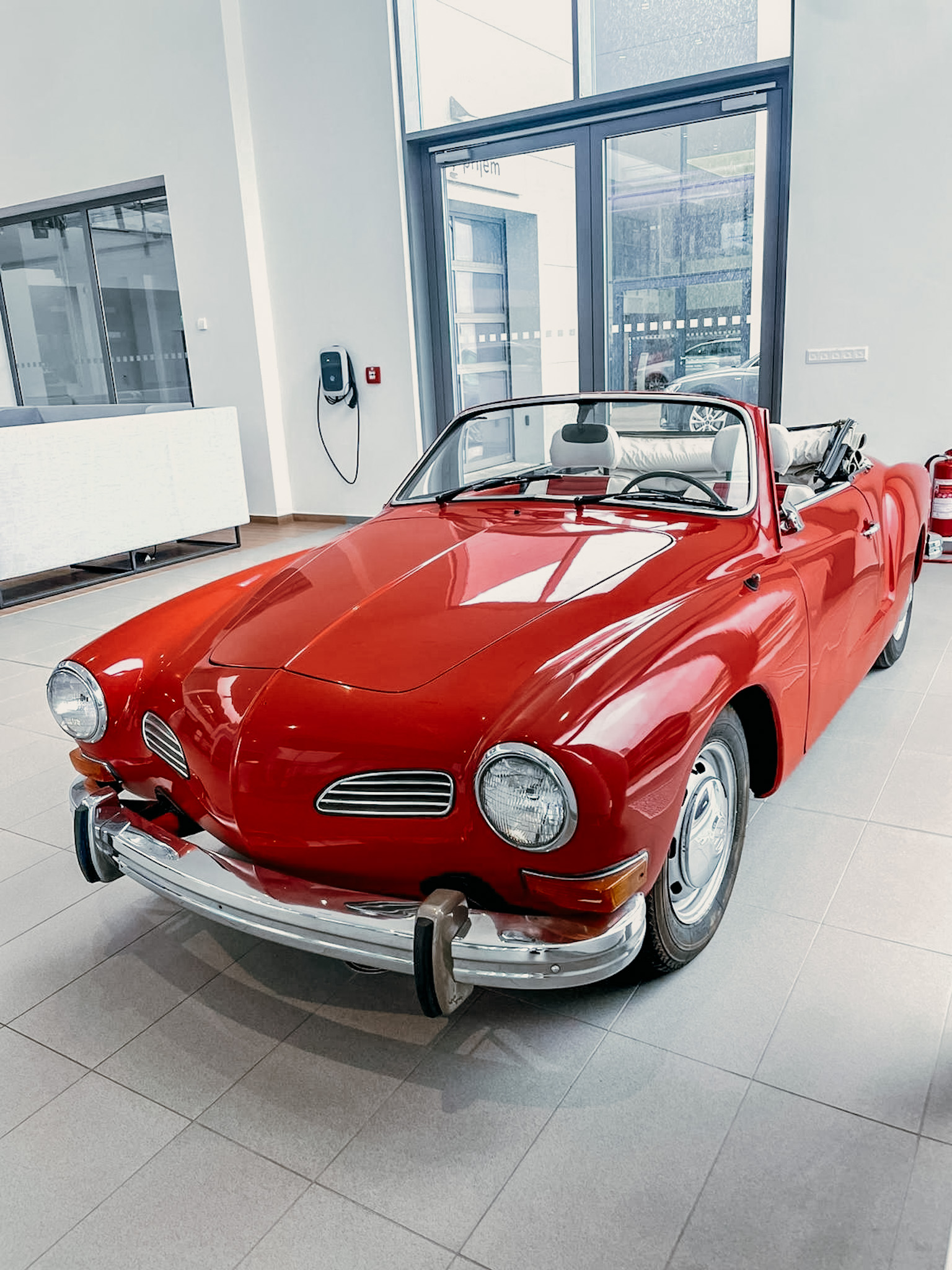
The car in our collection is a convertible version, dates from 1971, and is in fully functional drivable condition.