Showing all 8 results

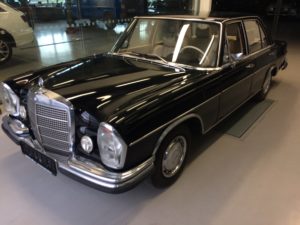
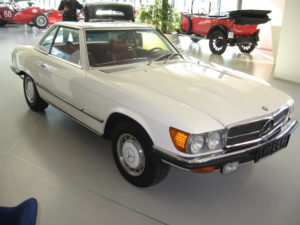
Mercedes-Benz 450 SL R107

Year of Manufacture: 1971
Power: 225 hp
Engine Displacement: 4,520 cm3

Number of Cylinders/Valves: 8/2
Weight: 1,580 kg

Condition: perfect
Catalog Number: 40


History
The Mercedes-Benz W107 was produced between 1971 and 1989. It was the second longest-produced series by the German car manufacturer Mercedes-Benz, following the off-road Mercedes-Benz G-Class. The vehicles were sold under the model designations SL (R107) and SLC (C107).


Development
The R107 and C107 borrowed chassis components from the mid-size W114 model and were originally paired with the M116 and M117 engines used in the W108, W109, and W111 series. In April 1971, mass production of the R107 began, with the 350 SL available with an optional four-speed hydraulic automatic transmission. In March 1973, the 450 SL/SLC was introduced to the North American market.

In September 1977, the 450 SLC 5.0 joined the lineup. It was a homologation version of the large coupé with a new aluminum 5-liter engine. Starting in 1980, the 350, 450, and 450 SLC 5.0 were replaced by the 380 and 500 SLC models. In 1981, production of the 280, 380, and 500 SL ended and was succeeded by the new W126-based 380 and 500 SEC models. From September 1985, the 280 SL was replaced by the new 300 SL and 380 SL, the 500 SL continued, and the 560 SL was introduced for select non-European markets, particularly the USA, Australia, and Japan.


Technical Data
Mercedes-Benz engineers focused on fine details when developing the W107. For example, this model was the first to feature the now-familiar rear light lenses with horizontal ribbing, previously used on trucks, which helped prevent dirt buildup.

The chassis featured a closed tunnel necessary for the gearbox and driveshaft, with a floor frame of longitudinal and transverse members and a welded body of either a two-seater roadster or a coupé for two adults and two children. The steel used varied in thickness, and carefully designed crumple zones based on Béla Barényi’s patents absorbed most of the impact energy in a crash, allowing the occupants in the so-called safety cell to remain better protected. The four-spoke steering wheel had a telescoping column and a polyurethane-filled hub. The dashboard was padded with foam to absorb impacts. The fuel tank, placed above the rear axle, was protected from rupture in collisions.

All U.S. models used the 4.5-liter engine and were designated 450 SL / SLC.


Interesting Facts
Let’s return to Germany, though we’ll stay a bit in America—further south, in fact. Teaching a 4.75-meter-long car to race was a challenging task, but it succeeded. The SLC coupé achieved great success particularly in rally competitions. In 1978, Andrew Cowan and Colin Malkin won the grueling Vuelta a la América del Sud marathon. Over five weeks on roads—and mostly off-road trails—across South America, the pair managed to finish the 28,500 km route in their 5-liter Mercedes 450 SLC ahead of all competitors. Only 22 of the original 56 teams completed the rally.


Record Holder
Thanks to its long career, the R107 still holds the record for the number of units produced among all generations of the “SL”. By August 1989, a total of 237,287 units had been built in Sindelfingen. The SLC coupé concluded its ten-year career with only 62,888 units produced and is now considered fairly rare. That career itself is also a record—no other passenger Mercedes was produced for so long (the G-Class is not quite a passenger car). The R107 was succeeded by the SL R129, which debuted in March 1989. While its career was shorter, it was still long by today’s standards: it remained in production for a full twelve years.
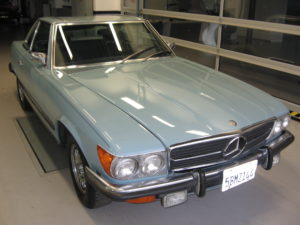
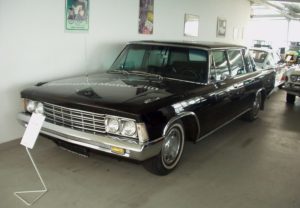
Mercedes Benz SL 350 W107

Year of manufacture: 1972
Power: 194 hp
Engine displacement: 4,520 cm3

Number of cylinders/valves: 8/2
Weight: 1,632 kg

Condition:
Catalogue number: 39

History

The Mercedes Benz 107, also known as the Timeless Endurer, was produced from 1971 to 1989. It was the second longest-produced series by the German automaker Mercedes-Benz, after the off-road Mercedes-Benz G-Class. The cars were sold under the model names SL (R107) and SLC (C107).

Development

The R107 and C107 adopted chassis components from the mid-size W 114 model and originally paired them with M116 and M117 engines used in the W108, W109, and W111 series.

Mass production of the R107 350 SL began in April 1971, offered with an optional four-speed hydraulic automatic transmission. The car accelerated from 0 to 100 km/h in 8 seconds.

In March 1973, the 450 SL/SLC was introduced to the North American market, equipped with a 4.5-liter 8-cylinder engine.

In September 1977, the 450 SLC 5.0 joined the lineup. This was a homologation version of the large coupe featuring a new aluminum 5.0-liter engine.

Starting in 1980, the 350, 450, and 450 SLC 5.0 were replaced by the 380 and 500 SLC models. The cars were slightly updated, including replacing the three-speed automatic with a four-speed unit.

In 1981, production of the 280, 380, and 500 SL models ended and was replaced by the new W126 380 and 500 SEC series.

From September 1985, the 280 SL was replaced by the new 300 SL and 380 SL, the 500 SL continued, and the 560 SL was introduced for some non-European markets, especially the USA, Australia, and Japan.

Technical specifications

Mercedes-Benz engineers paid great attention to small details in the W107. For example, this model was the first to feature well-known rear lights with horizontal ribs (previously used only on trucks), which prevented dirt buildup.

The chassis featured a closed tunnel necessary for the installation of the transmission and driveshaft, with a floor frame reinforced by longitudinal and cross members. The body was welded on top, either a two-seat roadster or a coupe for two adults and two children. The steel varied in thickness, and intelligently designed crumple zones, patented by Béla Barényi, absorbed most of the impact energy during collisions, resulting in less injury to occupants inside the so-called safety cell. The four-spoke steering wheel included a telescopic shaft and a polyurethane-padded hub. The dashboard was padded with foam to protect occupants during impacts. The fuel tank was located above the rear axle and did not rupture in collisions.

All American models used the 4.5-liter engine and were named 450 SL / SLC.

Interesting facts

Returning to Germany, but also slightly to America, albeit further south, teaching a 4.75-meter-long car to race was a difficult task—but it was accomplished. The SLC coupe achieved great success in competitions. In 1978, Andrew Cowan and Colin Malkin won the demanding Vuelta a la América del Sud marathon. After five weeks traveling mostly off-road through South America, the two drivers completed the route of over 28,500 kilometers with their heavy 5.0-liter Mercedes 450 SLC better than anyone else. Only 22 crews out of 56 finished the race.

Record holder

Thanks to its long career, the R107 still holds the record for the highest number of units produced among all generations of “eselka”. By August 1989, 237,287 units were built in Sindelfingen. The SLC coupe ended its ten-year career at only 62,888 units and is now relatively rare. Its career is a record as well, as no personal Mercedes model was produced for so long (the G-Class is not exactly a personal vehicle). The successor to the R107 series was the SL R129, first presented in March 1989. Although its production was shorter, by today’s standards it was still a long active life, produced for twelve full years.


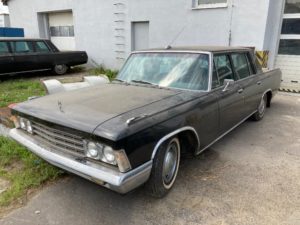
Zil 117

Year of Manufacture: 1978
Power: 300 horsepower
Displacement:6,959 cm3

Number of Cylinders/Valves: 8/2
Weight: 2,880 kg

Condition: Operational

Catalogue Number: 248

First, it transported communist party elites — later, it chauffeured a British secret agent on the silver screen.

The size of the car is not the main issue — it’s the handling that requires attention. The brakes must be approached with respect. The early ZIL 114 models were equipped with drum brakes, later replaced by disc brakes. The car can accelerate from 0 to 100 km/h in 13 seconds. Average fuel consumption hovers around 30 liters per 100 km — sometimes even up to 40 liters.

The representative ZIL 117 was manufactured between 1971 and 1983. It was a shortened version of the ZIL 114 limousine. This four-door, four- to five-seater sedan had a front-mounted engine and rear-wheel drive. It delivered 300 horsepower at 4,400 rpm. It came with a two-speed automatic transmission and reached a top speed of 200 km/h.

Upon sitting inside, one is surprised by the deeply cushioned seats. At first glance, the seats may appear uncomfortable — but quite the opposite is true. The driving comfort is exceptional. The performance of the three-speed transmission is impressive. Modern systems would envy its smoothness — it keeps the engine at low revs without over-revving during gear changes.

The Samohýl family collection includes 17 ZIL and Chaika state limousines — cars that were never meant to be preserved. After being decommissioned from the Ministry of the Interior in the 1980s, they were supposed to be scrapped for security reasons. However, the Samohýl family guaranteed the vehicles would be used solely for exhibition purposes. After the Velvet Revolution, they were able to acquire a stockpile of spare parts in Kralupy at a favorable price.

It’s worth noting that this particular ZIL also appeared in the James Bond film *Casino Royale*, where its trunk was used to hide two corpses.

ZIL 114

Year of Manufacture: 1974
Power: 300 horsepower
Displacement:6,959 cm3

Number of Cylinders/Valves: 8/2
Weight: 3,085 kg

Condition: Operational

Catalogue Number: 244

In the 1970s and 1980s, ZIL automobiles were a symbol of socialist luxury. However, aging caught up even with the best, and by the late 1980s, the modern ZIL 4102 was rejected, effectively marking the end of the line for these models.

The new generation of ZIL limousines debuted in 1967. The successor to the 111G model was named the 114 and introduced a significantly revised design. It featured boxier lines, while retaining the four round front headlights. The ZIL 114 was heavily inspired by American luxury cars, especially the Lincoln Continental.

Compared to its predecessor, the 114 boasted a length of up to 6.3 meters and a curb weight exceeding 3 tons. A new 7-liter V8 engine producing 221 kW (300 hp) powered the rear axle through a two-speed automatic transmission, later upgraded to a three-speed version. The front axle was newly designed with independent suspension. Initially equipped with drum brakes, the model soon received disc brakes on all wheels, featuring a three-circuit braking system to maintain safety in case of failure. The car was also equipped with central locking.

This seven-seater vehicle, with two emergency seats in the rear and a partition separating the driver from the rear passengers, came with a surprisingly rich interior: air conditioning, height-adjustable steering wheel, leather upholstery, electric windows and mirrors, wooden trim, and tinted glass to reduce light and heat penetration.

Production of this state limousine was extremely limited. ZIL kept a record of every owner, and no one could acquire the car without the approval of the Communist Party leadership. Production of the 114 and 117 models ended in 1977. In total, only 113 units of the extended version and 73 units of the shorter limousine were produced.

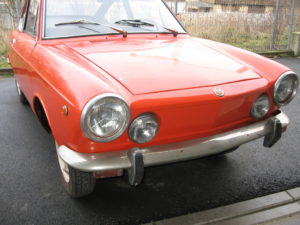
Fiat 850 Sport Coupé

Year of manufacture: 1971
Power: 52 hp
Displacement: 903 cm3

Number of cylinders/valves: 4/2
Weight: 715 kg

Condition: operational
Catalogue number: 50


Introduction
The FIAT brand originally stood for Fabbrica Italiana Automobili Torino, now Fiat Automobiles S.p.A., an automaker founded in Turin, Italy, in 1899, making it one of the oldest in Europe.

Development
The predecessor of this model was the Fiat 600 of similar concept. In 1964, its successor, the Fiat 850, was introduced, which was later replaced by the Fiat 127, a completely different concept. All these models made a significant mark in automotive history.

Technical Specifications
The Fiat 850 is a small two-door passenger car with a rear-mounted engine and rear-wheel drive. It features a four-cylinder inline OHV engine with a displacement of 903 cm3, bore of 65 mm and stroke of 68 mm, compression ratio of 9.5, producing 38 kW (52 hp) at 6,500 rpm, and torque of 66 Nm at 4,000 rpm.
It has a four-speed manual transmission, wheelbase of 2,030 mm, external dimensions 3650x1500x1300 mm, weight 700 kg, top speed of 145 km/h, and acceleration to 100 km/h in 17.7 seconds.

Production
The Fiat 850 was produced until 1971, with a total of 342,873 units made. The model was based on the earlier Fiat 600. It was intended to serve as an affordable family car accessible to the general public, with a focus on increased usability through more rear passenger space.
For enhanced safety, the body was reinforced, and the fuel tank was relocated from the front to behind the rear seat backrest, significantly increasing the luggage space.
The interior featured a wooden dashboard surface, a large dual-circuit racing-style instrument panel reminiscent of Ferrari anni cinquanta, and sport-type seats that were comfortable for long journeys with foldable backrests.

Market
After its launch, this model became popular due to its low price, ease of maintenance, and relatively solid utility value compared to its costs.

Models
In 1965 at the Geneva Motor Show, the Fiat 850 Coupé and Fiat 850 Spider versions were introduced. The Spider gained the greatest success in the USA, where it remains sought-after to this day.
In 1968, disc brakes were introduced in the 850 Berlina Special, which featured a different gearbox that provided excellent acceleration for the 47 hp engine, although fuel consumption increased due to shorter gear ratios.
That same year, the Coupé was replaced by the newer Sport Coupé with four round headlights on the front. The main upgrade was the 903 cm3 engine, later used in the Fiat 127 models until the early 1990s.
Also notable were the “large space” Fiat 850 transporter and Familiare station wagon with three rows of seats, replaced in the mid-1970s by the Fiat 900 E featuring body elements from the Fiat 127.

Interesting Fact
An interesting fact about this car is its engine’s left-hand rotation, which originated from the gearbox design history. The gearbox was originally intended for Simca’s new front-engine, front-wheel-drive 1100 model, but after that plan was abandoned, Italian engineers used the gearbox in the 850 model. They had to reverse the crankshaft rotation to prevent the car from having one forward gear and four reverse gears.


The car in our collection is a Fiat 850 Sport Coupé in fully operational and preserved condition. The Sport Coupé was, at its time, a beautiful example of a sports car built on the basis of an ordinary passenger car, and it remains so to this day.

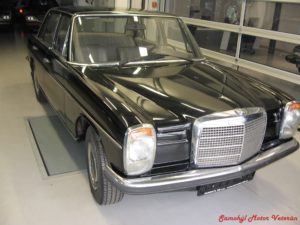
Mercedes-Benz 230 W114

Year of manufacture: 1972
Power: 135 hp
Displacement: 2,292 cm3

Number of cylinders/valves: 6/2
Weight: 1,355 kg

Condition: operational
Catalogue number: 97

The Mercedes-Benz W114 and W115 (nicknamed the “shorty”) was the internal designation used by Mercedes-Benz for a generation of classic sedans and coupes with a front-mounted engine and rear-wheel drive, introduced in 1968. At that time, Mercedes sold sedans in two classes: the mid-range W114/W115 and the larger S-Class.

The W114/W115 models were distinguished on the market by engine size badges. The W114 models had six-cylinder engines and were sold as 230, 250, and 280. Conversely, the W115 models had four-cylinder engines and were labeled 200 and 220. These also included brand-new diesel engines under the designations 200D and 220D. The cars were widely exported to North America, where they had differences mainly in body design.

The W114/W115 models were the first post-war Mercedes-Benz vehicles to use newly designed suspension, not derived from previous models. The new semi-trailing rear arms and front suspension with ball joints, first applied on the W114, were used on all new Mercedes passenger cars until the development of multi-link rear suspension in the 1980s.

The Mercedes-Benz W114/W115 was a mid-sized sedan positioned below the S-Class in the lineup. The company introduced its very first 5-cylinder diesel engine OM617 in this model. The car was designed by French automotive designer Paul Bracq, who was Mercedes-Benz’s chief designer for models from 1957 to 1967.

In 1969, Mercedes introduced the W114 coupe variant with a longer trunk lid and either a 2.5 or 2.8-liter six-cylinder engine. The W114 underwent a facelift in 1973 – featuring a lower hood line, a lower and wider grille, a simple front bumper replacing the previous double bumpers, lower headlight placement, modified A-pillars for better side window visibility, removal of the quarter windows in front doors, ribbed tail lights to minimize dirt coverage, and larger side mirrors. The interior received retractable seat belts and a new padded steering wheel with a four-hole design.

This model became crucial for Mercedes-Benz at the time, earning a reputation for incredible quality and near indestructibility. However, the company charged a premium for these qualities; the model was certainly not cheap. In total, 1,919,056 units were produced, including 67,048 coupes. At that time, it was the most successful model in the company’s history. The successor, introduced in 1976, was the new W123, the legendary “piano,” which eventually surpassed it in every way, including production numbers.

The car in our collection is a fairly well-preserved classic sedan with a 2.3-liter six-cylinder engine.

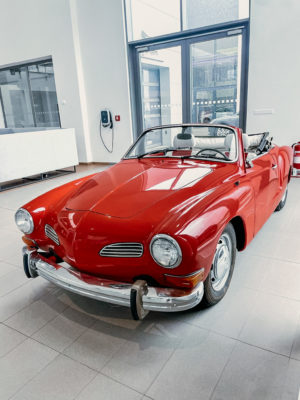
Volkswagen Karmann-Ghia

Year of Manufacture: 1971
Power: 50 hp
Engine Displacement: 1,600 cm3

Number of Cylinders/Valves: 4/2
Weight: 820 kg

Condition: drivable
Catalog Number: 271


Introduction

The Karmann-Ghia prototype premiered at the Paris Motor Show in 1953 and was created completely outside Wolfsburg. It carries the name of two coachbuilders, and rightly so. The German Karmann had asked the Italian studio Carrozzeria Ghia whether they could design something sexier, more attractive, and more interesting on the Beetle chassis. The Karmann coachworks in Osnabrück was already producing the open version of the legend, the classic cabriolet. The market would surely welcome such a car, so there was room for something new and fresh.

Important figures behind the creation of this model are the coachbuilder founder Wilhelm Karmann and the designer Luigi Segre, who worked at the Ghia studio in Turin. It was between these two men that a prestigious conversation took place at the Paris show. Segre and his team eventually designed a new coupe — why a convertible was not made first is unfortunately unknown. He showed his work in October 1953 to influential Karmann executives, led by the boss, in a Paris garage, and the decision was made.

The elegant car appeared in November at the motor show stand. Journalists and others were enthusiastic. What about Volkswagen itself? Its then head Heinz Nordhoff thoroughly inspected the car, liked it a lot, but shortly after the show delivered sad news: mass production would be too expensive for the factory alone. However, cheerful news came from Osnabrück: there was capacity alongside open Beetle production. The agreement among all three companies faced no further obstacles.

The series-production Volkswagen Karmann-Ghia Type 14 began selling in Europe in early 1955, and the production coupe differed little from the original prototype, with only minor changes to the body and interior. The convertible version with a fabric roof came into production in 1957.


Technical Specifications

The air-cooled flat four-cylinder engine with a displacement of 1.2 liters was rear-mounted and produced only 30 hp (22 kW). The convertible arrived in 1957 — Segre presented it directly in Wolfsburg. The variant with a fabric roof helped the brand, then still with a short tradition, build a solid image. Using existing technology was logical, as Wolfsburg had no other options available.

A comparison with the Porsche 356 somewhat suggests itself, but Volkswagens were more popular. Today they are sometimes disparagingly called “the slowest sports cars in the world.” After all, the original models with 1.2-liter engines reached a maximum speed of 120 km/h and accelerated to 100 km/h in 28 seconds. Throughout production, the chassis was consistently based on the classic Beetle, but engine displacement and power were gradually increased. First to 1.3 liters and 40 hp, and finally to 53 hp from 1.6 liters.


Production

The Volkswagen Karmann-Ghia was produced as a two-door coupe or convertible, with over 445,000 units manufactured from 1955 to 1974.


Car in Our Collection

The car in our collection is a convertible version, dates from 1971, and is in fully functional drivable condition.

Mercedes Benz S280 W108

Year of Manufacture: 1972
Power Output: 140 hp
Engine Displacement: 2,778 cm3

Number of Cylinders/Valves: 6/2
Weight: 1,470 kg

Catalogue Number: 8

These are luxury vehicles produced from 1965 to 1973. The cars were successful not only in West Germany but also in export markets including North America and Southeast Asia.

Difference between W108 and W109

Due to the success of the long-wheelbase model 300 SE Lang, Mercedes-Benz continued to offer two wheelbase lengths for the W108 and W109. Initially, the W108 designation referred to the standard wheelbase, and the W109 to the long wheelbase. In the 1968 model range, this distinction changed with the introduction of the 280 SEL, which retained the W108 chassis designation instead of W109, and the longer wheelbase was identified by the letter “L” in the model name. This designation has remained standard for all future Mercedes-Benz models.

First Series

The W108/W109 model debuted at the Frankfurt Motor Show in 1965. The initial model lineup consisted of three W108 models (250 S, 250 SE, and 300 SEb) and one W109 model (300 SEL).

– The 250 S model was equipped with the M108 engine with a displacement of 2,496 cm3, featuring dual downdraft two-barrel carburetors, producing 96 kW at 5,400 rpm. It reached a top speed of 182 km/h.

– The 250 SE model had the same engine as the 250 S, except for fuel injection and a different engine designation. The output increased to 110 kW at 5,500 rpm.

– The 300 SEb and 300 SEL models were equipped with a 2,996 cm3 engine, delivering 125 kW at 5,400 rpm. These models reached a top speed of 200 km/h and accelerated to 100 km/h in 6.2 seconds.

Second Series

In 1967, the six-cylinder engine range was revised. The 2.5L engine was increased to 2.8L.

The 250 S and 250 SE models were renamed 280 S and 280 SE in November 1967.

In January 1968, the long-wheelbase 280 SEL was introduced for the first time.

The 280 S model reached 100 km/h in 12.5 seconds with a top speed of 185 km/h.

The 280 SE and 280 SEL models accelerated to 100 km/h in 10.5 seconds and reached a maximum speed of 193 km/h.

Vehicles sold in Europe were equipped with a standard four-speed manual transmission. A four-speed automatic transmission was also available, which was quite unusual among car manufacturers at the time. A five-speed manual transmission was offered for inline-six engines, but only between 1969 and 1972.

In 1966, engineer Erich Waxenberger installed the massive 6.3L Mercedes-Benz M100 V8 engine from the company’s flagship 600 (W100) into the W109 chassis, creating the first large Mercedes-Benz sedan with a V8 engine. Full production of the 300 SEL 6.3 began in December 1967. The 300 SEL 6.3 reached 100 km/h in 6.5 seconds and a top speed of 220 km/h (137 mph), making it the fastest production sedan of its time—a title it held for many years.

When the 3.5L V8 engine was introduced in 1969, the only available transmission was a four-speed automatic with a fluid coupling. This model was aimed mainly at the North American market, where V8 engines were the dominant powertrain for large sedans. By the end of the series’ production run, it gave rise to the 450 SE model, symbolically concluding this highly successful series of large limousines—vehicles in which Mercedes-Benz would go on to dominate the segment for years to come.

A total of 383,361 units were produced during the seven-year production period.