Showing 17–20 of 20 results

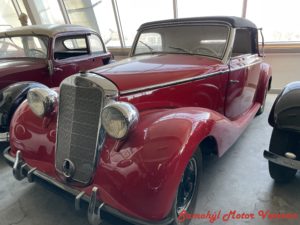
Mercedes-Benz 170 S (W136)

Year of manufacture: 1950
Power: 45 hp
Displacement: 1,767 cm3

Number of cylinders/valves: 4/2
Weight: 1,185 kg

Condition: restored
Catalogue number: 223

The Mercedes-Benz 170 V was first introduced on February 15, 1936, at the Berlin Motor Show. It was the W136 model, which almost immediately became the standard for a modern European car at the end of the pre-war years. Although it was the smallest car of Daimler-Benz A.G., with its 1.7-liter engine and spacious interior for its time, it also ranked among the “better” mid-range cars. By 1942, this model was the best-selling, with over 75,000 units sold. Its direct predecessor was the Mercedes-Benz 170 type W15, produced between 1931 and 1935. It had an engine of the same displacement, even a six-cylinder, but with six horsepower less.

Both two- and four-door sedans, cabriolets, two-seat roadsters, as well as modified utility versions such as ambulances or cars for the police, mountain rescue, and military were produced. For military use, Mercedes-Benz manufactured over 19,000 units with the “Kübelwagen” body type.

The vehicle’s body was very advanced—fully metal. Unlike previous practice, no wooden frames covered with sheet metal were used. The engine was front-mounted, and the rear-wheel drive was powered by a driveshaft. It used an inline four-cylinder with SV valve timing, a displacement of 1,697 cm³, bore of 73.5 mm, and stroke of 100 mm. The manufacturer specified a compression ratio of 6.5. The engine was equipped with a Solex carburetor. During and after the war, some cars were converted to run on generator wood gas. However, this reduced engine power and caused various operational issues.

The Mercedes-Benz 170 V was gradually improved and enhanced. After the war, this model became the core offering of Mercedes, mainly in the sedan version.

From May 1949, a diesel engine with 38 horsepower was even used. The car reached a top speed of 116 km/h.

In 1949, at the Hannover Fair, the 170 S model was presented for the first time. The engine had a larger displacement and increased power to 52 hp, and it mainly received better equipment in the passenger compartment. Cabriolets of types A and B were produced from 1949 to 1951, and the sedan until 1955. Especially the cabriolet A was considered a luxury car and became somewhat a predecessor of today’s S-Class.

The car from our collection is a type B cabriolet, fully restored and operational, and can be seen every year at the Bugatti GP during the Barum rally in Zlín.

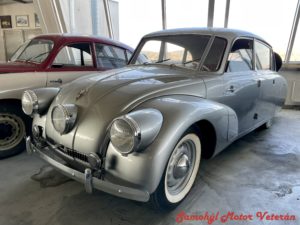
Tatra 87

Year of manufacture: 1946
Power: 75 hp
Displacement: 2,968 cm3

Number of cylinders/valves: 8/2
Weight: 1,490 kg

Condition: drivable
Catalog number: 158


Introduction

The Tatra 87 is an upper-class automobile manufactured by the Czechoslovak car company Tatra between 1937 and 1950. It is a luxury aerodynamic car and the successor to the T 77 A model.


Development

In 1936, the first two T 87 prototypes were produced for testing, followed by another five vehicles in 1937 as a verification series. The Tatra 87 was officially introduced in 1937. From 1938, the T 87 was manufactured in series. In 1940, two convertibles were also made for possible army use. After the war, serial production of the T 87 continued with minor body modifications until 1950.

In 1948, the front part of the body was modernized; headlights were recessed into larger wheel arch bulges, flush with the protective glass. The cars received new bumpers that formed a more compact unit with the body. This model also came standard with a sliding roof section over the front seats. This modernization was designed by František Kardaus. After the update, the central headlight became steerable and was controlled from the dashboard in the standard version; in the premium version, it was linked to the steering wheel. The car was delivered in this form until 1950, exclusively for the needs of state and party organizations.


Technical specifications

Compared to its predecessor, the new car was significantly lighter, while the engine displacement was increased to 2,968 cm3. The result was a power output of 55 kW (75 hp) at 3500 rpm and a maximum speed of 155 km/h. The type 87 was also shorter and narrower with a shorter wheelbase. The weight reduction was mainly achieved by using lightweight materials and alloys, resulting in a curb weight of 1,490 kg.

Compared to its predecessor, the T 87 had improved oil cooling; the engine was equipped with a full-flow oil filter, a ram-air oil cooler, and a double-barrel carburetor. The engine was located under an aerodynamically further improved rear hood with a stabilizing fin-shaped spoiler and powered the rear wheels. Next to the accelerator pedal, there is a button that the driver has to press approximately every 100 kilometers to pump additional oil into the engine and lubricate critical chassis points.

The Tatra 87 features a unique all-metal aerodynamic body (except for the door frames, which are wooden—as wooden construction was commonly used in most cars at the time), designed by Hans Ledwinka together with Erich Übelacker, based on the Tatra 77, which was the first car designed with an aerodynamic body concept. The body design was also influenced by Hungarian Paul Jaray, who designed the famous German airships Graf Zeppelin. The fin mounted on the sloping rear of the car helped split airflow to both sides of the vehicle, an idea later adopted by the aviation industry.

The car has rear wheel covers to reduce air turbulence around them. The windshield, originally intended to be panoramic, is divided into three parts; since manufacturing was unsuccessful, it was made of three flat panes. This car had a drag coefficient of 0.36 when tested in a Volkswagen wind tunnel in 1979; a 1:5 scale model tested in 1941 had a drag coefficient of 0.244.

The car has a central load-bearing frame that splits at the rear into a Y-shape. The wheels are independently suspended and measure sixteen inches, with the front axle supported by two semi-elliptical leaf springs and the rear by swing half-axles with quarter-elliptical springs. Many design features of the Tatra 87, later the V570 prototype and subsequently the T97, were copied by later car manufacturers. For example, Ferdinand Porsche was heavily influenced by the Tatra 87 and 97 and was subsequently sued by Tatra.

Between 1950 and 1953, some T 87 cars were fitted with the new T 603 A engine, later used in the “six hundred threes.” The engine provided sufficient power for the car to reach a maximum speed of nearly 170 km/h. These cars were labeled Tatra 87-603.


Production

A total of 3,023 vehicles of this type were produced over thirteen years (with production interrupted due to World War II), including 1,371 before 1945 and the remaining 1,652 after 1946. The highest production was in 1948, around 700 cars. The model was also successfully exported to countries such as Hungary, Romania, the USSR, Belgium, Germany, Austria, France, Sweden, South Africa, Egypt, Argentina, and even Australia. The successor to the T 87 was the more modern T 603.


Market

When introduced in the 1940s, the new car’s price was 25,000 Swiss francs.


Trivia

The Tatra 87 was highly regarded by Wehrmacht officers during World War II for its high speed and handling, suitable for driving on the German highways of the time—the Autobahns. The Minister of Armaments and Munitions Fritz Todt even stated: “This 87 is a car for the Autobahn…”. The car was also known as the Czech secret weapon because during high-speed accidents it killed so many officers that the Wehrmacht eventually banned all officers from driving the Tatra 87. The car had a light front end, making it easy to control at first glance even without power steering, but at high speeds, the car could disobey the driver due to weight placed on the rear.

Another interesting fact is that in 1947, travelers Jiří Hanzelka and Miroslav Zikmund, who met at university and became inseparable friends, decided to support the car company’s sales and fame worldwide. They embarked on expeditions in the Tatra 87 to Africa, South, and Central America. They had planned the world tour before the war, which disrupted their plans, and only after the war did they receive financial and political support, including from Tatra (for which they became sales representatives). They set out on April 22, 1947, from Opletalova Street in Prague, sailed via Marseille to Morocco, traveled through Egypt, Sudan, Ethiopia, and ended in South Africa.

On their journey, they had to replace the Tatra once, not due to technical problems but because of a serious accident in Libya. The original silver Tatraplán with recessed headlights was rendered immobile. They continued their journey with a new car. In Africa, they were also the first to cross the Nubian Desert by car and reached the summit of Kilimanjaro.

After their adventure in Africa, the duo moved to South America, starting their journey in Argentina and continuing to Mexico. They wanted to get to the USA, but the political atmosphere of the late 1940s and early 1950s, heightened by the Cold War, prevented this. Neither traveler received visas, and Hanzelka also broke his arm. Thus, they returned to Czechoslovakia in November 1950 with the Tatra 87, which was no longer the same country they had left.

Although the Communist Party was the main force of the National Front already in 1947—Klement Gottwald was prime minister at the time—neither of the two experienced the communist coup in February 1948 directly in Czechoslovakia. Many orders the duo secured abroad during their expedition were never fulfilled. Production of the Tatra 87 ended at the end of 1950, and in Kopřivnice, due to the central plan, production shifted mainly to trucks, and passenger cars became marginal.

Hanzelka and Zikmund brought back from their first expedition with the Tatra 87 about 120,000 slides, around 150 films, and produced numerous radio reports and travelogues. They traveled through 44 countries and covered nearly 62,000 kilometers in the Tatra 87 alone. Their original car, now a national cultural monument, can still be seen at the National Technical Museum in Prague.


Car in our collection

The car in our collection is a four-door five-seat sedan in perfect and fully functional condition from 1946.

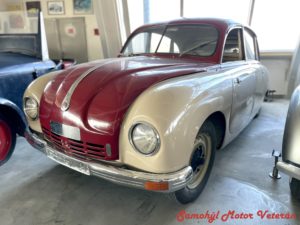
Tatra 600 Tatraplan

Year of manufacture: 1949
Power: 52 hp
Displacement: 1,952 cm3

Number of cylinders/valves: 4/2
Weight: 1,200 kg

Condition: drivable
Catalog number: 155

Introduction

The Tatra 600, also known as Tatraplán, is a mid-size passenger car produced from 1948 to 1951 by the company Tatra, n.p., and subsequently until 1952 by AZNP Mladá Boleslav. The car, featuring a streamlined body and a rear-mounted air-cooled flat-four engine, continued the tradition of aerodynamic automobiles made by Tatra. Its size corresponded to the pre-war Tatra 97 model.

Development

Originally designated as Tatra 107, the lucky “7” followed the previous aerodynamic models from Kopřivnice – T 77, T 87, and T 97. Development of the Tatraplán began at the end of World War II, intending to build upon the successes and traditions of the earlier aerodynamic cars. It was meant to be a newer, smaller, and more affordable version, also replacing the then somewhat outdated Tatra 57, whose production was ending.

The later designation Tatra 600 came from the new post-war numbering system of Tatra production, which assigned personal cars numbers beginning with 600. The name “Tatraplán” was inspired by the sleek shape resembling an airplane – an aeroplane. Some later brochures distorted this to associate the name with the two-year plan and planned economy, including the long á in the name.

Technical Specifications

The Tatraplán was characterized by a modern design for its time, featuring several advanced elements. It was one of the first cars with a pontoon-shaped body. The body was steel and self-supporting, without a wooden frame. A notable feature was the front split V-shaped windshield without a central pillar, sealed only with a narrow rubber profile.

The front axle consisted of two transverse semi-elliptical leaf springs, and steering was implemented via a rack and pinion system, contributing to light and precise control. The rear axle was a swing axle, sprung by transverse torsion bars. The four-speed gearbox with synchromesh on 2nd through 4th gears was operated by a gear lever located under the steering wheel.

The car was powered by a flat-four engine with relatively large cylinder dimensions (bore 85 mm, stroke 86 mm), cooled by a single axial fan initially driven by a bevel gear, later replaced by V-belts, with the fan axis changed from vertical to horizontal. The updated engine had two carburetors, improving the car’s performance.

The entire unit was mounted on robust rubber blocks in the body. The aerodynamically designed body with recessed headlights, handles, and door hinges had a drag coefficient of 0.32 to 0.33 – a leading value for serial production cars at the time, a figure other manufacturers only reached many years later.

Thanks to this, the Tatraplán (despite its relatively small engine displacement and size) could reach speeds up to 130 km/h. In later years, with the use of the Tatra 603 engine, T 600 cars (usually in security services) were capable of speeds well over 170 km/h. During development, a prototype with a diesel engine was tested in Kopřivnice, a pioneering effort at the time. Three Tatraplán Diesel cars produced in 1949 had an output of 31 kW (42 hp) and reached speeds of 125 km/h.

Despite the somewhat louder engine, the Tatraplán was among the quietest cars inside due to good sound insulation. This was helped by the luggage compartment located behind the rear seats, separated by a partition. The front compartment was designed for small luggage, mainly housing the spare wheel (with space for two spares), tools, and fuel tank. The oil cooler was also placed at the front.

Production

The Tatraplán was also made in a sporty two-door version with an aluminum body – the Tatra 601 Monte Carlo (named after the famous rally it was meant to enter but did not) and a few open racing versions T 602 Tatraplán Sport. These cars later served as test beds for the development of the eight-cylinder 2,545 cm³ engine used in later Tatra 603 cars.

Utility prototypes with the T 600 engine mounted in the front of the body were also derived from the Tatraplán.

An interesting prototype was the T 600 convertible bodied by Sodomka in Vysoké Mýto for the 1949 Geneva Motor Show, where it attracted deserved attention. Instead of planned serial production, which could have brought valuable foreign currency from exports, the leadership decided to gift the car for J. V. Stalin’s birthday (though he likely never used it). Fortunately, the car later returned to the company museum in Kopřivnice during an exchange in the 1980s.

In 1951, the production of the Tatraplán was centrally halted by the Ministry of Industry of the planned economy and transferred to Mladá Boleslav. Tatrapláns made at Škoda (identifiable by several detail differences) quickly damaged their reputation due to a decline in build quality, leading to falling interest abroad. The decision also halted Škoda’s project, reflecting tense relations between Tatra (Moravia) and Škoda/Praga (Bohemia) at the time. Tatra was to focus only on heavy trucks, while Škoda imported conventional cars with rigid axles and ladder frames. Škoda ceased Tatraplán production in 1952. In total, 6,342 T 600 cars were produced, 4,242 of them in Kopřivnice.

Market

Although not produced in large series, the T 600 enjoyed considerable commercial success abroad, helped by its sporting achievements. The Tatraplán was exported to many European countries and even overseas. In Czechoslovakia, it mainly served as an official car for state and party officials; it was inaccessible to ordinary motorists due to the political situation after February 1948.

Trivia

Serial Tatraplán cars were driven on Czechoslovak roads for many years and abroad, imported for example to the Netherlands by the well-known company Auto Palace. Today, they are sought-after vintage cars due to their unusual and timeless design.

Car in Our Collection

The car in our collection is in fully functional, drivable condition.

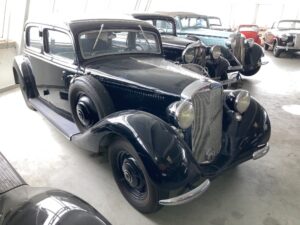
Mercedes-Benz 260 D W138

Year of manufacture:  1940
Power:  45 hp
Displacement:  2,545 cm3

Number of cylinders/valves:  4/2
Weight:  1,550 kg

Condition:  drivable
Catalogue number:  19


Introduction

The diesel engine, which had already proven its advantages in commercial vehicles, seemed a natural step towards developing a passenger car with this engine. The development strategy for diesel engines intended for light commercial vehicles and passenger cars was set by technical director Hans Nibel. However, he did not live to see the series production of the 260 D model in November 1935, passing away almost exactly one year earlier. Under his leadership, the development of small-capacity diesels by the tandem Albert Heess and Eckart Schmidt was carried out at Untertürkheim. The 260 D was introduced on February 21, 1936, at the 26th International Automobile and Motorcycle Exhibition (IAMA) in Berlin.


Development

In the autumn of 1933, the first experimental engines were installed in test vehicles – 3.8-liter six-cylinder units producing 80 hp. However, engine vibrations were so strong that they made the chassis unusable for passenger cars.

Subsequently, a four-cylinder diesel engine with identical cylinder dimensions but lower power density was developed. This 2.6-liter engine with 45 hp was installed in the long-wheelbase 200 version. After a prolonged testing program, production maturity was reached in mid-1935. In February 1936, at the Berlin Motor Show, Daimler-Benz presented the 260 D model as a six-seater Pullman landaulet, with 13 units produced since July 1935. The Hanomag Rekord, another passenger car with a diesel engine, was also shown in Berlin, but as it entered serial production only in 1938, the 260 D was the world’s first mass-produced passenger car with a diesel engine.


Technical specifications

A year after its debut in Berlin, the 260 D model, like the 230 which replaced the long-wheelbase 200, was presented in an improved version. The facelifted variant was recognizable by modifications to the radiator’s appearance. The headlights were reduced in size and mounted on the fenders instead of on a chrome strip in front of the radiator. Large Pullman limousines received more spacious bodies, adding greater prestige to their owners.

More importantly, the track width was increased. The front widened from 1,340 to 1,370 mm, and the rear from 1,380 to 1,390 mm. This allowed for wider wheels and tires (5.50 x 17 instead of the original 5.25 x 17). All four wheels were equipped with hydraulic drum brakes. The fuel tank for precious diesel grew from 45 to exactly 50 liters and was relocated from the engine compartment to the rear of the vehicle. This increased the driving range to at least 500 km. Customers welcomed this modification, as fuel stations were still very sparse in the late 1930s.

In February 1938, the previous gearbox with an overdrive was replaced by a fully synchronized four-speed gearbox with direct drive on the fourth gear. Another important innovation introduced in early 1938 was an electrically heated glow plug, which facilitated cold starts. Lastly, the 1938 model year also brought robust-looking bumpers, replacing the elegant design from 1936/37.

By December 1940, 1,967 units of the 260 D W 138 were produced. The advantages of the diesel engine – durability and economy – were thus finally utilized in a passenger car, and the 260 D laid the foundation for the lasting success of passenger cars with diesel engines. The fact that the first examples were almost exclusively used as taxis was due not only to the engine’s exceptional economy but also to the spacious six-seater body, which was launched in early 1934 as the long-wheelbase version.