Showing 1–16 of 20 results

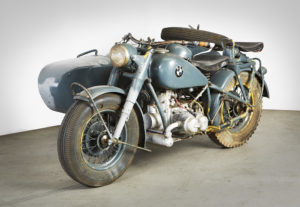
BMW R75

Year of Manufacture:  1942
Power Output: 26 hp
Displacement:  745 cm3

Number of Cylinders: 2
Weight: 400 – 420 kg (including sidecar)

Condition:  Excellent
Catalog Number: 89


Introduction

In 1938, the German Army High Command issued a requirement for the design and production of a motorcycle exclusively for military purposes. This was because the BMW R12 and R71 motorcycles were civilian models.


Development

The heavy BMW R75 Gespann motorcycles were originally intended to stir up dust on battlefields in North Africa and the Mediterranean. However, they were eventually used by Wehrmacht and Waffen-SS units on virtually all fronts. They became an integral part of the German army’s equipment.

In reconnaissance battalions, they replaced bicycles. Only insufficient production and fuel shortages delayed the full replacement by these military specials.

By the end of World War II, however, the expectations of Heinz Guderian—main architect of the German army’s tank doctrine and the theory of “Blitzkrieg”—were not fully realized, even though these rather clumsy yet very fast motorcycles would have fit his vision well. Allied bombing of Third Reich factory complexes further reduced production capacity and forced a reevaluation of priorities in weapon and equipment manufacturing.


Technical Specifications

The BMW R75 motorcycles were powered by air-cooled 2-cylinder boxer engines, the BMW M56 Baumuster 275, producing 19.1 kW. The first models were equipped with engines from the R71 type. The engines featured BMW’s characteristic outward-facing cylinders for better cooling. Compared to other manufacturers, who tried to hide the engine inside the frame, the R75 stood out as original and unconventional.

Engineers equipped the motorcycles with strong spoked wheels and car-type tires, interchangeable with small utility vehicles like the KdF. The tall wheels contributed to an unusually high ground clearance for the category. One of the most praised features was the rear-wheel drive system. Instead of a chain, a short cardan shaft was used. Acceleration and movement through difficult terrain were enhanced by drive to the fixed-mounted sidecar, with traction transferred through a rear transverse shaft. One-third of the total drive power was sent to the sidecar wheel, and two-thirds to the motorcycle’s rear wheel. A differential lock ensured optimal wheel speeds.

Maximum torque was achieved at 3,600 rpm. The gearbox had a unique layout: a standard four-speed forward gear setup, plus a lever beside the gear shifter on the rider’s right side—or a foot lever on the left side—allowed switching to a special off-road mode with three forward gears. Both modes included one reverse gear. Front suspension used telescopic forks, the rear wheel was rigid, and the sidecar wheel was suspended with a leaf spring. The braking system consisted of manual cable brakes and rear hydraulic drum brakes with a 25 cm diameter.

The R75’s power unit allowed for fording water up to 35 cm deep. Sensitive components were protected by special measures. The engines had Graetzin Sa carburetors with high water resistance. The spark plug was housed in a waterproof cover. The intake manifold and air filter were raised to prevent water ingress. The exhaust pipe led from the cylinder exhaust chamber to the right side of the motorcycle and was bent over the sidecar’s drive system. These motorcycles performed best in North Africa—earning the nickname “Sahara”—and on the dense road networks of Western Europe. In the Soviet Union, despite their reputation, they struggled with severe cold and mud (as did most German vehicles).

Electric power during operation was provided by a 70 W dynamo. Reliable ignition was supported by Noris ZG 2 or Bosch FJ 2R 134 coils, which, thanks to optimal sealing, could endure thousands of kilometers without maintenance. However, R75s performed poorly when towing light artillery—the front wheel would lift off the ground, rendering the vehicle uncontrollable.

Maintenance and parts replacement were simplified by the robust motorcycle design, with minimal welding. Welded joints were mostly used on the sidecar frame. The motorcycle’s tubular frame was bolted together. The connection between the motorcycle and the sidecar was also fully detachable—removable at four points even in field conditions.

The BMW R75 Gespann found use primarily with reconnaissance units, but also with motorized infantry and military police. These heavy motorcycles often led or closed columns and served as valuable tools for couriers and dispatch riders. Lockable boxes mounted on the motorcycle and sidecar were used for postal duties. Recon units and motorized infantry often used a sidecar-mounted MG 34 machine gun (caliber 7.92 mm). However, its ability to deliver fire was limited by its restricted range of motion.

The R75s were robust and reliable motorcycles—but disproportionately expensive. A single unit could cost twice as much as a four-wheeled Kübelwagen. Despite this, production continued even after the war (until 1946). Over more than five years, BMW delivered over 16,000 units of the R75, mostly in gray or sand camouflage. These German machines also appealed to other countries, especially the Soviet Union, where the popular IMZ M72 was produced based on the older R71. In China, the R71 was manufactured under the name Chang Jiang 750. In the U.S., the powertrain impressed engineers so much that Harley-Davidson developed the XA model based on the German R75.
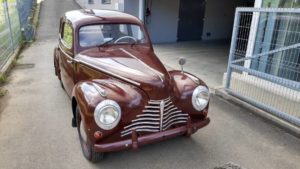
Škoda 1101 – Tudor

Year of Manufacture: 1948
Power Output: 32 hp
Displacement: 1089 cm3

Number of Cylinders/Valves: 4/2
Weight: 940 kg

Condition: Good
Catalog Number: 105

These passenger and light utility vehicles were produced in Mladá Boleslav and its branch factories, mainly in Kvasiny and Vrchlabí. The Škoda 1101 was a modernized version of the pre-war Škoda Popular 1101, differing primarily in its redesigned bodywork. Between 1946 and 1950, a total of 71,591 vehicles of all versions were produced, most of which were exported to various countries—chiefly Poland, the Netherlands, and Belgium.

Technical Specifications

Compared to its predecessor, the Škoda 1101 featured a slightly modernized engine with the same power output. Flexible Hardy couplings on the drive shaft were replaced with universal joints, and the original friction dampers on the front axle were replaced with hydraulic lever dampers. A four-speed gearbox was fitted as standard. A completely new dashboard replaced individual gauges with a combined instrument cluster, and a grille in the center was prepared for the installation of a car radio. The vehicle was not equipped with a heater as standard (except for the ambulance version).

Vehicle Development

The Škoda 1101 was a modernized version of the Škoda Popular 1101 from 1939. The most modern pre-war model of the Mladá Boleslav automaker was produced from 1940 to 1944. The development of this vehicle took place secretly during the war. A 1944 brochure already depicted the vehicle with a body design very similar to the future production version. The final shape was established in 1945, shortly after the end of the war.

Production Versions

The unfinished first prototype, built on the old Popular 1101 chassis, was presented to journalists at the end of 1945. It was completed in March 1946 and then went on a promotional tour across Czechoslovakia. This first car had a Tudor body. Between April and October 1946, body variants including ambulance, roadster, four-door sedan, Tudor convertible, and van were gradually introduced.

Modernization

In October 1947, a prototype roadster was unveiled with a new grille design consisting of five prominent ribs. This grille was subsequently fitted to all production roadsters and sedans. Other passenger versions began receiving the new grille from 1948. In mid-1950, a new two-spoke steering wheel began to be installed.

Škoda 1102

This updated version was introduced in April 1949. It was nearly identical to the 1101 model, differing mainly in the relocation of the gear lever from the floor to the steering column beneath the steering wheel. Another change was a new front bumper integrated with the bodywork. However, the 1102 model did not replace the older type. Passenger versions (primarily four-door sedans) were built as 1102s, while utility versions were mostly built on the 1101 chassis.


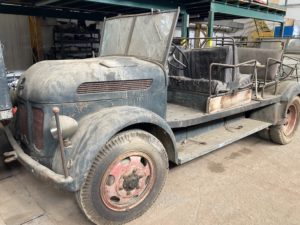
Steyr 1 500 A

Year of manufacture: 1942
Power: 85 hp
Engine displacement:3,517 cm3

Number of cylinders/valves: 8/2
Weight: 2,480 kg

Condition: not operational

Catalog number: 254

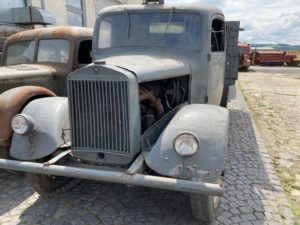
This vehicle was a light truck used by Germany during World War II. Its designer was Ferdinand Porsche. It had an air-cooled V8 engine with a displacement of 3.5 liters and a power output of 85 hp. An interesting feature is the front axle, which was suspended on torsion bars, while the rear axle was a conventional rigid one with leaf springs. This type allowed the installation of various superstructures and had wide use with ground forces. It had a payload capacity of 1.6 tons and could reach speeds up to 100 km/h on roads.

A total of approximately 18,000 vehicles were produced between 1941 and 1944.

The vehicle depicted from our collection served as a command vehicle. The same type of vehicle was used as a command vehicle by Marshal Erwin Rommel during his campaign in North Africa.

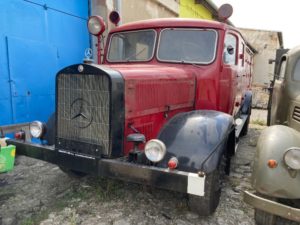
Mercedes Benz L 3000 LKW

Year of Manufacture: 1940
Power: 75 hp
Displacement:4,849 cm3

Number of cylinders/valves: 4/2

Weight: 7,000 kg

Catalog Number: 238

The Mercedes-Benz L 3000 is a two-axle truck manufactured by the German company Daimler-Benz AG, produced between 1938 and 1944. From 1939 onward, models with rear-wheel drive were produced and designated as L 3000 S. Models with all-wheel drive were called L 3000 A, and these were only built between 1939 and 1942.

This model was a key cargo vehicle in the arsenal of the German army during World War II. Countless different superstructures were installed on the basic chassis for broad use in military operations.

In all versions, more than 27,000 units of these trucks were ultimately built.

Opel Blitz fire truck body

Year of manufacture: 1942
Power: 75 hp
Displacement:3,626 cm3

Number of cylinders/valves: 6/2

Weight: 5,800 kg

Condition: Damaged

Catalog number: 243

Before World War II, Opel was the largest German manufacturer of trucks. The name Blitz was first used for a new Opel truck introduced in November 1930. As part of the Nazi economy and Germany’s rearmament efforts, authorities ordered the construction of the Opelwerk Brandenburg factory. Between 1935 and 1944, more than 130,000 trucks and chassis of various designs and load capacities were produced.

The original factory in Rüsselsheim could not keep up with the required production volume, so the German leadership decided to build a new factory on a “greenfield” site. Construction of the factory, from groundbreaking to the assembly of the first vehicle, took an incredible 7 months. On August 6, 1944, the factory was largely destroyed by an RAF air raid, and production was moved to the Mercedes Benz factory, where it replaced the MB L3000 model.

The Opel Blitz was a medium-duty truck intended in the 1930s and 1940s mainly for tasks related to offensive military operations. It was used both in Africa and on the Eastern Front. Countless versions were made, including various bodies, flatbeds, and it also served as a tractor for artillery and trailers.

The base design was a 4×2 with rear-wheel drive and two wheelbase lengths. Later, an all-wheel-drive version was added. The engine was initially a flat six-cylinder. However, the majority of production was equipped with an inline six-cylinder engine with displacements of 2.5, 3.4, and 3.7 liters producing 55, 64, and 75 hp. The total weight ranged from 2,300 kg up to 6,000 kg.

It was the most widespread truck of the German Wehrmacht during World War II. After Germany’s defeat, the Opel factories in Brandenburg fell into the Soviet zone and were completely dismantled, with equipment shipped east. Production of the Blitz did not continue in the USSR. Production in Rüsselsheim was soon resumed, and the first post-war Blitz was completed on July 15, 1946.

This vehicle has a fire-fighting body.


Opel Blitz flatbed

Year of manufacture: 1942
Power: 75 hp
Displacement:3,626 cm3

Number of cylinders/valves: 6/2

Weight: 5,800 kg

Condition: Damaged

Catalog number: 242

Before World War II, Opel was the largest German manufacturer of trucks. The name Blitz was first used for a new Opel truck introduced in November 1930. As part of the Nazi economy and Germany’s rearmament efforts, authorities ordered the construction of the Opelwerk Brandenburg factory. Between 1935 and 1944, more than 130,000 trucks and chassis of various designs and load capacities were produced.

The original factory in Rüsselsheim could not keep up with the required production volume, so the German leadership decided to build a new factory on a “greenfield” site. Construction of the factory, from groundbreaking to the assembly of the first vehicle, took an incredible 7 months. On August 6, 1944, the factory was largely destroyed by an RAF air raid, and production was moved to the Mercedes Benz factory, where it replaced the MB L3000 model.

The Opel Blitz was a medium-duty truck intended in the 1930s and 1940s mainly for tasks related to offensive military operations. It was used both in Africa and on the Eastern Front. Countless versions were made, including various bodies, flatbeds, and it also served as a tractor for artillery and trailers.

The base design was a 4×2 with rear-wheel drive and two wheelbase lengths. Later, an all-wheel-drive version was added. The engine was initially a flat six-cylinder. However, the majority of production was equipped with an inline six-cylinder engine with displacements of 2.5, 3.4, and 3.7 liters producing 55, 64, and 75 hp. The total weight ranged from 2,300 kg up to 6,000 kg.

It was the most widespread truck of the German Wehrmacht during World War II. After Germany’s defeat, the Opel factories in Brandenburg fell into the Soviet zone and were completely dismantled, with equipment shipped east. Production of the Blitz did not continue in the USSR. Production in Rüsselsheim was soon resumed, and the first post-war Blitz was completed on July 15, 1946.

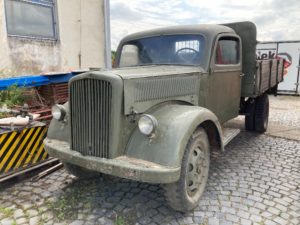
This vehicle is a classic flatbed truck for transporting materials.


Opel Blitz flatbed

Year of manufacture: 1942
Power: 75 hp
Displacement:3,626 cm3

Number of cylinders/valves: 6/2

Weight: 5,800 kg

Condition: Damaged

Catalog number: 236

Before World War II, Opel was the largest German manufacturer of trucks. The name Blitz was first used for a new Opel truck introduced in November 1930. As part of the Nazi economy and Germany’s rearmament efforts, authorities ordered the construction of the Opelwerk Brandenburg factory. Between 1935 and 1944, more than 130,000 trucks and chassis of various designs and load capacities were produced.

The original factory in Rüsselsheim could not keep up with the required production volume, so the German leadership decided to build a new factory on a “greenfield” site. Construction of the factory, from groundbreaking to the assembly of the first vehicle, took an incredible 7 months. On August 6, 1944, the factory was largely destroyed by an RAF air raid, and production was moved to the Mercedes Benz factory, where it replaced the MB L3000 model.

The Opel Blitz was a medium-duty truck intended in the 1930s and 1940s mainly for tasks related to offensive military operations. It was used both in Africa and on the Eastern Front. Countless versions were made, including various bodies, flatbeds, and it also served as a tractor for artillery and trailers.

The base design was a 4×2 with rear-wheel drive and two wheelbase lengths. Later, an all-wheel-drive version was added. The engine was initially a flat six-cylinder. However, the majority of production was equipped with an inline six-cylinder engine with displacements of 2.5, 3.4, and 3.7 liters producing 55, 64, and 75 hp. The total weight ranged from 2,300 kg up to 6,000 kg.

It was the most widespread truck of the German Wehrmacht during World War II. After Germany’s defeat, the Opel factories in Brandenburg fell into the Soviet zone and were completely dismantled, with equipment shipped east. Production of the Blitz did not continue in the USSR. Production in Rüsselsheim was soon resumed, and the first post-war Blitz was completed on July 15, 1946.

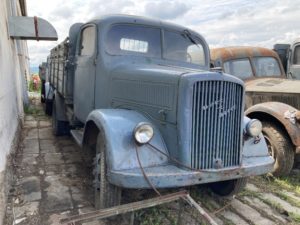
This vehicle is a flatbed truck designed for transporting soldiers, including seats in the cargo bed.


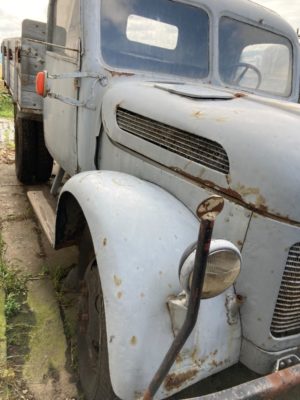
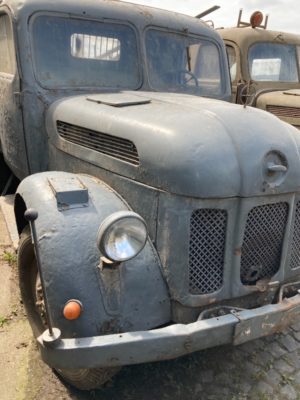
Steyr 1 500A flatbed truck

Year of manufacture: 1941
Power: 85 hp
Displacement:3,517 cm3

Number of cylinders/valves: 8/2
Weight: 2,480 kg

Condition: not drivable

Catalog number: 241

This vehicle was a light truck used by Germany during World War II. Its designer was Ferdinand Porsche. It had an air-cooled V8 engine with a displacement of 3.5 liters and a power output of 85 hp. An interesting feature is the front axle suspended on torsion bars, while the rear axle was a conventional rigid type with leaf springs. This model allowed for mounting various superstructures and had wide use by ground forces. It had a payload capacity of 1.6 tons and could reach speeds up to 100 km/h on roads.

Approximately 18,000 vehicles were produced between 1941 and 1944.

The vehicle shown from our collection is a standard flatbed truck.

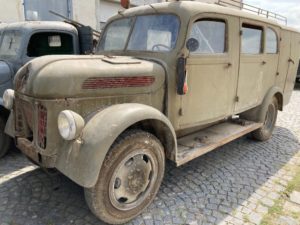
Steyr 1 500A

Year of manufacture: 1941
Power: 85 hp
Displacement:3,517 cm3

Number of cylinders/valves: 8/2
Weight: 2,480 kg

Condition: not drivable

Catalog number: 240

This vehicle was a light truck used by Germany during World War II. Its designer was Ferdinand Porsche. It had an air-cooled V8 engine with a displacement of 3.5 liters and a power output of 85 hp. An interesting feature is the front axle, which was suspended on torsion bars, while the rear axle was a conventional rigid type with leaf springs. This model allowed for the mounting of various superstructures and had a wide range of uses for ground forces. Its payload capacity was 1.6 tons, and it could reach speeds of up to 100 km/h on roads.

Approximately 18,000 vehicles were produced between 1941 and 1944.

The vehicle shown from our collection is a box-type radio station.


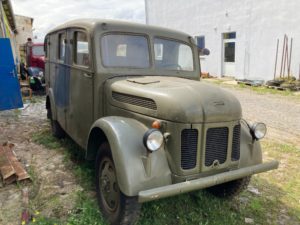
Steyr 1 500A

Year of manufacture: 1941
Power: 85 hp
Displacement:3,517 cm3

Number of cylinders/valves: 8/2
Weight: 2,480 kg

Condition: not drivable

Catalog number: 239

This vehicle was a light truck used by Germany during World War II. Its designer was Ferdinand Porsche. It had an air-cooled V8 engine with a displacement of 3.5 liters and a power output of 85 hp. An interesting feature is the front axle, which was suspended on torsion bars, while the rear axle was a conventional rigid type with leaf springs. This model allowed for the mounting of various superstructures and had a wide range of uses for ground forces. Its payload capacity was 1.6 tons, and it could reach speeds of up to 100 km/h on roads.

Approximately 18,000 vehicles were produced between 1941 and 1944.

The vehicle shown from our collection is a box-type radio station.


Steyr 1 500A

Year of manufacture: 1941
Power: 85 hp
Displacement:3,517 cm3

Number of cylinders/valves: 8/2
Weight: 2,480 kg

Condition: drivable

Catalog number: 231

This vehicle was a light truck used by Germany during World War II. Its designer was Ferdinand Porsche. It had an air-cooled V8 engine with a displacement of 3.5 liters and a power output of 85 hp. An interesting feature is the front axle, which was suspended by torsion bars, while the rear was a classic rigid axle with leaf springs. This type allowed the installation of various superstructures and had wide use in ground forces. Its payload capacity was 1.6 tons, and it could reach speeds of up to 100 km/h on roads.

Approximately 18,000 vehicles were produced between 1941 and 1944.

The vehicle pictured from our collection has a box body superstructure.


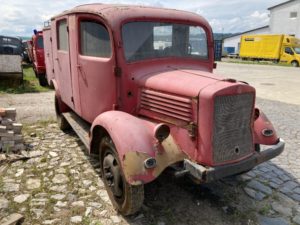
Mercedes Benz 1500 S LLG

Year of Manufacture: 1942
Power: 60 horsepower
Displacement:2,594 cm3

Number of Cylinders/Valves: 6/2
Weight: 4,080 kg

Condition: damaged

Catalogue Number: 234

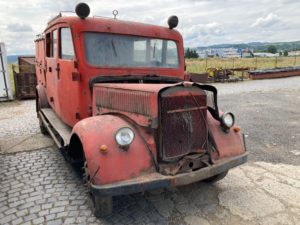
The Mercedes-Benz L 1500 S is a light-duty truck. Daimler-Benz built it for the German Wehrmacht and, especially, in large numbers for fire brigades during World War II.

It was available in two versions: the L 1500 S with rear-wheel drive only, and the L 1500 A with all-wheel drive. Most of the produced vehicles were ultimately used as transporters for infantry troops, and about one-third of the vehicles served as special fire trucks.

Our vehicle features the classic fire brigade box body.

Mercedes Benz L 4 500

Year of Manufacture: 1942
Power: 112 horsepower
Displacement:7,274 cm3

Number of Cylinders/Valves: 6/2
Weight: 10,400 kg

Condition:

Catalogue Number: 232

Mercedes-Benz L 4500 is a heavy-duty truck produced between 1939 and 1944. The vehicle was manufactured in versions with rear-wheel drive (L 4500 S) and all-wheel drive (L 4500 A).

During World War II, the Wehrmacht used the L 4500 extensively, including as a towing vehicle for anti-aircraft guns — which is the version in our collection. However, it was widely employed by the military as a universal base for various superstructures and modifications.

The engine was an inline six-cylinder diesel with 112 horsepower and water cooling. The very robust chassis was built with a frame made of pressed U-profile sections. Both axles were rigid and suspended using leaf springs. The payload capacity was 5 tons.

Surviving vehicles continued to operate reliably long after the war. In the 1950s, the model was modified into the L 312 type, which remained in production until 1955.

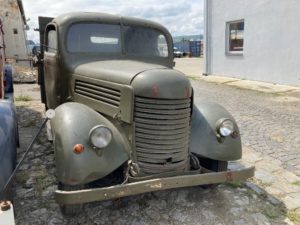
Praga RN/RND

Year of Manufacture: 1950
Power: 60 horsepower
Displacement:4,500 cm3

Number of Cylinders/Valves: 4/2
Weight: 6,300 kg

Condition:

Catalogue Number: 233

History

These were vehicles that didn’t stand out with eccentricity or innovation. Their design was classic — timeless and indestructible.

The “Erena” was developed before World War II. The designation RN stood for “Rychlý Nákladní” (Fast Truck). A parallel model, the RND, indicated a diesel engine version.

The first Praga, with a different front design, was introduced in 1933 as a 2-ton truck powered by a petrol inline six-cylinder engine producing 38 kW. The initial versions weren’t mass-produced — between 1934 and 1936, only 94 units were built.

Twelve series were produced before the war. The new RND version (Fast Diesel Truck) adopted all the improvements of its petrol-powered sibling, differing only in having a diesel engine.

Technical Specifications

The first version could carry a 2-ton payload. In 1937, Praga increased the power to 53 kW, which raised the payload capacity to 2.5 tons. The fifth series, from 1938, introduced a more rounded front and streamlined fenders.

After the war, the engine power remained unchanged, but a reinforced frame and upgraded brake system allowed a payload increase to 3 tons. This configuration remained in production until the end.

The original RN had a petrol six-cylinder engine; the diesel version had four cylinders. The modernized rounded version was produced until 1953 in Prague’s Vysočany district. It was eventually succeeded by the three-axle off-road Praga V3S, which was mainly used by the military.

No other vehicle in this category was produced in Czechoslovakia for many years, so the Praga trucks remained in service until the 1970s, when they were gradually replaced by licensed Avia A30 models.

Post-war Era

After the war, the Czechoslovak army also faced a shortage of trucks. From 1949 onward, over 4,000 Erenas were supplied for military use, despite having only rear-wheel drive. Both axles were solid and mounted on longitudinal leaf springs.

As was common, many superstructures and modifications were built on the RN chassis. Buses — in short supply after the war — were especially popular.

Czechoslovak Success

The petrol RN versions always enjoyed more popularity due to their higher speed. In 1938, Praga won a comparative trial in the former Yugoslavia. Reportedly, over 18,000 units were produced under license there, while over 40,000 were made in Czechoslovakia.

Today, the Erena is a cult classic among historical trucks. It receives great attention from collectors and participates in historic vehicle events.

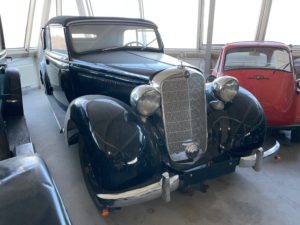
Mercedes-Benz 230 W143 cabrio

Here is the English translation of your text with the original formatting preserved:

Year of manufacture: 1941 Power: 55 hp Displacement: 2,229 cm3

Number of cylinders/valves: 6/2 Weight: 1,000 kg

Condition: after renovation Catalogue number: 230

The Mercedes-Benz type 230 W143 was introduced in 1937. It was produced until 1941, with a total of 20,336 units manufactured.

This model was the successor to the Mercedes-Benz 230 W21, from which it inherited the frame. The body of the new 230 is wider and longer than its predecessor, although the first prototypes were built on the shorter wheelbase chassis of the previous model.

Only from 1938 onwards did versions with a long wheelbase appear. Generally, the 230 W143 was available in several body styles: from classic limousine to sedan, from sporty roadster to two types of convertibles. In its time, it was one of the flagship models of Mercedes-Benz production.

The Mercedes-Benz 230 was powered by a 2.3-liter engine delivering 55 hp, capable of propelling the vehicle to speeds exceeding 116 km/h. In the roadster body version, the same engine was slightly modified, increasing its maximum power to 58 hp and the top speed to 122 km/h.

The car from our collection is a Cabrio “B” model, fully renovated and in very good condition.

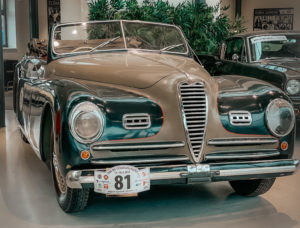
Alfa Romeo 6C 2500

Year of manufacture: 1948
Power: 95 hp
Displacement: 2,443 cm3

Number of cylinders/valves: 6/2
Weight: 1,430 kg

Condition: operational
Catalogue number: 196

The history of the legendary Alfa Romeo model with the designation 6C dates back to the early 1920s. At that time, Vittorio Jano, Alfa’s chief engineer, was tasked with creating, alongside successful racing cars, a brilliant, powerful, and lightweight car that would win races, command admiration, and conquer new markets as a commercial product. The first car bearing the 6C designation was introduced in 1925 but started production in 1927. The production of this type, after many innovations and improvements, ended only in 1954.

The Alfa Romeo 6C 2500 was introduced in 1938 and is the last road car of the 6C series. It represents a significant moment in the history of one of the most popular motor brands. It is the best and most advanced evolution of the great pre-war lineup. Immediately after World War II, it continued this tradition and was among the absolute best and most expensive cars available at that time. With its Pinin Farina body, this rare sports convertible is a unique proof of that.

This car, called the “Last Great Alfa,” marked the end of a long series of six-cylinder Alfa Romeo cars. It was produced between 1938 and 1952, with a total of 1,313 units made. During this period, this model bridged two radically different eras for the brand.

The first era was before World War II, characterized by large, exclusive, hand-built cars produced in relatively small numbers. They attracted a worldwide clientele of celebrities, especially those who loved highly sought-after top models. The Alfa Romeo 6C 2500, one of the most expensive luxury cars of its era, was popular among legends such as Rita Hayworth, Tyrone Power, and many others. This trend lasted into the early 1950s.

The second era appeared after the war and consisted of smaller, more modern, and more affordable sports cars. This production shift was necessitated by the post-war situation and market demands.

The factory mostly supplied complete chassis, while the bodies came from renowned Italian coachbuilders, primarily Bertone, Zagato, and of course Pinin Farina. The Alfa Romeo 6C 2500 was available in Turismo, Sport, and Super Sport versions, differing partly in technical details and power output. Many of the Pinin Farina-built cars were made in Sport and Super Sport versions.

The vehicles had only hand-assembled chassis and gearbox parts on the production line, but the body and interior design, which was perfect, was done by the Italian design studio Pinin Farina. The interior was upholstered with beautiful red leather. Key interior features included an ivory-colored steering wheel, wooden trim, and bright yellow control knobs. The car ran on chromed wire wheels with two-eared “discs” bearing the Alfa Romeo brand. The trunk held a fifth, spare wire wheel.

“6C” in the model name referred to six cylinders, with an engine capacity of 2,443 cm3, equipped with single, double, or triple carburetors. This Alfa Romeo could reach a maximum speed of 160 km/h with a 4-speed manual gearbox, producing 95 hp. The model had rear-wheel drive, independent suspension on all four wheels inherited from the 6C 2300 model, with double wishbones up front, coil springs, and hydraulic drum brakes on all four wheels. The two-door Alfa Romeo had a wheelbase of 3,000 mm and external dimensions of 5200x1800x1500 mm. The estimated weight is about 1,430 kg.

The car from our collection is in fully functional and perfect condition, as evidenced by its recent participation in historic car races.