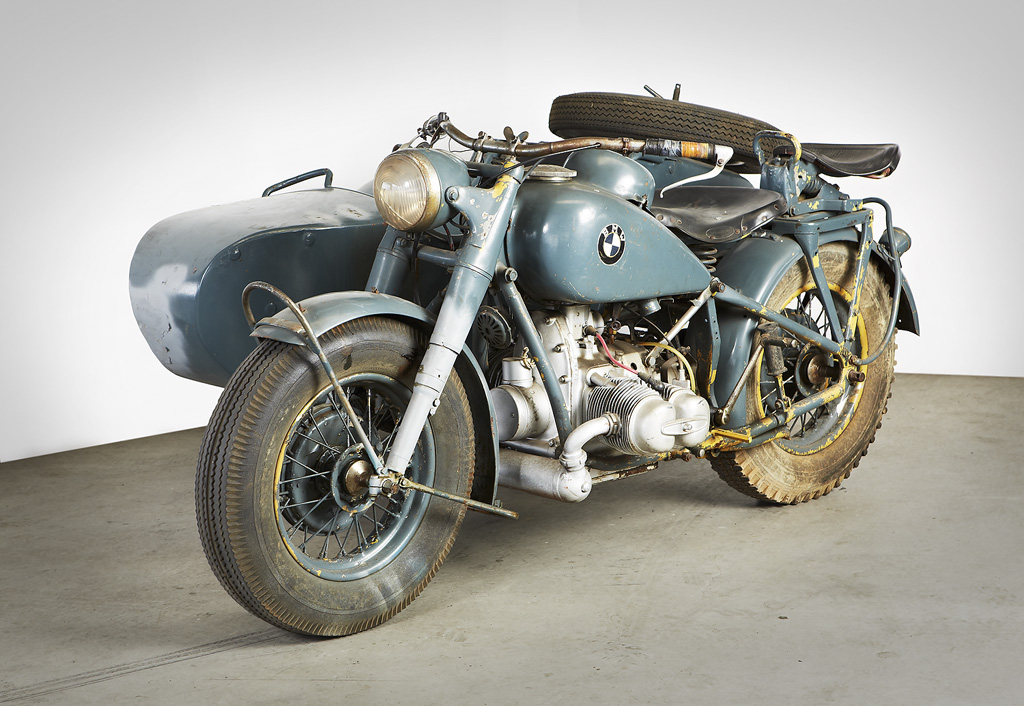
BMW R75
Year of Manufacture: 1942
Power Output: 26 hp
Displacement: 745 cm3
Number of Cylinders: 2
Weight: 400 – 420 kg (including sidecar)
Condition: Excellent
Catalog Number: 89
Introduction
In 1938, the German Army High Command issued a requirement for the design and production of a motorcycle exclusively for military purposes. This was because the BMW R12 and R71 motorcycles were civilian models.
Development
The heavy BMW R75 Gespann motorcycles were originally intended to stir up dust on battlefields in North Africa and the Mediterranean. However, they were eventually used by Wehrmacht and Waffen-SS units on virtually all fronts. They became an integral part of the German army’s equipment.
In reconnaissance battalions, they replaced bicycles. Only insufficient production and fuel shortages delayed the full replacement by these military specials.
By the end of World War II, however, the expectations of Heinz Guderian—main architect of the German army’s tank doctrine and the theory of “Blitzkrieg”—were not fully realized, even though these rather clumsy yet very fast motorcycles would have fit his vision well. Allied bombing of Third Reich factory complexes further reduced production capacity and forced a reevaluation of priorities in weapon and equipment manufacturing.
Technical Specifications
The BMW R75 motorcycles were powered by air-cooled 2-cylinder boxer engines, the BMW M56 Baumuster 275, producing 19.1 kW. The first models were equipped with engines from the R71 type. The engines featured BMW’s characteristic outward-facing cylinders for better cooling. Compared to other manufacturers, who tried to hide the engine inside the frame, the R75 stood out as original and unconventional.
Engineers equipped the motorcycles with strong spoked wheels and car-type tires, interchangeable with small utility vehicles like the KdF. The tall wheels contributed to an unusually high ground clearance for the category. One of the most praised features was the rear-wheel drive system. Instead of a chain, a short cardan shaft was used. Acceleration and movement through difficult terrain were enhanced by drive to the fixed-mounted sidecar, with traction transferred through a rear transverse shaft. One-third of the total drive power was sent to the sidecar wheel, and two-thirds to the motorcycle’s rear wheel. A differential lock ensured optimal wheel speeds.
Maximum torque was achieved at 3,600 rpm. The gearbox had a unique layout: a standard four-speed forward gear setup, plus a lever beside the gear shifter on the rider’s right side—or a foot lever on the left side—allowed switching to a special off-road mode with three forward gears. Both modes included one reverse gear. Front suspension used telescopic forks, the rear wheel was rigid, and the sidecar wheel was suspended with a leaf spring. The braking system consisted of manual cable brakes and rear hydraulic drum brakes with a 25 cm diameter.
The R75’s power unit allowed for fording water up to 35 cm deep. Sensitive components were protected by special measures. The engines had Graetzin Sa carburetors with high water resistance. The spark plug was housed in a waterproof cover. The intake manifold and air filter were raised to prevent water ingress. The exhaust pipe led from the cylinder exhaust chamber to the right side of the motorcycle and was bent over the sidecar’s drive system. These motorcycles performed best in North Africa—earning the nickname “Sahara”—and on the dense road networks of Western Europe. In the Soviet Union, despite their reputation, they struggled with severe cold and mud (as did most German vehicles).
Electric power during operation was provided by a 70 W dynamo. Reliable ignition was supported by Noris ZG 2 or Bosch FJ 2R 134 coils, which, thanks to optimal sealing, could endure thousands of kilometers without maintenance. However, R75s performed poorly when towing light artillery—the front wheel would lift off the ground, rendering the vehicle uncontrollable.
Maintenance and parts replacement were simplified by the robust motorcycle design, with minimal welding. Welded joints were mostly used on the sidecar frame. The motorcycle’s tubular frame was bolted together. The connection between the motorcycle and the sidecar was also fully detachable—removable at four points even in field conditions.
The BMW R75 Gespann found use primarily with reconnaissance units, but also with motorized infantry and military police. These heavy motorcycles often led or closed columns and served as valuable tools for couriers and dispatch riders. Lockable boxes mounted on the motorcycle and sidecar were used for postal duties. Recon units and motorized infantry often used a sidecar-mounted MG 34 machine gun (caliber 7.92 mm). However, its ability to deliver fire was limited by its restricted range of motion.
The R75s were robust and reliable motorcycles—but disproportionately expensive. A single unit could cost twice as much as a four-wheeled Kübelwagen. Despite this, production continued even after the war (until 1946). Over more than five years, BMW delivered over 16,000 units of the R75, mostly in gray or sand camouflage. These German machines also appealed to other countries, especially the Soviet Union, where the popular IMZ M72 was produced based on the older R71. In China, the R71 was manufactured under the name Chang Jiang 750. In the U.S., the powertrain impressed engineers so much that Harley-Davidson developed the XA model based on the German R75.