Showing all 9 results

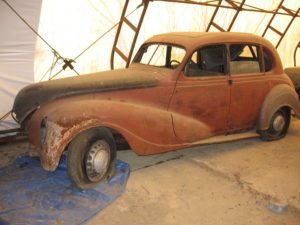
BMW EMW 340-2

Year of Manufacture: 1952
Power: 57 hp
Engine Displacement: 1,971 cm3

Number of Cylinders/Valves: 6/2
Weight: 1,250 kg

Condition: For restoration
Catalog Number: 48

This car, based on the pre-war BMW 326 model, was produced between 1952 and 1955 in the former BMW factory in Eisenach, East Germany. After the war, this area fell under the zone liberated by the Red Army and thus came under Soviet influence. After the war, there were still enough parts in the original factory to continue production of the BMW 326. However, in 1952, BMW, now part of the newly formed “Western” Germany, won an international court case over the rights to the BMW brand and all associated trademarks. As a result, production of the BMW 326 based on the original documentation was discontinued in Eisenach, and the EMW 340–2 model began production. It shares many mechanical components with the original BMW 326 but features a modified body. The car is complete but intended for restoration.

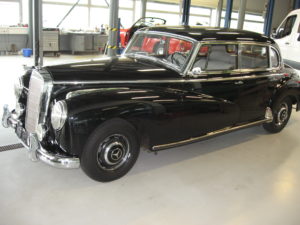
Mercedes Benz 300 Adenauer

Year of Manufacture: 1954 Power: 115 hp Displacement: 2,996 cm3

Number of Cylinders/Valves: 6/2 Weight: 1,780 kg

Condition: drivable Catalogue Number: 95

History

Six years after the end of World War II, in April 1951, the Stuttgart company continued the tradition of its luxury automobiles. In the same year, the Spanish supercar Pegaso from the former Barcelona Hispano-Suiza factory and the Bugatti type 101 also debuted.

Technical Specifications

The first version offered a naturally aspirated three-liter six-cylinder engine producing 115 hp. The short-stroke power unit differed from the smaller 220 series by having the crankshaft supported on seven bearings instead of four. By modifying the arrangement and angle of the valves (OHC), better cylinder filling and scavenging were achieved. The oil/water heat exchanger accelerated oil warming, which was especially useful during cold starts. Similar to the 220 type, the dashboard included an octane selector, a mechanical ignition timing adjustment according to the fuel type or octane rating. The innovative two-spoke steering wheel with a large diameter of 440 mm and the column-mounted gear lever contrasted with the X-shaped chassis frame and wheel suspension, which were based on pre-war designs.

Development

In March 1954, the W 186 series received its first update, designated 300 b. Power increased by 10 hp, and the reported fuel consumption dropped to 12.5 liters, though in practice it hovered around 16 liters.

In September 1955, the 300 c version took over, benefiting from a number of changes, including a single-joint rear axle. An automatic three-speed transmission with a hydrodynamic torque converter was optionally available. Only by the mid-1950s did the renowned manufacturer stop charging extra for heating in its flagship model.

The most significant changes came with the last version, the 300 D with internal designation W189. Power was increased to 160 hp. Thanks to larger glazing, the car offered significantly better visibility. The automatic transmission was upgraded with a fourth gear and became part of the standard equipment.

In September 1958, power steering was added.

Interesting Facts

It is impossible to omit the prominent users of the 300 series.

The first was long-time Federal Chancellor Konrad Adenauer, who initiated the construction of German highways even before Hitler and owned six different service 300 models. For this reason, this type of car is known among collectors as the “Adenauer.”

In 1960, Pope John XXIII took the extended 300 D landaulet with a raised throne.

Among the few Czech celebrities who used the W 186 series were personalities such as Josef Lada and Jan Werich.

Our Adenauer car was purchased in Switzerland in a somewhat different condition and color. It was finally decided to restore it to a condition typical for this car. The vehicle is in perfect drivable condition and is a beautiful example of this model series.


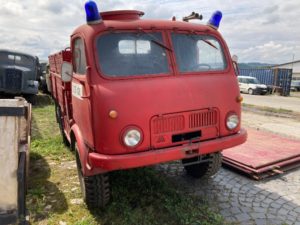
Tatra 805

Year of Manufacture: 1955
Power: 75 hp
Displacement:2,545 cm3

Number of cylinders/valves: 8/2

Weight: 4,450 kg

Condition: Operational

Catalog Number: 235

This light off-road truck, colloquially nicknamed “Duck,” “Squealer,” or “Whistler” due to the characteristic whining sound of the engine under load and during gear shifts, was manufactured by Tatra between 1952 and 1960.

The vehicle was developed specifically for military needs, requiring a vehicle capable of driving in difficult terrain with high towing power.

The chassis of the T 805 model was structurally based on the previous prototypes T 803 and T 804. The main innovation was the “trambus” cab, which required repositioning the driver’s seat.

Engine

The Tatra 805 was powered by an air-cooled, gasoline, V8 engine type T 603A with a displacement of 2,545 cm3. The engine differed from the passenger car versions by using a single carburetor, a lower compression ratio, forced cooling fans, and a “dry” crankcase with dual oil pumps.

Transmission

The four-speed transmission was supplemented by a two-speed auxiliary gearbox, allowing better adaptation to off-road conditions.

Chassis

The chassis was designed as a prime example of off-road construction. The torsion bar suspension on both axles ensured a comfortable ride even at higher speeds on paved roads. A weak point was the single-circuit hydraulic drum brakes without power assistance.

Usage

In the civilian sector, the Tatra 805 was used as delivery or street-sweeping vehicles, or with various special box body modifications such as a silver-painted van, known from Czechoslovak films.

The most famous application was the expedition vehicles used by travelers Zikmund and Hanzelka. These special vehicles featured a light-reflecting paint, thermal insulation, reinforced steering wheels, taller windshields, and trailer carts.

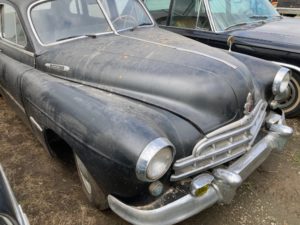
Gaz 12 Zim

Year of Manufacture: 1953
Power: 95 horsepower
Displacement:3,485 cm3

Number of Cylinders/Valves: 6/2
Weight: 1,900 kg

Condition: Operational

Catalogue Number: 247

This is a representative limousine over 5.5 meters long. Due to time constraints, chief designer Andrei Lipgart was given a choice between copying an American product (Buick) or developing an entirely new model — he chose the latter.

The GAZ-12 was a Soviet limousine produced from 1950 to 1960 by the Gorky Automobile Plant. It was built to serve both the upper and middle class, but was also widely used as a taxi and ambulance. Unlike its successors, the GAZ-12 was the only Soviet executive vehicle intended for private ownership. While a Pobeda cost about 16,000 rubles, a GAZ-12 cost around 40,000 rubles. It was designed for mid-level political and economic officials and was also used by the KGB.

The vehicle boasted a length of 5,530 mm and a wheelbase of 3,200 mm. Inside, it featured two rows of soft plush bench seats, with two additional fold-out jump seats integrated into the floor. For its time, it was considered highly luxurious.

It was powered by a 3,485 cm3 inline six-cylinder engine with a maximum output of 66 kW (95 hp), paired with a three-speed gearbox. The car could reach a top speed of around 125 km/h and accelerated from 0 to 100 km/h in roughly 40 seconds. Fuel consumption was about 19 l/100 km.

Over the ten-year production span, a total of 21,527 units were made. A few made their way to Czechoslovakia, where they were used by state officials. One such vehicle was used by then-Minister of Defense Alexej Čepička.

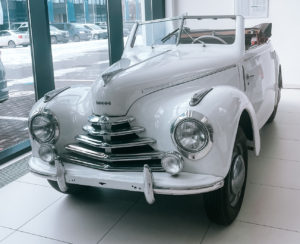
Škoda 1102 Tudor Roadster

Jasně, tady je překlad do angličtiny se zachováním formátování:

Year of manufacture: 1951 Power: 32 hp Displacement: 1,089 cm3

Number of cylinders/valves: 4/2 Weight: 960 kg

Condition: drivable Catalog number: 261

These passenger and light utility vehicles were produced in Mladá Boleslav and its branch plants, primarily in Kvasiny and Vrchlabí. The Škoda 1101, or Škoda 1102, also popularly known as Tudor, was a modernization of the pre-war Škoda Popular 1101, mainly distinguished by an updated body. Between 1946 and 1952, a total of 71,591 units of all versions were produced, most of which were exported to various countries, especially Poland, the Netherlands, and Belgium.

Technical data

Compared to its predecessor, the Škoda 1102 had a slightly modernized engine with the same power output. The flexible Hardy couplings on the drive shaft were replaced by universal joints, and the original friction shock absorbers on the front axle were replaced by lever-type hydraulic shock absorbers. A four-speed gearbox was standard. The entirely new dashboard replaced individual gauges with a combined instrument panel, and in the center, a grille prepared for a car radio appeared. The vehicle was not equipped with heating as standard (except for the ambulance version).

Vehicle development

The most modern pre-war model of the Mladá Boleslav automaker Škoda Popular was produced between 1940 and 1944. Development of the new car took place secretly during the war. A 1944 brochure already showed a drawing of a car with a body very similar to the eventual production version. The final design was completed during 1945 shortly after the war ended. In the 1102 version, passenger cars (mainly four-door sedans) were produced, while utility variants were mostly built on the 1101 chassis.

Production variants

An unfinished first prototype, still based on the old Popular 1101 chassis, was presented to journalists at the end of 1945. The prototype was completed in March 1946 and then underwent a promotional tour around Czechoslovakia. This first car had a Tudor body. Between April and October 1946, the body variants gradually emerged: ambulance, roadster, four-door sedan, Tudor convertible, and delivery van.

The roadster model differed from other versions by its two-piece, arrow-shaped windshield. The upper part of the windshield frame was made of a chrome strip. The roadster’s doors were frameless, and the curved sliding windows were trimmed with a thin chrome strip. The body was four-seater, although the rear seats were only for emergency use.

Modernization

In October 1947, a roadster prototype with a new grille consisting of five thick ribs was presented. This grille was adopted for all series roadsters and sedans. Other passenger versions received the new grille starting in 1948. In mid-1950, a new two-spoke steering wheel began to be installed.

The 1101/1102 series was replaced in 1952 by the Škoda 1200, which inherited the updated engine and chassis.


The vehicle from our collection is fully restored and in drivable condition.

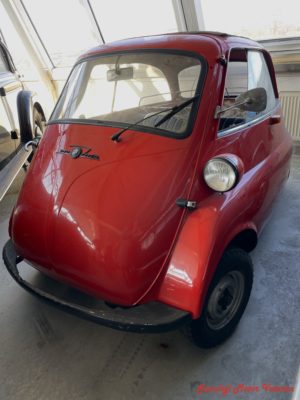
BMW ISETTA

Year of Manufacture:  1955 Power:  12 hp Engine Displacement:  247 cm3

Number of Cylinders/Valves: 1/2 Weight:  360 kg

Condition:  drivable Catalog Number: 263


Introduction

The car was designed by the Italian company Iso SpA. In the early 1950s, the company manufactured refrigerators, motor scooters, and small three-wheeled trucks. Iso’s owner, Renzo Rivolta, decided to build a small car for mass distribution. In 1952, engineers Ermenegildo Preti and Pierluigi Raggi designed a small car powered by the Iso Moto 200 motorcycle engine and named it Isetta.


Development

The Isetta caused a sensation when introduced to the automotive press in Turin in November 1953. It resembled nothing seen before. The small egg-shaped car featured bubble-type windows and a front end that hinged outward to allow entry.


Technical Specifications

The original Isetta was powered by a 236 cm3 motorcycle engine producing 9.5 hp, with a top speed of 75 km/h. It took more than 30 seconds to reach 50 km/h. The engine was started by a combined generator-starter called Dynastart. The fuel tank held only 13 liters. The manual gearbox offered four forward speeds and one reverse. A chain drive connected the gearbox to the fixed rear axle with a pair of closely spaced rear wheels 25 cm in diameter. Early prototypes had only one rear wheel, but the car was prone to tipping, so the rear wheels were spaced 48 cm apart. This narrow track eliminated the need for a differential.


Production

The car was produced from 1953 to 1958. In 1954, Iso entered several Isettas in the legendary Mille Miglia, achieving the top three positions in the economy class. Over a distance of 1,600 km, drivers averaged 70 km/h. Despite initial success, the Isetta’s popularity waned at home, mainly due to renewed competition from Fiat with the 500C model. Renzo Rivolta focused on developing his new sports car, the Iso Rivolta (later Iso Grifo), and sought to sell licenses for Isetta production. Factories in Spain and Belgium began assembling Isettas using components made by Iso in Italy.

BMW began negotiations with Rivolta and in mid-1954 purchased not only the license but also the complete tooling for the Isetta body. BMW was struggling to sell its expensive six- and eight-cylinder models, so it took the opposite approach by licensing the production of a small people’s car. BMW fitted the car with a single-cylinder four-stroke 247 cm3 engine producing 12 hp and extensively reworked much of the car, making parts non-interchangeable with the original Isetta. Given the post-war German market conditions, the car sold very well. It was the first car with a fuel consumption of 3 l/100 km. Yet in 1956, BMW introduced the Isetta 300 with a larger engine and other improvements.

The peak of these cars was the BMW 600, which was almost a fully-fledged car. It had four wheels and four seats like a normal car but still featured front-hinged front doors. The engine was a two-cylinder from the R67 motorcycle. This model marked the end of the era of small, specialized Isetta vehicles. The car left an indelible mark on automotive history and attracted many customers in its time and under the given conditions. Over 200,000 Isettas were produced in total, with BMW manufacturing 161,230 units alone.


Market

The car became very popular due to its affordable price and low fuel consumption. It was cheap, simple, and very economical in times of fuel shortages. It was perfectly timed for the market.


Trivia

The model appeared in the films *Smiling Face* and *Lisbon Story*.


Car in Our Collection

The car in our collection dates from 1955 and is in fully functional drivable condition.

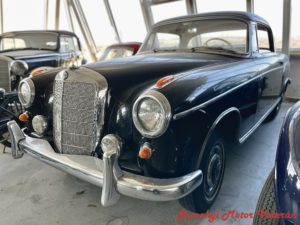
Mercedes-Benz 220 SE W128

Year of Manufacture: 1960
Power: 120 hp
Engine Displacement: 2,195 cm3

Number of Cylinders/Valves: 6/2
Weight: 1,380 kg

Condition: drivable
Catalog Number: 264


Introduction

The Mercedes-Benz 220 SE W128 is a six-cylinder luxury car produced by Mercedes-Benz from 1958 to 1960.

Development

It was the last new model of the “Ponton” series, whose design and style roots date back to the 1953 Mercedes-Benz 180 (W120) sedan. It was largely identical to its predecessor, the 220 S, except for fuel injection—“Einspritzung” in German—reflected by the additional E in its name 220 SE. The W128 was later succeeded by the emerging W111 series.

Technical Specifications

The 220 SE features a unibody construction and a chassis with fully independent suspension. All models are equipped with a 2.2-liter inline six-cylinder petrol engine with an aluminum head and Bosch mechanical fuel injection. This was performed as intermittent injection into the intake manifold and meant that the 2.2-liter engine produced 120 hp. The vehicle’s curb weight is 1,380 kg, it is rear-wheel drive, and its top speed is 160 km/h. The engine displacement is 2,195 cm3 with a four-speed manual transmission.

Production

Almost every interior is covered with wood and leather, and matching leather luggage was also available. However, original equipment for the 220 SE did not include power steering, electric windows, air conditioning, or an automatic transmission.

Market

This model was available as a sedan, coupe, convertible, and limousine.

Interesting Facts

The Mercedes-Benz 220 SE coupe is very rare, as only 830 units were produced.

Car in Our Collection

The car in our collection is a coupe and is in fully functional and drivable condition.

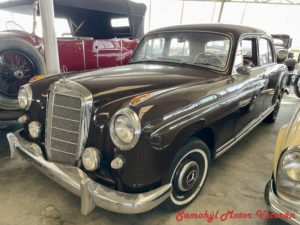
Mercedes-Benz 220 SE W128

Year of Manufacture: 1959
Power: 115 hp
Engine Displacement: 2,195 cm3

Number of Cylinders/Valves: 6/2
Weight: 1,380 kg

Condition: drivable
Catalog Number: 276


Introduction

The Mercedes-Benz 220 SE W128 is a six-cylinder luxury car produced in 1958 and 1959. It was the last new model of the “Ponton” series, which traced its design and style roots back to the 1953 Mercedes-Benz 180 (W120) sedan. It was largely identical to its predecessor, the 220 S, except for fuel injection — “Einspritzung” in German — reflected by the additional E in its name 220 SE. The W128 was succeeded by the emerging W111 series.

Technical Specifications

The 220 SE features a unibody construction with a chassis that has fully independent suspension. All models are equipped with a 2.2-liter inline six-cylinder petrol engine with an aluminum head and Bosch mechanical fuel injection. This injection was intermittent into the intake manifold, enabling the 2.2-liter engine to produce 115 horsepower. This stronger engine delivered better performance with lower fuel consumption but came at a cost: 1,900 DM more than the carburetor version.

Production

Almost every interior is covered with wood and leather, and matching leather luggage was also available. However, original equipment for the 220 SE did not include power steering, electric windows, air conditioning, or automatic transmission.

Market

This model was available as a sedan, coupe, convertible, and limousine.

Sales

A total of 1,974 units were produced in the four-door limousine configuration.


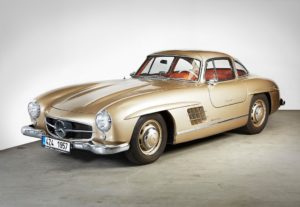
Mercedes Benz 300 SL Gullwing W198

Year of Manufacture: 1957
Power Output: 215 hp
Engine Displacement: 2,996 cm3

Number of Cylinders/Valves: 6/2
Weight: 1,310 kg

Condition: Perfect
Catalogue Number: 3


The Mercedes-Benz 300 SL of the W198 series is rightfully considered one of the most charismatic—indeed, iconic—models in the 130-year history of gasoline-powered automobile development. At the same time, it ranks among the most desirable and expensive historic vehicles ever made.

The prototype of the 300 SL, based on the coupé made famous by its success in the 1952 Panamericana race in Latin America, was created in the spring of the following year. However, its spiritual father was neither an engineer nor a manager at the German car manufacturer, but rather Mercedes-Benz’s U.S. dealer Edwin Hoffman. He saw great sales potential for the sports coupé (and later the roadster) in the North American market—and history proved him absolutely right.

The vehicle’s public debut took place in February 1954 at the International Motor Sports Show in New York—before it was even shown in Europe. Production ran from 1954 to 1957.

The engine, gearbox, front and rear axles, and steering were derived from the touring model 300 and were not originally designed for a sports car. However, they underwent significant modifications. Particularly advanced was the mechanical direct fuel injection system, which increased power output to 215 hp and later to 240 hp. The vehicle could reach speeds of up to 260 km/h. It was equipped with a four-speed gearbox.

A masterpiece by engineer Rudolf Uhlenhaut, the car featured a lightweight yet torsionally and flexurally rigid space frame made of welded steel tubing. The need for high structural rigidity required significantly raised door sills, leading to the development of the car’s distinctive “gullwing” doors, which were hinged at the roof centerline and opened upwards. The shape of the open doors resembled the wings of a seagull in flight. To reduce weight, aluminum was extensively used in the bodywork.

In 1957, an open-top roadster version was introduced, and it remained in production until 1963.

A total of 3,258 vehicles in both versions were produced, of which only about 2,600 survive to this day. This car is undoubtedly among the most sought-after historic vehicles ever.

The vehicle in the Samohýl family collection is a gold-painted coupé from 1957. It represents the final model from the last year of production. It is also notable for being one of only 209 cars equipped with a special crankcase made from an aluminum alloy.

In recent years, the legacy of this vehicle has been echoed by models such as the SLS AMG and the SLR McLaren. Together with the original, they form the so-called “Holy Trinity” of Mercedes-Benz vehicles featuring this type of door. All three can be seen in the Samohýl family’s historic car collection.