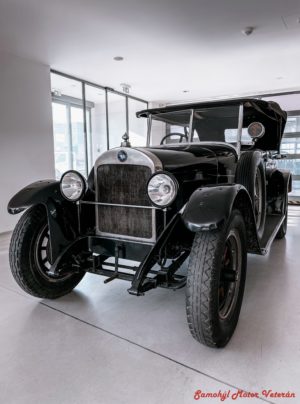
Year of Manufacture: 1925
Power: 70 hp
Engine Displacement: 1,991 cm3
Number of Cylinders/Valves: 8/3
Weight: 750 kg
Condition: Drivable
Catalog Number: 66
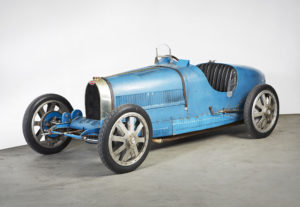
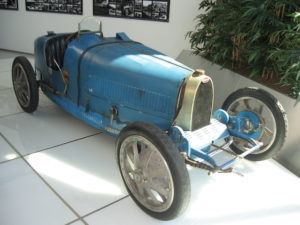
The Most Famous Bugatti Type – T35
For the first fourteen years of its existence, Bugatti was one of many small manufacturers building a limited number of cars with occasional racing success. That all changed in August 1924, when the factory introduced the Bugatti T35 at the Grand Prix in Lyon. This racing car later achieved phenomenal success, winning over 2,000 races, including 21 in the Grand Prix category. Among the prominent winners were names such as Tazio Nuvolari, Louis Chiron, William Grover-Williams, René Dreyfus – and, of course, our own Eliška Junková. Her greatest achievement was placing 5th overall in the 1928 Targa Florio in Sicily. Sadly, her husband Čeněk Junek was killed on July 15, 1928, at the Nürburgring while driving a T35B.
The visually distinctive Bugattis featured radiators shaped like narrow horseshoes. After retiring from racing, many were refitted with touring bodies and served as support or everyday vehicles. In the former Austro-Hungarian Empire, 22 T35s of various versions were documented as sold, including around two T35s, three T35Bs, and a few T35Cs in Czechoslovakia. After 1989, two T35As were imported to the Czech Republic.
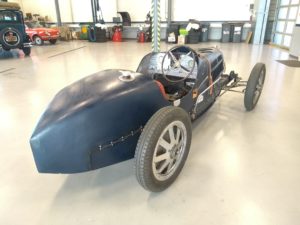
The Blue Bugatti
The Bugatti T35 was born during the era when Grand Prix cars were limited to two-liter engines. Ettore Bugatti designed an elegant long straight-eight engine, first seen in the prototype T28 (1921), then primarily in the racing T30 (1922–1926). It featured OHC valve timing with three valves per cylinder (two intake, one exhaust).
This lightweight engine was a mechanical gem, requiring precise craftsmanship. Numerous plain bearings needed spray lubrication and still suffered from wear, requiring frequent replacement. Compared to its predecessors, the T35 engine reached up to 30% higher revolutions. Camshafts, crankshafts, connecting rods, bearings, and lubrication had to be redesigned.
The factory-supplied eight-spoke aluminum alloy wheels with integrated brake drums gave the car its iconic look, forever associated with Bugatti. The wheelbase was 2,400 mm.
Bugatti T35A
In December 1924, the race-spec Bugatti T35B cost 100,000 francs – affordable only for the wealthy. To reach a broader audience, the factory introduced the more affordable T35A in May 1925. It looked visually similar to the Grand Prix T35B but used some components from the earlier T30 (such as a crankshaft supported by three bearings).
The engine blocks and camshafts differed from the T35B, and the ignition system was also simpler. Crucially, the T35A had no supercharger, resulting in lower power but greater durability. It came standard with wire-spoke wheels; solid and aluminum ones were available at extra cost. The T35A was priced at a “mere” 65,000 francs and nicknamed the “Course Imitation” – a race car lookalike.
Between 1925 and 1927, 124 T35As were sold compared to 87 T35Bs in the same period. In total, 139 units of the T35A were built. This particular 1925 Bugatti T35A is in original condition and was initially delivered to a customer in the Netherlands. It had a maximum output of 75 hp.
Other Versions and the Supercharger
Ettore Bugatti decided to build the T35T (“T” for Targa) to increase his team’s chances in the grueling 1926 Targa Florio. He increased the engine stroke by 100 mm, achieving a displacement of 2,262 cm3. The move paid off – three factory T35Ts finished in the top positions: Costantini, Minoia, and Goux. Fifth place went to Dubonnet in a private car.
Twelve competitors finished the race, seven of them in Molsheim-built Bugattis. The brand continued to dominate the Targa Florio through 1930. Only seven units of the T35T were produced, due to Grand Prix regulations limiting engines to two liters.
Between 1927 and 1930, 45 units of the T35B were built – essentially T35Ts fitted with a Roots supercharger. The first drawings of the supercharger date to May 1926. This upgrade enabled the 2,262 cm3 engine to produce a maximum output of 138 hp. The car won the 1929 French Grand Prix.
The T35B featured a slightly larger radiator, positioned further forward. Another variant, the Bugatti T35C (1927–1930), was a T35 with a 1,991 cm3 supercharged engine producing up to 127 hp. Fifty units of the T35C were built, winning the French Grand Prix in 1928 and 1930.
In truth, the various versions – including related models T39 and T43 – are often difficult to distinguish. Ettore Bugatti already practiced parts unification and reuse across multiple models, reducing production costs. In this, he was far ahead of his time, as others adopted similar strategies only many years later.