Showing all 7 results

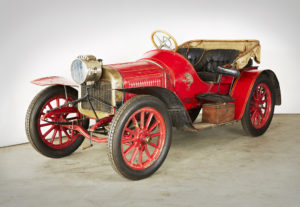
Laurin & Klement, F

Year of Manufacture: 1907
Power:
Engine Displacement:

Number of Cylinders/Valves:
Weight:

Condition: Drivable
Catalog Number: 80

This Model F was manufactured, according to the attached copy of the technical sheet dated August 17, 1907, by Laurin & Klement as a touring car for Count Alexander Kolowrat. He used it for his everyday needs as well as to train for his racing ambitions. He had a large acetylene lamp manufactured and supplied for it (according to a copy of the prospectus from the company Alois Böll-Vienna), known as the “Das Acetylen Sauerstoff-Kalklicht” (Acetylene-Oxygen-Lime Light).

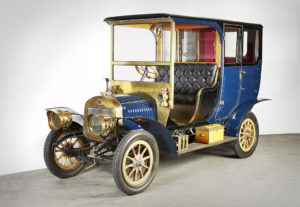
Laurin & Klement GDV

Year of Manufacture: 1909
Power:
Engine Displacement:

Number of Cylinders/Valves:
Weight:

Condition: Drivable
Catalog Number: 81

This vehicle ranks among the famous predecessors of today’s taxis, historically referred to as “drožka” (a type of horse-drawn carriage), and earned recognition in major European cities. The Laurin & Klement company successfully supplied these vehicles to cities such as Vienna and Saint Petersburg, and the models were named after these cities based on their specific equipment differences. These vehicles also sold successfully in Japan.

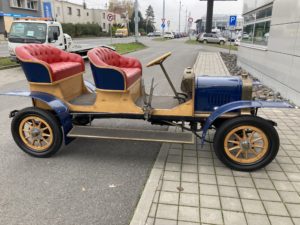
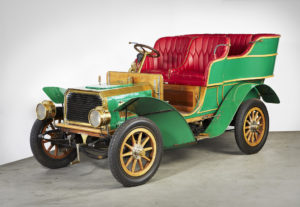
Laurin & Klement B Voiturette

Year of Manufacture: 1907 Power: 9 hp Displacement: 1,399 cm3

Number of Cylinders/Valves: 2/2

Condition: perfect Catalog Number: 165

The Laurin & Klement Voiturette B is the successor and continuation of the very first serially produced car in the Austro-Hungarian monarchy – the Voiturette A. Let us recall the history of the automobile’s origin on Czech territory.

In 1894, two Václavs, Klement and Laurin, began repairing bicycles in Mladá Boleslav. The following year, they started manufacturing them under the brand Slavia. The next logical step for this very ambitious company was the transition to motorcycle production. By 1899, they had their first motorcycle ready for production. The start of their business was not easy from a commercial perspective. Eventually, it succeeded, and motorcycles sold under the Slavia brand gained great respect and became an excellent commercial product. Thanks to these successes, the small workshop turned into a prosperous factory with an excellent reputation and a range of quality products. By 1905, Laurin & Klement offered nine different types of motorcycles, from twin-cylinder to four-cylinder engines. They had no competition within the then monarchy.

Meanwhile, the time came for another crucial step: the move to automobile production. It was a long road with many development stages. At the April 1905 auto show, Messrs. Klement and Laurin presented their new engine: a V-twin. This was a sign that production of their own car was imminent. Of course, it was based on a motorcycle engine but also met the requirements for powering a true automobile.

By the end of that year, complete functional cars were ready in a verifiable quantity of two units (some contemporary sources even mention three). They were intended for test drives and demonstrations, and their photographs appeared in newspapers of the time. Interestingly, the manufacturer at the time was deciding between rear axle drive by chains or a cardan shaft. Today, this seems amusing, but back then practical experience was lacking, so everyone followed their own path. Only after testing and customer feedback was the proven solution chosen. The car used the French designation “voiturette,” used in the pioneering days for small and light, mostly two-seater, vehicles. The original type still carried the “A” designation. The Mladá Boleslav “A” exactly matched this class. The car was type-approved on January 18, 1906, and officially presented to the public at the 2nd Prague Auto Show in April 1906.

Messrs. Laurin and Klement were guided in the construction of this vehicle by the idea that the car must be popular, i.e., accessible to a broader group of customers than was usual at the time. The automobile was a very luxurious affair back then. Eventually, they succeeded in creating a very attractive, elegant, and practical car at an excellent technical level, which many customers could afford at the offered price. The first Voiturette A is described in detail under catalog number 2 in our collection. So, how did the “B” type in our collection differ from the “A” type?

The car has a larger, four-seat open body mounted on a ladder frame made of pressed sheet metal. The four-stroke, two-valve engine with SV valve timing located at the front is structurally identical to its original predecessor. However, the car has an increased displacement of 1,399 cm3, and power increased from 7 hp to 9 hp. All other parameters were identical to the “A” type, and most parts and components were interchangeable. The car also achieved the same operating parameters.

Thanks to the larger chassis, its usage possibilities expanded. Mainly, the option of a four-seat body and use as a delivery vehicle. In fact, two flatbed trucks were even produced. Over three years, an incredible number of these cars were manufactured — exactly 250 units — which was unprecedented at that time.

Both types of these first cars contributed to the development of motorization and stood at the beginning of car production in our country.


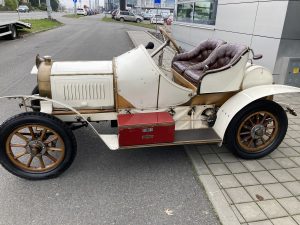
Laurin & Klement G

Year of Manufacture: 1908 Power: 15 hp Displacement: 1,767 cm3

Number of Cylinders/Valves: 4/2

Condition: perfect Catalogue Number: 124

This was a passenger and cargo vehicle produced by Laurin & Klement from 1908 to 1909. It was offered in various versions, including phaeton, landaulet, limousine, voiturette, ambulance, delivery van, and sports car. It was manufactured in both two-seat and four-seat configurations.

The engine was an inline four-cylinder with SV (side valve) valve train and L-head design, with a displacement of 1,767 cm3. It was front-mounted and drove the rear wheels. The engine delivered 11 kW, equivalent to 15 horsepower. The transmission was a three-speed gearbox.

The rigid axle had leaf springs, and the track width was 1,200 mm both front and rear. The vehicle reached a top speed of 55–60 km/h.

The two-door models had a wheelbase of 2,260 mm and weighed around 650 kg.

The four-door models had a wheelbase of 2,600 mm and weighed approximately 750 kg.

A total of 308 units were produced.

The vehicle in our collection is one of only two preserved examples of this model. The engine was assembled according to contemporary documentation on October 12, 1908, by mechanic Ouřecký and was sold in Vienna. This car was the favorite vehicle of the founder of our collection, Mr. Alois Samohýl. He bought it in the early 1960s in Vidnava, a small town in the Jeseníky region. He devoted 2,500 hours to its restoration, and the vehicle remains in excellent condition to this day.

Among other highlights, this car gained fame when A. Samohýl and Eliška Junková drove it in 1966 on a commemorative ride marking the 60th anniversary of the famous Targa Florio race in Sicily. The same team also participated with this car in a historic vehicle gathering in Monaco, celebrating the 100th anniversary of Monte Carlo. Both the car and Eliška Junková attracted well-deserved attention there.

The vehicle is currently exhibited as part of our historical car collection showcase at Tomáš Baťa Avenue 764 in Zlín. You are welcome to visit and see it in person.


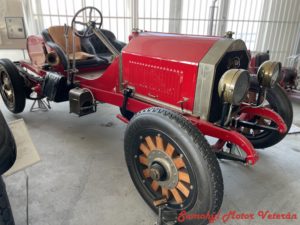
Simplex 90HP

Year of manufacture: 1907
Power: 90 hp
Displacement: 9,750 cm3

Number of cylinders/valves: 4/3
Weight: 1,700 kg

Condition: operational
Catalogue number: 216

The creation of the Simplex brand was actually driven by the economic conditions of passenger car sales in the USA before World War I. Import duties accounted for 40% of the car price, making vehicles nearly inaccessible for the intended clientele.

Therefore, the owners of companies importing European cars simply calculated that if they manufactured the cars themselves in the USA, they could sell them at roughly half the price. And as they said, so they did…

They took high-quality European cars as a model and tried to compete with both performance and especially quality with their products. Although the original owners of the Simplex brand were successfully fulfilling their plans, the company went bankrupt in 1907. The new owner and savior of the brand became Herman Broesel. He began developing the original ideas behind these cars, and the company started to prosper. The most successful car in the short history of Simplex was the 50HP model. It achieved both commercial and racing successes. It was mainly made from German components and stood out for the quality of materials and workmanship.

This was followed by the 90HP model with greater displacement and mainly power. It participated in various races in the USA and was very successful. At the peak of Simplex car production, there were a total of 5 types and 17 versions of these cars. Unfortunately, Broesel died in 1912, the original buildings in New York were sold, and under new ownership, the company moved to New Jersey.

The company continued to experience turbulent developments with changing owners and production programs. It was not until 1918 that the then owners decided to stop car production and continue only with aircraft engine manufacturing. The very last car was sold on February 27, 1920.

Despite its short presence on the automotive scene, Simplex made its mark in automotive history primarily by proving that it was possible to manufacture cars from European components on American soil and thus achieve the quality of European cars. This approach was later continued by other car manufacturers, especially Japanese ones.

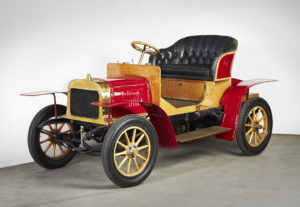
Laurin & Klement A Voiturette

Year of Manufacture: 1905
Power: 7 horsepower
Displacement: 1,005 cm3
Number of Cylinders/Valves: 2/2
Weight: 520 kg
Condition: Drivable
Catalogue Number: 2


This car is one of the rarest exhibits in our collection and one of the rarest in the Czech Republic overall. It was the first automobile produced by Laurin & Klement, and the first mass-produced car in the entire Austro-Hungarian Empire at the time. The path to its creation was neither simple nor quick.

In 1894, two men named Václav—Klement and Laurin—began repairing bicycles in Mladá Boleslav. The following year, they began manufacturing them under the Slavia brand. The next logical step for this ambitious company was motorcycle production. By 1899, they had a motorcycle ready for production. Business wasn’t easy at first, but eventually they succeeded. Motorcycles sold under the Slavia brand gained great respect and became a strong commercial product. Thanks to this success, their small workshop grew into a thriving factory with an excellent reputation for quality products. By 1905, the Laurin & Klement factory offered nine types of motorcycles, ranging from two- to four-cylinder models, unmatched in the monarchy.

It was time for the next major step—car manufacturing. It was a long journey with many development stages. At the April motor show in 1905, Klement and Laurin presented a new V-twin engine, signaling that their own automobile was near. It was based on a motorcycle engine but already met the requirements of a real car.

By the end of that year, two fully functional automobiles had been completed (some period sources say even three). They were used for test drives and demonstrations, and photos appeared in the press. Interestingly, the company had to decide between chain and shaft drive for the rear axle. Today it seems amusing, but practical experience was lacking back then. After trials and customer feedback, they chose the more effective solution. The car was referred to by the French term “voiturette,” commonly used at the time for small, lightweight, often two-seater vehicles. The original model carried the designation “A.” The Mladá Boleslav “A” perfectly matched this class. It was type-approved on January 18, 1906, and officially introduced to the public at the 2nd Prague Motor Show in April 1906.

Mr. Laurin and Mr. Klement designed the vehicle with the idea that it should be a “people’s car,” affordable for a wider range of customers, which was rare at the time since cars were considered a luxury. In the end, they succeeded in creating a stylish, elegant, and technically advanced vehicle that many could afford.

The car featured a two-seat open body on a pressed metal ladder frame. The four-stroke V-twin SV engine at the front had a 1,005 cm³ displacement, 7 horsepower, and water cooling. A fan behind the radiator ensured effective cooling. The gearbox had three forward gears and one reverse. It used a cone clutch with leather lining and drove the rear axle. The axles were rigid, sprung with leaf springs, and the main brake operated on the transmission shaft. The car weighed around 520 kg and could reach a “dizzying” speed of 45 km/h. Fuel was delivered via an in-house carburetor, and lubrication was ensured by a splash system, with a manual oil pump available for backup—usually operated by the passenger.

The “voiturette” soon ventured into the world, winning numerous awards and medals at exhibitions in Vienna, London, and Milan. Between 1905 and 1907, about 44 of these cars were produced in Mladá Boleslav, along with several dozen engines. Almost simultaneously, in 1906, the model “B” began production, differing only in a larger 1,400 cm³ engine and increased power of 9 hp.

This completely unique car essentially laid the foundation for motorization in our region and marked the beginning of one of Europe’s major car manufacturers. Today, its successors under the Škoda brand continue the tradition of quality and successful vehicles built in Mladá Boleslav.

Benz Parsifal 10/12 PS

Year of Manufacture: 1902
Power: 10 horsepower
Displacement: 1,727 cm3
Number of Cylinders/Valves: 2/2
Weight: 814 kg
Condition: Drivable
Catalogue Number: 1


This true gem, the Benz Parsifal, is today one of the rarest exhibits in the Samohýl family collection and often stars at Mercedes-branded exhibitions across Europe. However, it has been located in the Czech Republic for over one hundred years.

It undoubtedly ranks among the breakthrough models of the traditional Mannheim-based manufacturer. The company had to react quickly to what the British press referred to as the “Year of Mercedes,” marking the beginning of the 20th century and characterized by the rise of Wilhelm Maybach’s modern engineering designs.

The Departure of Carl Benz

The emphasis on a completely new technical concept, along with the management’s effort to distance itself from carriage-like constructions, led the sales department to prioritize the name Parsifal over that of Carl Benz. Outraged by this and other disagreements, the company’s founder decided to make a demonstrative exit and left the board in April 1903.

Although the Parsifal was received with mixed reviews, it unquestionably contributed to a major modernization and brought the Mannheim brand back into the black at the turn of 1903/1904.

Under the front hood, various two-cylinder engines appeared, rated at 8/10, 10/12, and 12/14 horsepower. In 1903, a four-cylinder Parsifal 16/20 PS followed. The increased power was supported by improved cooling with the help of a circulation pump. The idle speed was set at 300 rpm.