Showing all 7 results

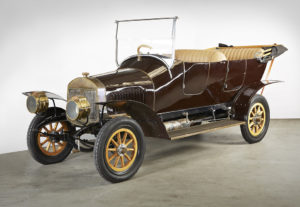
Laurin & Klement Sb

Year of Manufacture: 1911
Power: 16 hp
Engine Displacement: 1,771 cm3

Number of Cylinders/Valves: 4/2
Weight: 980 kg

Condition: drivable
Catalog Number: 88

Technically interesting and commercially very successful car with a light, simple, yet very sturdy body. The engine, equipped with a multi-plate clutch and a flywheel at the front end of the crankshaft, was assembled together with the clutch and gearbox into a single unit. The gearbox has three speeds, and power is transmitted to the rear axle via a modern jointed shaft. The entire design and technical level of this vehicle give a clean, refined impression for its time. This model remained in production practically until 1925. It can be said that this was the first version of a serially produced car by Laurin & Klement.

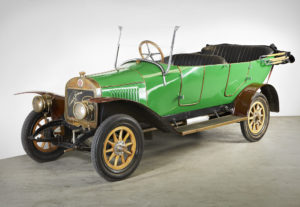
Laurin & Klement, Se

Year of Manufacture: 1913
Power:
Engine Displacement:

Number of Cylinders/Valves:
Weight:

Condition: drivable
Catalog Number: 90

History

Between 1913 and 1914, efforts at the Mladá Boleslav factory began to focus on rationalizing production. The threat of an invasion of American cars into Europe was becoming increasingly serious, so car manufacturers with foresight prepared defenses, or even counterattacks. Achieving the production numbers of American factories was not feasible under the economic conditions in Europe at the time, but organizing efficient production of small, inexpensive cars was realistic—cars that could better meet domestic needs than imported vehicles.

Technical Data

On an extended chassis originally designed for a two-cylinder engine, a compact four-cylinder open car was developed with many significant technical and design modifications. Its production was carried out in several small series. One of many variants was an open, sporty, four-seat phaeton body style with undivided seats and a lightweight American-style roof.

Development

In Mladá Boleslav, the Type S hit the mark. Demand for this fast and solid car was growing.

In 1913, the Sd, Se, and Sg series started using more powerful engines. The original stroke of 115 mm was increased to 120 mm, and engine power rose from 14 hp to 20 hp. More cars of the S type were produced in 1913 than all other types combined.

In 1914, for the Sh and Sk series, the bore was increased from 70 mm to 74 mm, and power rose to 24 hp.

In the spring of 1914, a new car type called T was introduced. This small yet solid car attracted attention from the general public and experts alike. The engine was a four-stroke four-cylinder delivering a maximum power of 12 hp from a displacement of 1,220 cm3. The car could reach speeds up to 60 km/h.

In the class of larger cars, the Mladá Boleslav factory prepared several newly designed models just before the war. In 1913, the Type M was introduced, featuring a four-cylinder engine with a displacement of 3,802 cm3 and a maximum power of 40 hp. The related Type MO was used for mounting military ambulance bodies.

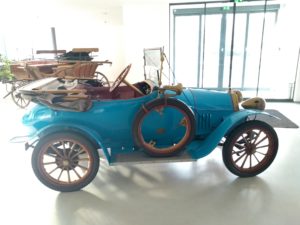
Bugatti 13

Year of Manufacture: 1911

Power: 25 hp

Displacement: 1,368 cm3

Number of Cylinders/Valves: 4/2

Weight: 380 kg

Condition: functional

Catalogue Number: 56

Ettore Bugatti worked from 1908 to 1909 as chief designer at the Cologne-based company Deutz Gasmotoren Fabrik. As soon as his contract ended there in 1910, he packed up his family and moved to the French industrial town of Molsheim. All his previous cars, on which he had collaborated, were completed in Cologne and did not bear his name.

The car named Type 13 was the first automobile, to bear the Bugatti brand. The model was later modified under the designations Type 15/17/22 and 23. From 1910, when the first example saw the light of day, until 1920, 435 units of these cars were produced. Even in Cologne, during his free time, he worked on developing his own engine for this model. It was a lightweight, inline four-cylinder, very advanced design with an OHC valve train. Most of these subsequently produced engines had the classic 8 valves for four cylinders, but a few vehicles were made with engines equipped with 16-valve heads. This was the Type 13 Brescia, which in its time and category became the embodiment of Bugatti’s invincibility on racing tracks. Bugatti was one of the first companies in the world to manufacture 16V engines.

Type 13 was a single-door two-seat roadster with a front engine and rear-wheel drive. The ignition, water-cooled, inline four-cylinder (R4) engine had a displacement of 1327 cm³, Zenith carburetor, naturally aspirated, outputting 15.0 kW (20.0 hp) at 2800 rpm, with a mechanical four-speed gearbox, a curb weight of 450 kg, and a top speed of 100 km/h. It featured a rigid front axle with longitudinal leaf springs and a rigid rear axle with longitudinal leaf springs. The car had no front brakes, only rear drum brakes. It also already had the famous horseshoe-shaped radiator grille, which remains a typical feature of all Bugatti cars to this day.

This particular car has been in the Czech lands for 104 years. In March 1912, it was purchased as a fully operational chassis by the Viennese dealer Franz Michelfeit, but it did not stay with him long. Fitted with a custom two-seat sporty body by the Austrian coachbuilder and wagon maker A. Schwanzar, it headed to Třeboň already in 1913. For the next 14 years, it belonged to the local veterinarian Dobroslav Horák.

After various vicissitudes, the car was eventually bought into the collection of Mr. Samohýl from Mr. Šeda. Interestingly, it is the 3rd oldest preserved car of this model, and the oldest preserved Type 13 is held in the collections of the NTM in Prague. This again confirms that the Czech lands were truly devoted to this brand.

This fully functional car can be seen at various vintage car events, where it is mostly driven by the famous cardiac surgeon prof. MUDr Jan Pirk DrSc.



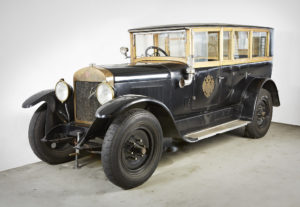
Laurin & Klement, Mh

Here is the English translation with the HTML formatting preserved:

Year of Manufacture: 1920 Power: Displacement:

Number of Cylinders/Valves: Weight:

Condition: Catalogue Number: 83

This is a limousine in a taxi style. An interesting feature of the body is the option of a removable wooden roof extension. For its time, it was a luxuriously equipped six-seat limousine that included many accessories such as cut-glass ashtrays, glass windows, interior lighting, and a period telephone for communication with the driver. It was mainly used for representative rides as a taxi or wedding car.

This vehicle served as the “official” car for Police Councilor Mr. Vacátko in the TV series *Sinners of the City of Prague*. It is believed that only one specimen exists.


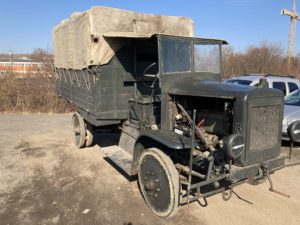
Laurin & Klement flatbed

Year of Manufacture: 1914–1920 Power: 38 hp Displacement: 4,713 cm3

Number of Cylinders/Valves: 4/2

Condition: drivable Catalogue Number: 168

Before World War I, the product range of the L & K automobile factory was already very broad. In addition to the rapidly developing production of passenger cars, the company also began manufacturing trucks. They were well aware that this segment had a great future and was economically attractive. Freight transport was gaining importance.

In 1914, the factory introduced a heavy truck to the market under the designation MS. The vehicle had a classic design — engine placed behind the front axle, a four-speed gearbox roughly in the middle, and a driveshaft powering the rear axle. The engine displacement was 4.7 liters with a power output of 38 hp, achieving a maximum speed of 16 km/h.

It featured a robust ladder-frame chassis, riveted from U-profiles. Many modifications for various uses were built on this frame, including buses of different types for mass passenger transport, flatbed trucks of all sizes, special superstructures such as fire trucks, cargo haulers, and others. The payload capacity of these vehicles was 1,500–2,000 kg.

The vehicle in our collection is a classic flatbed truck with versatile use. It is also notable for having appeared in several films set during World War I. Our example is fully operational and starts with a single turn of the hand crank.

Other vehicles in our collection built on the same MS chassis include the famous fire truck, which has participated in many events. Nearing completion is the restoration of a very rare first-series MS model that served for beer barrel delivery — colloquially called the “beer truck.”


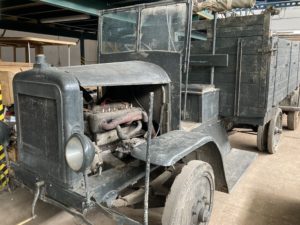
Laurin & Klement MS valník

Year of manufacture: 1914-1920
Power: 38 hp
Engine displacement:4,713 cm3

Number of cylinders/valves: 4/2

Catalog number: 253

Before World War I, the product range at the L & K automobile factory was already very broad. Besides the rapidly developing production of passenger cars, the company immediately began manufacturing trucks. They were well aware that this segment had a great future and was economically very interesting. Freight transport was gaining in importance.

In 1914, the factory introduced a heavy truck model designated MS. The vehicle featured a classic design – the engine was placed behind the front axle, a four-speed gearbox located approximately in the middle, and a driveshaft powered the rear axle. The engine had a displacement of 4.7 liters and produced 38 hp, reaching a maximum speed of 16 km/h.

It had a robust ladder-type frame, riveted from U-profiles, on which various modifications for different uses were built. Buses of various types for mass passenger transport, flatbed trucks of all sizes, special superstructures such as fire trucks, cargo tractors, and others were developed. The payload capacity of these vehicles ranged from 1,500 to 2,000 kg.

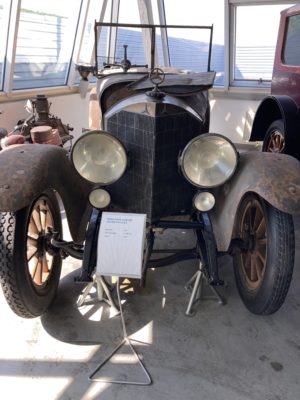
Mercedes Knight 16/45 PS Tourenwagen

Year of manufacture: 1918
Power: 50 hp
Displacement: 4,084 cm3

Weight: 1,750 kg

Condition: restored
Catalog number: 218

Since 1911, the Daimler-Motoren-Gesellschaft (DMG) company equipped some passenger car models with Knight engines. The engines, invented by American Charles Knight, operate with sleeve valves instead of conventional valves, offering exceptionally smooth operation. The company acquired a license for this engine in 1910 and used it in some of its cars since then. With more than 5,000 vehicles produced, the Mercedes-Knight with a power output of 16/45 PS became the most successful Mercedes model by 1926.

This three-door, five-seat car featured a front engine and rear-wheel drive. It had a spark ignition, water-cooled inline four-cylinder engine (I4) with sleeve valve (Knight) valve timing, displacement of 4,084 cm³, carburetor, naturally aspirated, producing 50 hp, and a mechanical four-speed manual gearbox. The curb weight was 1,750 kg, and the top speed reached 80 km/h. The front axle was solid with longitudinal leaf springs; the rear axle was also solid with longitudinal leaf springs. The car had no front brakes and drum brakes on the rear wheels.

This particular car in our collection is the oldest vehicle bearing the Mercedes name. Originally manufactured in 1918 in green, it still saw service at the end of World War I as an officers’ vehicle. After many vicissitudes, it was purchased for our collection and restored to its current condition.