
Showing all 3 results

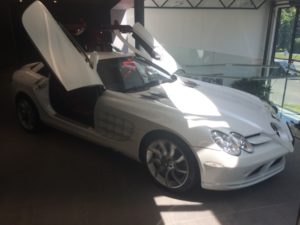
Mercedes Benz SLR McLaren W199

Year of Manufacture: 2004 Power: 617 hp Displacement: 5,439 cm3

Number of Cylinders/Valves: 8/3 Weight: 1768 kg

Condition: perfect Catalogue Number: 51

The Mercedes-Benz SLR McLaren is a car belonging to the Grand Tourer category, developed jointly by Mercedes-Benz and the British automaker McLaren Automotive. It was sold from 2003 to 2010. At that time, both companies closely collaborated in Formula 1 racing, making this car a natural continuation of their partnership. SLR stands for “Sport Leicht Rennsport” (Sport Light Racing) and is a tribute to the legendary Mercedes-Benz 300 SLR racing car from the 1950s.

A total of 2,157 units of this car were produced in all its variants. Interestingly, the company originally planned to manufacture 3,500 units at an annual production rate of 500 cars. These numbers were never reached, and production was eventually stopped earlier.

The base version was a two-door, two-seat coupe. However, a roadster and a racing GT version were also available. One of the limited editions (called the 722 Edition) referred to the famous victory of English driver Stirling Moss with co-driver Denis Jenkinson in the Mercedes-Benz 300 SLR with starting number 722 at the Mille Miglia in 1955. There was even a special edition called the SLR Stirling Moss, featuring Speedster styling without a roof or windshield.

The base model was equipped with a 5.4-liter engine, supercharged by a compressor, with two intercoolers and an output of 626 hp.

The transmission is a five-speed automatic, and the brake discs are carbon-ceramic with a diameter of 370 mm at the front and 360 mm at the rear. This highly specialized design incorporated knowledge gained from Formula 1 racing.

To maintain very low weight, the car’s body is made of carbon fiber-reinforced plastic. It features highly refined aerodynamics, making the car stable even at high speeds.

Acceleration is 3.4 seconds to 100 km/h, with a top speed of 334 km/h.

Technical specifications varied depending on the model and different editions. The car was originally conceived as a supercar and was not very suitable for everyday driving. Ironically, if such a car appears for sale today, its price is often higher than when it was new.

The exhibited car is part of the Samohýl family’s historic vehicle collection and belongs to the so-called “holy trinity” of Mercedes Benz cars with upward-opening doors, also reminiscent of the shape of a flying seagull’s wings.

Additionally, this particular car has a very interesting story.


In 2009, it was purchased by Tomáš Řepka, a well-known football rebel, for 14.5 million CZK.

Řepka fell in love with Vlaďka Erbová during a calendar photo shoot in 2010. This beautiful car was used as a prop during the shoot. Řepka assisted as the car’s owner during the session; sparks flew, and their acquaintance soon led to marriage. The couple later had a son named Markus.

However, the footballer did not enjoy the luxury car for long. About six months later, the state confiscated the car with the help of executors. Rumors circulated that a wealthy sheikh had seen photos of the car and claimed the Mercedes as stolen property. For several years, Řepka’s car sat dusty and overgrown with grass in a police impound lot, forgotten. The marriage of the footballer and model ended after some time amid disputes and legal battles.

After a while, the car was released from police custody and shortly after Řepka’s imprisonment was put up for auction. The car was renovated to an acceptable condition for around half a million CZK. The starting price at the public auction was 7 million CZK. Eventually, the McLaren was purchased by Zlín businessman and collector Ladislav Samohýl for his collection.

The car has only 20,000 kilometers on the odometer. It belongs to the so-called wing-cars, i.e., cars whose doors open upward. Mercedes released only three such models worldwide. All of them are in the Samohýl family’s historic vehicle collection, where this particular car holds a significant place.



Placeholder

Mercedes-Benz CL 600 C215

Year of Manufacture: 2000
Power: 367 hp
Engine Displacement: 5,786 cm3

Number of Cylinders/Valves: 12/3
Weight: 1,880 kg

Condition: excellent
Catalog Number: 12


Introduction

“When you come back down to earth after a trip in the CL Coupé, it’s like waking up from a beautiful dream. Make sure to find a firm point of reference – you will need it. Because you have returned from another world of CL Coupés.” This is how the official CL brochure summed up the essence of the large coupe.


Development

The C215 series was introduced in March 1999 at the Geneva Motor Show. Sales in Europe and Japan began in the autumn of the same year.


Technical Specifications

Amazing, elegant, and pioneering – the CL-Class is a masterpiece of the Mercedes-Benz brand. Its distinctive appearance is no accident; nearly 90% of assembly work is done by hand, partly using genuine craftsmanship techniques. A select group of mechanics ensures that every part, every trim element, and every seam is perfectly placed. They are responsible for the flawless design of the CL-Class interior and exterior.

The powerful appearance of the CL was matched by the engines Mercedes-Benz offered for the coupe. The flagship CL 600 featured a newly developed twelve-cylinder engine with smooth operation, generating 270 kW and 530 Nm of torque. Lightweight construction, three-valve technology, dual ignition with alternating voltage ignition system and ion current diagnostics, automatic cylinder deactivation – so-called Active Cylinder Control (reduces fuel consumption under partial load, i.e., when six cylinders can be used efficiently), six catalytic converters, and eight oxygen sensors – these are just a few examples of the sophisticated technical equipment of this ultramodern unit.

Standard equipment of the large coupe included an extensive safety package with front and side airbags in the front seats, window airbags, electronic stability program (ESP), acceleration slip regulation (ASR), anti-lock braking system (ABS), brake assist system (BAS), new bi-xenon headlights with washing/wiping system, and Parktronic system. The top position of this coupe was confirmed by features such as a multifunction steering wheel, adjustable steering column, five-speed automatic with one-touch shifting, cruise control with smooth speed adjustment Speedtronic, automatic climate control with active charcoal filter, electrically adjustable leather seats with memory function, Mercedes-Benz Audio 30 radio, leather trim on the dashboard and doors, and fine wood trim.

At its market introduction, the new large Mercedes-Benz coupe featured a world-first: the new Active Body Control (ABC) suspension system, which provided an unprecedented combination of sporty dynamics and comfort. Based on sensor signals and using special hydraulic cylinders on the axles, “ABC” almost completely compensates for body roll and pitch movements during acceleration, cornering, or braking.

All this sounds like the perfect car – and it is certainly true that the C215 series came close to this ideal. However, there is always room for improvement, as shown by the completely newly developed C216 series launched in June 2006. By 2006, a total of 47,984 C215 coupes had been sold.

Placeholder

Mercedes-Benz A 140 W168

Year of Manufacture: 2002
Power: 82 hp
Engine Displacement: 1,397 cm3

Number of Cylinders/Valves: 4/2
Weight: 1,090 kg

Condition: excellent
Catalog Number: 16


Introduction

With the introduction of the A-Class in 1997, Mercedes-Benz entered the compact car segment with a vehicle that featured innovative design, a fresh look, and all the qualities that belong to a Mercedes. Nothing smaller has ever been produced under this brand, and it probably never will be again.


Development

The desire for a car with very small exterior dimensions but all Mercedes-Benz values began to take shape in the early 1990s. Mercedes-Benz introduced the so-called sandwich principle, where the body is divided into two horizontal layers: the powertrain is placed in front and below the floor panel, so in the event of a collision it moves downwards and does not intrude into the interior.


Technical Specifications

Two models, the A 140 and A 160 with petrol engines, were the first A-Class variants introduced in October 1997. The A 140 had a 1,397 cm3 engine producing 82 hp (60 kW), while the A 160 with a 1,598 cm3 engine generated 102 hp (75 kW). Top speeds were 170 km/h and 182 km/h, respectively.

The A-Class lineup followed the proven concept of different design and equipment lines. In 1997, three variants were available – Classic, Elegance, and Avantgarde. These three design and equipment lines were presented at the 57th International Motor Show in Frankfurt several weeks before the market launch.

All series shared a comprehensive standard equipment package. Compared to the basic Classic version, the Elegance offered a number of optional extras related to the interior and exterior: alloy wheels, radiator grille and exterior mirror covers painted in the body color, chrome inserts on door handles, and two-tone rear light covers. Avantgarde was the technically progressive model variant, featuring alloy wheels with wide tires, a silver-painted radiator grille and exterior mirror covers painted in the body color, and monochromatic rear light lenses.

More than 20 technical innovations were incorporated in the model range that were previously unavailable in this category of cars. The newly developed and implemented unique sandwich body concept, where the engine and transmission are placed in front and below the passenger space, had many advantages. In the event of a frontal collision, the powertrain unit submerged beneath the passenger compartment in the A-Class. The model achieved safety levels of larger Mercedes sedans despite a vehicle length of only 3.57 meters (about 50 centimeters shorter than comparable competitors) and a weight of just 1,090 kilograms.

In terms of passive safety, the model line reached practically the same level as the Mercedes-Benz E-Class. Besides the sandwich principle, standard installed restraint systems specially adapted to the A-Class concept with short deformation zones contributed to this result. These included full airbags for the driver and front passenger, seat belts with pretensioners and force limiters on front and outer rear seats. Since February 1998, electronic stability program (ESP) and automatic brake assist system (BAS) have been standard equipment in the A-Class, placing the model at the top of its market segment.

The choice of powertrain systems for the A-Class was expanded in 1998 with two diesel models. The A 160 CDI and A 170 CDI, with fuel consumption of 4.5 and 4.9 liters per 100 kilometers (according to NEDC methodology), respectively, were among the most environmentally friendly cars worldwide. The diesel A-Class models featured new common rail direct injection (CDI), which significantly reduced fuel consumption combined with dynamic handling and smooth operation compared to older diesel engines. The Öko-Trend Institute in Wuppertal, Germany, awarded the A 160 CDI the title “Most ecological German car.”

The year 2001 was characterized not only by the introduction of the long-wheelbase version but also by improvements to the A-Class. This upgrade enhanced the true bestseller: since production began in 1997, Mercedes-Benz had sold over 550,000 units of the model series, and the A-Class was among the best-selling cars in its category in Germany and other European countries.

From spring 2001, the model was available at dealers with new body elements, new interior materials, more powerful CDI engines, and ESP with hydraulic brake assist. The facelift was especially noticeable in the revised front and rear design. Fresh design elements emphasized the model’s dynamics. The new design included updated bumpers front and rear and a radiator grille with four slats instead of three. Thanks to these changes, the body appeared wider and more athletic, and the A-Class also received clear glass headlights.

The interior featured a redesigned cockpit equipped in part with new materials, some borrowed from the Mercedes-Benz S-Class. Engineers and designers modified or redesigned about 980 components of the innovative vehicle. The fourth generation of ESP® collaborated for the first time with an even more powerful hydraulic brake assist. The A-Class thus provided the latest and most effective dynamic driving system as standard at that time.

More than 1.1 million first-generation A-Class cars were produced in total.