Year of Manufacture: 1885
Power Output: 0.5 horsepower
Displacement: 264 cm3
Number of Cylinders/Valves: 1/2
Weight: 90 kg
Condition: replica
Catalogue Number: 258
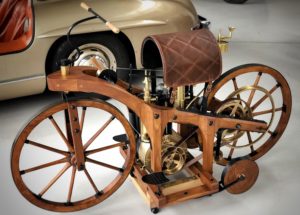
The Daimler Reitwagen, also known as the “Petroleum Reitwagen” or “Einspur”, is recognized as the world’s first true motorcycle. This motorized vehicle was built by Gottlieb Daimler and Wilhelm Maybach in 1885. The term “Motorrad” was first used later by Heinrich and Wilhelm Hildebrand together with Alois Wolfmüller for their 1.49-liter twin-cylinder machine.
The Reitwagen was essentially still a “rider’s carriage”. In fact, it wasn’t truly a single-track vehicle, as it had small auxiliary wheels on the sides to help maintain stability.
However, it took a long journey to get there. In 1861, at the age of 27, Gottlieb Daimler traveled to Paris to explore the invention of the Belgian Étienne Lenoir—an internal combustion engine. This experience later proved useful when he joined Nicolaus August Otto, who designed a single-cylinder gas-powered engine in 1864. In July 1872, Daimler was appointed technical director of Otto’s company, where Wilhelm Maybach also worked as head of the design department.
Four years later, in 1876, Otto developed his famous four-stroke engine with higher compression. However, Otto had no interest in miniaturizing his commercially successful industrial engines for broader use in transportation. They barely reached 150 to 200 revolutions per minute. Thus, Daimler and his longtime friend Maybach left the company. Daimler moved to Cannstatt near Stuttgart. In June 1882, he bought a villa at Taubenheimstrasse 13 for 75,000 gold marks, where he lived with his wife Emma and their five children.
He converted the large garden house into an experimental workshop with water and gas lines. Maybach joined Daimler at the beginning of November. They lived close to each other; Wilhelm turned one room into a design office and translated Daimler’s ideas into technical drawings.
In the workshop, they began developing their own high-speed four-stroke engine. But Daimler and Maybach weren’t interested in slow combustion. The first prototype ran in the second half of 1883. From a displacement of around 100 cm3, it produced 184 W—about a quarter of a horsepower at 600 rpm, which was Daimler’s goal. It could even run on coal gas.
An evolved version called the “pendulum engine” from 1884 produced 735 W from a much larger 462 cm3, equaling one full horsepower. It earned its nickname from its oscillating motion, resembling a pendulum clock. The gearbox components and flywheel were enclosed in a crankcase. The float-type carburetor was Maybach’s invention.
They decided to mount the revised engine in a test frame with two 60 cm high wheels. The frame was made from hickory wood reinforced with metal. Tires didn’t exist yet, so the wheels were wrapped in 35 mm wide iron bands.
At the heart was an air-cooled four-stroke single-cylinder engine with a 264 cm3 displacement. The modified “pendulum” engine had a 58 mm bore and 100 mm stroke, was mounted on rubber blocks, started by hand crank, and had two flywheels (one on the crankshaft), an aluminum crankcase, and fan-based cooling. It produced just 0.37 kW—half a horsepower at 700 rpm. Compression was very low, only 2.3:1. Like its predecessors, it used a hot-tube ignition invented by the Englishman Watson. A platinum tube led into the combustion chamber, and it had to be ignited by an external open flame—basically, by striking a match.
Although electric systems existed, they were unreliable and too slow to ignite the air-fuel mixture in a high-speed engine. Daimler and Maybach mounted the engine vertically between wooden supports and cross braces in the frame. The intake valve operated automatically—the piston’s suction opened the mixture intake into the cylinder, while Daimler invented a mechanical exhaust valve. The transmission had just one gear, and power was delivered to the rear wheel by a belt. This 90-kg ancestor of today’s motorcycles could reach a speed of just 11 km/h. It had no suspension or front brake; the rear block brake was cable-operated from the handlebars. The engine alone weighed 60 kg.
Daimler received patent DRP 36423 for a “single-track vehicle with a gas or petroleum engine” on August 29, 1885. The first motorcyclist was his son Adolf, who completed the first 3-kilometer ride in early November. On November 10, his other son Paul rode 9.5 kilometers from Cannstatt to Untertürkheim. He was 17 years old at the time.
The test machine, with dimensions of 1680 x 610 x 1040 mm (length, width, height), proved the feasibility and viability of a compact liquid-fueled engine. Even Maybach later test-rode it. Preparation for a ride took only a minute—an enormous advantage over steam-powered vehicles.
The original Reitwagen did not survive; it was lost in a fire at the Daimler-Motoren-Gesellschaft factory in 1903. More than ten replicas have been made. Besides museum displays, the German carmaker built one working demo machine as part of its collection. Others are housed in the Deutsches Museum in Munich, the Verkehrsmuseum in Dresden, the Auto und Technik Museum in Sinsheim, the NSU Zweirad Museum in Neckarsulm, the Deutsches Technikmuseum in Berlin, and the Motor-Sport Museum at the Hockenheimring.
They can also be found outside Germany, including at the Honda Collection Hall at the Twin Ring Motegi circuit, in the Lyman & Merrie Wood Museum collections in Springfield (Massachusetts), and the AMA Hall of Fame in Columbus (Ohio). Other examples are on display at the Guggenheim Museum in New York, the Deeley Motorcycle Exhibition in Vancouver, Canada, and in Melbourne, Australia.
Our replica is very well-made but unfortunately non-functional. Nevertheless, it complements our collection of automotive history—this piece, quite literally, from the prehistoric age of motoring.