Benz Patentwagen
Year of Manufacture: 1885
Power: 1.5 hp
Displacement: 954 cm3
Number of Cylinders / Valves: 1
Weight: 260 kg
Condition: replica
Catalogue Number: 85
Karel Benz owned a successful factory, but rather than a businessman, he was an inventor. He constantly invented and improved his ideas and always wanted to build a vehicle powered by an engine, not horses. In 1885, he built a vehicle that crashed immediately during testing, so he continuously worked on improving it.
Satisfaction came in June 1886, when his wife Berta Benz proved that his Patentwagen was capable of driving by traveling 104 km in 13 hours, confirming the validity of the advertising slogan: “A full-fledged replacement for horse-drawn carriages.” With this feat, she secured not only fame for the family but also sufficient financial support. Benz then shaped the direction of the automotive industry for many years.
Although the automobile could not climb every hill, was not quiet, and did not smell pleasant, it still became popular and ultimately turned Benz from an inventor back into an entrepreneur. His company employed over 10,000 people. Benz contributed significantly to directing the global development of automobiles toward their current path.
Horse-less Carriage
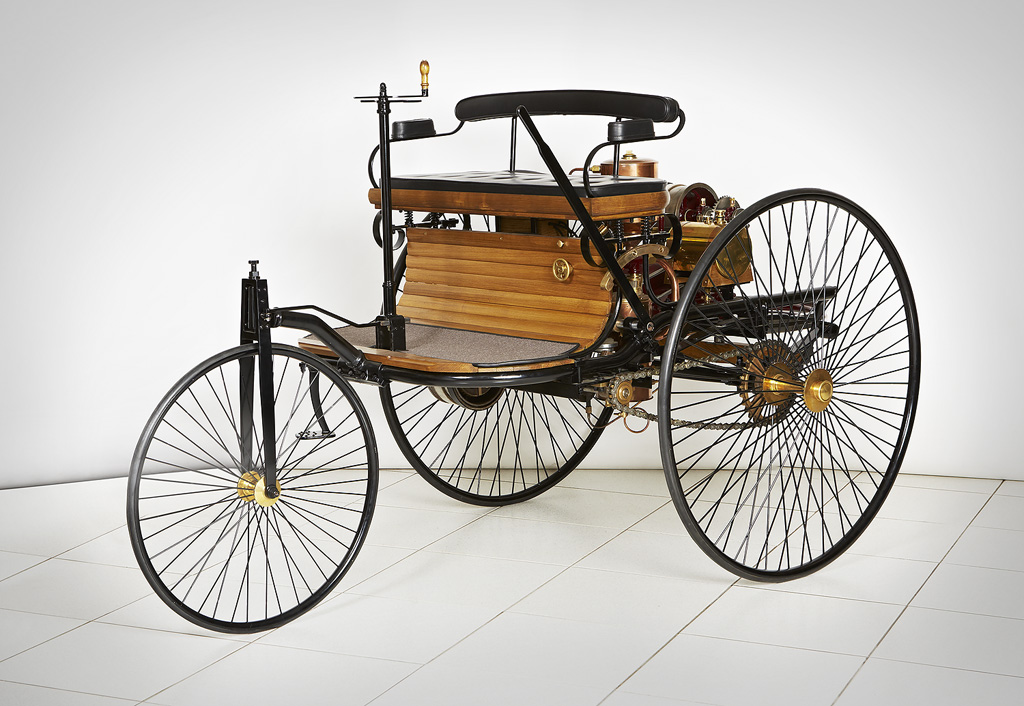
The vehicle was powered by a four-stroke spark-ignition engine with a displacement of 0.954 liters. Many elements of this engine are found even in modern combustion engines. According to Benz’s measurements, the engine had a power output of 0.5 kW. For its time, it was an extremely light engine, weighing about 100 kg. It featured an open crankcase and a drip oil system. The vehicle consumed 10 liters of fuel per 100 km, using light gasoline called ligroin, which at that time was sold in pharmacies as a stain remover.
The entire vehicle was built as a three-wheeled velocipede. The front wheel was suspended on an unsprung fork and was steered by a crank. The wheels were supplied by the Adler bicycle factory in Frankfurt am Main. The wheels already featured ball bearings. Power transmission from the crankshaft to the rear wheels was done via two flat chains, left and right of a differential prototype. A flat belt, which also served as a clutch, drove the rear solid axle through elliptical springs connected to the vehicle frame. This first automobile had only one gear, consisting of a fixed disk and an integrated differential.
The exhibit in our collection is, of course, a replica; the original vehicle is displayed in an honored place at the Mercedes-Benz factory museum. A very well-made replica was purchased by Mr. Samohýl in England and is fully functional. Therefore, it can be seen on various occasions, admired for its movement and sound.